
Why foot alignment matters: comfort, health, and style
TL;DR:
- Proper foot alignment is essential for reducing joint pain, fatigue, and maintaining posture.
- Shoes with supportive features and correct cushioning improve alignment and overall musculoskeletal health.
- Myths about pronation control and cushioning often mislead; personalized assessment is key.
Most people choose shoes based on how they look, then wonder why their feet, knees, or back ache by mid-afternoon. The truth is, aesthetics alone cannot protect you from the consequences of poor foot alignment. Even tiny deviations in how your foot sits, strikes the ground, or rolls through each step create a chain reaction that travels up your entire body. Foot alignment is one of the most overlooked factors in everyday health, yet the evidence linking it to joint pain, posture problems, and fatigue is compelling. This article lays out what the science says, what the myths are, and how to make smarter choices when shopping for footwear.
Table of Contents
- What is foot alignment and how does it affect you?
- The science behind foot alignment: Evidence from recent studies
- How footwear influences foot alignment: What shoppers need to know
- Foot alignment myths: What retailers and experts disagree on
- Our perspective: Why alignment-first thinking changes everything
- Find shoes that prioritise alignment, comfort, and style
- Frequently asked questions
Key Takeaways
| Point | Details |
|---|---|
| Tiny misalignments matter | Even minor shifts in foot alignment can significantly impact joint health and comfort. |
| Footwear shapes posture | Properly designed shoes and orthotics can correct and enhance alignment, improving your daily posture. |
| Choose alignment-first | Prioritising alignment when shopping for shoes delivers lasting comfort, style, and foot health benefits. |
| Evidence beats marketing | Focus on scientific findings and expert advice rather than retailer marketing claims. |
What is foot alignment and how does it affect you?
Foot alignment refers to the precise positioning of your foot’s bones, joints, muscles, and connective tissues relative to one another and to the ground. When every structure sits where it should, your body distributes weight efficiently across the heel, midfoot, and forefoot with each step. When something shifts even slightly, that balance breaks down.
Think of your foot as the foundation of a building. If the foundation tilts by even a fraction, every floor above it must compensate. The same principle applies to your ankle, knee, hip, and spine. A misaligned foot forces surrounding structures to overwork, which leads to inflammation, fatigue, and, over time, chronic pain.
The numbers are striking. A 1mm lateral talar shift reduces the tibiotalar contact area by 42%, meaning the same force is concentrated into a much smaller area of cartilage. That is not a trivial difference. It is the kind of loading pattern that wears tissue down prematurely.
Common signs that your foot alignment may need attention include:
- Persistent heel or arch pain that does not improve with rest
- Uneven shoe wear, where one side of the sole wears down faster than the other
- Knee pain that cannot be traced to a specific injury
- Fatigue in the lower limbs after moderate walking distances
- Lower back tension that appears after long periods of standing
Understanding the relationship between footwear and posture is essential, because the shoes you wear directly influence how your foot aligns with every single step. If you want a practical starting point, our lasting comfort guide walks through the key principles in accessible terms.

Poor alignment is not a niche concern for athletes or people with diagnosed foot conditions. It is an everyday issue that affects anyone who stands, walks, or wears shoes for extended periods, which is most of us, most of the time.
The science behind foot alignment: Evidence from recent studies
Science has moved well beyond the idea that foot problems are simply about comfort. Researchers now understand that alignment at the foot level sends measurable changes cascading through the entire musculoskeletal system.
Studies examining plantar pressure, the distribution of force across the sole of your foot during movement, reveal meaningful differences between healthy and misaligned feet. Symptomatic flexible flatfeet show altered plantar pressure, with greater midfoot peak forces, a lateralised pressure distribution, and reduced rearfoot loading compared to normally arched feet. This shift matters because the midfoot is not designed to absorb the same impact loads as the heel and forefoot.
“Correcting alignment at the foot can create measurable improvements not just in the foot itself, but in the pelvis and spine above it.”
Orthotics research supports this broader impact. Custom orthotics improve pelvic alignment and posture by adjusting the sagittal talus-first metatarsal angle by an average of 2.0 degrees. That might sound small, but in biomechanical terms, it represents a meaningful postural correction that reduces strain on multiple joints simultaneously.
The table below illustrates how plantar pressure distribution shifts across different foot conditions:
| Foot condition | Rearfoot loading | Midfoot loading | Forefoot loading |
|---|---|---|---|
| Neutral arch | High | Low | Moderate |
| Flexible flat foot | Reduced | Elevated | Variable |
| High arch (cavus) | High | Very low | Very high |
| Post-orthotic support | Moderate | Normalised | Moderate |
For practical foot support tips that translate this data into everyday decisions, our blog covers both the evidence and the application.
The key takeaway is that foot alignment is systemic. It does not stay in the foot. Addressing it correctly, whether through footwear, orthotics, or targeted exercises, creates benefits that extend well up the kinetic chain.
How footwear influences foot alignment: What shoppers need to know
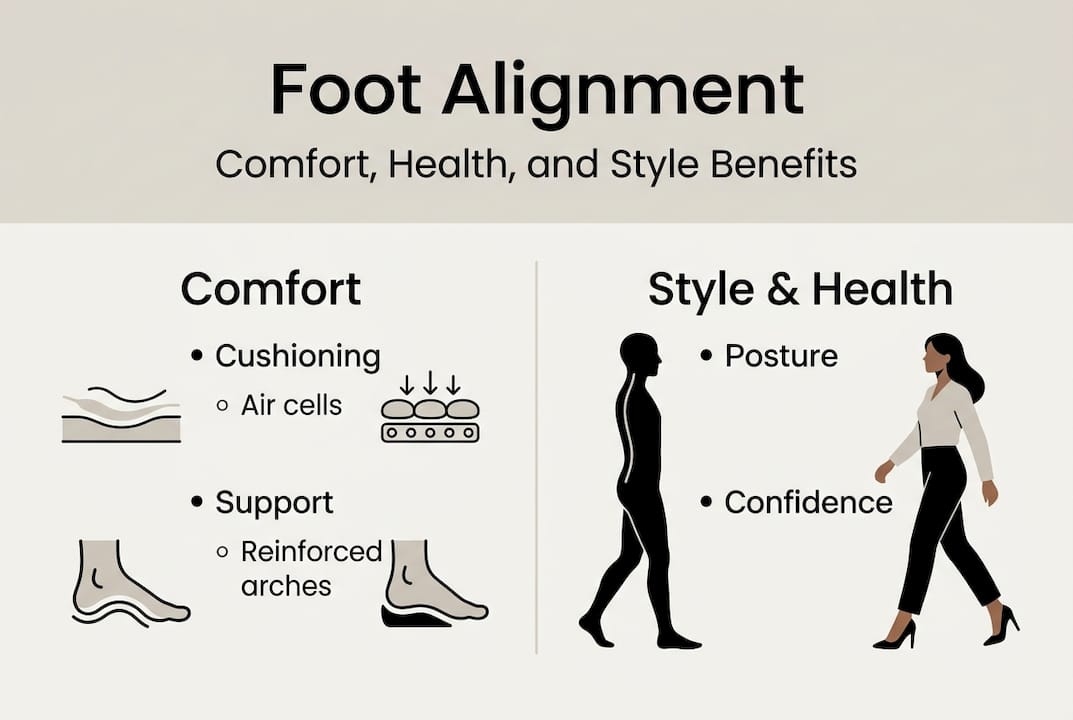
Choosing the right shoe is not just about fit. The structural features built into a shoe determine how much support your foot receives and how well your alignment is maintained throughout the day.
Midfoot support and metatarsal pads are two features that make a measurable difference. Medially wedged foot orthoses with metatarsal pad reduce pressure under the metatarsal heads more effectively than standard orthoses, which matters for anyone prone to forefoot pain or discomfort after long walks.
| Feature | Standard shoe | Specialised orthotic shoe |
|---|---|---|
| Arch support | Minimal or generic | Contoured, condition-specific |
| Metatarsal relief | None | Pad or bar integrated |
| Medial wedging | Absent | Present, angle-adjusted |
| Plantar pressure distribution | Uneven | Corrected and balanced |
| Posture impact | Neutral or negative | Measurable improvement |
Cushioning plays a dual role. It absorbs shock, which protects joints, but it also reduces the sensory feedback your foot receives from the ground, known as proprioception. A shoe with the right cushioning and comfort balance supports alignment without numbing your foot’s natural ability to adapt to terrain.
Key features to look for when shopping:
- A firm midsole that does not collapse inward under load
- Heel counter rigidity to prevent excessive pronation
- Adequate toe box width to allow natural toe splay
- Low heel-to-toe drop to encourage more natural foot positioning
Pro Tip: Before buying, press your thumb firmly into the midsole of a shoe. If it compresses easily and does not bounce back, the cushioning may be too soft to maintain alignment over time.
Understanding shoe cushioning technologies helps you move beyond marketing language and focus on what the materials actually do for your foot. The science of cushioning reveals that not all foam compounds are equal in their ability to support alignment across a full day of wear.
Foot alignment myths: What retailers and experts disagree on
The footwear industry does not always speak with one voice, and the gap between retail messaging and clinical evidence can mislead well-intentioned shoppers.
Here are the most common myths worth questioning:
- “Pronation control is essential for everyone.” Pronation, the inward roll of the foot during walking, is a normal movement. Overcorrecting it in people who do not need correction can actually create new strain patterns.
- “More cushioning always means better alignment.” Extra cushioning can mask poor biomechanics rather than address them. Comfort and alignment are not the same thing.
- “Orthotics are only for people with diagnosed conditions.” Mild alignment improvements can benefit everyday wearers, not just those with clinical diagnoses.
- “All stability shoes deliver the same benefit.” The level and type of stability varies enormously between brands and models, and not all are backed by rigorous evidence.
- “If it feels comfortable in the shop, it will feel comfortable all day.” Alignment problems often only emerge after sustained wear, when muscles fatigue and compensatory patterns kick in.
Retailers emphasise pronation control 82% of the time, compared to 55% of podiatrists and 42% of physiotherapists, and systematic reviews show the evidence for orthoses reducing pain is weak or inconclusive in several scenarios.
“The loudest marketing claims are not always the most evidence-based ones.”
Pro Tip: Ask a podiatrist or physiotherapist for a gait assessment before investing heavily in orthotic footwear. Their view will be grounded in your specific biomechanics, not a retail category.
Understanding the genuine role of stability in footwear is far more valuable than following trend-driven advice. And knowing how cushioning improves health versus when it hinders it gives you a more complete picture before you commit to a purchase.
Our perspective: Why alignment-first thinking changes everything
Most buyers approach shoe shopping backwards. They pick a style, check the price, and hope the fit will work out. Alignment is an afterthought, if it is considered at all.
Here is what years of working at the intersection of style, comfort, and foot health have taught us: the shoes that look the most impressive in the shop are often the least impressive for your body over time. True comfort is not felt in the first five minutes of wearing a shoe. It is felt at hour six, when your feet still feel supported and your posture has not collapsed.
Alignment-first thinking is not about wearing clinical-looking shoes. It is about demanding that the shoes you choose work with your body’s mechanics, not against them. Modern foot health solutions show that the two goals, style and function, are no longer mutually exclusive.
We also believe in the value of variety. Shoe rotation and foot health are deeply connected, because wearing one pair every day creates repetitive loading patterns that can accelerate misalignment, even in well-designed shoes. The smartest approach is to treat your shoe wardrobe as a health tool, not just a style statement.
Find shoes that prioritise alignment, comfort, and style
If this article has shifted how you think about your feet, the next practical step is finding footwear that reflects those priorities.
At YDA UK, our collection is built around the principle that great shoes should support your alignment without asking you to compromise on style. Every design integrates foot health technology, from thoughtful midsole construction to structured arch support, so that looking good and feeling strong are genuinely compatible goals. Browse our shoe collection to find options designed with your long-term comfort in mind. Your feet carry you everywhere. It is only fair to choose footwear that carries them properly.
Frequently asked questions
What is foot alignment and why is it important?
Foot alignment is the way your bones, joints, and tissues are positioned when you stand or walk, and it affects your comfort, posture, and injury risk. Even a 1mm lateral talar shift can reduce the contact area within the ankle joint by 42%, illustrating how small changes carry large consequences.
Can shoes really help correct my foot alignment?
Specialised shoes and orthotics can provide meaningful support and, in many cases, correction for misalignment. Foot orthoses with medial support have been shown to correct the sagittal talus-first metatarsal angle by an average of 2.0 degrees, improving both posture and pelvic alignment.
Are flat feet always a problem for foot alignment?
Flat feet can alter how pressure is distributed across the foot, but they do not always cause pain or injury on their own. Research confirms that symptomatic flexible flatfeet display greater midfoot peak forces and a lateralised pressure pattern, though the right footwear can offset much of this effect.
Does shoe cushioning impact alignment?
Cushioning helps absorb impact but can reduce the sensory feedback your foot relies on to adjust its position, a quality known as proprioception. Highly cushioned shoes may reduce foot strike awareness, which can increase injury risk for some wearers.