
Role of Stability in Footwear – Impact on Foot Health
Finding stylish shoes that truly support your feet can feel like a challenge when stability matters most. For those navigating conditions like flat feet, overpronation, or balance issues, comfort and mobility are closely linked to intelligent footwear design. Research highlights that stability in footwear combines support, cushioning, and the perfect fit to reduce injury and boost comfort. Discover how modern shoe technology balances innovative style with advanced engineering to keep you active and walking confidently every day.
Table of Contents
- Defining Stability In Modern Footwear
- Types And Categories Of Stability Shoes
- Essential Shoe Features Enhancing Stability
- Biomechanical Benefits And Improved Alignment
- Risks Of Unstable Footwear And Common Mistakes
- Choosing Optimal Footwear For Specific Needs
Key Takeaways
| Point | Details |
|---|---|
| Understanding Stability | Stability in footwear is a complex interaction between the foot and ground, involving personalised support and comfort. Selecting shoes that align with individual movement patterns is crucial for optimal performance and injury prevention. |
| Categories of Stability Shoes | Different categories of stability shoes are designed to cater to specific foot motions, from motion control for severe overpronation to neutral shoes that allow natural movement. Understanding the right type can enhance foot health. |
| Key Shoe Features | Essential features like medial posts, firm heel counters, and structured midsoles significantly improve stability and biomechanics, reducing injury risk. Focus on multiple supportive elements rather than a single feature for comprehensive support. |
| Risks of Poor Footwear | Casual footwear that neglects biomechanical stability can lead to serious health risks, including joint pain and balance issues. Regular evaluations and a focus on proper support are necessary to maintain foot health. |
Defining stability in modern footwear
Stability in modern footwear represents a complex biomechanical concept that goes far beyond simple structural support. At its core, stability involves creating a dynamic interface between the human foot and the ground, balancing multiple critical factors to enhance comfort, performance, and injury prevention.
The fundamental elements of footwear stability include several key components:
- Weight distribution across the entire foot surface
- Heel and arch support that matches individual anatomical variations
- Midsole cushioning that adapts to different movement patterns
- Structural rigidity that prevents excessive lateral movement
- Neuromuscular coordination enhancement through intelligent design
Research indicates that stability is not a one-size-fits-all concept. Biomechanical metrics of postural control demonstrate significant variations based on individual physiological characteristics and specific usage requirements. Modern footwear designers must consider complex interactions between shoe geometry, material properties, and human biomechanics.
Understanding stability requires recognising that it is both a physical and perceptual experience. Footwear comfort involves structural and functional design elements that interact with an individual’s unique anatomical profile. Lightweight shoes with soft midsoles and curved rocker-soles can provide perceived stability, even when traditional support structures might seem minimal.
Pro tip: When selecting stable footwear, prioritise shoes that match your specific movement patterns and foot anatomy rather than relying solely on generic support classifications.
Types and categories of stability shoes
Stability shoes represent a sophisticated category of footwear engineered to address specific biomechanical needs and movement patterns. Categories of stability shoes are primarily designed to support individuals with varying degrees of foot motion and alignment requirements.
The primary categories of stability shoes include:
- Motion control shoes for severe overpronation
- Stability shoes for mild to moderate pronation
- Neutral shoes with minimal additional support
- Structured cushioned shoes for enhanced comfort
- Performance stability shoes for athletic activities
Each category employs unique technological interventions to manage foot movement. Postural control strategies differ significantly across these shoe types, with design elements like medial posts, dual-density midsoles, shoe sidewalls, and sole flares providing targeted biomechanical support.
The selection of appropriate stability shoes depends on multiple factors, including an individual’s foot structure, walking or running gait, body weight, and specific physical activities. Biomechanical assessment by podiatrists or specialised footwear experts can help determine the most suitable stability shoe category for optimal foot health and performance.

To better understand different stability shoe categories, see this comparison of their main target users and primary benefits:
| Shoe Category | Designed For | Key Stability Intervention | Main Benefit |
|---|---|---|---|
| Motion control shoes | Severe overpronation | Strong medial support structures | Maximum alignment correction |
| Stability shoes | Mild/moderate pronation | Dual-density midsoles, sidewalls | Reduces excessive movement |
| Neutral shoes | Normal arch/neutral gait | Minimal additional support | Natural foot motion allowed |
| Structured cushioned shoes | Comfort-focused customers | Enhanced midsole/arch support | Plushness with mild stability |
| Performance stability shoes | Athletes/performance users | Lightweight support, responsive foam | Boosts stability for speed |
Pro tip: Consider getting a professional gait analysis to accurately identify your specific stability shoe requirements and prevent potential injury.
Essential shoe features enhancing stability
Stability in footwear is a complex engineering challenge that requires multiple sophisticated design elements working in harmony. Shoe features critical for stability are meticulously crafted to address individual biomechanical needs and prevent potential movement-related injuries.
Key structural features that enhance shoe stability include:
- Medial posts to control excessive pronation
- Firm heel counters for rearfoot alignment
- Wider sole bases to increase ground contact
- Structured midsoles to limit unwanted foot motion
- Robust arch supports to distribute body weight
Supportive footwear design strategies emphasise proprioception and balance through advanced technological interventions. These features work collectively to maintain proper foot alignment, reduce slip risks, and provide comprehensive biomechanical support during various physical activities.
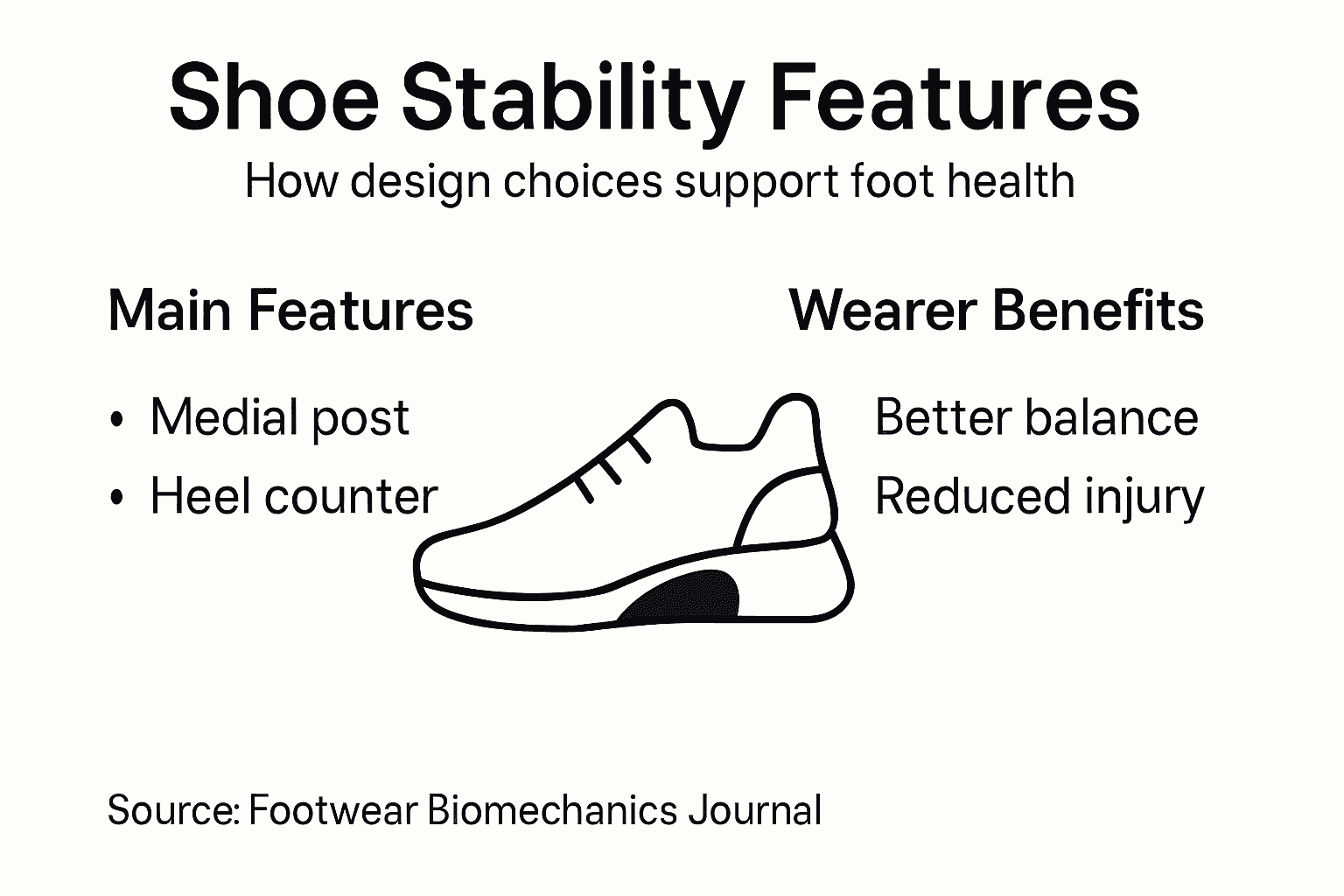
The effectiveness of stability features depends on precise engineering and understanding individual biomechanical requirements. Advanced shoe designs incorporate multiple technologies like dual-density materials, strategic cushioning, and anatomically mapped support zones to create a comprehensive stability solution that adapts to different movement patterns and foot structures.
Here is a summary of how key stability features affect overall foot biomechanics:
| Stability Feature | Biomechanical Impact | Typical Result for Wearer |
|---|---|---|
| Medial post | Limits inward foot rolling | Improved alignment, less strain |
| Firm heel counter | Stabilises rearfoot on impact | Better balance, reduced slipping |
| Wider sole base | Increases ground contact area | Enhanced stance stability |
| Structured midsole | Restricts excessive motion | Greater support during movement |
| Robust arch support | Evenly distributes body weight | Less fatigue, lower injury risk |
Pro tip: Prioritise shoes with multiple stability features rather than relying on a single technological intervention for comprehensive foot support.
Biomechanical benefits and improved alignment
Stable footwear significantly impacts overall biomechanical performance by creating a sophisticated interface between the human body and ground interaction. Understanding these biomechanical benefits reveals how thoughtfully designed shoes can transform movement patterns and reduce potential injury risks.
Key biomechanical improvements include:
- Reduced joint stress through strategic support
- Enhanced motion control limiting excessive foot movements
- Optimised weight distribution across foot surfaces
- Improved shock absorption during dynamic activities
- Balanced gait mechanics promoting natural movement
Postural control strategies demonstrate remarkable improvements with advanced stability footwear. These technological interventions work by adjusting ankle angles, limiting unwanted foot motion, and creating more precise neuromuscular responses during standing and movement.
The sophisticated engineering behind stability shoes transforms biomechanical performance by addressing individual movement patterns. Advanced designs incorporate intricate support mechanisms that adapt to different body types, activity levels, and physiological requirements, ensuring a personalised approach to foot health and movement efficiency.
Pro tip: Invest in professional gait analysis to understand your unique biomechanical needs and select stability footwear that precisely matches your movement patterns.
Risks of unstable footwear and common mistakes
Casual footwear choices significantly compromise biomechanical stability and expose individuals to numerous potential health risks. Understanding these risks is crucial for preventing long-term musculoskeletal complications and maintaining optimal foot health.
Common mistakes when selecting footwear include:
- Prioritising fashion over function
- Ignoring individual foot biomechanics
- Selecting shoes without proper arch support
- Wearing inappropriate footwear for specific activities
- Neglecting regular footwear replacement
Unstable shoes create multiple biomechanical challenges that can dramatically increase injury risks. These challenges manifest through increased postural sway, altered joint mechanics, and inappropriate load distribution across foot and leg structures.
Vulnerable populations such as elderly individuals, athletes, and those with pre-existing conditions are particularly susceptible to biomechanical complications from inappropriate footwear. The consequences extend beyond immediate discomfort, potentially leading to chronic joint issues, balance problems, and increased fall risks.
Pro tip: Conduct an annual professional gait analysis to understand your unique foot mechanics and select footwear that provides targeted biomechanical support.
Choosing optimal footwear for specific needs
Selecting appropriate footwear requires comprehensive biomechanical assessment that considers individual movement patterns, activity requirements, and specific physiological characteristics. Understanding these nuanced considerations is crucial for preventing injury and maintaining optimal foot health.
Critical factors in footwear selection include:
- Individual biomechanical profile
- Specific activity demands
- Foot structure and arch type
- Environmental conditions
- Personal comfort and performance goals
Footwear selection involves detailed biomechanical evaluation to match shoe characteristics with individual movement patterns. Stability requirements vary dramatically across different populations, from athletes requiring high-performance support to older adults needing enhanced balance protection.
The complexity of footwear selection extends beyond simple sizing, encompassing sophisticated considerations of foot mechanics, movement patterns, and potential injury prevention strategies. Professional gait analysis provides invaluable insights, helping individuals identify precise footwear requirements tailored to their unique physiological needs.
Pro tip: Invest in a professional biomechanical assessment to understand your specific foot mechanics and receive personalised footwear recommendations.
Discover Footwear That Supports Your Unique Stability Needs
Foot health depends on wearing shoes that provide precise support for your foot structure and movement patterns. The article highlights how stability features like medial posts, firm heel counters and dual-density midsoles help reduce injury risks and improve alignment. If you struggle with discomfort or imbalance caused by unsuitable shoes, it is essential to prioritise options engineered for motion control and enhanced postural support.

Explore a curated collection of high-performance footwear at YDA UK that combines advanced technology with style and comfort. Benefit now from designs focused on foot health, energy efficiency and personalised stability solutions. Do not delay your journey towards improved comfort and balanced gait. Visit our main site to find shoes tailored to your needs. For expert guidance on matching footwear with your biomechanical profile discover how YDA Technology supports your foot every step of the way.
Frequently Asked Questions
What is the significance of stability in footwear?
Stability in footwear is crucial for enhancing comfort, performance, and injury prevention by creating a dynamic interface between the foot and the ground, taking into account factors like weight distribution, support, and cushioning.
How do different types of stability shoes cater to individual needs?
Different types of stability shoes, such as motion control, stability, neutral, structured cushioned, and performance stability shoes, are designed based on an individual’s biomechanics, foot structure, and activity demands to provide optimal support and comfort.
What are the key features that enhance stability in shoes?
Key features that enhance shoe stability include medial posts, firm heel counters, wider sole bases, structured midsoles, and robust arch supports, all of which work together to ensure proper foot alignment and prevent movement-related injuries.
How can unstable footwear affect foot health?
Unstable footwear can lead to increased risks of injuries, joint stress, altered gait mechanics, and chronic conditions due to inadequate support and improper load distribution, particularly affecting vulnerable populations such as the elderly and athletes.