
Why foot width matters for comfort and health
Most of us spend years perfecting our shoe size, confidently declaring ourselves a size 8 or 10. Yet we rarely consider the other dimension that can make or break our comfort: foot width. Whilst length gets all the attention, width silently influences everything from daily comfort to long-term foot health. Ignoring this crucial measurement can lead to persistent discomfort, altered gait patterns, and even chronic pain that extends far beyond your feet. Understanding why foot width matters empowers you to make smarter footwear choices that support your body’s natural biomechanics and prevent avoidable health issues.
Table of Contents
- Key takeaways
- How foot width influences foot health and biomechanics
- The role of foot width in specific conditions like flat feet and diabetes
- How proper foot width enhances performance and comfort
- Find footwear made for your foot width at YDA UK
- Frequently asked questions
Key Takeaways
| Point | Details |
|---|---|
| Foot width matters | Foot width determines how your toes splay, shaping stability, shock absorption and overall comfort. |
| Narrow footwear risks | Wearing shoes that are too narrow can crowd the forefoot and trigger compensations in the knee, hip and back. |
| Wide toe boxes | Wide toe boxes improve toe splay and balance, potentially enhancing mobility and movement performance. |
| Conditions require width | In flat feet and diabetes, choosing the correct shoe width helps protect biomechanics and long term comfort. |
How foot width influences foot health and biomechanics
Your feet function as complex mechanical structures that distribute your entire body weight across multiple contact points. When shoes constrain this natural architecture, the consequences ripple through your entire skeletal system. Foot width directly determines how effectively your toes can splay during weight-bearing activities, a movement essential for shock absorption and balance maintenance.
Natural toe splay allows your forefoot to widen slightly when you step, creating a stable base that adapts to uneven surfaces. Narrow shoes prevent this expansion, forcing your toes into an unnatural position that compromises proprioception. This restriction doesn’t just cause immediate discomfort; it fundamentally alters how forces travel through your foot during each step. Your body compensates by adjusting ankle angles, knee rotation, and hip alignment, creating a cascade of biomechanical adaptations that strain joints never designed to bear loads at these angles.
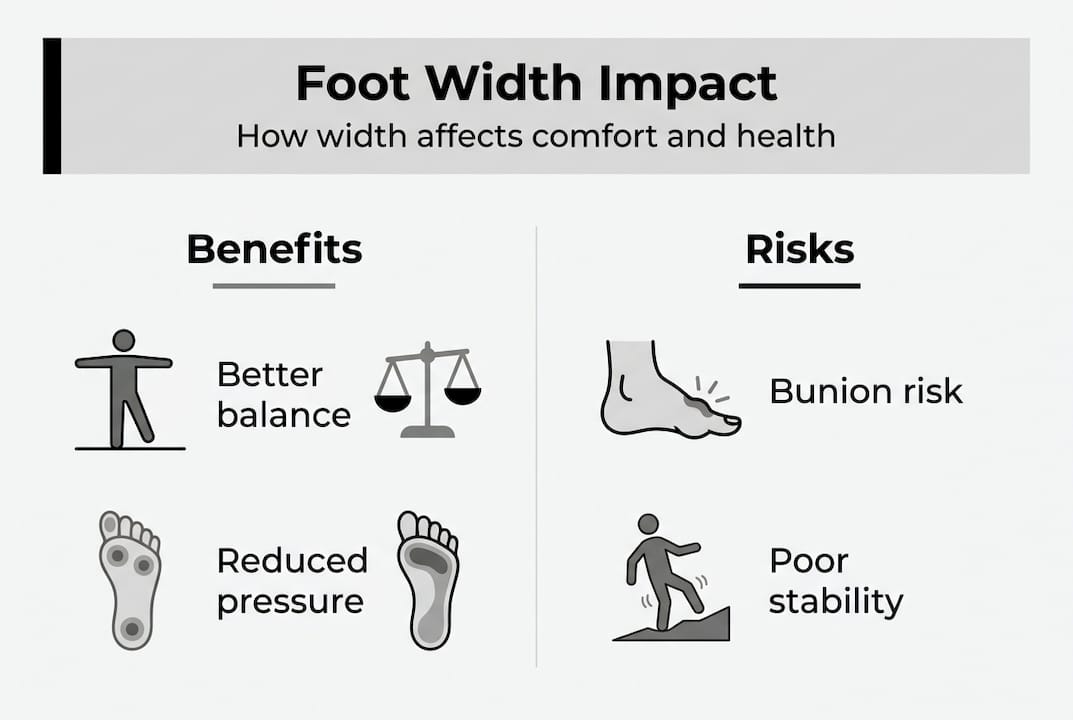
Research confirms that wide feet provide better weight distribution and stability, reducing pressure points, but narrow shoes lead to kinetic chain issues like knee, hip, back pain, and plantar fasciitis. The kinetic chain concept explains how dysfunction in one area creates compensatory problems elsewhere. When your feet cannot function properly due to width restrictions, your knees rotate inward to maintain balance, your hips tilt to compensate for the knee position, and your lower back curves to keep your centre of gravity aligned.
Pro Tip: Stand barefoot and observe your toes spreading naturally. Now try the same in your shoes. If your toes cannot maintain that natural splay, your footwear is too narrow regardless of what the size label says.
The risks of ill-fitting shoes extend beyond temporary discomfort. Chronic compression from narrow footwear can cause:
- Metatarsalgia (forefoot pain from excessive pressure on metatarsal heads)
- Morton’s neuroma (nerve compression between toes causing burning sensations)
- Bunions and hammertoes (progressive deformities from sustained toe compression)
- Altered proprioception leading to increased fall risk in older adults
“The foot is the foundation of human movement. When that foundation is compromised by improper width, every structure above it must compensate, often leading to chronic pain patterns that seem unrelated to footwear.”
Proper width maintains alignment throughout the kinetic chain, allowing your arches to function correctly and your ankles to move through their full range of motion. This alignment reduces strain on knee ligaments, prevents hip impingement, and maintains neutral spine positioning. The difference between correctly fitted and too-narrow shoes can mean the distinction between pain-free movement and chronic discomfort that limits your daily activities.
The role of foot width in specific conditions like flat feet and diabetes
Certain foot conditions amplify the importance of proper width selection, transforming it from a comfort consideration into a medical necessity. Flat feet, characterised by reduced or absent arch height, alter how your foot contacts the ground and distributes forces during movement. People with flat feet often unconsciously adopt wider step widths to improve stability, and footwear that accommodates this natural adaptation can significantly improve gait quality.
Research demonstrates that wider step width reduces injury risks in flat feet by altering lower limb inter-joint coordination and reducing variability during gait. This coordination improvement helps prevent the excessive pronation (inward rolling) that commonly leads to shin splints, Achilles tendinitis, and knee pain in individuals with flat arches. Shoes with adequate width allow the foot to spread naturally, engaging more surface area and reducing the concentrated stress that narrow footwear would create.
| Condition | Width impact | Recommended features |
|---|---|---|
| Flat feet | Requires width for stability and pronation control | Wide toe box, structured heel counter, adequate midfoot width |
| Diabetes | Poor circulation makes pressure points dangerous | Extra width to prevent rubbing, seamless interiors, adjustable closures |
| Bunions | Existing deformity needs accommodation | Wide forefoot, soft uppers, no seams over bunion area |
| Plantar fasciitis | Width affects arch support effectiveness | Sufficient width for orthotic inserts, supportive midsole |
For individuals with diabetes, foot width considerations become even more critical due to reduced sensation and impaired healing. Studies reveal that footwear width risk affects 31 to 78 percent of diabetic patients who wear too-narrow shoes, significantly increasing ulcer risk. Diabetic neuropathy diminishes your ability to feel pressure points developing, meaning damage can occur long before you notice discomfort. Shoes that are even slightly too narrow create friction and pressure that healthy feet would register as pain, prompting adjustment or removal.
The consequences of inadequate width in diabetic footwear include:
- Pressure ulcers that develop unnoticed and become infected
- Reduced circulation to compressed areas delaying healing
- Callus formation at pressure points that can break down into wounds
- Increased amputation risk from unmanaged foot injuries
Selecting appropriate shoe selection for flat feet requires measuring both the widest part of your forefoot and your heel width, as these dimensions can vary independently. Similarly, footwear for diabetics should prioritise width that accommodates swelling, which commonly occurs throughout the day, without creating gaps that allow foot movement inside the shoe. The ideal fit provides consistent, gentle contact across the entire foot surface without concentrated pressure anywhere.
Pro Tip: If you have diabetes, measure your feet in the afternoon when they are slightly swollen to ensure your shoes accommodate natural volume changes. Check your feet daily for any red marks that indicate pressure points from inadequate width.
How proper foot width enhances performance and comfort
Beyond preventing problems, appropriate foot width actively improves how you move and feel during daily activities. Athletic performance particularly benefits from footwear that allows natural foot mechanics rather than constraining them. Research into basketball players found that wider forefoot benefits movement performance by enhancing foot mobility and force transmission, with 3mm toe box extension proving optimal.

This performance enhancement occurs because unrestricted toes can grip the ground more effectively during push-off phases. When your toes splay naturally, they create additional leverage points that increase the force you can generate with each step. Basketball players experienced improved agility and quicker direction changes with slightly wider toe boxes, benefits that translate to any activity requiring balance and rapid movement adjustments.
| Toe box width | Mobility impact | Performance effect | Comfort rating |
|---|---|---|---|
| Standard (narrow) | Restricted toe movement | Reduced force transmission | Moderate to poor |
| +3mm extension | Optimal toe splay | Enhanced agility and balance | Excellent |
| +6mm extension | Excessive space | Foot sliding reduces control | Good but unstable |
| Custom wide | Individual accommodation | Maximised natural mechanics | Excellent for wide feet |
The 3mm measurement represents a sweet spot where additional width provides functional benefits without creating excess space that allows foot movement inside the shoe. Too much width can be as problematic as too little, causing your foot to slide laterally and reducing the shoe’s ability to provide stable support. This precision highlights why generic “wide” sizing often fails; effective width accommodation requires understanding the specific dimensions of your foot.
Everyday comfort improves dramatically when width matches your foot shape. You experience:
- Reduced fatigue from muscles not fighting to maintain balance in constrictive footwear
- Better circulation as blood flow is not restricted by tight shoe walls
- Enhanced sensory feedback allowing more confident movement on varied terrain
- Lower injury risk from trips and falls caused by compromised proprioception
The foot-friendly shoe features that support optimal width include flexible uppers that adapt to your foot shape, anatomically shaped toe boxes that mirror natural foot contours, and adjustable closure systems that allow customisation across different parts of the foot. These design elements recognise that feet are three-dimensional structures with individual variations in width, volume, and shape.
Pro Tip: Test shoe width by standing in them and checking if you can wiggle your toes freely without your foot sliding side to side. Your toes should have space to spread, but your heel should feel securely held without gaps.
For people who spend extended periods on their feet, proper width becomes a determining factor in whether they finish the day energised or exhausted. Healthcare workers, retail employees, and anyone whose occupation involves prolonged standing report significantly less foot pain and lower limb fatigue when wearing shoes that accommodate their true foot width rather than forcing their feet into standard dimensions.
Find footwear made for your foot width at YDA UK
Understanding foot width importance is only valuable when you can access footwear designed with these principles in mind. YDA UK specialises in shoes for problem feet that prioritise biomechanical function alongside style, offering solutions for individuals whose feet require more than standard sizing can provide.

The technology of YDA shoes incorporates research-backed design features that accommodate natural foot width whilst providing the support necessary for optimal alignment. Their footwear recognises that proper fit extends beyond length, addressing the three-dimensional nature of feet with toe boxes that allow natural splay and midsoles that support individual arch types. Whether you are managing specific foot conditions or simply seeking footwear that works with your body rather than against it, exploring options designed for genuine foot health can transform your daily comfort and long-term wellbeing.
Frequently asked questions
Why is foot width crucial for comfort and health?
Foot width determines how pressure distributes across your foot during weight-bearing activities. Inadequate width compresses toes, restricts natural movement, and creates pressure points that cause immediate discomfort and long-term problems like bunions, neuromas, and altered gait patterns. Proper width allows your foot to function as designed, maintaining balance and reducing strain throughout your kinetic chain.
How can I measure my foot width correctly?
Stand barefoot on paper and trace your foot outline, then measure the widest part of your forefoot across the ball. Compare this measurement to width charts specific to your shoe size, as width categories (narrow, standard, wide) represent different absolute measurements at different lengths. Measure both feet in the afternoon when they are slightly swollen for the most accurate assessment.
Do wide feet always require special shoes?
Not necessarily, but they require attention to width specifications. Some brands run wider in their standard sizes, whilst others are notoriously narrow. Wide feet need shoes labelled as wide or extra wide in most cases, but trying multiple brands helps identify which standard sizes might accommodate your width. The key is ensuring your toes can spread naturally without your foot sliding laterally.
Can wrong shoe width worsen foot conditions?
Absolutely. Narrow shoes accelerate bunion progression, increase plantar fasciitis risk, and can cause permanent toe deformities over time. For diabetics, inadequate shoe width dramatically increases ulceration risk. Conditions like flat feet benefit from appropriate width that allows natural foot mechanics, whilst narrow shoes force compensatory movements that strain joints and soft tissues.
What are signs my shoes don’t fit my foot width?
Red marks on the sides of your feet after removing shoes indicate excessive pressure. Numbness or tingling in your toes suggests nerve compression from inadequate width. If you can see your foot bulging over the shoe’s midsole or your toes feel cramped, width is insufficient. Pain in your knees, hips, or lower back that improves when barefoot may also indicate footwear width issues forcing biomechanical compensations. When selecting shoes for flat feet, ensure the widest part of your foot aligns with the widest part of the shoe without overhang or compression.