
Prioritise foot alignment for lasting comfort: key guide
TL;DR:
- Foot alignment affects pain, injury risk, and movement efficiency across the body.
- Correcting alignment is most beneficial when pain or functional issues are present.
- Practical steps include observing shoe wear, using footprint tests, and seeking professional assessment.
Foot pain is not simply the price you pay for an active life, and yet millions of people accept daily discomfort as though it were inevitable. The real culprit, more often than not, is poor foot alignment. Whether you spend long hours on your feet, enjoy regular sport, or manage a condition such as plantar fasciitis, how your foot sits, moves, and loads weight through each step shapes everything from your energy levels to your injury risk. This guide cuts through the noise to explain what foot alignment actually means, when it matters most, and what practical steps you can take to support it every single day.
Table of Contents
- What is foot alignment and why does it matter?
- How foot alignment influences comfort, performance and injury risk
- When does foot alignment correction make a difference?
- Practical steps: Assessing and supporting your foot alignment
- Why the best foot support starts with your own awareness
- Explore supportive footwear solutions tailored for your feet
- Frequently asked questions
Key Takeaways
| Point | Details |
|---|---|
| Alignment impacts comfort | Small shifts in foot position can change how your feet feel day after day. |
| Correction isn’t always needed | Evidence suggests alignment support matters most when you have symptoms or discomfort. |
| Choice of shoes is crucial | Supportive, appropriate footwear is one of the simplest ways to assist foot alignment. |
| Self-assessment is powerful | Understanding your own alignment helps you make better choices for lifelong foot health. |
What is foot alignment and why does it matter?
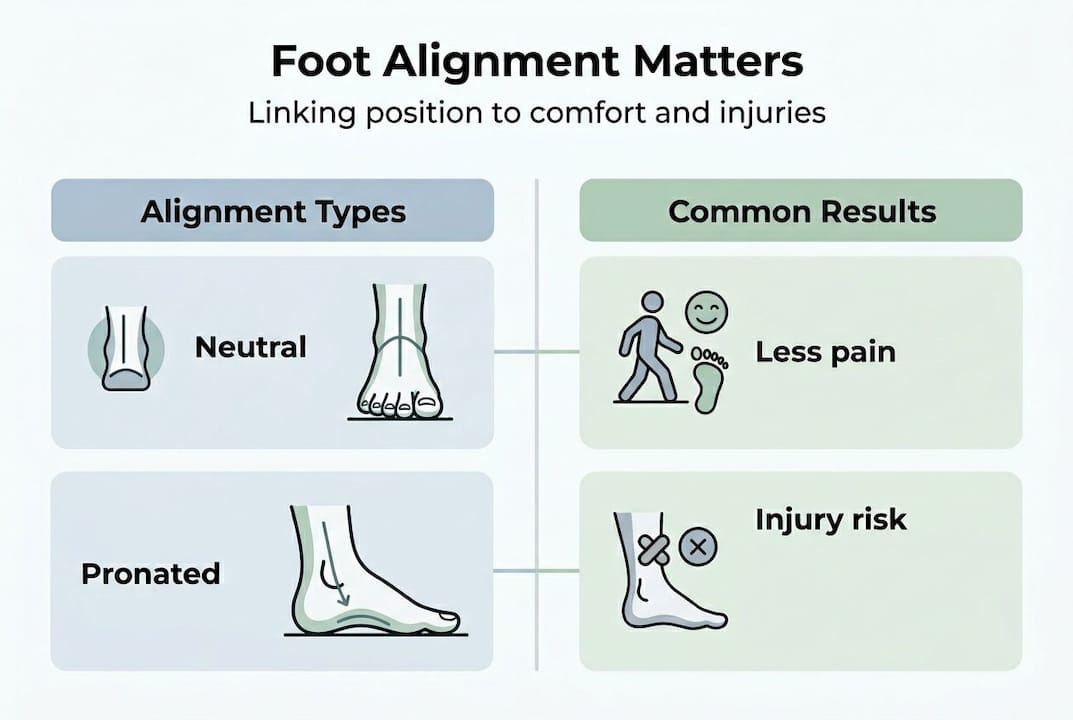
Foot alignment refers to the relationship between the bones, joints, and soft tissues of your foot and how they position themselves during standing, walking, and movement. Think of it as the foundation of a building. If the base is off-centre, everything built on top of it is under extra stress. Your ankles, knees, hips, and even your lower back all respond to what happens at foot level.
When your foot is well aligned, weight distributes evenly across the heel, midfoot, and forefoot. Muscles and tendons work efficiently. When alignment is compromised, certain areas absorb far more load than they are designed to handle. Over time, this leads to pain, fatigue, and structural wear.
Common signs of misalignment include:
- Heel pain that is worst first thing in the morning
- Arch discomfort after prolonged standing
- Calluses forming on one side of the foot
- Knees that turn inward or outward during walking
- Uneven shoe wear patterns
Professionals use a validated clinical tool called the Foot Posture Index (FPI-6) to assess and score foot posture objectively. The FPI-6 evaluates six observable features of the foot and produces a score that indicates whether the foot is neutral, pronated (rolled inward), or supinated (rolled outward). This matters because different alignment profiles carry different pressure patterns and injury risks.
Pro Tip: Stand barefoot on a hard floor and look at your footprint after stepping out of a shallow tray of water. A full imprint with no arch curve suggests a pronated foot; a very thin connection between heel and forefoot suggests supination. Neither is automatically a problem, but both are worth knowing about.
Understanding your alignment is the first step toward reducing foot pain and making smarter choices about footwear’s comfort role in your daily life. Ignoring alignment does not make it go away. It simply lets the consequences accumulate quietly.
How foot alignment influences comfort, performance and injury risk
Poor alignment does not just cause discomfort. It actively undermines how efficiently your body moves. When the foot pronates excessively, the arch collapses inward with each step, placing strain on the plantar fascia, the tibialis posterior tendon, and the medial knee. When it supinates, the outer edge of the foot absorbs shock without the benefit of the arch’s natural cushioning, stressing the lateral ankle and peroneal tendons.

For those with an active lifestyle, this inefficiency translates directly into fatigue. A foot that is working against its own structure burns more energy per stride. Over a long run or a full day on your feet, that adds up considerably.
| Alignment issue | Common pain site | Performance impact |
|---|---|---|
| Excessive pronation | Arch, medial knee, heel | Reduced propulsion efficiency |
| Supination | Lateral ankle, forefoot | Poor shock absorption |
| Forefoot varus | Ball of foot, second toe | Pressure hotspots, blistering |
| Neutral with poor support | Variable | Fatigue over extended activity |
The evidence for targeted interventions is compelling. Orthotics reduce plantar pressures in people with rheumatoid arthritis, and motion control shoes demonstrably reduce rearfoot eversion. These are not minor adjustments. They represent measurable changes in how force travels through the foot.
Here is why this matters in practice:
- Reduced plantar pressure lowers the risk of stress fractures and soft tissue overload.
- Controlled rearfoot eversion protects the medial structures of the ankle and knee.
- Better load distribution means less compensatory tension in the calf and Achilles tendon.
- Efficient alignment supports longer, more comfortable activity without the energy drain of constant muscular correction.
Exploring the benefits of foot health shoes reveals how much of this correction can be built into everyday footwear, without the need for complex clinical intervention. For practical examples, everyday foot health shoes show how design choices translate into real-world comfort.
The myth that any shoe will do is exactly that: a myth. Footwear is not passive. It either supports your alignment or it works against it.
When does foot alignment correction make a difference?
Here is where the science becomes genuinely interesting, and where a lot of well-meaning advice goes wrong. Alignment correction is not universally beneficial. The evidence is clear that context matters enormously.
For people experiencing pain, stiffness, or functional limitation linked to alignment issues, targeted interventions such as orthotics, motion control footwear, and structured exercise programmes offer real, measurable relief. The benefit is most pronounced when symptoms are present and traceable to a specific alignment pattern.
However, the picture changes for asymptomatic individuals. Orthotics show no clear benefit over standard shoes for healthy children with painless flat feet. This is a significant finding, because it challenges the instinct to correct anything that looks different from textbook neutral.
| Scenario | Prioritise alignment correction? | Recommended approach |
|---|---|---|
| Pain with activity, linked to flat feet | Yes | Orthotics, supportive footwear |
| Painless flat feet in children | No | Monitor, avoid unnecessary intervention |
| Adult with heel pain and pronation | Yes | Targeted support, professional assessment |
| Asymptomatic high arch | Possibly | Cushioning focus, monitor for symptoms |
| Post-injury rehabilitation | Yes | Structured correction and footwear review |
The contrasting viewpoints between podiatry practice and formal evidence reviews reflect a genuine tension in the field. Many clinicians prioritise early intervention based on clinical experience, while systematic reviews urge caution for symptom-free cases.
“Not all flat feet require correction. The priority should always be the person’s experience of pain and function, not the shape of their foot alone.”
Who benefits most from alignment correction:
- Adults with heel or arch pain lasting more than six weeks
- Runners or athletes experiencing repetitive strain injuries
- People with rheumatoid arthritis or diabetes-related foot complications
- Those recovering from ankle sprains or lower limb injuries
When deciding whether to prioritise alignment, choosing orthopaedic shoes is often a sensible starting point before committing to clinical orthotics. If you are unsure whether orthotics are right for you, an orthotic shoe guide can help clarify the distinction.
Practical steps: Assessing and supporting your foot alignment
Knowing that alignment matters is one thing. Doing something about it is another. The good news is that several practical steps are accessible without a clinic visit, and they can give you a genuinely useful picture of where you stand.
- Observe your shoe wear. Turn your shoes over and examine the sole. Heavy wear on the inner heel suggests pronation; wear concentrated on the outer edge points to supination. This is a quick, free alignment indicator you already have at home.
- Try the wet footprint test. As described earlier, a wet footprint on a flat surface reveals your arch profile at a glance. It is not diagnostic, but it is informative.
- Stand in front of a mirror. Look at your feet from the front. Do your ankles roll inward? Do your arches appear to collapse? Ask someone to observe your gait from behind as you walk naturally.
- Seek a professional assessment. A podiatrist or physiotherapist can use the FPI-6 assessment tool to give you an objective, scored evaluation of your foot posture. This is particularly worthwhile if you have recurring pain or a history of lower limb injuries.
- Choose footwear with intention. Look for shoes that offer a supportive heel counter, a firm midsole, and enough width for your foot type. Improving foot comfort often starts with retiring footwear that has lost its structure.
Pro Tip: Rotate between two pairs of supportive shoes rather than wearing one pair every day. This allows the midsole cushioning to recover fully between wears, maintaining its alignment support for longer.
If your symptoms persist beyond six to eight weeks despite footwear changes, or if pain is affecting your sleep or daily function, that is the point to seek specialist input. Orthotic-friendly footwear is an excellent bridge between standard shoes and custom clinical devices, offering meaningful support without the cost of bespoke orthotics.
Small, consistent changes beat dramatic interventions almost every time. Stretch your calves daily, strengthen your intrinsic foot muscles with simple exercises like toe spreads and short-foot drills, and pay attention to how your feet feel after different activities.
Why the best foot support starts with your own awareness
There is a tendency in foot health to reach immediately for a product or a prescription. A new insole, a corrective device, a specialist shoe. And while these tools genuinely help many people, they are most effective when they follow self-awareness rather than replace it.
The uncomfortable truth is that generic advice, including the kind dispensed by well-meaning professionals, does not always account for the enormous variation between individual feet. Two people with identical FPI-6 scores can have completely different experiences of pain, function, and need. One may benefit from motion control footwear; the other may thrive with minimal intervention.
We believe the most durable foot health improvements come from people who understand their own patterns. Which activities aggravate their discomfort? Which surfaces feel better underfoot? What time of day does pain peak? These observations are more valuable than any single product claim.
Scepticism is healthy here. Be wary of any shoe, orthotic, or corrective trend that promises universal results. Foot health is personal. Incremental, informed change, guided by your own experience, beats the latest corrective fad every time. Explore the honest trade-offs between comfort vs performance shoes before committing to any single approach.
Explore supportive footwear solutions tailored for your feet
Translating your understanding of foot alignment into everyday comfort starts with choosing footwear that genuinely supports your foot’s structure. For many people, the right shoe, one that accommodates their alignment profile and keeps their foot in a healthy position throughout the day, is the single most impactful change they can make.
At YDA UK, our range of shoes for problem feet is designed with foot health at its core, not as an afterthought. Whether you need orthotic-friendly designs, structured support, or simply a shoe that does not fight against your natural foot posture, you will find options built around real foot health principles. Discover the innovation behind our designs on the technology of YDA shoes page, and take the next step toward footwear that works with your alignment rather than against it.
Frequently asked questions
Can foot alignment really prevent injuries?
Correcting misalignment can meaningfully lower pressure on vulnerable foot structures. Orthotics reduce plantar pressures and control rearfoot eversion, which may reduce injury risk particularly for those already experiencing pain or repetitive strain.
Should everyone use orthotics for better alignment?
Not necessarily. Evidence shows that no significant benefit is found for pain or quality of life in asymptomatic cases, such as children with painless flat feet. Orthotics are most justified when symptoms are present and linked to a specific alignment pattern.
What is the Foot Posture Index (FPI-6)?
The FPI-6 is a standardised clinical assessment used by foot health professionals to score how a foot is aligned across six observable criteria, producing a reliable, reproducible result that guides treatment decisions.
Are expensive shoes necessary for proper foot alignment?
Price is not a reliable indicator of alignment support. Focus on structural features such as a firm heel counter, appropriate width, and midsole integrity rather than cost. Orthotic-friendly shoes often deliver excellent value for those who need accommodation for insoles or custom devices.