
Understanding plantar pressure for foot comfort and support
TL;DR:
- Plantar pressure distribution, the force spread across the foot during movement, is key to understanding foot pain and complications.
- Assessing pressure patterns helps determine effective footwear solutions, especially for conditions like diabetes and plantar fasciitis.
Most people assume that sore feet are simply a footwear problem, something you fix by buying a better pair of shoes. The reality is more nuanced. Plantar pressure, the distribution of force across the underside of your foot during standing and movement, is often the hidden factor driving persistent pain, complications in diabetes, and the cycle of discomfort that no ordinary shoe change seems to resolve. Understanding plantar pressure gives you the power to make choices that genuinely support your feet, rather than guessing.
Table of Contents
- What is plantar pressure and why does it matter?
- How plantar pressure is measured and the key parameters
- Normal and abnormal plantar pressure patterns
- Implications for diabetes, plantar fasciitis, and specialised footwear
- What most guides miss about plantar pressure and comfort
- Explore specially designed footwear for problem feet
- Frequently asked questions
Key Takeaways
| Point | Details |
|---|---|
| Plantar pressure basics | It is the distribution of force across the foot’s underside during movement and standing. |
| Measurement methods | Platforms and in-shoe sensors help analyse plantar pressure for tailored footwear choices. |
| Risk patterns | Elevated pressure in diabetes and plantar fasciitis increases pain and ulcer risk. |
| Custom footwear | Specialised insoles and shoes effectively offload risky zones and prevent recurrence. |
| Expert advice | No universal norm exists; personal analysis and real-world testing are key for comfort. |
What is plantar pressure and why does it matter?
Plantar pressure is not just an abstract clinical term. It describes how your body weight and movement forces are spread across the sole of your foot at any given moment. When that distribution is uneven, certain areas of the foot absorb far more load than they are designed to handle, leading to pain, tissue damage, and in some cases, serious medical complications.
Think of it this way: if you place a heavy object on a mattress, a concentrated load creates a deep indent, while a spread load barely leaves a mark. Your foot works the same way. When pressure concentrates in one spot, tissues there face repeated stress that eventually causes damage.
“Plantar pressure is the distribution of pressure over the plantar surface of the foot during static or dynamic activities.”
Here is why this matters for everyday life:
- Pain after walking often traces back to pressure hotspots under the heel or ball of the foot, not just poor cushioning in shoes.
- Diabetic foot complications develop because high pressure points damage fragile skin and underlying tissue over time.
- Plantar fasciitis is aggravated when forefoot and metatarsal areas absorb excessive load with each step.
- Fatigue in your legs and lower back can stem from altered pressure patterns causing compensatory gait changes.
If you have been exploring comfort footwear for plantar fasciitis, understanding the underlying pressure mechanics will help you evaluate those shoes far more effectively than reading marketing descriptions alone.
How plantar pressure is measured and the key parameters
Knowing that plantar pressure matters is one thing. Understanding how it is measured and what the numbers mean gives you the practical knowledge to interpret clinical advice and product claims.
There are three main categories of measurement tools. Platform systems, in-shoe sensors, and wearable insoles each offer different insights depending on whether you need laboratory precision or real-world monitoring.
| Measurement method | Accuracy | Usability | Best suited for |
|---|---|---|---|
| Force platform | Very high | Low (lab only) | Baseline clinical assessment |
| Pressure mat | High | Moderate | Gait clinics, orthopaedic assessment |
| In-shoe sensors | Moderate | High | Real-world daily activity monitoring |
| Wearable insoles | Moderate | Very high | Ongoing home monitoring |
The key metrics that clinicians and footwear designers focus on include:
- Peak pressure: The highest force per unit area at any point on the foot. This identifies the most vulnerable zones.
- Pressure-time integral: The total pressure load over a period, reflecting cumulative tissue stress.
- Centre of pressure trajectory: The path your body weight travels across your foot with each step, revealing gait irregularities.
- Contact area: How much of the foot’s surface actually touches the ground, which indicates arch collapse or high arches.
- Stance time: How long the foot stays in contact with the ground, affecting how long tissues are under load.
Pro Tip: If you are visiting a podiatrist or foot specialist, ask specifically whether they use dynamic or static measurement. Static measures (standing still) reveal structural issues, while dynamic measures (walking) reveal gait-related pressure problems that are often more clinically relevant.
Platform systems give the gold standard in accuracy, but they only capture a few steps in a controlled environment. In-shoe sensors and wearable insoles capture your actual daily activity and are increasingly popular for monitoring people with diabetes or recovering from injury. Keeping up with footwear innovations for plantar pressure matters because the technology embedded in modern shoes is directly informed by this kind of measurement data.
Normal and abnormal plantar pressure patterns
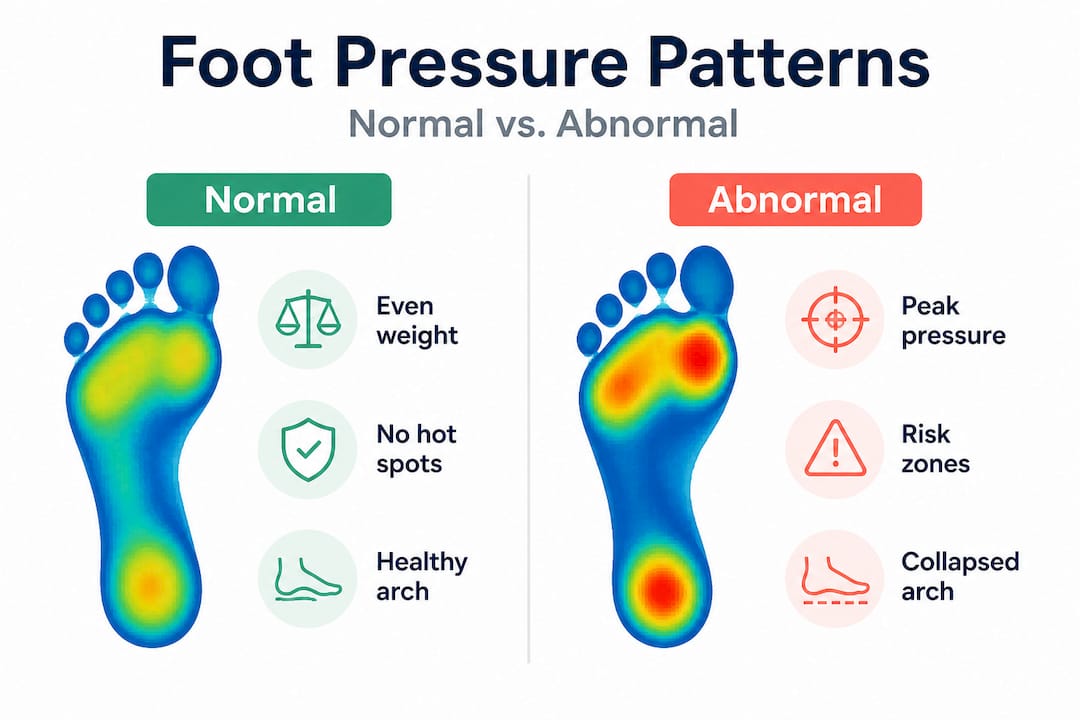
Understanding what a healthy pressure pattern looks like helps you recognise when something is off in your own feet. Healthy feet do not distribute pressure evenly across the entire sole. That would actually be abnormal.
In a typical healthy foot, approximately 60% of body weight is borne by the hindfoot (heel) and roughly 40% by the forefoot during static standing. This balance shifts dynamically during walking, with the heel striking first and pressure rolling forward towards the toes at push-off.
Here is how different conditions alter that normal pattern:
- Flatfoot (pes planus): The arch collapses inward, shifting load towards the inner edge of the foot. Medial pressures increase, and the forefoot absorbs more impact than intended. People with flat feet often describe a dull, spreading ache along the inner foot or ankle.
- Plantar fasciitis: The fascia (the thick band of tissue running along the sole) becomes inflamed, partly because higher peak pressures in the forefoot and metatarsals place repetitive strain on the tissue. Midfoot and forefoot loading becomes symptomatic, particularly during the first steps of the morning.
- Diabetes: The stakes rise considerably. Peripheral neuropathy (nerve damage that reduces sensation) means patients cannot feel pressure building in vulnerable areas. Clinicians flag pressures between 200 and 800 kPa as elevated risk, and pressures above 800 kPa carry a high risk of ulceration, a serious and potentially limb-threatening complication.
| Foot condition | Pressure distribution | Key risk zone |
|---|---|---|
| Healthy foot | 60% hindfoot, 40% forefoot | Balanced, no hotspot |
| Flatfoot | Increased medial pressure | Inner arch and heel |
| Plantar fasciitis | Elevated forefoot/metatarsal | Ball of foot and toes |
| Diabetic foot | Variable; hotspots unpredictable | Metatarsal heads, heel |
Key parameters such as peak pressure and pressure-time integral are what clinicians use to distinguish between these patterns. If you are choosing footwear to address flat feet specifically, learning how to pick shoes for flat feet based on these pressure principles will help you filter out shoes that look supportive but fail to redistribute load where it counts.
Understanding your own pressure pattern is also empowering when it comes to pain management. You can reduce foot pain with shoes more effectively when you know whether your problem is a heel hotspot, a metatarsal pressure spike, or a medial arch collapse issue.
Implications for diabetes, plantar fasciitis, and specialised footwear
The clinical research is clear. For people with diabetes, elevated plantar pressure is not just uncomfortable, it is genuinely dangerous. Offloading via custom insoles reduces diabetic foot ulcer recurrence by up to 58%. That is a remarkable figure. It means the right footwear is not a comfort preference but a medical intervention.
For plantar fasciitis and flatfoot, the evidence is equally compelling. Increased midfoot and forefoot loading in symptomatic patients shows that general cushioning is not sufficient. You need footwear that specifically targets and offloads the problematic zones.
Here are practical footwear recommendations based on condition:
- Diabetes: Choose shoes with deep toe boxes, no internal seams, and custom or semi-custom insoles designed to offload metatarsal heads and the heel. Check daily for pressure-related skin changes. Explore how insoles improve diabetic foot health to understand why material density and contour matter.
- Plantar fasciitis: Seek shoes with strong arch support and a slight heel raise. The goal is to reduce the stretch force on the plantar fascia during push-off. Avoid flat or minimalist footwear during flare-ups.
- Flatfoot: Medial posting (a firmer wedge on the inner side of the insole) is the standard recommendation. This corrects the inward roll of the foot and reduces medial pressure spikes.
- General high-pressure risk: Width matters enormously. A narrow shoe compresses the foot laterally and forces pressure upward into the metatarsals. Wider fitting shoes spread load more effectively.
Pro Tip: Offloading specific high-risk zones is far more effective than simply adding extra cushioning throughout the shoe. Thick foam everywhere feels comfortable initially but does not prevent pressure concentrations forming. A contoured insole that redirects load away from a known hotspot achieves more with less material.
Understanding the role of footwear in ulcer prevention becomes especially important if you have been diagnosed with diabetic peripheral neuropathy. Similarly, a thorough diabetic footwear selection guide can help you navigate the specific features that matter beyond general comfort claims.
What most guides miss about plantar pressure and comfort
Here is an uncomfortable truth: most footwear guides present plantar pressure as if there were a neat, universal benchmark everyone should aim for. There is not. Clinicians acknowledge that no standard benchmarks exist due to variations in measurement equipment, protocols, and populations studied. A pressure reading considered normal for one body type, gait pattern, or age group may be elevated for another.
This means two things for you as someone managing foot discomfort. First, personalised assessment matters far more than generic recommendations. If a health professional tells you your pressure is fine based on a single static reading, that may only tell part of the story. Dynamic analysis during walking is far more relevant for most gait-related issues. Second, do not assume off-the-shelf solutions will work just because they are labelled as therapeutic.
Pressure-guided custom insoles are proven cost-effective in preventing recurrence of foot problems, particularly in diabetic patients. Yet many people continue choosing cheaper, generalised insoles that feel cushioned but do not address their specific pressure map. The difference in outcome can be significant over months and years.
We also see people rely too heavily on static posture assessments, where they stand on a pressure plate in a clinic or shop for a few seconds. This captures your structure but tells you almost nothing about how your foot behaves during a long walk, a day on your feet at work, or navigating uneven ground. Real-world testing and, where possible, in-shoe sensor data gives a far more honest picture.
The right approach when choosing shoes for health and comfort is to combine structural knowledge of your foot type with dynamic information about your gait. Then match that to footwear specifically designed with those parameters in mind, rather than selecting shoes on aesthetics or general comfort ratings alone.
Explore specially designed footwear for problem feet
Once you understand what plantar pressure is doing to your feet, you want solutions that are actually built around that science, not just marketed as comfortable.

At YDAUK, we design shoes for problem feet with foot health technology at their core, addressing the pressure patterns that cause real discomfort and long-term risk. Whether you are managing diabetes, living with plantar fasciitis, or simply tired of shoes that fail you after an hour on your feet, our range is built to redistribute load where it matters most. Explore the technology behind YDA shoes to understand exactly how each design decision, from insole contour to sole geometry, targets the pressure zones that standard footwear overlooks. Your feet deserve footwear that understands them.
Frequently asked questions
How does plantar pressure contribute to foot pain?
High plantar pressure in specific zones creates localised tissue stress that aggravates conditions like plantar fasciitis and, in diabetic patients, drives ulceration risk at pressures above 800 kPa. Elevated forefoot loading is a consistent finding in symptomatic feet across multiple conditions.
What is the best way to measure plantar pressure at home?
In-shoe sensors and wearable insoles offer the most practical home monitoring option, capturing real-world pressure data during your daily activities rather than just a brief clinical snapshot.
Can custom insoles really reduce plantar pressure and prevent ulcers?
Yes. Custom insoles designed to offload high-risk zones have been shown to reduce ulcer recurrence by up to 58% in diabetic patients, making them one of the most evidence-backed interventions available for foot health.
How do pressure patterns differ for flat feet and plantar fasciitis?
Flat feet produce higher medial pressures due to arch collapse, shifting load inward, while plantar fasciitis is characterised by increased forefoot and midfoot loading that places repetitive strain on the plantar fascia with each step.
Recommended
- Discover metatarsal support: relieve foot pain and boost comfort – YDA UK
- How to Maintain Foot Comfort Naturally for Healthy Feet – YDA UK
- How to improve foot support for lasting comfort – YDA UK
- How to test shoe comfort: practical steps for healthier feet – YDA UK
- General Foot & Ankle Care - Stride Foot & Ankle