
Diabetic Footwear Selection Guide for Optimal Comfort
Finding comfortable and stylish footwear can be especially challenging for people with diabetes, as nearly 60 percent of diabetic complications begin with poor foot care. Balancing health needs with design, many British shoppers now seek advanced shoes from global e-commerce platforms that offer both support and fashionable options. This guide breaks down practical steps to help you assess your needs and select the right diabetic footwear for lasting comfort and protection.
Table of Contents
- Step 1: Assess Foot Health Needs
- Step 2: Measure Feet Accurately
- Step 3: Select Appropriate Shoe Features
- Step 4: Verify Fit and Comfort
- Step 5: Review and Purchase Safely
Quick Summary
| Key Insight | Explanation |
|---|---|
| 1. Regular Foot Assessments are Essential | Schedule annual assessments with a podiatrist to monitor changes and adapt your footwear strategy. |
| 2. Accurate Foot Measurements Matter | Measure both feet later in the day to accommodate any swelling before selecting diabetic shoes. |
| 3. Choose Shoes with Key Features | Select footwear with seamless interiors and adjustable closures for comfort and to prevent complications. |
| 4. Verify Proper Fit and Comfort | Walk around in the shoes to check for pressure points and overall comfort before purchasing. |
| 5. Prioritise Professional Guidance | Consult with healthcare professionals when selecting footwear to ensure they meet medical standards and personal needs. |
Step 1: Assess Foot Health Needs
Successfully managing diabetic foot health starts with a comprehensive personal assessment. Understanding your specific foot condition will guide your footwear selection process, ensuring optimal comfort and preventing potential complications.
Begin by carefully examining your feet for signs of neuropathy, circulation issues, or structural changes. Foot health assessments are critical for identifying early warning signs that might impact your footwear requirements. Look for key indicators such as reduced sensation, skin colour changes, temperature variations between feet, and any existing deformities or calluses. Pay special attention to areas prone to pressure and friction, as these can develop into more serious problems if left unaddressed.
Understanding your specific risk factors allows for targeted footwear selection. Diabetic foot risk guidelines recommend comprehensive evaluations that consider neuropathy levels, blood circulation, skin integrity, and foot structure. By mapping out these individual characteristics, you can choose shoes that provide precise support, pressure distribution, and protection tailored to your unique foot health profile.
Pro tip: Schedule a professional foot assessment with a podiatrist specialising in diabetic foot care at least once annually to track changes and update your footwear strategy accordingly.
Here is a quick summary of common foot assessment findings and their impact on footwear selection:
| Assessment Finding | Potential Complication | Footwear Consideration |
|---|---|---|
| Reduced sensation | Higher ulcer risk | Extra cushioning for protection |
| Skin colour change | Poor circulation | Breathable, moisture-wicking |
| Foot deformity | Pressure areas, calluses | Wide toe box, custom orthotics |
| Temperature asymmetry | Circulation problems | Insulated, temperature-neutral |
Step 2: Measure Feet Accurately
Accurately measuring your feet is crucial for selecting diabetic footwear that provides optimal comfort and protection. This step ensures you choose shoes that accommodate your unique foot characteristics and prevent potential pressure points or complications.

Begin by gathering the right measurement tools: a piece of white paper, a pencil, a ruler, and a hard surface. Diabetic foot measurement techniques recommend tracing your foot while standing to capture its true size and shape. Place the paper on a flat surface, stand fully on it with your weight distributed evenly, and carefully trace around your entire foot. Measure the length from the heel to the longest toe and the width at the widest part of your foot. For individuals with diabetic foot conditions, multiple measurements are essential, as foot size can fluctuate due to swelling or structural changes.
Precision matters when selecting diabetic footwear. International diabetes foot guidelines emphasise the importance of comprehensive measurements that account for volume, potential deformities, and asymmetry between feet. Consider measuring your feet later in the day when natural swelling occurs, and always measure both feet, as they might differ in size. Take measurements while wearing the type of socks you typically use with diabetic footwear to ensure the most accurate fit possible.
Pro tip: Consider having a professional podiatrist perform your foot measurements at least annually, as they can detect subtle changes that might impact your footwear requirements.
Step 3: Select Appropriate Shoe Features
Choosing the right footwear features is critical for individuals managing diabetes, as the correct shoe design can significantly reduce foot complications and enhance overall comfort. Your goal is to find shoes that provide maximum protection and support for your unique foot health needs.
Diabetic footwear guidelines recommend several key features essential for optimal foot protection. Look for shoes with extra depth to accommodate custom orthotics or insoles, ensuring ample room for potential foot swelling. Seek out seamless interior linings that minimise friction and reduce the risk of skin irritation. The sole should be rigid yet cushioned, providing stability while absorbing shock and reducing plantar pressure. Prioritise shoes with adjustable closures like velcro straps, which allow for easy accommodation of foot volume changes and provide a customisable fit.
Beyond structural considerations, material selection plays a crucial role in diabetic footwear. Diabetic footwear recommendations emphasise choosing lightweight, stretchable materials that promote circulation and reduce pressure points. Breathable fabrics help manage moisture, while soft, flexible materials can adapt to foot shape and movement. Opt for shoes with reinforced heel counters for added stability and consider styles with wide toe boxes to prevent compression and potential ulceration.
Pro tip: Try on shoes later in the day when feet are slightly swollen to ensure the most accurate and comfortable fit throughout daily activities.
For reference, the following table highlights essential features of diabetic shoes and their primary benefits:
| Shoe Feature | Main Benefit | Recommended For |
|---|---|---|
| Seamless interior | Prevents friction and skin breakdown | Sensitive or fragile skin |
| Adjustable closure | Accommodates swelling and fit | Variable foot shape or size |
| Rigid yet cushioned sole | Enhances stability and absorption | High-risk foot structure |
| Reinforced heel counter | Improves foot alignment and support | Weak or unstable ankles |
Step 4: Verify Fit and Comfort
Verifying the perfect fit and comfort of diabetic footwear is a critical step that goes beyond simply selecting the right shoe size. Your goal is to ensure that every aspect of the shoe provides optimal support and protection for your unique foot health needs.
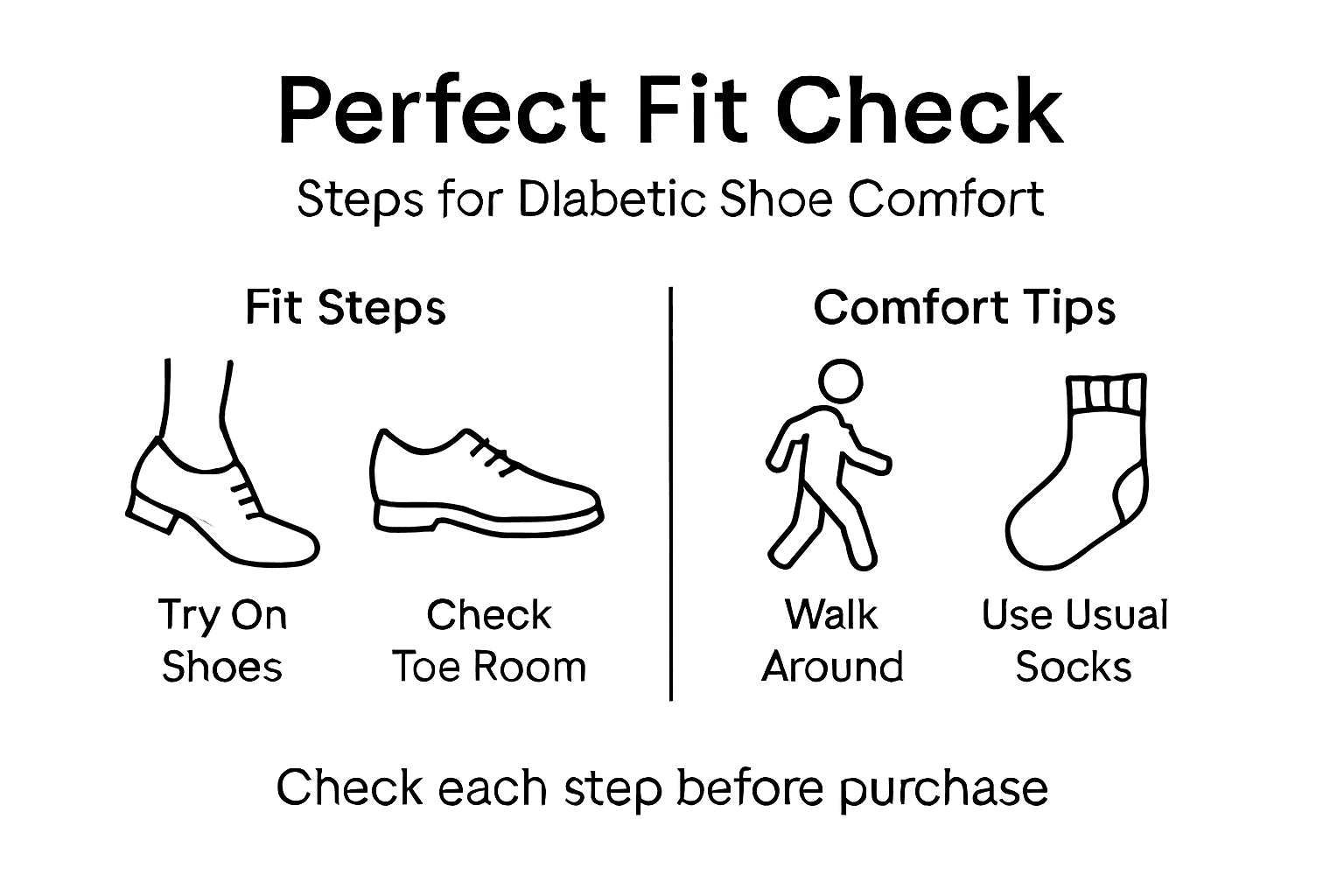
Diabetic shoe fit guidelines recommend a comprehensive assessment process that involves more than just visual inspection. When trying on shoes, stand and walk around to evaluate how they feel during actual movement. Check for adequate toe box space that allows your toes to move freely without compression. The shoe should feel snug but not tight, with no areas of excessive pressure or friction that could cause skin irritation. Pay close attention to how the shoe accommodates any existing orthotics or insoles, ensuring they fit smoothly without creating additional pressure points.
Precise comfort verification requires careful attention to multiple factors. Orthopaedic foot care recommendations suggest wearing the shoes for short periods initially to allow for gradual breaking in. Examine the heel stability by walking and ensuring there is no slipping or rubbing that could cause blisters. Check the interior lining for any potential rough spots or seams that might cause friction. Remember that comfort is not just about immediate feel but also about long term foot health and protection.
Pro tip: Bring the specific socks you plan to wear with these shoes during fitting to ensure the most accurate representation of actual wearing conditions.
Step 5: Review and Purchase Safely
Purchasing diabetic footwear requires a strategic approach that prioritises your health and safety over simple aesthetic preferences. Your ultimate goal is to select shoes that provide comprehensive protection and support for your unique foot health requirements.
Diabetic footwear purchasing guidelines emphasise obtaining professional guidance before making your final selection. Consult with a podiatrist or diabetes healthcare professional who can provide personalised recommendations based on your specific foot health needs. These experts can assess your individual risk factors, recommend therapeutic shoe specifications, and ensure you select footwear that meets medical standards for diabetic foot protection. Verify that the shoes come from certified providers who understand the complex requirements of diabetic foot care.
Diabetes foot care recommendations suggest conducting a thorough review of shoe specifications before purchasing. Check for essential features such as extra depth, seamless interiors, robust heel counters, and materials that accommodate potential foot changes. Request documentation about the shoe’s medical specifications and therapeutic design. Consider purchasing from specialists who offer comprehensive fitting services and understand the nuanced needs of diabetic foot health. Always prioritise function and medical appropriateness over aesthetic considerations.
Pro tip: Request a detailed fitting consultation and keep your purchase receipt for potential medical documentation or insurance claims related to therapeutic footwear.
Discover Diabetic Footwear Designed for Your Comfort and Health
Managing diabetic foot health requires footwear that goes beyond ordinary shoes. The challenges of finding shoes with the right fit, cushioning, and support are critical to avoid pressure points, irritation, and further complications. Our collection at Shoes – YDA UK specialises in combining advanced comfort technologies with thoughtful designs tailored to accommodate sensitive feet and diabetic needs.

Take control of your foot health today by exploring our range of stylish, high-performance footwear engineered for enhanced support and durability. Visit YDA UK to find shoes that deliver precision fit, breathability, and stability. For women seeking specialised options, our Womens – YDA UK section offers carefully crafted styles that prioritise both health and elegance. Don’t wait to protect your feet — experience the difference proper diabetic footwear makes now.
Frequently Asked Questions
How do I assess my foot health needs for diabetic footwear?
Assessing your foot health needs involves examining your feet for signs of neuropathy, circulation issues, and structural changes. Begin by checking for reduced sensation, skin colour changes, or existing deformities, and schedule a professional foot assessment with a podiatrist annually to track changes.
What are the key measurements I should take for selecting diabetic shoes?
You should measure the length and width of your feet while standing to capture their true size and shape. Ensure to measure both feet, as they may differ in size, and consider measuring later in the day to account for any swelling.
What features should I look for in diabetic footwear?
Look for shoes with extra depth, seamless interiors, and adjustable closures to accommodate foot swelling. Ensure the soles are rigid yet cushioned for stability, and opt for lightweight, breathable materials to promote circulation and reduce pressure points.
How can I verify the fit and comfort of diabetic shoes?
To verify fit and comfort, walk around in the shoes after trying them on, ensuring that they feel snug without being tight. Check for adequate toe box space and ensure that no areas of excessive pressure or friction could lead to skin irritation.
What should I do before purchasing diabetic footwear?
Before purchasing diabetic footwear, consult with a podiatrist to receive personalised recommendations based on your foot health needs. Review shoe specifications carefully, checking for essential features like extra depth and materials that accommodate potential foot changes.
Why is it important to choose the right diabetic footwear?
Choosing the right diabetic footwear is crucial for preventing complications such as ulcers and ensuring overall foot health. Select shoes that provide comprehensive protection and consider your individual foot characteristics to maintain comfort and reduce risk.
Recommended
- Shoe Fit for Diabetics: Preventing Foot Complications – YDA UK
- What Are Diabetic Shoes? Complete Expert Overview – YDA UK
- Neuropathy Footwear: Improving Comfort for Diabetics – YDA UK
- What Makes Shoes Diabetic Friendly – Foot Health Matters – YDA UK
- How to Choose Christian Footwear for Faithful Style – Walk In His Footsteps