
Discover metatarsal support: relieve foot pain and boost comfort
TL;DR:
- Proper metatarsal support targets the transverse arch to relieve forefoot pain.
- Correct pad placement is 1-2 cm behind the metatarsal heads for effective relief.
- Support and footwear design should work together for optimal long-term foot health.
Foot pain has a way of quietly taking over your day. You might notice a burning sensation in the ball of your foot after a few hours of standing, or a dull ache that builds through a long shift at work. What many people never discover is that metatarsal support refers to pads or inserts placed in footwear to support the transverse arch of the forefoot, specifically targeting the metatarsal bones in the midfoot — and addressing this one area can change everything about how your feet feel by mid-afternoon.
Table of Contents
- Understanding metatarsal support and the foot’s anatomy
- Types of metatarsal supports and how they work
- Why pad placement matters: avoiding common mistakes
- Who benefits from metatarsal support and when to seek further advice
- The overlooked impact of metatarsal support in everyday footwear
- Find the right footwear solutions for enhanced metatarsal support
- Frequently asked questions
Key Takeaways
| Point | Details |
|---|---|
| What metatarsal support is | Metatarsal support means padding or inserts that relieve pressure under the ball of your foot. |
| Correct placement matters | Pads placed 1-2 cm behind the metatarsal heads are most effective and reduce pain. |
| Choose the right support | Dome or teardrop pads come in various materials suited for different needs and daily shoes. |
| Consult if pain persists | See a professional if your symptoms do not improve in 3-4 weeks with metatarsal support. |
Understanding metatarsal support and the foot’s anatomy
To understand how to support your feet properly, it helps to know what you’re actually supporting. The metatarsal bones are five long bones that run through the middle of your foot, connecting your ankle region to your toes. They form a natural arch across the width of your foot, known as the transverse arch. Every time you take a step, these bones absorb and distribute a significant portion of your body weight.
Most people think of arch support as something that runs along the length of their foot, from heel to toe. That’s the longitudinal arch. The transverse arch is different. It sits across the width of your foot, right at the ball. Without proper support here, the metatarsal heads — the rounded ends of those five bones — take on excessive pressure, particularly during walking, standing, or any activity that puts weight through the front of the foot.
The symptoms that signal a lack of metatarsal support are often dismissed as general foot tiredness:
- Burning or aching pain in the ball of the foot, especially after standing for long periods
- Numbness or tingling in the toes, often in the third and fourth toe area
- Sharp or stabbing sensations when walking on hard surfaces
- A feeling of walking on pebbles or a bunched-up sock, even when the foot is bare
- Swelling around the metatarsal heads after activity
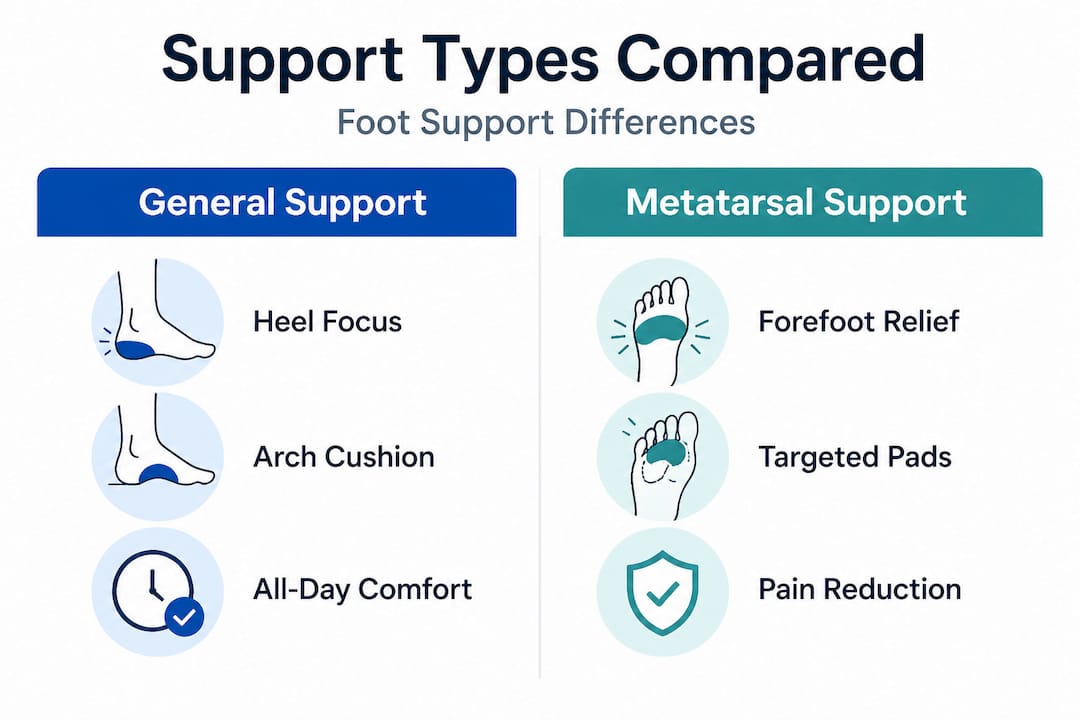
The distinction between general foot support and targeted metatarsal support matters enormously here. A standard cushioned insole softens impact, but it doesn’t lift or redistribute pressure from the forefoot specifically. Metatarsal support is purpose-built for that transverse arch, placing a raised surface just behind the ball of the foot to offload those metatarsal heads.
| Feature | General foot support | Metatarsal support |
|---|---|---|
| Target area | Heel and longitudinal arch | Transverse arch and forefoot |
| Primary benefit | Shock absorption | Forefoot pressure relief |
| Best for | General fatigue | Forefoot pain, numbness, burning |
| Typical form | Full-length insole | Pad, dome, or teardrop insert |
Understanding this difference helps you make a more informed choice about what your feet actually need, rather than reaching for the nearest gel insole and hoping for the best.
Types of metatarsal supports and how they work
Now that you know why the metatarsals matter, the next step is understanding what support options are available. Metatarsal pads are typically dome-shaped or teardrop, made from foam, gel, felt, or silicone, and are used to alleviate pain in conditions like metatarsalgia, Morton’s neuroma, and fat pad atrophy.
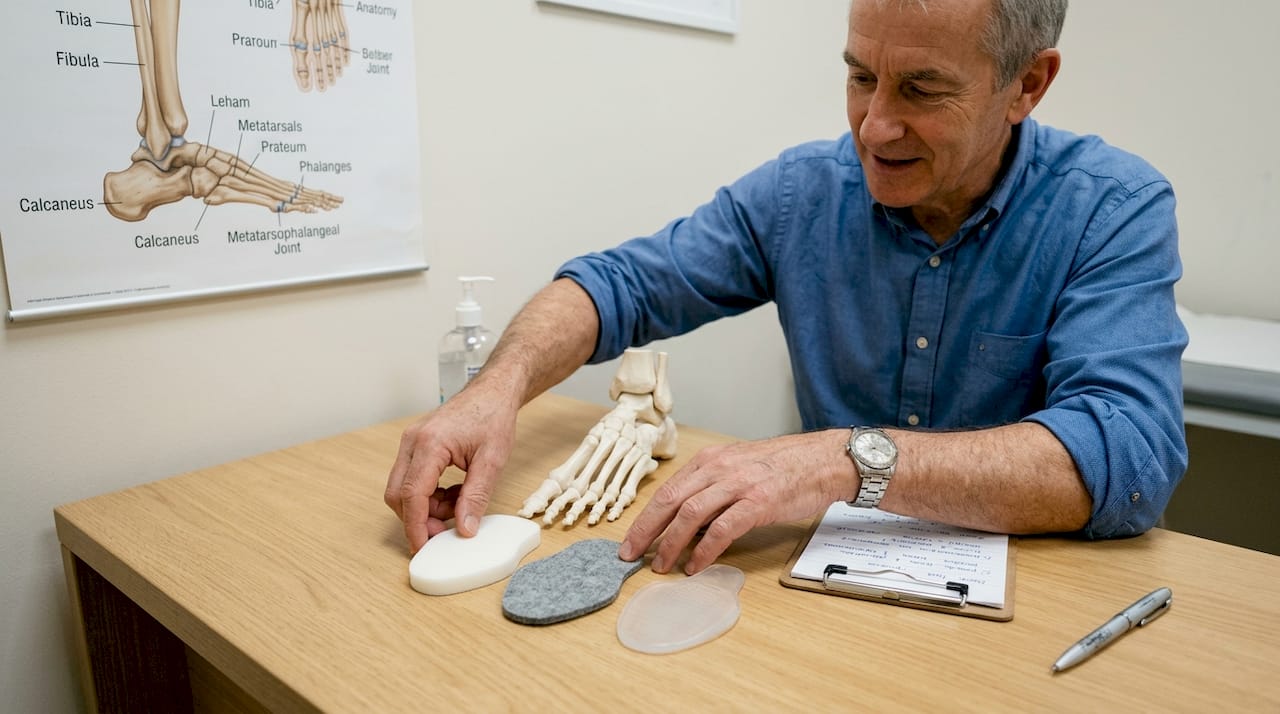
Each material has its own feel and purpose. Foam is lightweight and affordable, making it a practical first option to try. It compresses with use and may need replacing more frequently, but it offers a gentle lift that many people find immediately comfortable. Gel provides a softer, more cushioned feel and is particularly good for those whose feet feel bruised or tender after activity. Gel pads are also washable and reusable, which makes them economical over time.
Felt is firmer and holds its shape well, making it a favourite in clinical settings. It provides reliable, consistent support without compressing too much underfoot. Silicone is flexible and durable, conforming to the foot’s shape with wear. It also tends to grip the skin or insole more effectively, reducing the risk of the pad shifting during the day.
The shape of the pad matters too. Dome-shaped pads create an even lift across all the metatarsal heads, which suits people with general forefoot discomfort. Teardrop pads are narrower and target a specific area more precisely, making them the better choice if your pain centres on one or two metatarsal heads rather than the full width of the forefoot.
Here’s a quick overview of which pad types suit which conditions:
| Condition | Recommended pad type | Why |
|---|---|---|
| Metatarsalgia | Dome or teardrop, foam or felt | Broad offloading of forefoot pressure |
| Morton’s neuroma | Teardrop, silicone or gel | Targets the nerve-affected space |
| Fat pad atrophy | Gel, full metatarsal width | Replaces natural cushioning lost with age |
| General fatigue | Foam or gel dome | Gentle, all-round forefoot support |
Good footwear cushioning and comfort works hand-in-hand with metatarsal pads. A shoe that already incorporates responsive cushioning will amplify the relief that a well-placed pad provides, because you’re addressing pressure from two directions at once. Understanding shoe cushioning technologies can also help you choose a base shoe that won’t work against your support needs.
Pro Tip: Always check whether your shoe has enough depth and width in the toe box before adding a metatarsal pad. Adding a pad inside a narrow or shallow shoe can create new pressure points, particularly across the top of the foot.
Why pad placement matters: avoiding common mistakes
Picking the right pad is only half the challenge. Placement is just as vital to achieving genuine relief. This is where many people go wrong, and it’s the reason they give up on metatarsal pads too quickly, assuming they simply don’t work.
Proper placement is critical: the pad should sit 1-2 cm just behind (proximal to) the metatarsal heads, not under them. Placing the pad directly under the heads increases pain rather than reducing it, because you’re adding pressure to the very area that needs offloading.
Follow these steps to get placement right:
- Remove the insole from your shoe (if it’s removable) and stand on it in your socked foot. Mark the spot where the ball of your foot rests using a washable pen or a small piece of tape.
- Place the pad 1-2 cm behind that mark, towards the heel. This positions the raised part of the pad so it lifts the metatarsal shafts rather than pressing on the heads.
- Replace the insole and try the shoe on. Walk around for a few minutes. The pad should feel like it’s gently lifting the arch of your forefoot, not pressing uncomfortably into the ball.
- Adjust gradually. If the pad feels too prominent, try a thinner version or one made from softer material before repositioning.
- Test during real-world use. Wear the shoe for a portion of your normal daily activity and monitor how your foot feels after an hour, then after three or four hours.
“Placement is everything with metatarsal pads. A pad positioned even a centimetre too far forward can transform a helpful support into an additional source of pain.”
When it comes to buying supportive shoes, the shoe itself must accommodate a pad without becoming too tight. A shoe that fits well without a pad may feel cramped once one is added. This is worth factoring in whenever you are reducing foot pain through footwear choices rather than clinical intervention. The goal of preventing foot fatigue over a full working day depends as much on shoe design as on the insert itself.
Pro Tip: If you’re unsure about placement, use a temporary adhesive like double-sided tape on the first few trials. This lets you reposition without damaging the pad or the insole while you find the sweet spot.
Even small misplacements can be enough to make metatarsal pain worse rather than better. This is not an exaggeration. The metatarsal heads are close together, and an error of just a centimetre or two in pad position shifts weight directly onto the problem area instead of away from it. Take the time to get it right before dismissing the approach entirely.
Who benefits from metatarsal support and when to seek further advice
Understanding whether you’re a good candidate for metatarsal support, and recognising when to move beyond self-treatment, helps prevent prolonged discomfort and potential worsening of the underlying issue.
People who typically benefit the most include:
- Those with diagnosed metatarsalgia, characterised by pain and inflammation in the ball of the foot
- Individuals with Morton’s neuroma, where a thickened nerve between the third and fourth toes causes burning or shooting pain
- People experiencing fat pad atrophy, common in older adults, where the natural cushioning under the metatarsal heads reduces with age
- Anyone who spends long hours on their feet, such as healthcare workers, retail staff, teachers, and hospitality professionals
- Those wearing unsupportive footwear regularly, including dress shoes, thin-soled trainers, and work boots without adequate forefoot cushioning
For many people, an over-the-counter metatarsal pad is sufficient to provide meaningful relief, particularly in early-stage discomfort. The key is to use the right pad, positioned correctly, in a suitable shoe. If you find that shoes for neuropathy and pain are relevant to your situation, it’s worth pairing them with appropriately chosen metatarsal support for layered comfort.
However, there is a clear limit to what self-treatment can achieve. Consult a podiatrist if you experience no relief within 3-4 weeks, as underlying issues like stress fractures or neuromas may require advanced care beyond what pads can offer. Tracking your symptoms honestly during this period is important. Keep a simple note of which activities worsen your pain, whether the discomfort is improving, staying the same, or getting worse, and whether swelling or skin changes are present.
Understanding the foot support benefits of proper footwear can motivate you to make changes sooner rather than later, before minor discomfort develops into a more persistent problem.
Pro Tip: Take photos of your foot position in your shoe and keep a brief symptom diary. When you visit a podiatrist, this information is genuinely valuable and can shorten the time it takes to arrive at an effective treatment plan.
The overlooked impact of metatarsal support in everyday footwear
Here’s what most footwear advice gets wrong: it treats metatarsal discomfort as something you manage with an add-on. A pad here, an insert there. The real issue is that everyday shoes are rarely designed with the transverse arch in mind at all. Most mass-market footwear focuses on heel cushioning and longitudinal arch support, largely ignoring the forefoot dynamics that affect millions of people every single day.
Metatarsal support enhances foot health in daily activities by reducing forefoot stress, and is ideal for those with pain from standing or walking. But correct placement and shoe fit are essential for the best results. This is not a minor caveat. It is the central challenge.
We’ve seen time and again that people wait far too long to address subtle forefoot discomfort. A slight burning sensation after lunch becomes sharp pain by mid-afternoon, and then becomes something they simply expect as part of their day. This acceptance of low-grade pain is one of the most counterproductive habits in foot care. The discomfort is a signal, and early intervention, whether through a well-placed pad or a shoe designed with purpose-built forefoot support, costs far less effort than managing a worsened condition later.
The role of cushioning and foot health is not about softness alone. It is about appropriate support at the right anatomical locations. A shoe that cushions the heel but delivers nothing meaningful to the forefoot is doing half a job. When footwear is engineered with metatarsal considerations built into the sole structure, rather than relying on the wearer to add pads after purchase, the result is noticeably more effective and more consistent throughout the day.
Small changes in footwear, made before pain becomes serious, are among the highest-value decisions you can make for your long-term mobility and daily comfort.
Find the right footwear solutions for enhanced metatarsal support
Relief from forefoot pain does not have to be a complicated process. The most effective starting point is footwear that is designed with your foot’s anatomy in mind, right from the sole up.

At YDA UK, the focus is on high-performance shoes that combine style with genuine foot health technology. The range is built around the principle that everyday footwear should support the whole foot, including the forefoot and transverse arch, not just the heel. Whether you are on your feet all day at work or managing a specific condition like metatarsalgia, there is a solution that fits your lifestyle. Explore the YDA shoe technology to understand how each design element works together to deliver lasting comfort. If you have questions about which style suits your specific needs, the team is available to offer personalised guidance.
Frequently asked questions
How do I know if I need metatarsal support?
If you experience persistent forefoot pain, burning, or numbness during long periods of standing or walking, you likely need metatarsal support targeting the transverse arch of the forefoot. These symptoms point specifically to pressure on the metatarsal heads that general cushioning does not address.
Can I use metatarsal pads in any type of shoe?
Metatarsal pads work best in shoes with enough room in the toe box and a removable insole. Tight or shallow footwear may not accommodate a pad without creating additional pressure points elsewhere in the foot.
How long will it take to feel relief when using metatarsal support?
Most people notice improvement within a week of correct use, but if there is no relief after 3-4 weeks, it is important to consult a podiatrist, as an underlying condition may need clinical attention.
Where exactly should I place a metatarsal pad in my shoe?
Place the pad 1-2 cm behind the ball of your foot (the metatarsal heads) for optimal support. Placing it directly under the heads adds pressure to the wrong spot and is likely to make pain worse.
Are metatarsal supports only for people with diagnosed conditions?
No. Anyone experiencing daily forefoot discomfort, fatigue, or a feeling of excessive pressure in the ball of the foot may benefit from metatarsal support, even without a formal diagnosis or clinical referral.