
Shock absorption in shoes: benefits for comfort and foot health
TL;DR:
- Effective shock absorption in shoes involves precise engineering of the midsole, insole, and outsole.
- Choosing shoes based on lab-tested impact scores and structural support is more reliable than just feel.
- Balance between cushioning, stability, and support is key for foot health and managing foot conditions.
Most people assume that the squishier a shoe feels in the shop, the better it will protect their feet. That assumption is wrong, and it costs many wearers months of discomfort, recurring injuries, and money spent on replacements that never quite deliver. Effective shock absorption in footwear is a precise engineering balance involving the midsole, insole, outsole, and structural geometry working together. Understanding how these systems function, which materials genuinely perform, and how to match them to your specific foot condition will transform the way you choose shoes for life.
Table of Contents
- What shock absorption in shoes really means
- How shock absorption technologies work
- Why shock absorption matters for comfort and foot health
- Choosing the right shock absorption for your needs
- The real secret: balancing absorption, stability, and support
- Find advanced shock-absorbing shoes for your comfort and health
- Frequently asked questions
Key Takeaways
| Point | Details |
|---|---|
| Impact reduction is vital | Good shock absorption in shoes protects joints and muscles by dispersing force at each step. |
| Material and fit matter | Choose midsoles like EVA or PU that suit your activity, weight, and foot needs for comfort and durability. |
| Balance cushioning and support | Too much softness can harm stability; proper foot support is key for long-term comfort and health. |
| Lab scores over ‘feel’ | Actual shock absorption is best judged by lab-tested scores, not just perceived softness. |
What shock absorption in shoes really means
Shock absorption is not simply a measure of how soft a shoe feels underfoot. It is the measurable ability of a shoe’s combined layers to intercept, reduce, and disperse the impact force generated each time your foot strikes the ground. Shock absorption in shoes is the ability of the midsole, insole, and outsole to reduce and disperse impact forces from footstrike, typically up to three times body weight during running, to minimise stress on joints, bones, muscles, and feet.
That figure, three times your body weight with every running stride, is remarkable. For someone weighing 80 kilograms, that is roughly 240 kilograms of force passing through the foot, ankle, knee, and hip dozens of times per minute. Without adequate dispersion, those forces accumulate and lead to stress fractures, joint degeneration, and chronic soft tissue pain.
“The midsole is the unsung hero of any shoe. It is the layer most responsible for determining how much impact your body absorbs and how much the shoe absorbs on your behalf.”
The three structural components each play a distinct role:
- Midsole: The primary shock-absorbing layer, usually made from foam compounds that compress and rebound with each stride.
- Insole: Adds a secondary layer of cushioning and can be customised with orthotics for targeted support.
- Outsole: The ground-contact layer; its hardness and geometry influence how forces are distributed across the foot before they even reach the midsole.
Understanding this layered system matters for shoes and joint health, because choosing based on feel alone misses how these components interact. A shoe may feel plush at first touch but deliver poor energy dispersion during actual movement. Real shock absorption is measured, not felt.
How shock absorption technologies work
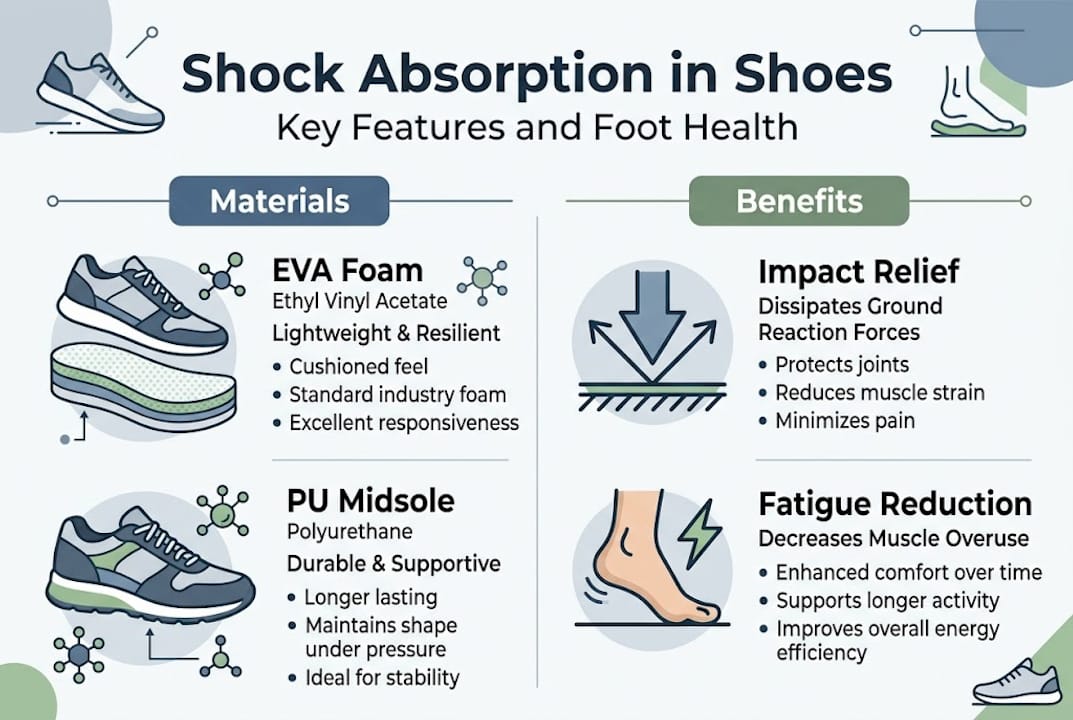
Once you understand the basics, the differences between materials become genuinely fascinating, and they have real consequences for how long your shoes last and how well they protect you. Running shoe midsole foams primarily involve foam midsoles that compress and rebound: EVA is lightweight and affordable but compresses significantly after 400 to 600 miles of use, PU is denser with better compression resistance, and TPU such as Adidas Boost delivers high energy return of 70 to 75 percent and remains resilient across temperature ranges.
Here is a practical comparison of the most common materials:
| Material | Weight | Durability | Energy return | Best for |
|---|---|---|---|---|
| EVA | Light | 400 to 600 miles | Moderate | Budget-conscious, casual wear |
| PU | Heavier | 12 to 18 months heavy use | Good | Long-term durability seekers |
| TPU (e.g. Boost) | Moderate | High | 70 to 75% | Performance and high energy return |
| Supercritical foams | Very light | Variable | Very high | Elite running, premium shoes |
Beyond raw materials, brands use additional structures to enhance absorption. ASICS Gel inserts place a silicone-based compound in the heel and forefoot to disperse impact outward rather than straight down through the foot. Supercritical foams, made by injecting nitrogen or carbon dioxide into foam under extreme pressure, create a lighter and more responsive cellular structure than traditional methods can achieve.
Pro Tip: When comparing shoes, look for brands that publish independent lab-tested shock absorption scores. These figures, measured against standards such as ASTM F1976-13, tell you far more about real-world performance than the thickness of the midsole alone.
The biggest misconception in footwear is that a softer foam always absorbs more impact. Softer materials do reduce the loading rate, which is how quickly force builds up in the body, but they can also increase the peak impact force if they bottom out or provide insufficient rebound. This is why advanced shoe cushioning technology focuses on the rebound characteristics of a foam as much as its initial softness. Durability also matters enormously: EVA degrades faster than PU, meaning the shoe that felt perfect in week one may offer substantially less protection by month six. Keeping track of mileage and replacing shoes proactively is not optional for serious wearers. You can explore how athletic footwear innovations have advanced these trade-offs considerably in recent years.
Why shock absorption matters for comfort and foot health
Technical knowledge is only useful when it connects to real physical outcomes. For those managing specific foot conditions, the right shock absorption characteristics are not a luxury. They are clinically meaningful.
Research shows that footwear for plantar fasciitis reduces heel peak pressure by 15% with a PU outsole and 14mm drop, lowers loading rates by 7 to 29 percent, and improves comfort by 47 to 67 percent. These are not marginal improvements. For someone living with plantar fasciitis, a condition that causes stabbing heel pain particularly during the first steps of the morning, those percentages translate directly into the ability to walk, work, and live without constant pain.
Here are the key footwear features ranked by importance for people managing foot pain:
- Heel drop of 8mm or more: Reduces tension on the plantar fascia and Achilles tendon by shifting load distribution forward.
- Firm heel counter: Prevents the heel from rolling inward or outward, which aggravates inflammation.
- Stable platform: Ensures the foot does not sink unevenly into the midsole, which would destabilise the arch.
- Durometer of 33 AC or higher: Firmness threshold to prevent the midsole from bottoming out under load, which ironically increases pressure rather than reducing it.
- Arch support: Helps distribute metatarsal load across the full plantar surface rather than concentrating it in one area.
| Foot condition | Key cushioning need | Recommended feature |
|---|---|---|
| Plantar fasciitis | Heel pressure reduction | High heel drop, firm midsole |
| Metatarsalgia | Forefoot load dispersion | Rocker sole, cushioned forefoot |
| Arthritis | General joint offloading | Full-length EVA or PU midsole |
| Overpronation | Medial arch stability | Motion control, firm medial post |
You can find more practical guidance in our guide on shoes for plantar fasciitis, which covers heel drop, midsole firmness, and structural support in depth. The article on foot-friendly shoe features also outlines the six structural elements that matter most for everyday comfort and long-term foot health.
What many people do not realise is that shock absorption also affects fatigue. Insufficient impact dispersion forces the muscles of the calf, shin, and hip to do compensatory work with every step, accelerating the onset of muscular tiredness. Proper cushioning literally reduces how hard your body works during daily movement.
Choosing the right shock absorption for your needs
Knowing what to look for is half the challenge. Applying that knowledge to your specific body, activity level, and foot type is where most people still go wrong.
Research on high shock absorption sneakers shows that beginners and heavier runners need more cushioning, but excessive cushioning can be counterproductive. Maximalist shoes may actually increase impact forces by 6 to 12 percent at speed, as the body unconsciously stiffens the leg to compensate for the unstable base. This finding surprises most people because it runs directly against the marketing claims attached to thick-soled shoes.
Here is a practical checklist to guide your selection:
- Assess your body weight: Heavier individuals compress foam faster and need denser, more resilient midsole materials such as PU or TPU.
- Consider your primary activity: Walking exerts different repetitive forces than running or standing for prolonged periods; cushioning needs differ accordingly.
- Know your foot condition: Flat feet, high arches, overpronation, and heel conditions all require different support structures alongside cushioning.
- Check midsole firmness ratings: A durometer reading of 33 AC or above prevents bottoming out under load.
- Prioritise lab scores over feel: A shoe that feels extraordinary in a brief shop trial may perform poorly under real conditions; manufacturer lab data is more reliable.
- Track wear cycles: Replace shoes at the recommended mileage intervals, not when they look worn out.
Pro Tip: If you are managing a chronic foot condition, ask for a shoe’s torsional rigidity rating alongside its cushioning score. A shoe that twists easily across the arch may undermine all the cushioning benefits by allowing abnormal foot mechanics with every step.
Understanding how to evaluate shoe technology properly means looking beyond the marketing language on the box. Terms like “ultra cushion” or “cloud-like comfort” are marketing descriptions, not technical specifications. Equally, the debate between minimalist and cushioned shoes illustrates that there is no single correct answer. Minimalist shoes may strengthen intrinsic foot muscles over time, while cushioned shoes provide immediate protection for those with acute conditions. The best choice is always the one matched to your specific biomechanical needs and health status.
The real secret: balancing absorption, stability, and support
Here is what most footwear guides will not tell you plainly: for the majority of people managing foot conditions or seeking genuine long-term comfort, maximum cushioning is rarely the right answer. The real goal is optimised cushioning paired with structural integrity.
Expert guidance on plantar fasciitis footwear is clear that consumers with foot issues should prioritise torsional rigidity and heel counter stiffness over maximum stack height to maintain gait health long-term. A shoe with an 18mm stack height and excellent torsional rigidity will outperform a 32mm maximalist shoe with a floppy structure every time, particularly for those whose conditions are aggravated by abnormal foot mechanics.
At YDA, we see this played out constantly. Customers who have spent years chasing the softest shoe on the market often arrive with more entrenched discomfort than those who chose moderately cushioned, structurally sound footwear from the start. The foam degrades, the instability worsens, and the body compensates with altered gait that creates new problems upstream in the ankle, knee, and hip.
The concept of stability in footwear deserves far more attention than it typically receives. Lab scores matter more than stack height. Heel counter stiffness matters more than the softness of the first layer you touch in the shop. Torsional rigidity, which is the resistance of a shoe to twisting across its length, is one of the most predictive markers of long-term foot health outcomes. Choose balance over excess, and your feet will thank you for it.
Find advanced shock-absorbing shoes for your comfort and health
If this article has clarified how complex and consequential shock absorption really is, the next step is finding footwear engineered to get that balance right from the ground up.
At YDA, our YDA shock absorption technology is built around precisely this principle: combining clinically informed cushioning with structural support systems that maintain gait health across thousands of steps. Whether you are managing plantar fasciitis, recovering from joint discomfort, or simply demanding more from your everyday footwear, our range of shoes for problem feet is designed to deliver measurable comfort without compromising stability. Explore our technology page to understand the engineering behind every pair.
Frequently asked questions
Does more cushioning always mean better shock absorption?
No, softer cushioning does not guarantee more shock absorption. Softer midsoles may reduce loading rate but can increase peak impact force, and balance with stability is critical for effective impact protection.
What is the most durable shock-absorbing midsole material?
PU (polyurethane) midsoles are generally the most durable, with PU lasting 12 to 18 months under heavy use compared to EVA which typically lasts 6 to 12 months.
Are shoes with high shock absorption suitable for plantar fasciitis?
Yes, provided they have the right heel drop and structural support. Appropriate footwear can reduce heel peak pressure by 15% and improve comfort by 47 to 67 percent for plantar fasciitis sufferers.
How do I know if a shoe’s shock absorption is right for me?
Look for independently lab-tested shock absorption scores and factor in your body weight, gait pattern, and foot condition rather than relying on how the shoe feels briefly in a shop.
Can too much shock absorption be harmful?
Yes. Maximalist shoes can increase impact forces by 6 to 12 percent at speed because the body stiffens the leg to compensate for an unstable base, making excessive cushioning counterproductive in many situations.