
How to Evaluate Shoe Technology for Better Foot Health
Finding shoes that protect your feet while keeping up with style can be a daily challenge for British and other European adults managing foot pain or chronic conditions. Recent studies reveal that nearly 40 percent of adults in the United Kingdom experience ongoing foot discomfort affecting their quality of life. Prioritising comfort and support through the right shoe technology matters more than ever. This guide highlights the most effective steps for choosing footwear that merges clinical foot health benefits with innovative design and day-to-day performance.
Table of Contents
- Step 1: Assess Your Foot Health Needs
- Step 2: Review Shoe Technology Features
- Step 3: Compare Comfort And Support Innovations
- Step 4: Test Fit And Energy Efficiency
- Step 5: Verify Performance And Durability
Quick Summary
| Key Point | Explanation |
|---|---|
| 1. Assess your unique foot health needs | Conduct a thorough self-assessment of your foot condition and consult a specialist for tailored recommendations. |
| 2. Understand shoe technology features | Familiarise yourself with the latest footwear technologies that enhance performance and comfort for your specific biomechanical needs. |
| 3. Try before you buy | Test shoes on various surfaces and during different activities to check for comfort, support, and energy efficiency. |
| 4. Evaluate long-term performance and durability | Monitor shoe performance over time to ensure they consistently meet your biomechanical and activity requirements. |
| 5. Document findings for future reference | Maintain a journal detailing your assessment and experiences to guide future footwear choices and performance evaluations. |
Step 1: Assess your foot health needs
Understanding your unique foot health requirements forms the critical foundation for selecting appropriate shoe technology. Every individual has distinct biomechanical characteristics that significantly influence their footwear needs. Foot health research demonstrates substantial variations in foot shape, skin condition, and mechanical stress patterns across different populations.
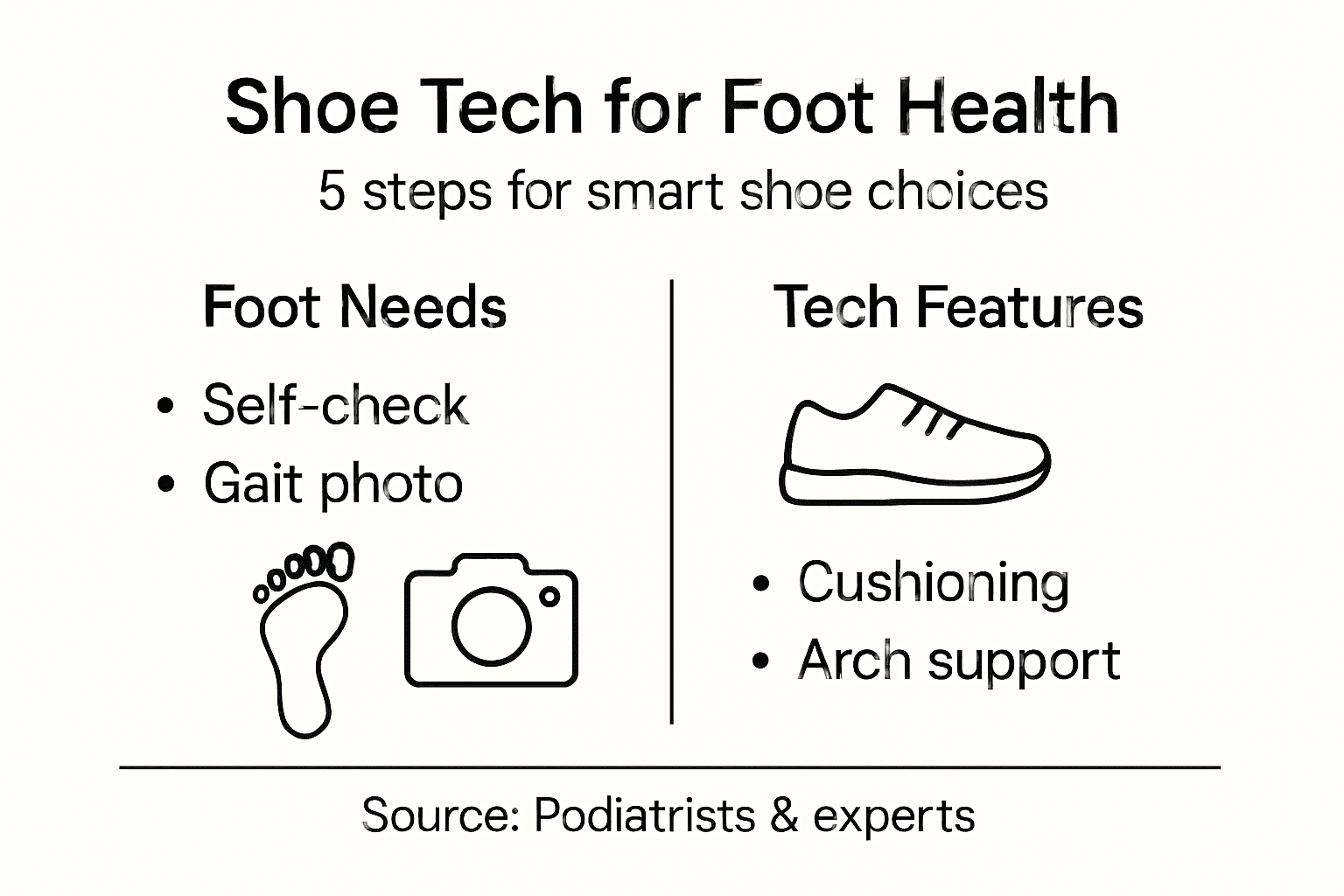
Begin by conducting a comprehensive self assessment focusing on several key areas. First, examine your existing foot condition and medical history. Look for indicators such as persistent pain, previous injuries, arch type, and any diagnosed conditions like diabetes or arthritis that might impact your foot health. Consider consulting a podiatrist or foot health professional who can provide detailed clinical recommendations tailored to your specific needs.
Document your observations systematically. Note down areas of discomfort, pressure points, skin conditions, and any asymmetries between your feet. Pay attention to how different shoe types currently impact your comfort and performance. This detailed personal inventory will serve as your roadmap for selecting footwear technology that genuinely supports your foot health.
Pro tip: Photograph the wear pattern on your current shoes to understand your unique foot mechanics and gait characteristics.
Step 2: Review shoe technology features
Examining shoe technology features requires a systematic approach that goes beyond aesthetic considerations. Advanced footwear technologies represent sophisticated biomechanical solutions designed to enhance performance and comfort. Understanding these intricate design elements will help you make informed decisions about your footwear selection.
Focus on key technological components that directly impact foot health and performance. Modern shoe technologies include innovative materials like resilient foams, carbon fiber plates, pressure sensors, and advanced cushioning systems. Smart shoe technologies now incorporate sensors that analyse gait patterns, monitor foot pressure, and provide real-time biomechanical feedback. Evaluate features such as arch support, heel counter stability, breathability, moisture management, and energy return capabilities. Pay particular attention to how these technologies interact with your specific foot mechanics and address any individual health requirements.
Consider consulting specialised footwear experts or podiatrists who can help interpret these complex technological features in relation to your unique foot structure. Some technologies might seem impressive but may not necessarily suit your specific biomechanical needs. Prioritise technologies that offer targeted support, comfort, and potential injury prevention rather than being swayed by marketing claims.
Pro tip: Request a professional gait analysis to understand precisely which shoe technology features will benefit your individual foot mechanics.
Here is a comparison of modern shoe technologies and their unique advantages:
| Technology Type | Key Benefit | Typical Application |
|---|---|---|
| Resilient foam | Enhanced energy return | Running and performance shoes |
| Carbon fibre plate | Greater propulsion | Racing and high-intensity sports |
| Pressure sensors | Real-time gait analysis | Activity tracking in smart shoes |
| Engineered mesh | Improved breathability | Daily trainers and summer footwear |
| Graphene composite | Exceptional durability | Trail and long-distance shoes |
Step 3: Compare comfort and support innovations
Comparing comfort and support innovations requires a nuanced understanding of how different technological features interact with your unique foot biomechanics. Smart textile advancements have revolutionised footwear design, offering unprecedented customisation and performance potential. This evaluation process demands careful analysis of multiple technological components that contribute to overall foot health and comfort.
Examine key innovative features systematically. Focus on cushioning systems like energy return technologies, which can significantly impact performance and reduce fatigue. Sneaker design innovations now incorporate advanced materials such as engineered mesh, lightweight foams, and strategic support structures like medial posts and heel counters. Assess each technology’s specific contribution to stability, shock absorption, breathability, and overall foot support. Consider how these innovations address potential biomechanical challenges such as arch support, pressure distribution, and movement efficiency.

Prioritise technologies that provide holistic support rather than isolated features. Look for integrated design approaches that balance comfort, performance, and injury prevention. Pay attention to how different materials and structural elements work together to create a comprehensive foot support system. Remember that the most advanced technology is only beneficial if it genuinely matches your individual foot mechanics and specific activity requirements.
Pro tip: Try on shoes with different technological features and walk or run in them to personally assess their comfort and support characteristics.
Step 4: Test fit and energy efficiency
Testing shoe fit and energy efficiency requires a methodical approach that goes beyond superficial assessments. Mechanical power analysis reveals the intricate relationship between footwear design and running performance. Understanding how different shoe characteristics impact your biomechanical efficiency is crucial for selecting the most appropriate footwear.
Evaluate energy return capabilities by conducting practical tests that simulate your typical movement patterns. Energy dissipation research demonstrates that shoe cushioning is complex and not simply about perfect energy rebound. Assess factors such as shoe weight, cushioning responsiveness, and bending stiffness during your trials. Walk or run in potential shoes, paying close attention to how the footwear responds to your specific foot mechanics. Notice subtle differences in comfort, bounce back, and overall energy transfer during movement.
Consider multiple dimensions beyond immediate comfort. Examine how shoes perform during different activities and intensities. Some shoes might feel excellent during walking but perform differently during running or more dynamic movements. Take time to understand how the shoe’s technological features translate into actual performance and comfort for your unique biomechanical needs.
Pro tip: Wear the shoes on different surfaces and during various activities to comprehensively evaluate their energy efficiency and comfort characteristics.
The following table summarises essential steps to systematically test shoe fit and performance:
| Step | What to Do | Why It Matters |
|---|---|---|
| Try on varied surfaces | Walk and run on different floors | Evaluates real-world feel |
| Assess energy responsiveness | Observe bounce and fatigue levels | Reveals efficiency and return |
| Test during various activities | Wear for walking and running | Detects suitability for tasks |
| Monitor over time | Track comfort after several uses | Checks durability effects |
Step 5: Verify performance and durability
Advanced footwear technology demands rigorous performance evaluation beyond initial impressions. Understanding the long-term capabilities of your chosen footwear requires a systematic approach to assessing both immediate performance and sustained durability. Your goal is to determine whether the shoes can consistently meet your biomechanical and activity requirements.
Conduct comprehensive testing across multiple dimensions. Examine how the shoes perform during different activities, intensities, and surface conditions. Pay attention to material resilience, structural integrity, and energy return capabilities. Graphene enhanced materials represent cutting-edge innovations in footwear durability, suggesting that modern shoes can offer extended performance life. Track wear patterns, cushioning responsiveness, and structural stability over multiple uses. Document any changes in comfort, support, and energy transfer to understand how the shoes evolve with repeated use.
Consider the broader context of shoe performance. Evaluate not just immediate comfort but long-term biomechanical support. Some technological features might initially feel impressive but could degrade quickly with regular use. Look for consistent performance across different environments and activity levels. Your assessment should prioritise shoes that maintain their core technological benefits over extended periods.
Pro tip: Maintain a performance journal documenting your shoes’ characteristics and changes over time to develop a comprehensive understanding of their durability.
Discover the Perfect Blend of Foot Health and Cutting-Edge Shoe Technology
Choosing footwear that genuinely supports your unique foot biomechanics can be a challenging journey. The article highlights crucial steps to assess comfort, support, energy efficiency and durability while navigating complex shoe technologies. If you seek shoes that combine advanced cushioning systems, targeted arch support and real-time biomechanical benefits, then exploring specialised options is essential to elevate your foot health and performance.

Take control of your foot health today by browsing the carefully curated selection of innovative footwear at Shoes – YDA UK. Each pair is designed with high-performance materials and technology backed by expert insights from the biomechanical field. You can also visit our Home page – YDA UK to discover the full range including women’s styles at Womens – YDA UK. Experience shoes that bring together style, comfort and cutting-edge technology all in one place. Head to https://ydauk.com now to find your next step towards healthier feet and energised days.
Frequently Asked Questions
How can I assess my foot health needs before selecting shoe technology?
Understanding your foot health needs begins with a thorough self-assessment. Examine your existing foot condition, medical history, and any specific issues like pain or diagnosed conditions; document these observations to guide your footwear selection.
What key features should I look for in modern shoe technology?
Focus on features such as cushioning systems, arch support, and materials used for breathability and durability. Evaluate how these elements align with your unique foot mechanics and comfort needs to make an informed decision.
How do I test the fit of shoes to ensure comfort and support?
To test shoe fit, try them on various surfaces and walk or run to evaluate comfort and energy efficiency. Pay attention to how the shoe responds to your foot mechanics, noting any discomfort or areas of support.
What is the best way to verify the performance and durability of new shoes?
Conduct a series of practical tests during different activities and check for consistency in performance over time. Track any changes in comfort and support throughout repeated use to assess how well the shoes maintain their benefits.
How can I determine if a shoe’s technology suits my specific biomechanical needs?
Consult with specialised footwear experts or podiatrists who can interpret the technological features in relation to your foot structure. Prioritise shoes that offer tailored support and comfort rather than relying solely on marketing claims.