
How cushioning in shoes boosts comfort and performance
TL;DR:
- Proper cushioning reduces impact forces and injury risk during physical activity.
- Modern midsole materials like PEBA and air chambers enhance energy return and durability.
- Matching shoe cushioning to individual biomechanics and activity needs optimizes comfort and performance.
Not all cushioning is created equal. Many active people pick up a shoe, press their thumb into the sole, and decide whether it feels soft enough. But that single-second test misses almost everything that matters. The science behind modern shoe cushioning spans biomechanics, material engineering, and individual anatomy, and the differences between getting it right and getting it wrong show up in your joints, your energy levels, and your long-term foot health. This guide cuts through the noise and gives you a clear, evidence-based look at how cushioning actually works, what the research says about performance and injury, and how to match the right technology to your lifestyle.
Table of Contents
- Why cushioning matters: comfort, impact and performance explained
- How shoe cushioning works: midsole science and technology
- Cushioning, performance, and injury risk: what the evidence shows
- Choosing the right cushioning: matching your needs with technology
- Why cushioning is often misunderstood: the real path to better performance and comfort
- Find your perfect fit: explore cushioning innovations at YDA UK
- Frequently asked questions
Key Takeaways
| Point | Details |
|---|---|
| Cushioning absorbs shock | The right cushioning in shoes protects joints by reducing the impact of every step. |
| Boosts performance | Advanced cushioning improves running efficiency and helps you go further with less effort. |
| Prevents injuries | Properly chosen cushioning significantly lowers the risk of common sports injuries. |
| Choose to fit your needs | The best cushioning depends on your activity, comfort preference, and biomechanical profile. |
Why cushioning matters: comfort, impact and performance explained
Every time your foot strikes the ground, your body absorbs a force equivalent to roughly two to three times your body weight. Over a typical run or a long day on your feet, that adds up fast. Without adequate cushioning, those forces travel directly into your ankles, knees, and hips, compounding over time into discomfort, fatigue, and potentially injury.
“Cushioning in shoes, primarily via midsoles, absorbs impact forces during heel strike, reducing loading rates and peak impacts on joints for heel-toe runners.”
This is the core job of any shoe midsole: act as a buffer between the hard ground and your body. But cushioning goes beyond simple shock absorption. It also influences how energy is transferred through your stride, how stable your foot feels mid-movement, and how fatigued your muscles become after extended activity.
What makes this genuinely interesting is the connection to injury prevention. Perceived cushioning and comfort correlate with lower injury risk in runners, with higher perceived cushioning linked to a measurably reduced hazard ratio for injury. In other words, if a shoe feels well-cushioned to you, that perception itself is a meaningful protective signal.
Modern cushioning innovations have moved well beyond simple foam. Here are the primary functions a quality midsole should deliver:
- Shock absorption: Reduce the peak impact force at heel strike
- Load distribution: Spread force across a wider area of the foot
- Energy return: Convert absorbed energy back into forward momentum
- Stability: Keep the foot aligned through the gait cycle
- Durability: Maintain these properties over thousands of steps
Pro Tip: When testing shoes in-store, walk or jog rather than simply pressing the sole. Real cushioning performance only reveals itself during actual movement, not static compression.
Exploring the world of advanced shoe cushioning reveals just how far material science has progressed in recent years. For anyone spending hours on their feet, understanding this foundation changes how you shop entirely. The relationship between foot health and comfort is direct, measurable, and worth taking seriously.
How shoe cushioning works: midsole science and technology
The midsole is where cushioning lives. Positioned between the outsole (the part touching the ground) and the insole (what your foot rests on), the midsole determines the vast majority of a shoe’s cushioning character. The materials used here have evolved dramatically over the past decade.
Traditional EVA (ethylene-vinyl acetate) foam is still common because it is lightweight and inexpensive. However, its energy return is modest and it compresses permanently over time. Newer materials like PEBA (polyether block amide) foams, used in premium running shoes, are both lighter and more resilient, bouncing back more completely after each compression. Gel units, air chambers, and proprietary foam blends each offer different trade-offs between softness, stability, and longevity.
Scientists now evaluate cushioning quality using a metric called the energy-to-force ratio at what is known as the ‘shoulder point’, which reveals optimal cushioning performance without relying on fixed energy inputs like the traditional ASTM 5J test. This approach gives a more real-world accurate picture of how a midsole actually behaves underfoot.
Here is a comparison of common cushioning materials:
| Material | Energy return | Weight | Durability | Best for |
|---|---|---|---|---|
| Standard EVA foam | Moderate | Light | Moderate | Everyday casual wear |
| PEBA-based foam | High | Very light | High | Performance running |
| Gel units | Low to moderate | Moderate | High | Shock-sensitive areas |
| Air chambers | Moderate to high | Light | Moderate | Lifestyle and training |
| Dual-density foam | Variable | Moderate | High | Stability and support |
When evaluating cushioning, consider these steps in order:
- Identify your primary activity. Running shoes need different cushioning profiles than walking or cross-training shoes.
- Assess your strike pattern. Heel strikers need more rear-foot cushioning; midfoot strikers need balanced coverage.
- Check midsole thickness. Thicker is not automatically better, but it does affect energy dynamics significantly.
- Test for responsiveness. A good midsole rebounds quickly; a poor one feels dead and flat after the first compression.
- Consider weight. Highly cushioned shoes add mass, which affects stride efficiency over long distances.
Understanding shoe cushioning explained at this level gives you a real advantage when comparing models or evaluating whether a shoe is genuinely worth its price.
Cushioning, performance, and injury risk: what the evidence shows
The research on cushioning and real-world outcomes has matured rapidly. A growing body of evidence now connects specific cushioning properties to measurable improvements in both performance and injury rates, challenging several long-held assumptions.
One of the most striking findings involves midsole thickness. Thicker midsoles of 40 to 50mm improve running economy by 2 to 4 percent through better energy storage and return in advanced footwear technology shoes. A 2 to 4 percent efficiency gain is enormous in performance terms: it is the difference between finishing comfortably and hitting the wall.
“The assumption that softer always means better is one of the most persistent myths in footwear. The evidence points clearly to an optimal range, not a simple ‘more is better’ rule.”
On the injury side, technologically advanced shoes with optimal cushioning reduce joint reaction forces and muscle demands compared to both conventional and minimalist footwear. This has real consequences for anyone managing knee pain, plantar fasciitis, or shin splints.
Here is how key shoe categories compare across relevant outcomes:
| Shoe type | Joint load | Energy return | Injury risk | Best suited for |
|---|---|---|---|---|
| Minimalist | High | Low | Higher for beginners | Experienced, adapted runners |
| Conventional | Moderate | Moderate | Average | General fitness, casual use |
| Advanced cushioned | Low | High | Lower | Distance running, daily activity |
| Maximalist | Low to moderate | Variable | Moderate | Recovery, walking, sensitive feet |
Key takeaways from the evidence:
- Cushioning reduces muscle fatigue during prolonged activity
- Optimal cushioning is specific to the individual, not universal
- Injury prevention and cushioning are more tightly linked than most people realise
- Minimalist vs cushioned shoes present genuinely different risk profiles depending on experience level
- Transitioning between shoe types too quickly is a common cause of overuse injuries
For those recovering from injury, a detailed sports injury rehabilitation approach often incorporates footwear changes as a primary intervention, not an afterthought.
Choosing the right cushioning: matching your needs with technology
Knowing the science is one thing. Applying it to your next shoe purchase is another. The right cushioning for you depends on a combination of factors that no single rating or review can fully capture.
Start with your primary activity. A runner logging 50 kilometres per week needs fundamentally different cushioning than someone walking their dog twice a day or standing in a kitchen for eight hours. The loading patterns, duration, and surfaces involved all shift the ideal specification considerably.
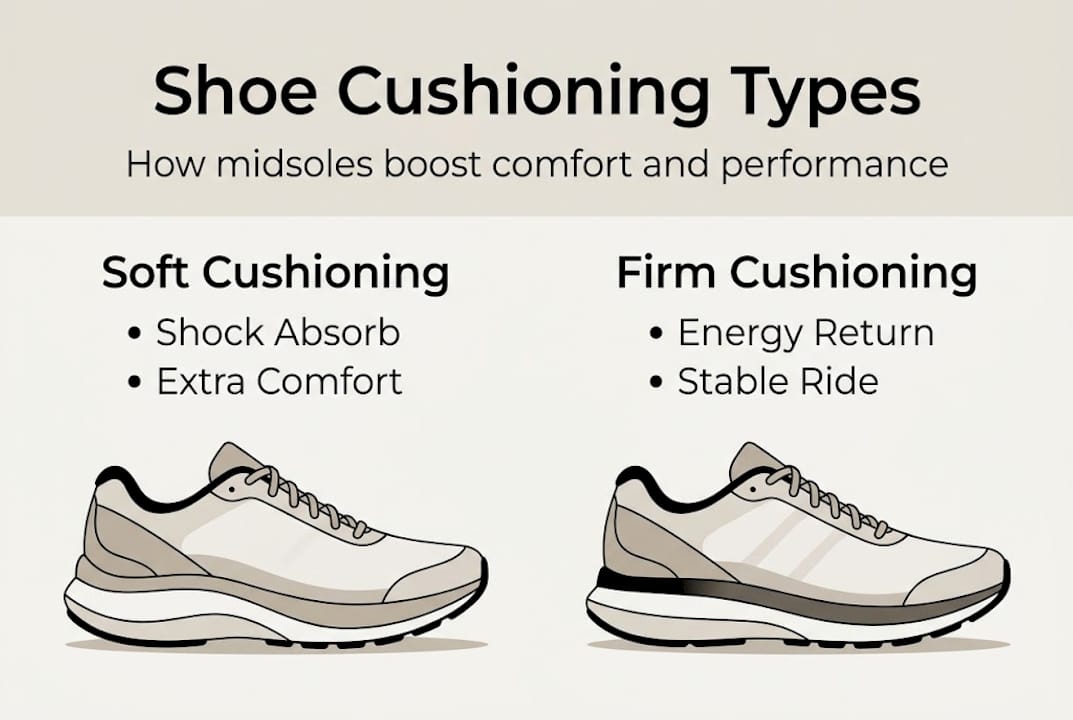
Next, consider your personal biomechanics. High-arched feet tend to benefit from softer, more compliant cushioning to compensate for reduced natural shock absorption. Flatter feet often need firmer, more structured cushioning to prevent overpronation. Neither group is served well by a one-size-fits-all approach.
Pro Tip: Do not ignore the comfort test. Perceived cushioning correlates directly with reduced injury risk in runners, so if a shoe does not feel right immediately, trust that instinct rather than assuming you will break it in.
Use this checklist when evaluating cushioning in-store or online:
- Does the midsole material offer energy return, or just softness?
- Is the heel-to-toe drop appropriate for your strike pattern?
- Does the shoe feel stable under lateral movement, not just forward motion?
- Is the cushioning distributed evenly or concentrated in specific zones?
- How has the cushioning performed after 300 to 500 kilometres in verified reviews?
Exploring footwear innovations for support can help you identify which technologies are genuinely evidence-backed versus marketing language. Understanding how cushioning improves comfort over both short and long periods is equally important when making a choice you will live with every day.
Why cushioning is often misunderstood: the real path to better performance and comfort
Here is an uncomfortable truth: most people, including many fitness enthusiasts, approach shoe cushioning as a simple spectrum from ‘soft’ to ‘firm’ and assume one end is obviously better. The ultra-minimal movement told us barefoot was best. Now the maximalist trend insists thicker is always superior. Both are wrong in their absolutism.
What the evidence actually supports is far more nuanced. The best cushioning for your foot is the one that matches your biomechanics, your activity load, and your personal comfort threshold. There is no universal answer. A carbon-plated shoe with a 45mm midsole might transform one runner’s performance while contributing to another’s knee pain.
At YDA UK, we think the footwear industry does consumers a disservice by chasing trends rather than promoting individual fit. Exploring energy return soles as a concept, for instance, shows how the right technology can work with your natural movement rather than overriding it. The goal is not the thickest or the thinnest midsole. It is the most thoughtfully matched one.
Find your perfect fit: explore cushioning innovations at YDA UK
Understanding how cushioning actually works puts you in a far stronger position to choose footwear that genuinely supports your goals. At YDA UK, every shoe in our range is built around the principle that comfort and performance should never be in conflict.
Our cushioning technology at YDA is designed with real biomechanical research at its foundation, not just aesthetics or trend cycles. Whether you are managing a specific foot condition or simply want to move through your day with less fatigue and more energy, our shoes for problem feet are engineered to meet you where you are. Explore our range and discover cushioning that is built around science, not guesswork.
Frequently asked questions
How does shoe cushioning reduce injury risk?
Shoe cushioning absorbs shock and lowers joint stress, significantly reducing the risk of running-related injuries. Perceived cushioning is directly linked to a lower injury hazard ratio in active runners.
Is softer cushioning always better for running shoes?
No. While soft midsoles can reduce loading rates, optimal performance and support come from a balanced cushioning design. Softer midsoles decrease loading rate but can increase impact peak, so the overall design matters far more than softness alone.
How do thick midsoles impact running economy?
Thicker midsoles in the 40 to 50mm range improve running economy by enhancing energy storage and reducing the effort needed per stride. Midsole thickness improvements translate to a 2 to 4 percent gain in running economy in advanced footwear.
What makes cushioning technology ‘advanced’?
Advanced cushioning uses innovative materials and optimised structures to balance shock absorption, energy return, and support for each foot type. Technologically advanced footwear measurably reduces joint reaction forces and muscle demands compared to conventional designs.