
Energy return soles: boost comfort and support in 2026
TL;DR:
- Energy return soles store and release kinetic energy to improve running efficiency.
- Material choice and shoe design significantly impact energy return and overall comfort.
- Effectiveness varies based on individual biomechanics, activity, and environmental conditions.
Most people assume that a softer shoe automatically means a more comfortable one. It’s a reasonable guess, but it misses something important. Soft foam absorbs impact, yes, but it doesn’t necessarily give anything back. Energy return soles work on a different principle entirely: they’re engineered to absorb the force of each step and release it as propulsive energy during push-off. If you’ve ever felt inexplicably tired after a long walk even in what seemed like plush shoes, this distinction might explain why. This article breaks down how energy return soles work, which materials matter, what the research says, and what you need to know before buying.
Table of Contents
- What is an energy return sole and how does it work?
- Key materials and technologies used in energy return soles
- Evidence-based benefits: what does the research show?
- Nuances and limitations every shoe buyer should know
- A fresh perspective: why energy return isn’t everything in supportive footwear
- Find your perfect energy return fit with YDA shoes
- Frequently asked questions
Key Takeaways
| Point | Details |
|---|---|
| Energy return mechanics | These soles absorb and release energy as you move to make walking and running more efficient. |
| Material matters | The type of midsole foam or plate heavily impacts comfort and energy return. |
| Benefits vary by user | Not everyone benefits equally, so testing fit and support is crucial. |
| Check for practical fit | The best shoe balances support, comfort, and energy return for your individual needs. |
What is an energy return sole and how does it work?
An energy return sole isn’t just a marketing phrase for “bouncy foam.” It’s a functional technology built around a specific mechanical goal: capturing kinetic energy as your foot strikes the ground and redirecting it to assist your next step. Think of it like a compressed spring. When you land, the midsole compresses and stores energy. When you push off, it rebounds and releases that energy forward.
This process is measured as a percentage. If a foam absorbs 100 joules of energy on impact and returns 75 joules during push-off, it has a 75% energy return rate. That number matters because energy return sole technology absorbs energy during impact and returns it during push-off, enhancing propulsion and efficiency. Even a few percentage points of difference between foam types can shift how fatigued your legs feel after several hours on your feet.
For daily wearers, particularly those dealing with foot fatigue or joint discomfort, understanding the dual density sole benefits and how shoes impact energy expenditure helps clarify why not all “comfortable” shoes feel the same after a full day.
Here’s a simplified breakdown of what makes up an energy return system:
- Midsole foam: The primary energy-storing layer, where most of the return happens
- Carbon fibre plate (in performance models): Acts as a lever to enhance rebound timing
- Outsole rubber: Affects grip and ground contact time, which influences how efficiently energy transfers
- Stack height: The total thickness of material between your foot and the ground
Supershoes built around high-performance foams often achieve over 70% forefoot energy return, compared to around 56–64% in standard daily trainers.
| Shoe type | Typical energy return (%) |
|---|---|
| Supershoes (race day) | 70–85% |
| Performance trainers | 64–70% |
| Standard daily trainers | 56–64% |
| Budget cushioning foam | Below 55% |
For everyday wearers, the goal isn’t to chase race-day numbers. It’s to find the sweet spot where your shoe is doing some of the work so your legs don’t have to.
Key materials and technologies used in energy return soles
Understanding the basic mechanism is only the beginning; the actual materials used in soles make all the difference to performance and comfort.
Popular midsole materials like PEBA, Boost, ReactX, and A-TPU offer different energy return rates, with PEBA (used in Nike ZoomX) topping approximately 85% energy return. Each material has trade-offs between responsiveness, durability, weight, and cost.

For those interested in advanced shoe cushioning technologies and understanding outsole technology, here’s how the main materials compare:
| Material | Brand example | Energy return (%) | Feel | Best for |
|---|---|---|---|---|
| PEBA (ZoomX) | Nike | ~85% | Plush, springy | Racing, fast pacing |
| Boost (TPU bead) | Adidas | ~65–70% | Cushioned, smooth | Daily training |
| ReactX | Nike | ~60–65% | Firm, responsive | Everyday wear |
| Lightstrike Pro | Adidas | ~70–75% | Light, bouncy | Racing, tempo |
| EVA | Various | ~50–55% | Firm, durable | Budget, casual |
| A-TPU | Various | ~68–72% | Resilient | Long-distance training |
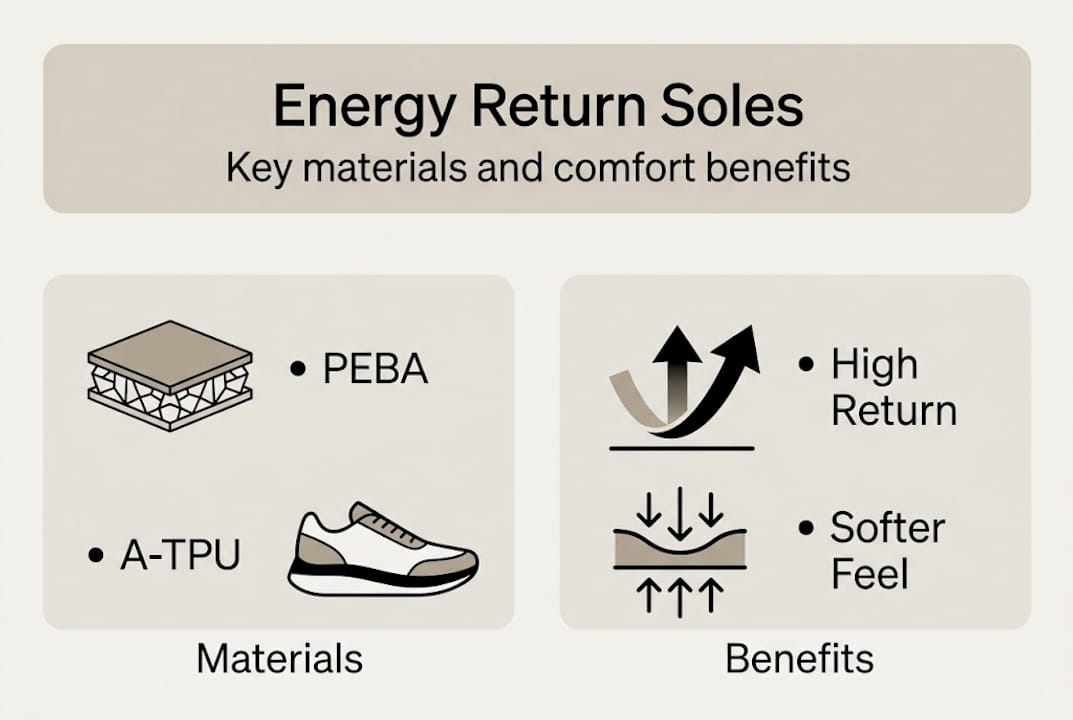
PEBA leads in raw return figures but can feel unstable for those with wider feet or pronation issues. EVA, while lower in return percentage, remains durable and consistent across temperature ranges, which matters for everyday wearers in the UK’s variable climate.
Other design features that affect overall energy return include:
- Stack height: Higher stacks can increase cushioning but sometimes reduce ground feel
- Carbon or nylon plate: Controls how energy is directed during toe-off
- Outsole geometry: Rocker shapes and lugs affect contact time
- Shoe weight: Heavier shoes offset energy return gains, so lighter builds tend to perform better
Pro Tip: If you’re managing a specific foot condition such as plantar fasciitis or overpronation, don’t select a shoe based solely on energy return figures. A biomechanical assessment combined with a supportive fit can deliver far better day-to-day comfort than a raw performance spec.
Evidence-based benefits: what does the research show?
With an understanding of materials, it’s vital to consider the proven benefits and who truly gains the most from this technology.
The science here is genuinely impressive. Lab studies show energy return soles can improve running economy by 2 to 5% and reduce calf soreness by 19% during training. For context, a 2% improvement in running economy can translate to roughly 2.2 minutes off a marathon time. That’s meaningful even for recreational runners.
For benchmarking, supershoes with >70–80% forefoot energy return show noticeable performance gains, while standard trainers in the 56–64% range offer moderate benefits.
Who benefits most from energy return soles?
- Competitive and recreational athletes: The efficiency gains are most measurable at faster paces where push-off force is greater
- People with foot fatigue: Reduced muscular effort per stride means less cumulative stress over a full day
- Health-conscious walkers: Those covering significant ground daily experience less leg fatigue with high-ER soles
- Individuals recovering from lower limb injuries: Reduced muscular demand during gait can support rehabilitation
For those selecting shoes for energy and seeking an energy efficient footwear guide, one caveat is worth noting: the gains from high-ER soles diminish at slower walking speeds and when gait mechanics don’t naturally load the forefoot. If you walk with a heavy heel strike and low cadence, the bounce-back happens at the wrong point in your stride cycle, and some of those efficiency gains simply don’t materialise.
The takeaway isn’t that energy return soles are overhyped. It’s that matching the technology to your actual movement pattern is what unlocks the benefit.
Nuances and limitations every shoe buyer should know
But before you buy the highest-rated energy return shoes, it’s important to consider practical nuances and possible pitfalls.
High energy return figures look compelling on a spec sheet. Real-world performance is more complicated. Not all high-ER shoes deliver better efficiency, as weight, plate stiffness, and even weather conditions impact perceived benefits.
Here are the most important real-world limitations to understand:
- Shoe weight: A 200g shoe with 75% ER can outperform a 280g shoe with 80% ER because carrying extra weight costs more energy than the foam returns
- Temperature sensitivity: Most foams, especially PEBA-based ones, become stiffer in cold weather, reducing the energy return rate noticeably
- Gender biomechanics: Differences in Q-angle and pronation patterns mean women and men often experience the same shoe very differently
- Individual variance: Response to high-ER soles ranges from a 9% detriment to a +9.7% benefit depending on personal biomechanics
- Carbon plate adaptation risk: Relying exclusively on carbon plate shoes can cause smaller stabilising muscles to weaken over time
It’s also worth considering the interplay between components. A highly responsive midsole paired with a rigid outsole that doesn’t flex at the right point in the gait cycle can neutralise much of the expected benefit. The entire athletic footwear system has to work together.
Pro Tip: Rotate between two or three different shoe types, including at least one with lower energy return but higher stability. This approach trains a broader range of foot muscles while still letting you benefit from high-ER shoes on longer walks or runs.
A fresh perspective: why energy return isn’t everything in supportive footwear
There’s a temptation, especially when reading performance data, to assume that the highest number wins. In footwear, that thinking can actually lead you away from the right shoe.
For those with plantar fasciitis, bunions, or general foot pain, the priority isn’t energy return. It’s stability, arch support, and controlled motion. A shoe that returns 80% of energy but allows excessive pronation can make foot pain significantly worse over time. The impressive figure becomes irrelevant when the shoe doesn’t suit your foot’s actual needs.
We’ve seen users at YDAUK switch from high-spec performance shoes back to well-fitted, supportive models and report dramatically less daily pain. Their stride efficiency didn’t suffer; in fact, pain-free movement tends to produce more natural, efficient gait patterns anyway.
Reading about cushioning and foot health reinforces this: cushioning strategy, fit, and biomechanical support consistently matter more than raw energy return for people with foot conditions. Chasing percentages without accounting for your unique foot shape and gait is like buying the fastest car for a road full of speed bumps. The specs look great on paper, but they don’t match your reality.
Test, rotate, and prioritise comfort over figures.
Find your perfect energy return fit with YDA shoes
Ready to experience the benefits yourself? Here’s where to explore the latest in energy return sole technology tailored for healthier steps.
At YDA, we’ve built our footwear around the understanding that energy return only matters when it’s paired with the right support, fit, and ergonomic design. Our advanced foam technology and purpose-engineered sole construction are designed to work for everyday wearers, not just athletes on race day.
Whether you’re on your feet all day at work, managing a foot condition, or simply tired of shoes that leave you exhausted by evening, you can explore the YDA shoe technology behind our approach or browse our range of shoes for problem feet designed to support your specific needs. Comfort that’s built on science, not just softness.
Frequently asked questions
Does a higher energy return percentage always mean a more comfortable shoe?
Not always. Comfort also depends on fit, support, and your unique stride, as individual response to high energy return varies from a 9.6% detriment to a +9.7% benefit depending on biomechanics.
Are energy return soles only useful for athletes?
No. Everyday walkers and those with foot fatigue benefit too, particularly with proper fit, since high ER with shock absorption reduces leg fatigue across a range of activities.
How do I know if energy return soles are right for me?
Test different models in-store or over a short trial period, since individual response varies significantly and no single spec predicts what will feel best for your gait and use case.
Do colder temperatures affect energy return in shoes?
Yes. Cold weather lowers the energy return rate of most midsole foams, particularly PEBA-based materials which are most sensitive to temperature fluctuation.