
Why upgrade athletic shoes: performance, comfort, health
TL;DR:
- Worn athletic shoes can silently increase injury risk and impair performance.
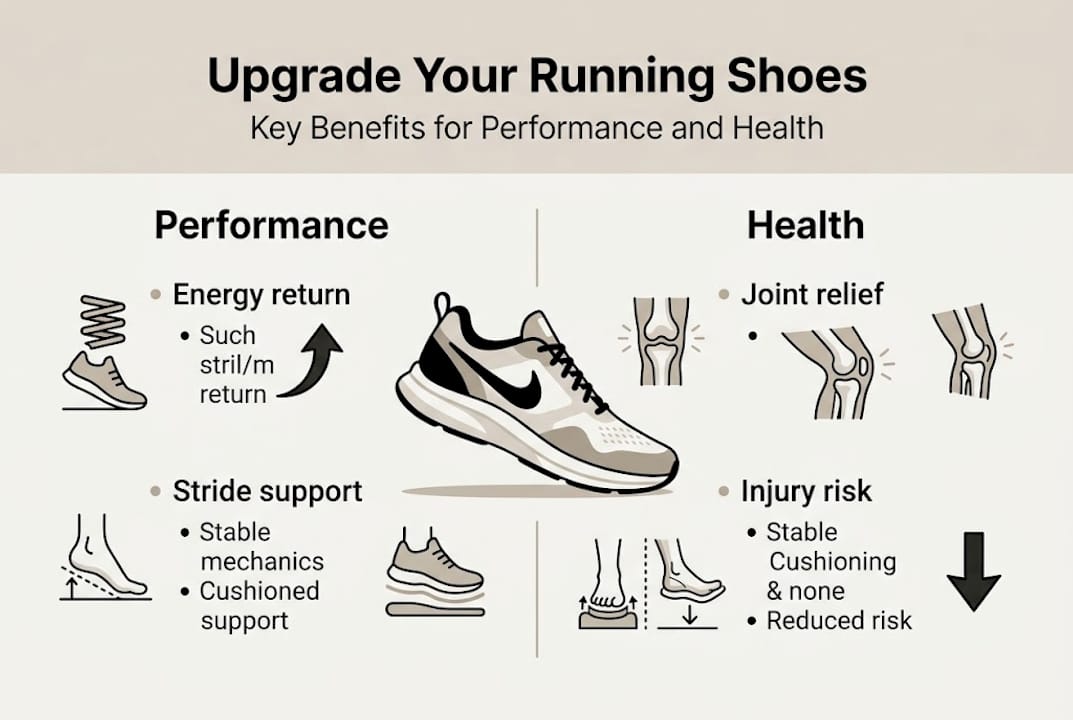
- Modern shoe technology offers better energy return, comfort, and injury prevention benefits.
- Monitoring shoe condition and body feedback is essential for optimal foot health and athletic performance.
Most athletes would never knowingly train with faulty equipment, yet millions lace up shoes that have quietly stopped doing their job. The cushioning compresses, the midsole breaks down, and the shoe still looks fine from the outside. That invisibility is the problem. Worn trainers can be silently adding stress to your knees, altering how you run, and robbing you of energy return with every stride. This guide covers the physiological risks of outdated footwear, the genuine performance gains that modern shoe technology delivers, and the practical steps you can take to protect your joints and sharpen your movement.
Table of Contents
- The impact of worn athletic shoes on your body
- How shoe technology upgrades enhance performance and comfort
- Upgrading shoes for injury prevention: fact or fiction?
- Practical essentials: when and how to upgrade your athletic shoes
- A fresh perspective on upgrading: beyond the mileage myth
- Move with confidence: invest in better foot health
- Frequently asked questions
Key Takeaways
| Point | Details |
|---|---|
| Hidden risks | Worn shoes can lead to joint stress, muscle fatigue, and increased injury risk even before they look visibly damaged. |
| Performance benefits | Upgraded athletic shoes offer better energy return, comfort, and support, directly boosting your efficiency. |
| Individual timing | Don’t wait for an app reminder—replace shoes when your body signals pain, changed comfort, or declining performance. |
| Smart upgrades | Choose footwear based on your activity, biomechanics, and purpose for longer-lasting, healthier results. |
The impact of worn athletic shoes on your body
Having revealed why outward appearance is misleading, let’s examine what happens inside your shoes and body when they’re past their prime.
The midsole is the engine room of any athletic shoe. It absorbs impact, redistributes force, and returns energy with each footstrike. Once that foam degrades, the entire system fails quietly. You might notice nothing for weeks, then suddenly find yourself nursing shin splints or a nagging knee that wasn’t there before. The connection is not coincidental.
Worn athletic shoes lose cushioning and shock absorption, leading to increased impact forces on joints of two to four times body weight per step, raising the risk of shin splints, knee pain, IT band syndrome, and Achilles tendinopathy. Those numbers matter because the damage is cumulative. Every run in degraded footwear adds micro-stress that your body absorbs until something gives.
Understanding shoes and joint health is key to appreciating why the midsole matters so much. Joint cartilage does not have a generous blood supply. It relies on mechanical loading within a safe range. Tip that balance with worn-out foam and you accelerate wear in tissue that is already slow to recover.
Here is a snapshot of what declining cushioning actually means in practice:
| Shoe condition | Estimated energy absorption | Injury risk level |
|---|---|---|
| New (0–100 miles) | Optimal | Low |
| Moderate wear (100–300 miles) | Slightly reduced | Moderate |
| Worn (300–500+ miles) | Significantly reduced | High |
Common physical consequences of running in worn shoes include:
- Shin splints from elevated tibial stress
- Knee pain and patellofemoral pressure
- IT band syndrome due to altered leg mechanics
- Achilles tendinopathy from inadequate heel support
- Generalised muscle fatigue caused by compensatory movement patterns
“The damage from worn shoes is not always felt immediately. It accumulates beneath the surface, reshaping how you move long before pain appears.”
Effective sports injury rehab consistently highlights footwear as a primary variable in both injury onset and recovery. Ignoring your shoes is one of the easiest avoidable errors in athletic training.
How shoe technology upgrades enhance performance and comfort
Understanding the risks of worn shoes sets up the next question: what do today’s upgrades actually offer you?
Modern athletic footwear is a different category of product compared to what was available even five years ago. The materials, geometry, and sole construction have shifted considerably, and the gains are measurable, not just marketed.
Degraded midsoles reduce energy return, causing lower running efficiency, a sluggish feel, and harder efforts at the same paces. Flip that around: a fresh, well-matched shoe actively returns energy to your stride rather than absorbing it passively.

Performance foams such as PEBA (polyether block amide) and similar superfoams used in advanced shoes offer significantly higher energy return than traditional EVA foam. They also compress and rebound faster, meaning less of your muscular effort is wasted between footstrikes. Paired with a curved or rockered plate, these materials improve propulsion at toe-off, which directly benefits running economy. This matters both on race day and on your long Sunday run when fatigue accumulates.
Exploring footwear innovations for performance reveals just how rapidly this space has evolved, with purpose-built constructions for road, track, and trail environments each targeting specific biomechanical demands.
| Feature | Worn shoe | Modern upgraded shoe |
|---|---|---|
| Energy return | Poor | High (PEBA/superfoam) |
| Cushioning consistency | Degraded | Stable across mileage |
| Propulsion support | Minimal | Plate-assisted |
| Injury risk indicators | Elevated | Reduced |
| Comfort over long distances | Declining | Maintained |
Advanced shoe cushioning technologies also benefit shorter distances. Sprint and interval sessions place intense, repeated loads on the foot. Shoes engineered for those forces reduce muscular strain and let you recover faster between sessions, which compounds over a training cycle.
For a deeper understanding of how these systems work mechanically, shoe cushioning explained breaks down the science behind how different foams behave under load, which is worth reading before your next purchase.
Pro Tip: Match your shoe technology to your primary sport and your foot’s biomechanics. A high-stack road shoe used for trail running wears at a different rate and offers different protection than one designed for that terrain. Specificity pays off.
Key upgrade benefits at a glance:
- Improved running economy through energy return
- Reduced muscle fatigue on long efforts
- More consistent cushioning across varied surfaces
- Better steps for joint health across high-mileage weeks
Upgrading shoes for injury prevention: fact or fiction?
While advanced shoe technology promises many benefits, the link with injury risk is often debated. Let’s clarify the current evidence.
The relationship between footwear and injury is genuinely complex. Shoes are one variable among many: training load, surface, biomechanics, strength, and sleep all contribute. So the question is not whether upgrading shoes prevents all injuries, but whether degraded shoes meaningfully increase risk. The evidence leans clearly in one direction.
Biomechanical changes from worn shoes include altered gait, including longer stance phase, less forward lean, and reduced ankle flexion, as well as increased heel pressure and potential kinetic asymmetry across the two legs. Some athletes adapt to these changes without incident. Many do not.
Considering footwear and injury prevention as a long-term strategy rather than a single purchase decision is the more useful frame. You are not buying protection from one specific injury. You are managing the accumulated mechanical load on your joints over months and years.
Key considerations when evaluating your injury risk:
- Check your stance pattern: Asymmetric wear on the outsole often signals uneven loading between legs.
- Monitor new discomfort: Pain that starts during a training block, particularly around the shin, knee, or heel, often corresponds with shoe degradation.
- Assess your ankle position at foot strike: Reduced ankle flexion is a subtle but meaningful warning sign of midsole breakdown.
- Track your mileage honestly: Many runners underestimate usage, especially across multiple activities.
“Not every worn shoe guarantees injury, but the risk climbs significantly once cushioning and structural support have declined beyond a functional threshold.”
Statistically, the difference is not trivial. Technology-advanced running shoes (TARS) reduce soleus muscle force by 1.10 body weight and peroneus force by 0.43 body weight compared to standard shoes. That kind of reduction in muscle load over thousands of steps adds up across a training week. Options for joint pain recovery become relevant only after injury takes hold. Prevention through proper footwear is simpler and far less disruptive.
For runners with specific gait patterns, motion control shoes offer additional structural guidance that standard shoes do not provide, which makes upgrading to the right category, not just a newer version of the same shoe, a meaningful decision.
Practical essentials: when and how to upgrade your athletic shoes
With the stakes and debates in mind, how do you make the right call on upgrading and maintaining your shoes?
No single mileage number applies to every athlete. A body feedback approach is more reliable than any app, since modern foams improve durability but require purpose-specific use to avoid rapid wear. That nuance matters because a daily trainer and a race shoe age at completely different rates.
Upgrading to advanced shoes with resilient foams and plates reduces joint reaction forces and muscle loads while improving running economy. Rotating pairs extends the life of each shoe and reduces repetitive stress on the same tissues every session.
Here is a practical step-by-step monitoring process:
- Log your mileage: 300 to 500 miles is a useful range. High-mileage runners, heavier athletes, and those training on hard surfaces should lean towards the lower end.
- Press the midsole: If the foam feels stiff and does not spring back, it has lost functional compression.
- Check the outsole: Worn-through rubber or significantly uneven tread indicates structural compromise.
- Flex the shoe: A shoe that bends too easily at the midfoot has lost torsional rigidity.
- Listen to your body: New soreness in the shin, knee, or foot during or after training is a reliable signal that your shoes are no longer absorbing load effectively.
Shoe rotation and injury reduction go hand in hand. Foam needs 24 to 48 hours to fully rebound after a run. Using the same pair daily compresses its lifespan and never gives the material time to recover its structure.
Pro Tip: Rotate your shoes by function: one pair for daily training runs, one for speed sessions or races, and one for trail or cross-training. This approach spreads mechanical wear, preserves the integrity of each shoe, and helps you evaluate shoe technology for different contexts before committing to a full replacement cycle.
A fresh perspective on upgrading: beyond the mileage myth
The athletic footwear industry talks a great deal about mileage thresholds. 300 miles. 500 miles. Track your runs, get an alert, buy new shoes. It is a tidy narrative that suits both apps and marketing departments.
But the reality is messier and more interesting. A heavier runner covering hilly terrain in the same shoe as a lighter runner on flat roads will degrade that midsole in a fraction of the time. Someone doing frequent speedwork puts far more compressive force through the foam per session than someone running easy. The mileage number is a starting point, not a verdict.
What matters more is the relationship you build with how your shoes feel over time. The science of shoe cushioning makes clear that foam response is dynamic and degrades non-linearly. You will not feel a steady, gradual decline. You will feel fine, then suddenly notice you are working harder for the same effort.
Trust that signal. It is your most accurate upgrade indicator, sharper than any mileage counter. Planned rotation combined with honest body feedback is a more sophisticated and more personalised approach than any algorithm. Upgrading is not about following a rule. It is about restoring the energy return, comfort, and structural support that your performance depends on.
Move with confidence: invest in better foot health
If the evidence above has prompted you to reassess what is on your feet, that instinct is worth following through on. The right shoe is not a luxury. It is foundational equipment for every session you put in.

At YDA UK, the focus is on footwear built around the science of foot health, combining energy-efficient materials with designs that support how the foot naturally moves. Whether you are managing existing discomfort or simply want to move better and recover faster, the technology behind YDA shoes is worth understanding before your next upgrade. Take the next step towards footwear that genuinely works for your body, not against it.
Frequently asked questions
How often should you upgrade athletic shoes?
Most athletes need to upgrade after 300 to 500 miles or when cushioning, comfort, or support noticeably diminishes, whichever comes first. Body feedback is often more reliable than mileage alone.
Can worn athletic shoes really cause injuries?
Yes. Worn shoes alter gait, increase heel pressure, and raise impact forces on joints, though individual responses vary depending on biomechanics and training load.
What are the signs your athletic shoes need replacing?
Look for heel collapse, uneven tread, foam that does not spring back, or new aches during and after training. A body-first approach is more accurate than mileage tracking alone.
Do more expensive shoes last longer or protect you better?
Higher-end shoes with advanced energy-return materials can offer better durability and comfort, but fit, foot type, and purpose matter more than price when choosing your next pair.
Recommended
- Top athletic footwear innovations for performance and foot health – YDA UK
- How to Evaluate Shoe Technology for Better Foot Health – YDA UK
- Selecting Shoes for Energy: Achieve Comfort and Performance – YDA UK
- 7 Essential Features of Performance Shoes for Foot Health – YDA UK
- Sports injury prevention guide: proven steps for joint health