
Improve foot health: what gait analysis reveals
TL;DR:
- Gait analysis turns movement patterns into measurable data, revealing hidden inefficiencies affecting foot health.
- Identifying overload zones and movement deviations allows targeted interventions with footwear or exercises to improve comfort.
Most people blame uncomfortable shoes the moment their feet start aching. The fit feels wrong, the sole too thin, or the toe box too narrow. Yet the real culprit is often invisible. The way you move, your gait, shapes how load travels through your feet with every single step. Gait analysis brings those hidden movement patterns into sharp focus, revealing inefficiencies that no tape measure or shoe fitting can uncover. This guide explains exactly how gait analysis works, which metrics matter most, and how you can translate those findings into shoes and habits that genuinely improve how your feet feel every day.
Table of Contents
- What gait analysis really means
- How gait analysis works in practice
- Key metrics: what experts look for
- Comparing gait analysis methods
- From gait analysis to healthier feet
- What most guides miss about gait analysis and real foot health
- Explore advanced footwear solutions informed by gait analysis
- Frequently asked questions
Key Takeaways
| Point | Details |
|---|---|
| Gait analysis shows hidden patterns | By measuring how you walk, gait analysis uncovers causes of foot discomfort not visible with the naked eye. |
| Metrics inform better shoe choices | Loading and pressure data help tailor footwear so it redistributes pressure and boosts comfort. |
| Compare methods for best results | Different gait analysis approaches suit different needs—combine observation and instrumented tools for clarity. |
| Results guide practical actions | Use gait findings as a feedback loop: observe, intervene with footwear or rehab, and re-test for improvement. |
| Simple changes make big impacts | Often, the least-invasive intervention such as footwear adjustment yields measurable improvements in foot health. |
What gait analysis really means
Gait analysis is a more precise discipline than the name suggests. It is not simply watching someone walk across a room and guessing what looks off. According to clinical guidelines, gait analysis is the systematic study of human locomotion to quantify movement patterns and biomechanics, using observation and instruments to identify abnormalities or inefficiencies that may not be visible to the unaided eye. That word “quantify” is important. Gait analysis turns movement into measurable data, which means decisions about footwear or treatment become evidence-based rather than guesswork.
“Gait analysis transforms the subjective experience of foot discomfort into objective, measurable data that clinicians and individuals can act upon with confidence.”
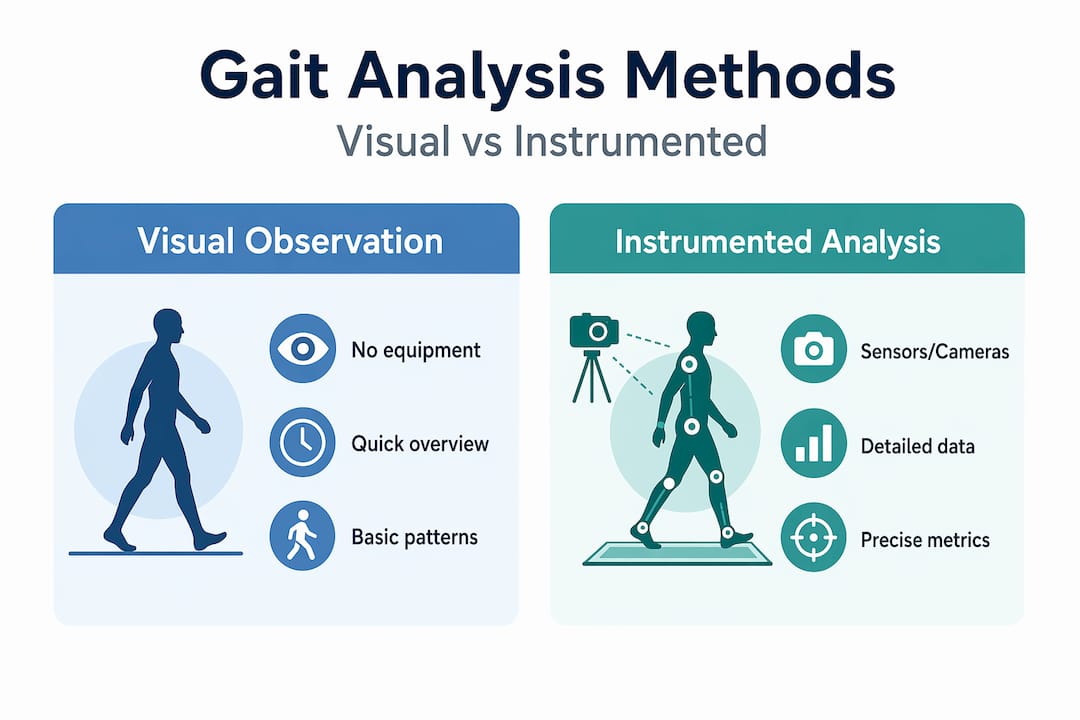
Practitioners combine direct observation with instrumented tools. Visual assessment captures broad patterns, posture, and obvious asymmetries. Instrumented tools such as force plates, motion capture cameras, and pressure mapping systems gather granular data that the human eye simply cannot detect.
Common gait metrics at a glance
| Metric | What it measures | Why it matters |
|---|---|---|
| Cadence | Steps per minute | Reveals walking efficiency and fatigue risk |
| Stride length | Distance of one full gait cycle | Highlights propulsion and mobility limits |
| Stance phase | Percentage of cycle spent in contact with ground | Shows loading duration and balance |
| Swing phase | Percentage of cycle spent in the air | Indicates clearance and muscle control |
| Pressure distribution | Force across foot regions | Pinpoints overload zones linked to pain |
Understanding plantar pressure insights is particularly valuable, because pressure maps show exactly which zones of the foot bear excessive load during walking, information that translates directly into smarter footwear choices.
What gait analysis can reveal includes:
- Hidden overloads at the forefoot, heel, or lateral border
- Compensatory movements caused by weakness or reduced joint range of motion
- Asymmetries between left and right foot mechanics
- Timing mismatches in the stance and swing phases
- Pressure hotspots that predict blistering, ulceration, or joint stress
How gait analysis works in practice
Once you understand what gait analysis measures, the process itself becomes clearer. Clinical gait analysis follows an observation-first process: the practitioner observes from multiple viewpoints, identifies deviations from a normal symmetrical pattern, then determines probable causes before choosing corrective actions. This sequence matters enormously. Jumping straight to a solution without identifying the cause is a common mistake, and it is precisely why some people cycle through multiple shoe types without ever finding relief.
The clinical process, step by step
- Observe the patient walking from the front, back, and side to capture the full picture of movement.
- Identify deviations from a symmetrical, efficient gait pattern, noting timing, angles, and asymmetries.
- Determine probable causes by cross-referencing observations with clinical examination findings such as joint range of motion, muscle strength, and medical history.
- Select interventions starting with the least invasive option, typically changes in footwear, insoles, or targeted strengthening.
- Re-test to confirm that the chosen intervention actually changed the gait pattern in the intended direction.
Visual observation vs instrumented analysis
| Feature | Visual observation | Instrumented analysis |
|---|---|---|
| Equipment needed | None | Force plates, cameras, pressure mats |
| Data type | Qualitative | Quantitative |
| Best for | Broad pattern recognition | Precise metric capture |
| Cost | Low | Moderate to high |
| Accessibility | Any clinical setting | Specialist labs or advanced clinics |
| Limitation | Misses subtle asymmetries | Requires calibration and expertise |
Many gait deviations arise from causes that have nothing to do with shoe fit. Reduced ankle range of motion, hip abductor weakness, neurological conditions, and foot deformities all generate distinctive walking patterns. Testing shoe comfort in isolation, without understanding the underlying movement pattern, often leads to short-term relief at best.
Pro Tip: Always start with the simplest possible intervention. A footwear change or a targeted exercise programme will often resolve a deviation before more complex orthotics or clinical treatment becomes necessary.
Key metrics: what experts look for
Not every measurement in a gait report carries equal weight. When foot health and performance are the primary concern, plantar pressure and centre of pressure (CoP) are the most actionable metrics available. Research shows that quantifying where load travels during walking, specifically plantar pressure and CoP, reveals overload patterns that can be addressed with footwear and orthotic interventions.

Centre of pressure is the single point through which the resultant ground reaction force acts at any given moment during the gait cycle. Tracking how CoP progresses from heel strike to toe-off shows whether force is being distributed efficiently or concentrated in a harmful area.
The main metrics specialists prioritise include:
- Peak plantar pressure: identifies the highest force per unit area across the foot
- Pressure time integral: shows cumulative loading across the full stance phase, relevant for tissue fatigue
- CoP trajectory: maps how force progresses along the foot, revealing medial or lateral deviation
- Ankle and foot segment angles: indicate joint positions that create or relieve load
- Joint moments: show how internal muscular forces interact with ground reaction forces
Research into pressure analysis limitations confirms that whilst pressure systems are highly informative, spatial resolution varies across the foot. Interpreting small mediolateral differences, those occurring side-to-side across the foot width, requires caution because these measurements are inherently less accurate than forward-to-back metrics.
Different orthotic designs and footwear constructions redistribute these pressures meaningfully. Studies comparing orthotic conditions consistently show reductions in peak plantar pressure in targeted zones, confirming that informed footwear and insole choices driven by gait data genuinely change loading patterns. Exploring the science behind evaluating shoe technology can help you understand how construction choices translate to real-world pressure changes.
Pairing those insights with a footwear selection guide tailored to your specific metrics ensures you are not simply guessing about which features will benefit your feet most.
Pro Tip: Be cautious about over-interpreting small differences in mediolateral pressure readings. These measurements are harder to reproduce reliably, so focus on trends and larger deviations rather than single-point numeric differences.
Comparing gait analysis methods
Gait analysis is not a single, uniform procedure. Several distinct methods exist, each measuring different aspects of movement with different strengths and practical constraints. The choice of method shapes both the quality of the data and the conclusions you can draw. Crucially, gait analysis methods vary in what they measure and how directly they map to biomechanical constructs, meaning results can differ between clinics depending on which system is used and how it is calibrated.
Marker-based vs CoP-based methods
| Feature | Marker-based systems | CoP-based systems |
|---|---|---|
| Core measurement | Segment position in three-dimensional space | Ground reaction force location |
| Stability assessment | Derived from body segment positions | Directly measured from force data |
| Equipment | Reflective markers and cameras | Force plates or pressure mats |
| Clinical setting | Research labs, specialist rehab | Clinical settings, specialist retail |
| Advantages | Full-body kinematic picture | Simpler setup, direct pressure data |
| Limitations | Expensive, time-consuming, operator skill | Less detail on upper-body mechanics |
| Standardisation | Reasonable consistency in research | Variable across commercial systems |
“The method you choose shapes the questions you can answer. Marker-based systems excel at mapping full-body mechanics, whilst CoP-based tools excel at quantifying how the foot interacts with the ground.”
Which method suits which scenario:
- Clinical rehabilitation: marker-based motion analysis provides the detailed segmental data needed for complex neurological or orthopaedic cases
- Footwear selection and retail: CoP and pressure-based systems provide practical, actionable data without the laboratory overhead
- Performance benchmarking: combined approaches offer the most complete picture, though at significant cost and time investment
- Routine foot health monitoring: pressure mapping within a well-designed shoe selection workflow is often sufficient for identifying problematic loading and tracking improvement
The lack of universal standardisation across commercial gait analysis systems is a genuine limitation. A reading from one clinic’s pressure mat may not be directly comparable to readings from a different system elsewhere. This is not a reason to avoid gait analysis. It is a reason to use findings directionally, focusing on changes over time within the same system rather than comparing absolute numbers across different providers.
From gait analysis to healthier feet
Measurement without action is simply data collection. The real value of gait analysis emerges when findings are connected to practical, testable changes in your footwear, lifestyle, or rehabilitation programme. Treating gait metrics as a clinical hypothesis is the most reliable way to ensure progress. This means connecting observed deviations to exam findings, choosing the least invasive change that reduces harmful loading, then re-testing to confirm the intervention worked.
Turning findings into action
- Observe and document your current gait pattern using whichever method is accessible. Note the specific deviations or overload zones identified.
- Connect those deviations to your symptoms. A forefoot pressure hotspot, for example, correlates predictably with metatarsal discomfort. A lateral CoP shift may explain ankle fatigue.
- Intervene with the simplest possible change first. If forefoot pressure is elevated, a shoe with greater toe-box depth and a cushioned forefoot zone is the first test.
- Re-test after a defined period, typically four to eight weeks. Measure whether the target metric improved and whether symptoms changed accordingly.
Practical actions informed by gait analysis:
- Switch to footwear with a wider toe box if forefoot pressure is concentrated medially
- Add cushioned insoles or custom orthotics if heel pressure is excessive during the stance phase
- Begin a targeted strengthening programme for hip abductors or calf muscles when gait timing asymmetries are identified
- Explore buying shoes for foot pain with an informed understanding of your specific pressure profile
- For those managing conditions such as diabetes, consult a diabetic footwear guide to understand how gait-informed shoe design reduces ulceration risk
Pro Tip: Always re-test after any intervention. Foot health improvement is measurable, and returning to the same assessment after a few weeks confirms whether the change is working or whether a different approach is needed.
What most guides miss about gait analysis and real foot health
Most articles about gait analysis get caught up in the technology. They describe motion capture systems, force plate specifications, and pressure thresholds in enough detail to impress a researcher but leave an ordinary person with sore feet feeling no closer to a solution. Here is the uncomfortable truth: technical sophistication is not what produces better outcomes. Practical, iterative action does.
The single most important thing to understand about gait analysis is that it is a feedback loop, not a one-off diagnostic. Observe what is happening, connect it to a real symptom, try the simplest possible change, then measure whether it helped. Repeat. This approach is more effective than a single expensive session that produces a detailed report you read once and then put in a drawer.
“Meaningful foot health improvement comes not from perfect measurement, but from practical testing and iterative action.”
Many people who struggle with foot discomfort are waiting for a definitive answer, the one measurement that will explain everything. Gait analysis can provide extraordinary insight, but no single metric tells the whole story. A high forefoot pressure reading combined with a tight calf muscle and a shoe with insufficient toe spring tells a richer story than any one number alone. The skill is in connecting those dots.
We have seen this pattern repeatedly: people invest in a gait analysis session, receive a pressure map, and then use it to justify buying a specific insole. Sometimes that works. But when it does not, they assume gait analysis failed them. In reality, they skipped the re-testing step. Identifying the deviation was step one. Testing, adjusting, and re-testing is where the real benefit lies. Read about reducing foot pain naturally to understand how iterative footwear changes can produce lasting relief without complex intervention.
Pro Tip: Look for meaningful improvement over time, not a “perfect” score in a single session. Consistent, gradual reduction in your overload metrics is a far more reliable indicator of progress than chasing a specific number.
Explore advanced footwear solutions informed by gait analysis
If you have followed the principles in this guide, you already understand that footwear is not just about style or basic comfort. It is a direct intervention in your gait pattern and your foot health.

YDA footwear is designed with exactly this understanding at its core. The YDA shoe technology brings together gait-informed construction, pressure-redistributing materials, and ergonomic design to create shoes that work with your natural movement rather than against it. Whether you are addressing a specific pressure hotspot identified in analysis or simply looking for everyday footwear that supports healthier loading patterns, YDA’s range offers a technically grounded starting point. Explore the technology behind each design and find the footwear that matches what your gait data is telling you.
Frequently asked questions
What is gait analysis and why is it important?
Gait analysis studies how you walk by quantifying movement patterns and biomechanical signals, and it identifies abnormalities that are invisible to the unaided eye and directly affect foot health.
How can gait analysis help with shoe selection?
It reveals where your feet experience the greatest load during walking, so you can choose shoes or insoles that redistribute plantar pressure and reduce discomfort in targeted areas.
What kinds of gait analysis methods exist?
Common methods include visual observation, marker-based motion capture, and pressure or CoP-based systems. Each suits different settings, and methods vary in accuracy depending on the biomechanical question being asked.
Can gait analysis help prevent foot pain?
Yes. By identifying overload zones and movement inefficiencies early, gait analysis guides interventions that reduce harmful loading patterns before they develop into persistent pain or injury.
Is pressure-based gait analysis always accurate?
Pressure-based analysis is highly valuable but carries measurement limits. Small mediolateral differences are less reliably interpreted than forward-to-back metrics, so treat directional trends as more meaningful than single-point readings.