
Buying orthopedic shoes guide for foot health and style
TL;DR:
- Finding shoes that protect your feet and look appealing is challenging but essential for those with foot conditions like diabetes or bunions. Proper fit, material, and style are crucial to ensure comfort, long-term health, and consistent wear, especially since many modern options combine therapy with contemporary design. Choosing from specialized retailers, ensuring correct measurements, and maintaining proper shoe care help optimize foot protection and support ongoing mobility.
Finding shoes that genuinely protect your feet while looking like something you’d actually want to wear is harder than it should be. This buying orthopedic shoes guide exists because people with diabetes, bunions, neuropathy, or chronic foot pain deserve better than choosing between clinical-looking clogs and shoes that cause real harm. The right orthopedic shoe does more than cushion your sole; it can prevent ulcers, reduce joint stress, and keep you mobile for longer. What follows is a practical, honest walkthrough of everything you need to know before spending a penny.
Table of Contents
- Understanding your foot health needs before buying
- Measuring and fitting: getting the right size and shape
- Materials and design features to look for
- Where and how to buy orthopedic shoes
- Caring for your orthopedic shoes for longevity and comfort
- Rethinking the role of style in orthopedic shoe buying
- Explore YDA UK’s orthopedic shoe technology for foot health
- Frequently asked questions
Key Takeaways
| Point | Details |
|---|---|
| Know your foot condition | Understanding your specific foot health needs guides you to choose the right supportive shoe type. |
| Proper fit matters | Always measure feet at end of day and allow adequate toe space and width for comfort and injury prevention. |
| Look for pressure relief features | Wide toe boxes and soft materials reduce irritation around bunions and sensitive areas. |
| Buy from trusted sources | Choose specialist stores or podiatrists for expert fitting and reliable returns policies. |
| Maintain shoes well | Regular cleaning and timely replacement keep your shoes effective and comfortable over time. |
Understanding your foot health needs before buying
Before you browse a single product page, you need to be clear about what your feet actually require. This sounds obvious, but most people skip it and end up buying on looks or price alone. That is how people with undiagnosed neuropathy end up in shoes that create pressure sores they cannot even feel forming.
The most common foot conditions that drive people towards orthopedic footwear include:
- Diabetic neuropathy: Reduced sensation in the feet means you cannot rely on pain as a warning signal for poor fit or friction.
- Peripheral vascular disease: Reduced circulation makes any skin damage slower to heal and higher risk for infection.
- Bunions: A bony protrusion at the base of the big toe that needs room and zero lateral pressure.
- Plantar fasciitis: Inflammation along the arch that responds to heel cushioning and arch support.
- Hammertoes and claw toes: Toe deformities that require extra depth in the toe box to avoid rubbing on the upper.
- Flat feet or high arches: Structural differences that affect how load distributes across your foot with every step.
For diabetic and other high-risk feet, authoritative guidance emphasises wearing shoes that fit well and protect the feet to prevent injuries even in the absence of pain. That last part matters. If you have neuropathy, you genuinely cannot trust discomfort as your guide. The shoe must be right from the start.
Understanding your specific condition also tells you what type of orthopedic shoe to prioritise. Someone with diabetes and neuropathy needs seamless interiors and protective depth. Someone with bunions needs lateral width. Someone with plantar fasciitis needs a structured heel counter and proper arch support. These are not the same shoe. For condition-specific guidance, our diabetic footwear tips outline what to look for at every stage.
Measuring and fitting: getting the right size and shape
Once you understand your foot condition, the next crucial step is ensuring your orthopedic shoe fits correctly. Fit is not just about length. It involves width, depth, volume, and even the time of day you measure.
Feet swell throughout the day, particularly if you stand for long periods or have circulation issues. Measuring in the morning produces a smaller result than measuring in the evening, and shoes bought to morning measurements will be too tight by afternoon. Always measure at the end of the day.
Key fitting principles to follow:
- Measure both feet. They are rarely the same size. Always fit to the larger foot.
- Leave 3/8 to 1/2 inch of space between your longest toe and the shoe’s front when standing upright.
- The shoe should not gape at the heel or require you to curl your toes to keep it on.
- Width must accommodate the widest part of your foot without pinching the sides.
- Depth matters too: there should be room to wiggle your toes without the shoe deforming upward.
Pro Tip: Bring the socks or orthotics you intend to wear with the shoes when you measure or try them on. A thick diabetic sock changes the internal volume significantly and affects what size you actually need.
Here is a quick reference for fitting checks you should run before committing to a pair:
| Fitting check | What to look for | Red flag |
|---|---|---|
| Toe clearance | 3/8" to 1/2" gap from longest toe to end | Toes touching the front |
| Width | No pinching at ball of foot | Side bulge or tight sensation |
| Heel | Snug but not gripping, minimal slip | Lifting more than 1/4" with each step |
| Depth | Toes lie flat without pressing upward | Knuckles rubbing on upper |
| Overall comfort | Immediate comfort when standing | Any immediate pressure points |
Walk around the shop or your room for at least five minutes before deciding. A shoe that feels acceptable standing still can cause real problems in motion. For more on this topic, our guide on shoe fitting for diabetics goes further, and understanding shoe width importance is especially relevant if you have swelling or wide feet.
Materials and design features to look for
After measuring for fit, understanding shoe features that protect and accommodate your feet makes a significant difference to both comfort and long-term health. Not all orthopedic shoes are built the same, and the materials matter as much as the shape.
Upper materials: Breathable, soft materials such as leather, mesh, or specialist moisture-wicking fabrics help prevent skin irritation and reduce the risk of fungal infections. Avoid rigid synthetics that do not flex with the foot or trap heat.
Toe box shape and width: This is non-negotiable if you have bunions or any toe deformity. A wide toe box and soft or stretchy upper that avoids pressure on the bunion joint is essential to reduce irritation, even if it cannot correct the deformity itself. Round or square toe boxes are far preferable to pointed ones.
Midsole and cushioning: Look for multi-density midsoles that absorb impact and distribute pressure evenly across the foot. Memory foam and EVA (ethylene-vinyl acetate, a lightweight foam material) are common in quality orthopedic shoes. If you have plantar fasciitis, a slight heel elevation of around 12 to 15 millimetres often helps reduce strain on the fascia.
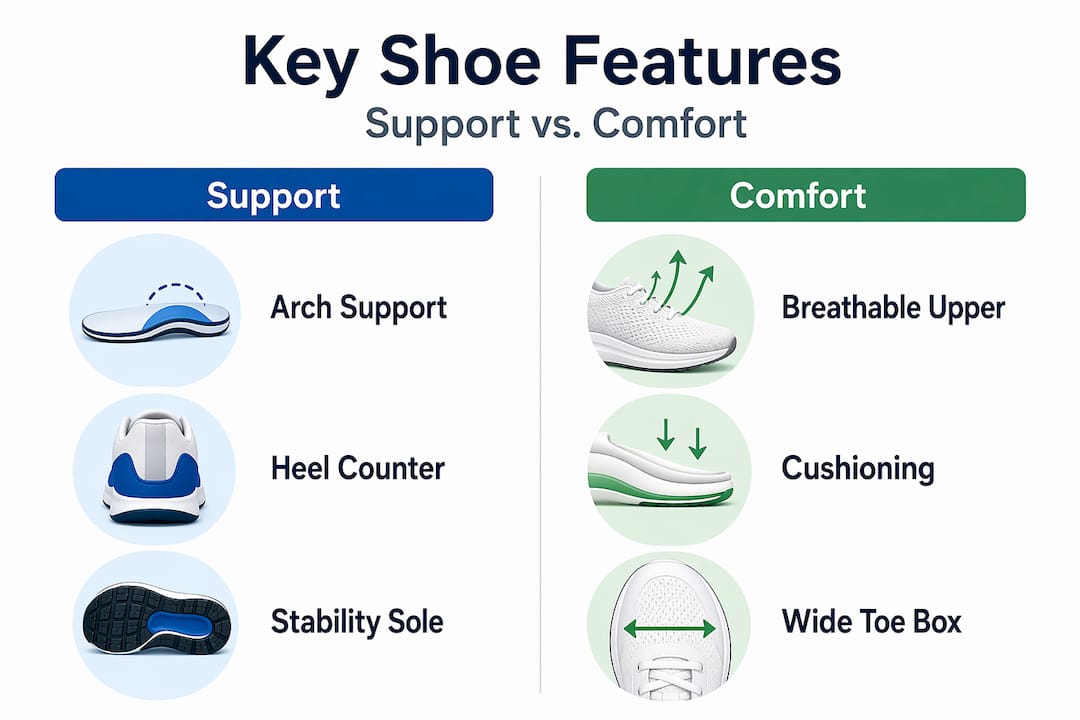
Arch support: Orthopedic shoes should support your specific arch type. Flat-footed wearers need motion control; high arches need cushioned, flexible support. Consider whether the shoe accommodates a custom orthotic insert, as some conditions require prescription support that sits inside the shoe.
Fastenings: Laces allow you to adjust fit throughout the day. Velcro or hook-and-loop closures are especially useful if manual dexterity is limited or if swelling changes foot volume during the day. Slip-on styles offer convenience but rarely provide the secure fit that sensitive or high-risk feet need.
Pro Tip: Check whether the shoe has a removable insole. If it does, that is a strong sign the shoe is designed to accommodate custom orthotics, which is a significant advantage for people with complex foot conditions.
For a detailed breakdown of construction standards, our guide on diabetic friendly shoe features covers what separates a genuinely therapeutic shoe from one that merely markets itself as orthopedic.
Where and how to buy orthopedic shoes
With knowledge of fit and features, the next step is deciding where and how to purchase your orthopedic shoes. The channel you choose affects not just price but safety, particularly if your condition is complex.
- Specialist medical footwear retailers: Staff are trained in therapeutic fitting and can assess your foot condition, measure professionally, and guide you to appropriate styles. Many stock diabetic and extra-wide options not available in general shoe shops.
- Podiatrist clinics: For complex needs such as severe neuropathy, post-surgical feet, or Charcot foot, a podiatrist can recommend or directly supply footwear, and in some cases prescribe custom-made shoes through the NHS.
- Online retailers: The widest selection and often the best prices, but the risk is buying the wrong fit. Only buy online if you know your measurements precisely and the retailer has a clear, cost-free returns policy.
- General footwear shops: Useful if a specific brand or model has been recommended, but staff are rarely trained in therapeutic fitting. Do not rely on their advice for condition-specific needs.
| Channel | Best for | Watch out for |
|---|---|---|
| Specialist medical retailers | Complex conditions, wide fitting, professional advice | Higher prices, limited style range |
| Podiatrist clinics | Prescription needs, severe conditions | Appointment lead times |
| Online retailers | Convenience, variety, affordability | Sizing errors, poor returns policies |
| General shoe shops | Known brand, simple conditions | Inadequate fitting knowledge |
Orthopedic shoes can be purchased via specialised stores, podiatrists’ offices, or online marketplaces, each offering distinct benefits for fit and convenience. Our guide to selecting diabetic footwear helps you weigh up which channel suits your health requirements.
Pro Tip: When buying online, search specifically for retailers that include width measurements (not just length) and offer half-size increments. A retailer that only offers standard sizing is not equipped for orthopedic needs.
Caring for your orthopedic shoes for longevity and comfort
Properly caring for your orthopedic shoes ensures they remain effective and comfortable over time. A well-made pair that is neglected will lose its supportive function faster than a budget pair that is looked after properly.
Key care habits to adopt:
- Clean regularly: Follow the manufacturer’s care instructions. Most orthopedic shoes should be wiped clean with a damp cloth and allowed to air dry naturally. Avoid putting them in the washing machine or drying them with direct heat, which damages both the upper and the midsole structure.
- Inspect and replace insoles: The insole is often the first component to wear out. Replacing worn insoles helps maintain arch support and prevents the shoe from becoming flat and ineffective.
- Rotate pairs: Wearing the same pair every day accelerates material compression. Rotating between two pairs gives each shoe time to recover its shape and allows moisture to evaporate fully.
- Break in new shoes gradually: Even a well-fitted orthopedic shoe needs a breaking-in period. Start with one to two hours of wear on the first day and increase gradually. Check your feet carefully for any redness, pressure marks, or irritation after each wear, particularly if you have reduced sensation.
Pro Tip: Photograph the soles of your shoes monthly. It is a simple way to track uneven wear patterns, which often signal changes in gait or fit that need addressing before they cause problems.
For more on keeping your footwear in good condition, our guide on shoe care and maintenance explains why the wrong shoe, poorly maintained, can undo the protection you bought it for.
Rethinking the role of style in orthopedic shoe buying
Here is something most orthopedic shoe guides will not say directly: if you hate the way a shoe looks, you will not wear it consistently. And a shoe you leave in the wardrobe protects nobody.
For years, the medical footwear industry operated on the assumption that patients would wear whatever they were told because their feet hurt badly enough. That assumption produced decades of beige, boxy, uninspiring shoes that many people, particularly younger adults and those in professional environments, refused to be seen in. The result was poorer adherence to foot care regimens and, in the case of diabetic patients, avoidable complications.
The good news is that the market has genuinely changed. Modern orthopedic footwear from forward-thinking brands now incorporates wide toe boxes, cushioned midsoles, and breathable uppers into designs that look contemporary. Trainer-style orthopedic shoes, leather-look options, and even dress shoes now exist with meaningful therapeutic construction. You do not have to choose between protection and looking like a functioning adult.
The practical implication for you as a buyer is that style should be a criterion, not an afterthought. When comparing two pairs that meet your clinical requirements equally well, choosing the one you actually like is not vanity; it is sound judgement. Footwear you are proud to wear becomes footwear you actually wear, consistently, every day. That consistency is what delivers the long-term foot health benefit.
For a broader perspective on how design and health intersect in modern footwear, our footwear selection insights explore this in more detail.
Explore YDA UK’s orthopedic shoe technology for foot health
Putting this buying orthopedic shoes guide into practice means finding footwear that genuinely delivers on its promises. At YDA UK, the technology behind each shoe is built around the specific needs of people with diabetic and sensitive feet, combining breathable, protective materials with pressure-relief engineering that meets real therapeutic standards.

The YDA shoe technology is designed to give you correct fit, meaningful pressure distribution, and everyday wearability without the clinical aesthetic that puts so many people off. Whether you are looking for in-depth shoe fit advice or want to explore options through the diabetic footwear selection guide, YDA UK provides the expert guidance and product range to match the health priorities this guide has laid out. Your feet deserve footwear designed with them specifically in mind.
Frequently asked questions
How do I know if orthopedic shoes are right for my foot condition?
If you experience foot pain, deformities such as bunions, or diabetes-related neuropathy, orthopedic shoes are likely appropriate. Orthopedic shoes help alleviate foot pain and provide stability for a range of conditions including diabetes and bunions, and a podiatrist can confirm the right specification for your situation.
Can I buy orthopedic shoes online safely?
Yes, provided you have accurate foot measurements in both length and width, and the retailer offers a clear returns policy. Online shopping for orthopedic footwear requires careful attention to sizing charts and return terms before you commit to a purchase.
What features should I prioritise if I have bunions?
Focus on a wide toe box and soft or stretchy uppers as your first filter. Wide toe boxes and stretchy uppers reduce pressure and irritation on the bunion joint, which is the key goal since footwear cannot correct the deformity itself.
How often should I replace my orthopedic shoes?
Replace them when you notice cushioning loss, uneven sole wear, or returning discomfort that was previously absent. Replacing insoles and shoes when worn is essential to maintain the support that protects your feet, and most quality orthopedic shoes need replacing every twelve to eighteen months under regular use.