
Walking vs running shoes: comfort, health and style
TL;DR:
- Walking and running shoes are biomechanically different with distinct design features.
- Proper footwear selection depends on activity, gait, foot condition, and individual biomechanics.
- Labels like “walking” or “running” are marketing tools; the best shoe matches your unique needs.
Most people own at least one pair of trainers they use interchangeably for walking and running, assuming a shoe is a shoe. That assumption costs them more than comfort. Running generates 2 to 3 times body weight per stride compared to walking’s 1 to 1.5 times, meaning the wrong shoe can quietly accumulate stress on your joints, tendons, and soft tissue before you ever notice a problem. Whether you are managing a foot condition, building an active lifestyle, or simply want footwear that works as hard as you do, understanding what separates these two categories changes everything about how you shop.
Table of Contents
- Key biomechanical differences between walking and running
- Construction differences: cushioning, flexibility and drop
- Choosing based on foot health: special considerations
- Practical checklist: finding your fit and style
- Why shoe labels matter less than your individual needs
- Find the perfect shoes for your needs
- Frequently asked questions
Key Takeaways
| Point | Details |
|---|---|
| Impact forces vary | Running shoes must absorb higher forces than walking shoes, affecting cushioning and safety. |
| Design differences matter | Heel-to-toe drop, cushioning and flexibility distinguish walking shoes from running shoes. |
| Match shoes to activity | The right shoe supports your mechanics, style, and unique foot health requirements. |
| Consult professionals | For complex needs or foot conditions, expert advice ensures optimal comfort and injury prevention. |
Key biomechanical differences between walking and running
Walking and running are not simply fast and slow versions of the same movement. They are mechanically distinct in ways that demand completely different things from your footwear.
When you walk, at least one foot is always in contact with the ground. Your weight transfers in a smooth, controlled heel-to-toe roll, loading the foot progressively. Impact forces during walking are comparatively modest, typically between 565N and 581N of peak vertical ground reaction force per stride. That steady, predictable loading pattern means your foot has time to adapt and spread naturally through each step.
Running is a different story. Every stride includes a brief flight phase where neither foot touches the ground. When you land, your body absorbs the full force of that impact almost instantaneously. Research confirms that running generates significantly higher peak vertical ground reaction forces, reaching approximately 844N, and far greater loading rates than walking, even when both activities are performed at the same aerobic intensity. That gap justifies the specialised engineering built into running shoe cushioning systems.
“The difference between walking and running impact forces is not trivial. It is the biomechanical gap that shapes every design decision in performance footwear.”
The table below illustrates just how different these forces are in practical terms:
| Metric | Walking | Running |
|---|---|---|
| Peak vertical ground reaction force | 565 to 581N | ~844N |
| Flight phase | None | Present every stride |
| Impact loading rate | Gradual | Rapid |
| Primary loading pattern | Heel-to-toe roll | Heel strike or midfoot strike |
| Stride frequency | Lower | Higher |
Understanding these differences is not just academic. When you are testing shoe comfort in a shop or online, you need to know which biomechanical demands the shoe is actually designed to meet. A shoe that feels perfectly cushioned standing still may offer entirely the wrong type of support once you start moving at pace.
The heel-to-toe roll in walking means your foot benefits most from shoes that allow gradual, natural flexion through the forefoot. Running, with its abrupt ground contact, needs materials that absorb force fast and return energy efficiently. These are not the same engineering problems, and they rarely have the same solution.
Construction differences: cushioning, flexibility and drop
With the biomechanical demands established, the design differences between walking and running shoes begin to make obvious sense. These are not marketing distinctions. They are functional ones, and they directly influence your foot health.
Cushioning is the most obvious difference. Running shoes carry more cushioning than walking shoes because they have to manage substantially higher impact forces with every stride. That cushioning is not simply thicker foam; it is typically denser and more responsive, engineered to compress rapidly and recover before the next foot strike. Walking shoe cushioning tends to be firmer and more consistent because it does not need to handle rapid, repeated high-force impacts. Softer cushioning under a walking shoe can actually destabilise the foot rather than protect it.
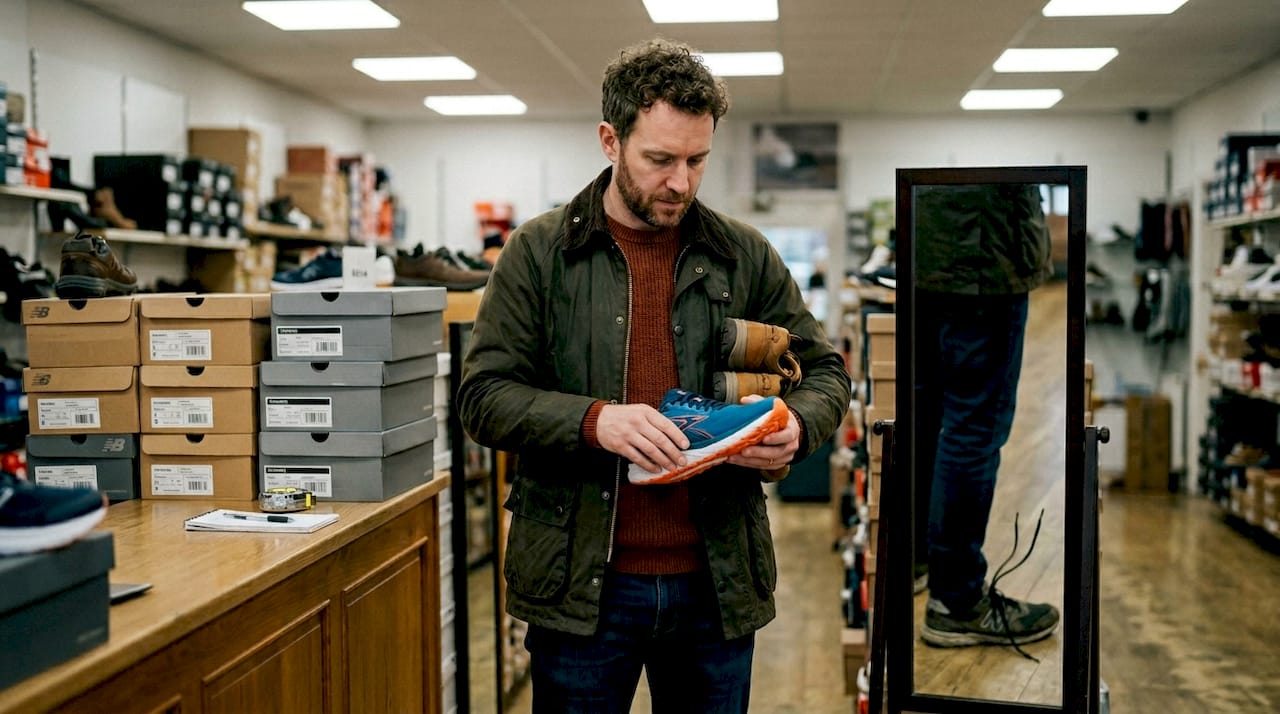
Flexibility tells a subtler but equally important story. Walking shoes flex predominantly in the forefoot to accommodate the natural heel-to-toe transition, allowing your foot to move through its full range of motion during each step. Running shoes, by contrast, are typically stiffer through the midfoot. That midfoot rigidity provides the stability platform your foot needs during the propulsion phase of a running stride, where forces travel through the arch and push off the forefoot.
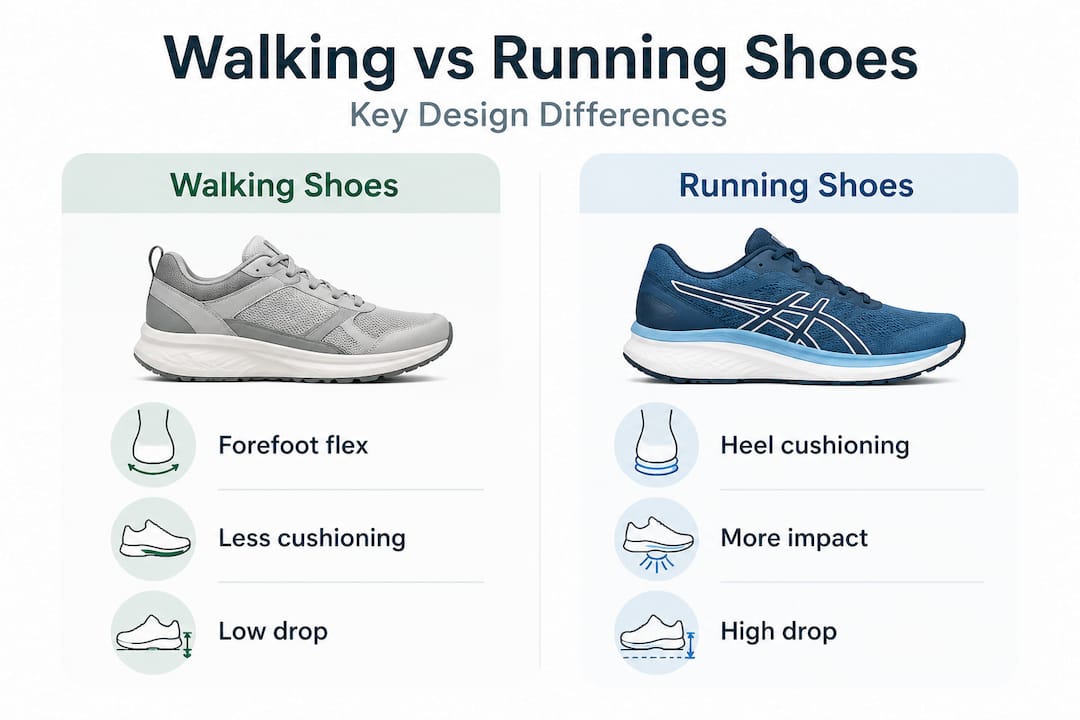
Heel-to-toe drop is the measurement most shoppers overlook, yet it has a profound influence on gait and long-term comfort. Running shoes generally feature a drop of 8 to 12mm or more, which elevates the heel relative to the forefoot and helps absorb the impact of heel striking while encouraging forward propulsion. Walking shoes tend to feature a lower drop of around 4 to 8mm, which keeps the foot closer to a natural angle and supports better balance throughout the stride cycle.
Here is a quick comparison to make these contrasts concrete:
| Feature | Walking shoe | Running shoe |
|---|---|---|
| Cushioning density | Firmer, moderate volume | Softer or responsive, higher volume |
| Forefoot flexibility | High | Low to moderate |
| Midfoot stiffness | Moderate | Higher |
| Heel-to-toe drop | 4 to 8mm | 8 to 12mm or more |
| Primary gait supported | Heel-to-toe roll | Heel strike or midfoot landing |
| Best suited for | Daily walking, low-impact activity | Running, mixed pace workouts |
Key features to evaluate when comparing shoes for your activity:
- Drop: lower for walking, higher for running to match heel strike patterns
- Forefoot flex: pick up the shoe and bend it. A walking shoe should flex easily at the ball of the foot
- Midsole density: press your thumb into the midsole. Running shoes typically compress more readily
- Outsole pattern: walking shoes often have smoother, shallower tread; running shoes have more directional grip for propulsion
Pro Tip: Before buying, bend the shoe at the forefoot and note where it flexes. A shoe that bends in the middle of the arch rather than near the toes is usually better suited to running mechanics, not walking. If you are unsure which category matches your activity, check a guide to buying healthy footwear online or look for performance shoe buying tips before committing.
Choosing based on foot health: special considerations
Features matter even more when you are managing a specific foot condition. The right shoe can meaningfully reduce pain, prevent injury progression, and make daily activity genuinely sustainable.
For consumers dealing with plantar fasciitis, overpronation, or general arch instability, walking shoes with firmer cushioning, reinforced arch support, and a lower heel-to-toe drop tend to provide the best combination of stability and load distribution. Walking shoes with structured support reduce strain during low-impact activities and can help calm inflammation by preventing excessive heel drop and arch collapse with each step. Running shoes, with their higher drop and more dynamic cushioning systems, can be appropriate for active individuals who mix walking and running, but those with complex conditions should seek personalised guidance.
A particularly useful fact: it is generally safe to walk in running shoes due to their substantial cushioning, even if they are not optimally designed for the purpose. The reverse is not true. Running in walking shoes creates a genuine injury risk because they lack adequate impact protection for the rapid, high-force loading that running demands. Common consequences include plantar fasciitis, shin splints, and stress reactions in the foot and lower leg.
Specific features worth prioritising for foot health:
- Arch support type: neutral, stability, or motion control, matched to your pronation pattern
- Toe box width: ensure adequate room so the toes can splay naturally without compression
- Heel counter rigidity: a firm heel counter controls rear-foot motion and supports overpronators
- Removable insoles: allows you to insert custom orthotics if prescribed
- Outsole durability: look for reinforced wear zones at the heel and lateral forefoot, which are high-load areas for most foot types
If you have persistent foot pain or a diagnosed condition, explore dedicated guidance on footwear for plantar fasciitis or consult a podiatrist before committing to a new pair. More general guidance for managing ongoing foot problems is available on shoes for foot problems.
Pro Tip: If you pronate moderately and mostly walk, a stability walking shoe with a slightly raised medial post offers meaningful support without the aggressive corrections found in motion control running shoes, which can overcorrect gait and cause new problems.
Practical checklist: finding your fit and style
Health considerations and biomechanics point you in the right direction, but the final decision always comes back to the individual wearing the shoe. Here is a step-by-step process that balances science with real-world practicality.
Step-by-step shoe selection process:
- Define your primary activity. Are you primarily walking, running, or mixing both? Be honest. Most people vastly underestimate how much walking they do compared to running.
- Assess your gait. Note whether you tend to pronate, supinate, or land neutrally. A wet foot test on paper or a gait assessment at a specialist shop both work well.
- Measure your feet properly. Measure both feet at the end of the day when they are at their largest. Fit to the larger foot and account for around 1cm of space at the toes.
- Check the drop. Match the heel-to-toe drop to your activity and existing biomechanics. If you have been wearing high-drop shoes for years, do not switch abruptly to a low-drop option.
- Flex and press test the shoe. Bend at the forefoot and press the midsole to evaluate flex point and cushioning density before buying.
- Consider style and use case. A shoe that does not suit your wardrobe or context is one you will not wear consistently. Comfort and style are not mutually exclusive.
- Trial under real conditions. Walk or jog in the shoes for at least 10 minutes before deciding. Shops with treadmills or good return policies make this possible.
Podiatrists emphasise matching footwear to mechanics: walking’s heel-toe roll demands flexibility and stability, while running’s flight phase requires genuine shock absorption and propulsion support. There is a contrasting view worth knowing: minimal shoes, with their low drop and thin midsoles, may strengthen intrinsic foot muscles over time by allowing more natural foot movement. However, transitioning to minimal footwear requires patience. Rushing the process overloads tendons and tissues before they have adapted.
Additional tips for a smarter selection:
- Replace shoes every 500 to 800km of use, or when the midsole visibly compresses and no longer springs back
- Try shoes in the afternoon when foot swelling is at its peak for the most accurate fit
- If you stand for long periods at work, prioritise shoes rated for all-day comfort, not just performance metrics
For a broader framework, the guide to shoe selection for health and a practical workflow for finding right shoes both provide structured approaches to narrowing down your options efficiently.
Why shoe labels matter less than your individual needs
Here is an uncomfortable truth the footwear industry rarely advertises: the “walking” and “running” labels on most shoes are useful starting points, but they are not clinical prescriptions. They are marketing categories shaped partly by biomechanical research and partly by commercial positioning. Treating them as absolute rules leads to poor decisions far more often than people realise.
We have seen active individuals in their fifties doing regular 8km walks in running shoes, reporting zero discomfort and excellent joint support, because their specific gait pattern suited the higher-drop, well-cushioned construction of a running shoe. We have also seen runners who transitioned to lower-drop walking shoes to address chronic heel pain, with positive outcomes because their stride mechanics favoured a more neutral platform. Neither approach fits neatly into the conventional label.
The more useful question is not “is this a walking shoe or a running shoe?” but rather “does this shoe match my movement pattern, my foot condition, and my daily context?” That shift in thinking cuts through enormous amounts of marketing noise. Industry campaigns often amplify features like maximal cushioning or energy return as universal selling points, when in reality those features serve specific biomechanical profiles. A maximally cushioned running shoe may feel extraordinary to one person and genuinely problematic for another who has a gait that does not distribute force evenly across that platform.
Your long-term foot health depends on shoes that respond to how you actually move, not how a label assumes you should. The best investment you can make is understanding your own mechanics, ideally with professional input. From there, the guidance on preventing foot injuries through informed footwear choices becomes genuinely actionable rather than generic advice. Labels guide you to the right shelf. Your individual needs guide you to the right shoe.
Find the perfect shoes for your needs
Knowing what separates walking and running shoes transforms the way you shop, but finding footwear that delivers on biomechanics, foot health, comfort, and style in one package is the real challenge.
At YDA, we have built our range around YDA shoe technology that combines proven foot health principles with contemporary style, meaning you do not have to compromise on either front. Whether you are seeking structured support for a specific condition or a versatile everyday shoe that keeps pace with an active lifestyle, our YDA trainers are designed with your movement in mind. For those managing complex foot concerns, explore the full range of shoes for problem feet to find options engineered for your specific needs.
Frequently asked questions
Can you use running shoes for walking?
Yes, running shoes are generally safe for walking because they provide extra cushioning and impact protection, though they may feel less flexible through the forefoot compared to a dedicated walking shoe.
Why can’t you run in walking shoes?
Running in walking shoes is inadvisable because they lack the cushioning and impact absorption needed for the higher forces involved, which increases injury risk such as plantar fasciitis and shin splints.
What is heel-to-toe drop and why does it matter?
Heel-to-toe drop is the height difference between the heel and forefoot of a shoe; running shoes typically feature 8 to 12mm to aid impact absorption, while walking shoes use a lower drop of 4 to 8mm to support balance and natural gait.
Are minimal shoes good for foot health?
Minimal shoes can strengthen intrinsic foot muscles over time, but transitioning gradually is essential to avoid overloading tendons and soft tissue before they have adapted to the reduced support.
Recommended
- Guide to stylish health shoes for comfort in 2026 – YDA UK
- Footwear Selection Guide 2025: Choose Shoes for Health and Comfort – YDA UK
- Choosing Shoes for Daily Wear: Find Comfort and Style Easily – YDA UK
- 7 Examples of Stylish Footwear for Foot Health and Comfort – YDA UK
- Nature-inspired fashion: 5 proven benefits for mindful style – Memento Vivere Co