
Slip resistance explained: Essential facts for safer footwear
TL;DR:
- Slip resistance is a measurable property that varies depending on testing methods, surfaces, and conditions, not just a marketing label.
- Choosing truly slip-resistant footwear requires understanding testing standards, outsole design, and matching shoes to your specific environment and hazards.
The label “slip-resistant” on a shoe box sounds reassuring, but it can create a false sense of security that gets people into real trouble. Many shoppers assume any shoe carrying that description will keep them safe regardless of surface, weather, or wear. The truth is that slip resistance is a precise, measurable property that varies considerably depending on how a shoe was tested, what surfaces it was tested on, and the conditions present when you actually wear it. This guide cuts through the confusion so you can make genuinely safer choices for your feet and your daily life.
Table of Contents
- What does slip resistance mean in footwear?
- How is slip resistance tested?
- Factors that affect slip resistance in everyday life
- How to choose truly slip-resistant shoes
- A closer look: Why slip resistance is about context, not just claims
- How YDA shoes put slip resistance into practice
- Frequently asked questions
Key Takeaways
| Point | Details |
|---|---|
| Slip resistance defined | Slip resistance measures a shoe’s ability to grip surfaces and is not just a marketing term. |
| Testing matters | Only shoes tested for both dry and wet conditions provide reliable real-world safety information. |
| Choose with context | Always match footwear to your surfaces, lifestyle, and health needs for best slip resistance. |
| Factors affect safety | Surface type, contaminants, and shoe wear all influence how slip-resistant your footwear is. |
What does slip resistance mean in footwear?
Slip resistance is not simply a marketing phrase stamped on a box to make a shoe sound safer. It is a measurable, technical characteristic that describes how well two surfaces resist sliding against each other. In footwear, that typically means the interaction between your shoe’s outsole and the floor beneath your feet.
The core concept is the coefficient of friction (COF). Think of it as a number that describes the grip between two surfaces. A higher COF means more resistance to sliding. A lower COF means surfaces slide more easily. Slip resistance is a measure of how well two contacting surfaces resist sliding, commonly expressed via the coefficient of friction, which can be static (starting to move) or dynamic (while sliding).
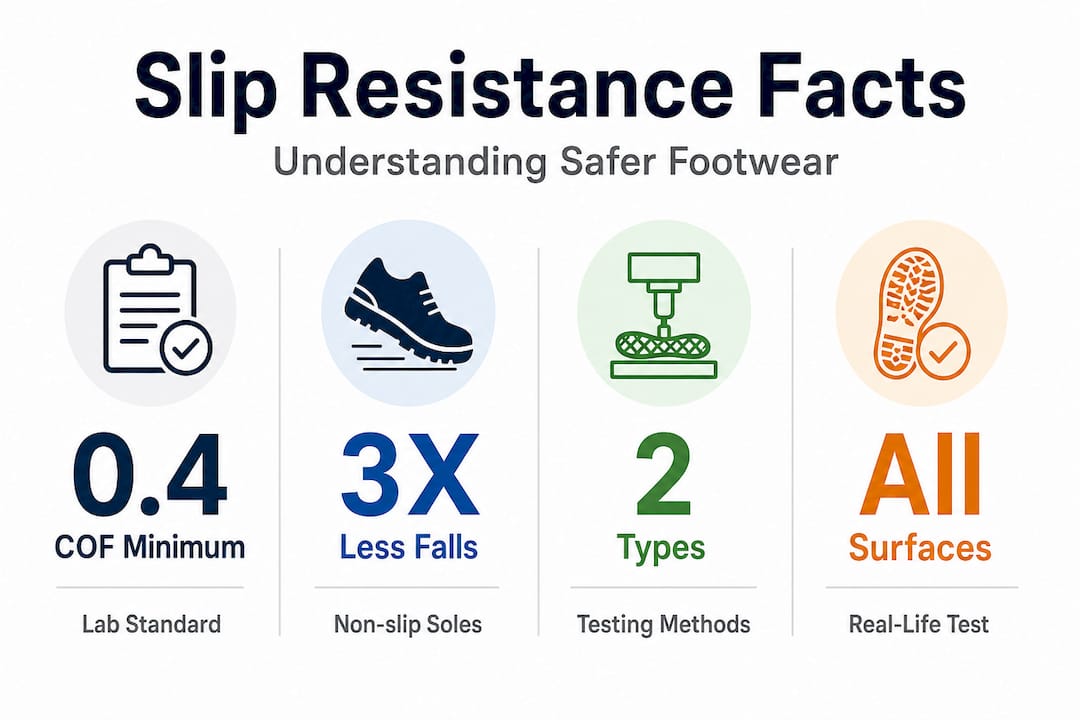
Static COF describes the resistance your shoe encounters the moment before it begins to slide, while dynamic COF describes the resistance during the sliding motion itself. For everyday safety, both matter. Static COF helps prevent a slip from starting in the first place. Dynamic COF determines how quickly you can recover if your foot does begin to slide.
Here are the key concepts worth keeping in mind:
- Static COF relates to initiating movement between two surfaces
- Dynamic COF relates to friction whilst surfaces are already in motion relative to each other
- A COF above 0.4 is commonly considered the minimum safe threshold for walking surfaces in many industry standards
- Surface texture, contamination, and shoe wear all affect the effective COF in real conditions
- A shoe might achieve a high COF on a clean tile but a dangerously low COF on the same tile with a film of cooking oil
Understanding how anti-slip footwear and foot health are connected is especially important if you have conditions that affect balance or gait. And if you have ever wondered why good shoe grip matters beyond simple comfort, the answer is rooted directly in these friction principles.
“A shoe can be perfectly slip-resistant in one context and dangerously slick in another. The coefficient of friction is the tool we use to measure that difference, but the environment is the true test.”
How is slip resistance tested?
Knowing the terminology is a start, but understanding how slip resistance is actually measured brings the real insight. Slip resistance is evaluated by measuring the friction performance between the whole shoe and a test surface under controlled dry and contaminated conditions. This distinction matters enormously because not all tests are equal, and a result from one method does not automatically translate to safety in another context.
There are broadly two approaches: whole-shoe tests and outsole-only tests. Whole-shoe tests assess the shoe as it actually functions, factoring in flex, heel contact angle, and the natural motion of a stride. Outsole tests isolate the rubber compound or tread pattern from the full mechanical interaction of walking. Whole-shoe tests are generally considered more representative of real conditions, but both approaches have their place in a thorough assessment.
| Test method | Surfaces used | Contaminants tested | What it tells you |
|---|---|---|---|
| ASTM F2913 (whole shoe) | Ceramic tile, steel | Water, glycerol | Dynamic COF during natural gait |
| EN ISO 13287 (EN standard) | Ceramic tile, steel | Water, sodium lauryl sulphate | Both forward and sideways slip |
| Mark II Pendulum Test | Various floor materials | Water or dry | Surface friction rating (SRV) |
| SATRA TM144 | Ceramic, vinyl, steel | Water, motor oil | Outsole compound performance |
The main footwear testing standards and what each reveals:
- ASTM F2913 assesses whole-shoe performance during a simulated walking motion and is widely referenced in North American and international contexts.
- EN ISO 13287 is the European standard that covers footwear for professional use and tests in multiple directions, which is vital since real slips do not always happen in a straight forward direction.
- The Pendulum test is more commonly used to assess floor surfaces than footwear, but the results inform how well a given shoe will interact with a specific floor rating.
- SATRA TM144 focuses on the outsole material itself and helps manufacturers understand which rubber compounds provide the best grip on specific surfaces.
You can find further guidance on testing principles through the HSE slip testing FAQ, which is particularly useful for understanding how floor assessments interact with footwear performance.
Pro Tip: Do not rely on a generic slip-resistance label. Ask specifically which standard was used to test the shoe and under what conditions (dry, wet, oily). A shoe tested only under dry conditions may perform very differently in the kitchen or on a rainy pavement.
The anti-slip outsole technology built into a shoe is where much of this science is applied in practice, from tread depth and pattern to the specific rubber compound chosen for the sole.
Factors that affect slip resistance in everyday life
Testing in a controlled laboratory is one thing. Your actual morning commute, your kitchen floor, and your favourite weekend walk are quite another. Slip resistance is highly test-method dependent: some floor tests are not appropriate for assessing wet or contaminated conditions because results can be misleading. This is not a flaw in the science; it is a reminder that context transforms safety performance.
Several key variables change how your shoes actually perform day to day:
| Variable | Effect on slip resistance | Practical example |
|---|---|---|
| Floor type | Tile and polished marble reduce COF significantly | Supermarket floors vs. rough pavement |
| Contaminant (water) | Reduces friction across almost all outsoles | Puddles, wet bathroom floors |
| Contaminant (oil or grease) | Severely reduces friction even on textured soles | Kitchen spills, workshop environments |
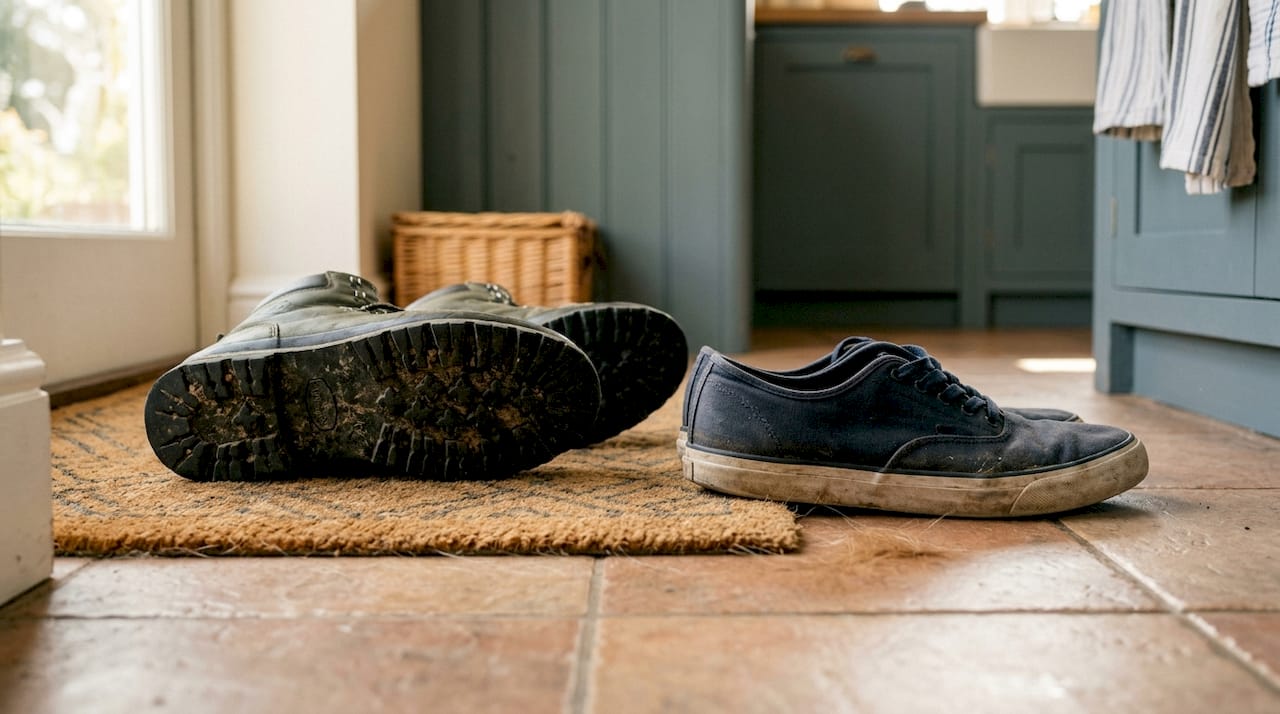
| Shoe wear | Worn tread removes texture that channels fluids away | Old trainers on a rainy day |
| User gait | Unusual stride patterns increase lateral slip risk | People compensating for joint pain |
| Environmental lighting | Poor visibility increases misplaced footfalls | Dimly lit stairs or corridors |
Everyday scenarios where slip risk increases significantly include:
- Entering a building from rain: water tracked onto smooth lobby tiles creates a contaminated surface the shoe was likely not tested on
- Cooking environments: oil and grease in kitchens create one of the most challenging surfaces for any shoe sole
- Seasonal transitions: leaves on pavements in autumn create a slick, compressed layer that catches many pedestrians off-guard
- Worn outsoles: a sole that originally provided excellent grip loses its channel grooves and tread depth, drastically reducing its ability to displace water or debris
- Hospital and care settings: polished floors combined with cleaning products create conditions that require specifically tested, health-setting footwear
Understanding the role of non-slip soles is particularly relevant here, as outsole design choices directly determine how well a shoe handles these real-world variables. For a broader view of how environmental factors interact with footwear choice, expert insights on OH&S slip resistance offer useful reading.
For those with foot conditions such as diabetes, peripheral neuropathy, or balance disorders, these variables carry greater stakes. Reduced sensation means a slip may not register until a fall is already in progress. Consulting a guide to choosing shoes for health and comfort alongside understanding slip resistance will give you the fullest picture of what safe footwear means for your specific circumstances.
How to choose truly slip-resistant shoes
Understanding the theory is satisfying. Acting on it is what keeps you safe. The process of selecting genuinely slip-resistant shoes does not need to be complicated, but it does require you to ask better questions than most product listings encourage.
- Identify your primary surfaces. Think honestly about where you spend most of your time. Is it a kitchen at work, a tiled hospital corridor, rough outdoor paving, or polished office floors? Your answer shapes which test conditions matter most.
- Look for the specific standard tested. EN ISO 13287 or ASTM F2913 on a product specification tells you a shoe was assessed properly. “Slip-resistant” alone tells you almost nothing about which conditions were tested.
- Check the contaminants used in testing. A shoe tested with water only may perform poorly in oily conditions. Seek out footwear that has been assessed under the conditions closest to your daily environment.
- Assess outsole design. Deep, channel-style grooves in a herringbone or circular pattern help the sole displace water and debris. Flat or shallow tread wears quickly and loses effectiveness faster.
- Consider fit and comfort together with grip. A shoe that does not fit well changes your gait, which in turn increases lateral slip risk. This is especially relevant for health-conscious users with balance challenges, for whom traction performance depends on the specific floor conditions and outsole wear, not just a label.
- Replace footwear proactively. Even excellent slip-resistant soles degrade. If the tread pattern looks worn flat, the shoe’s tested performance no longer applies.
- Consult stylish health-focused shoes resources that blend performance requirements with the design you actually want to wear every day.
Pro Tip: To field test a shoe’s slip resistance at home safely, find a smooth, dry floor (not a slippery surface) and shift your weight onto the heel then the ball of your foot whilst standing still. Note whether the sole grips firmly or shifts slightly. Then do the same test on a very slightly damp surface such as a barely moistened tile near the sink. The difference you feel between those two scenarios gives you a rough, real-world indicator of how sensitive that outsole is to moisture.
A closer look: Why slip resistance is about context, not just claims
Here is something most buying guides will not tell you plainly: a single “slip-resistant” label is almost meaningless without supporting data. We have seen time and again that consumers make purchasing decisions based on reassuring language rather than the specific test conditions that language is drawn from. That is not the consumer’s fault. It is a transparency problem that the footwear industry has not fully addressed.
The uncomfortable truth is that a shoe can pass its lab test with an excellent COF rating, be correctly labelled slip-resistant by the manufacturer, and still fail you on a wet kitchen floor because the test used a dry ceramic tile at a controlled temperature. Neither party lied. But the result is someone slipping on a surface their shoe was never validated for.
This is not a reason to distrust tested footwear. It is a reason to become a more specific buyer. Personal context is the ultimate test of footwear safety. If you have a condition that affects balance, sensation, or gait, then the average slip-resistance rating is not designed with you in mind. Your needs require footwear that has been tested for your most common surfaces and that supports your particular way of moving through the world.
We also believe strongly that brands have a responsibility here. Publishing test data, naming the standards used, and specifying the contaminants and surfaces in the test should be the baseline expectation, not an afterthought reserved for occupational safety catalogues. Buzzwords are not a substitute for transparency.
For those ready to take a more structured approach, a step-by-step shoe selection guide can help you move from understanding these principles to making specific, confident choices. Long-term foot health is built on consistent, informed decisions, not one lucky purchase.
How YDA shoes put slip resistance into practice
Understanding the science is only useful if it helps you take confident next steps. At YDA UK, we have built our footwear around the exact principles this article covers: tested traction, outsole design that functions in real-world conditions, and technology that supports foot health rather than just looking the part.

Our YDA slip-resistant technology is designed with the full picture in mind. That means outsoles developed for genuine performance across varied surfaces, not just clean lab conditions. It means combining grip with the comfort and fit that allow your natural gait to work as it should. And it means giving you the transparency to understand what you are buying. Browse our current range and see how YDA brings tested, health-supporting performance together with footwear you will genuinely want to wear every day.
Frequently asked questions
What does it mean when shoes are ‘slip-resistant’?
Slip-resistant shoes are designed and tested to provide better grip, reducing the risk of slipping on different surfaces. Technically, slip resistance is a measure of how well two contacting surfaces resist sliding, expressed via the coefficient of friction, which can be static or dynamic.
Can slip resistance guarantee I won’t slip in wet conditions?
No guarantee exists, even with tested slip-resistant shoes. Results can be misleading when test conditions do not match real-world environments, because slip resistance is highly dependent on floor type, contaminants, and shoe wear.
How do I know which shoes are safest for me?
Look for shoes tested on surfaces similar to your own daily environment, check for recognised slip-resistance ratings such as EN ISO 13287, and review product health features. For those with balance or sensation challenges, real risk depends on your surface type, contamination level, and outsole wear, not just the label.
Why do some shoes labelled ‘slip-resistant’ still feel slippery?
Testing and real-life conditions often differ considerably. A higher friction on dry tests does not necessarily translate to safe performance in wet or contaminated real-world scenarios, which is precisely why robust standards include multiple conditions and specific contaminants in their methodology.