
What is an anti-slip outsole? Safety, comfort & style
TL;DR:
- Anti-slip outsoles are engineered with specialized materials and tread patterns to resist slipping.
- Proper testing data like COF and MAA standards are essential to verify slip resistance.
- Regular replacement is crucial as wear can significantly reduce outsole effectiveness and safety.
Most people assume that any rubber-soled shoe will keep them safe on a wet floor or an icy pavement. That assumption is wrong, and it costs people dearly every year. Slips and falls are among the most common causes of injury in both workplaces and everyday settings, and poorly designed outsoles are frequently to blame. An anti-slip outsole is not simply any rubber bottom — it is a precisely engineered component built to maintain grip across a range of surfaces and conditions. This article explains what anti-slip outsoles are, how they work, and how to choose the right pair for your specific needs.
Table of Contents
- What is an anti-slip outsole?
- The science behind anti-slip outsoles
- Health benefits and use cases for anti-slip outsoles
- Selecting the right anti-slip outsole for you
- Our take: what really matters when choosing anti-slip footwear
- Find your next step in anti-slip footwear
- Frequently asked questions
Key Takeaways
| Point | Details |
|---|---|
| Defined anti-slip outsole | An anti-slip outsole is specifically engineered to maximise grip and reduce the risk of slipping in daily activities. |
| Verified safety standards | Look for shoes meeting COF ≥0.40 or MAA angle above 7° for proven slip resistance. |
| Wear impacts performance | Regularly assess shoe tread and replace shoes as wear significantly reduces anti-slip effectiveness. |
| Health and comfort advantages | Well-designed anti-slip outsoles not only protect from falls but also support natural gait and reduce fatigue. |
| Personalised choices matter | Choose outsoles that suit your specific mobility, work, and style needs for best results. |
What is an anti-slip outsole?
The outsole is the very bottom layer of a shoe, the part that makes direct contact with the ground. A standard outsole is designed primarily for durability and basic traction. An anti-slip outsole, by contrast, is specifically engineered to resist sliding across surfaces that would otherwise cause a shoe to lose grip. This includes wet tiles, polished floors, oily surfaces, and icy pavements.
The physics behind slip resistance comes down to friction. When your foot contacts a surface, the outsole must generate enough friction to prevent lateral movement. Two key measurements define whether a sole truly qualifies as anti-slip. The coefficient of friction (COF) measures how much resistance exists between two surfaces. According to established safety benchmarks, a COF of ≥0.40 passes ASTM standards for slip resistance, while MAA (maximum achievable angle) scores of ≥7° indicate good ice resistance. These are not arbitrary numbers — they are empirically tested thresholds that separate genuine anti-slip footwear from marketing claims.
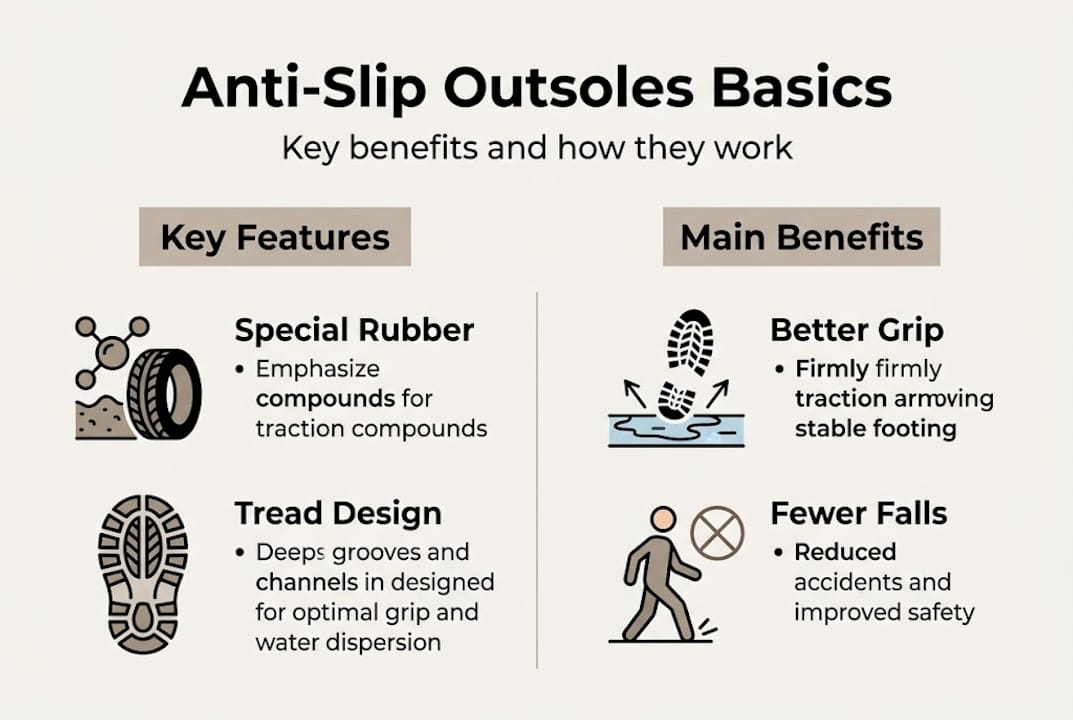
Here is where many people go wrong. Not all rubber soles are equal. A smooth rubber sole may have adequate COF on dry concrete but fail completely on a wet kitchen floor. Anti-slip outsoles use specific rubber compounds, tread geometries, and surface textures to maintain friction across multiple surface types. Understanding anti-slip footwear safety means recognising that the design details matter just as much as the material itself.
Common misconceptions include:
- Any rubber sole is slip-resistant. False. Rubber hardness, tread depth, and compound all vary enormously.
- Slip-resistant and anti-slip mean the same thing. Not quite. Slip-resistant is a broader term; anti-slip implies tested performance to specific standards.
- Thicker soles are safer. Thickness alone does not determine grip. Tread pattern and flexibility matter more.
- Anti-slip shoes look industrial. Modern anti-slip outsoles are found in stylish everyday footwear, not just work boots.
Pro Tip: When shopping, ask the retailer or brand for evidence of COF testing or industry safety ratings. If they cannot provide it, the anti-slip claim is likely just a label. Good shoe grip and safety come from verifiable performance data, not packaging promises.
“A shoe that passes a wet-floor COF test in a lab is not automatically safe on every surface. Always consider your specific environment when selecting anti-slip footwear.”
The science behind anti-slip outsoles
With a clear understanding of what anti-slip outsoles are, let’s examine the underlying science that makes them effective.
The materials used in high-performance anti-slip outsoles are not generic rubber. Manufacturers use specific compounds such as nitrile rubber, thermoplastic rubber (TPR), and carbon-reinforced rubber to achieve the right balance of flexibility, durability, and grip. Softer compounds tend to conform better to irregular surfaces, increasing the contact area and therefore the friction. Harder compounds last longer but may sacrifice grip on smooth, wet surfaces.
Tread design is equally critical. Channels and grooves in the outsole displace water, oil, and debris away from the contact zone. Sipes (narrow cuts across the tread blocks) increase the number of edges gripping the surface, much like the way a car tyre performs better in rain with well-designed tread. Higher sipe density generally improves wet-surface performance. The role of non-slip soles in everyday footwear is directly tied to how well these tread features are executed.
Flexibility is an often-overlooked factor. A rigid outsole reduces the surface area in contact with the ground at any given moment, which lowers the effective friction. A more flexible sole allows the shoe to conform to the surface, increasing contact and stability. Good shoe flexibility is therefore not just a comfort feature — it is a safety feature.
| Material | Best conditions | Durability | Grip rating |
|---|---|---|---|
| Nitrile rubber | Oil and chemical resistance | High | Excellent |
| TPR (thermoplastic rubber) | Everyday wet surfaces | Medium | Good |
| Carbon-reinforced rubber | Mixed outdoor terrain | Very high | Very good |
| Standard rubber | Dry surfaces | Medium | Moderate |
Wear is the hidden enemy of anti-slip performance. Research shows that MAA scores drop from 13.86° to 8.81° after approximately 150,000 steps, demonstrating that even a well-designed outsole loses meaningful slip resistance with prolonged use. This is not a slow, gradual decline — it is a measurable deterioration that can leave you vulnerable without any visible warning sign on the sole surface.
Stat: Properly designed anti-slip footwear can reduce outdoor fall risk by up to 78%, making outsole selection one of the most impactful decisions you can make for everyday safety.
Health benefits and use cases for anti-slip outsoles
Understanding the science helps, but how do anti-slip outsoles benefit you or people you care about in everyday life?
The most obvious beneficiaries are older adults. Balance naturally declines with age, and a single fall can have life-changing consequences. But anti-slip outsoles are not exclusively a senior concern. People with diabetes often experience peripheral neuropathy, which reduces sensation in the feet and makes it harder to detect unstable footing. Anyone recovering from a lower-limb injury, or living with a condition that affects balance, stands to gain significantly from properly engineered footwear.
In professional settings, the stakes are just as high. Kitchen workers, healthcare staff, warehouse operatives, and cleaners routinely navigate wet, oily, or polished floors. Anti-slip outsoles in these environments are not a luxury — they are a practical safety measure. Evidence confirms that flexible soles improve gait stability and reduce outdoor fall risk by up to 78%, which translates directly into fewer injuries and faster, more confident movement throughout the working day.

There is also a comfort dimension that is easy to overlook. A well-designed anti-slip outsole distributes pressure more evenly across the foot, reducing fatigue during long periods of standing or walking. This is why foot health shoe benefits extend well beyond simple grip — the right outsole supports the entire kinetic chain from your foot upward.
Top scenarios where anti-slip shoes make a real difference:
- Hospital and care home floors: Polished surfaces with frequent liquid spills.
- Commercial kitchens: Grease, water, and food debris create constant hazards.
- Wet weather and rainy pavements: Leaf-covered or rain-slicked paths are deceptively dangerous.
- Icy surfaces in winter: MAA-rated outsoles provide measurable grip where standard soles fail.
- Retail and hospitality environments: Long shifts on hard, smooth floors cause both fatigue and slip risk.
- Outdoor hiking and urban walking: Uneven terrain demands consistent grip and flexibility.
Pro Tip: Replace your anti-slip shoes once you notice the tread becoming visibly shallow or smooth. Do not wait for a slip to tell you the sole has worn past its effective range. The types of health-oriented footwear available today mean you do not have to sacrifice style for this kind of protection.
Selecting the right anti-slip outsole for you
Ready to buy or upgrade your footwear? Here is how to shop smart for anti-slip outsoles.
Start with your environment. A shoe that performs brilliantly on wet kitchen tiles may not be the best choice for icy outdoor pavements. Knowing your primary surface type narrows your options immediately and prevents you from being swayed by generic marketing language.
Next, check the certifications. Look for references to ASTM F2913 (a standard wet-surface slip resistance test), ISO 13287, or EN ISO 20347 for occupational footwear. These are not just acronyms — they are evidence that the outsole has been tested under controlled conditions. As research confirms, COF and material wear together determine long-term slip resistance, so both the initial rating and the expected wear lifespan matter when comparing options.
| Outsole type | Best activity | Surface suitability | Wear lifespan |
|---|---|---|---|
| Nitrile rubber | Professional kitchen, healthcare | Oily, wet, polished | Long |
| TPR with deep sipes | Everyday urban walking | Wet pavements, light rain | Medium |
| Carbon-rubber blend | Outdoor, mixed terrain | Gravel, wet grass, mud | Very long |
| Soft compound rubber | Indoor casual wear | Dry to lightly damp | Short |
Here is a simple process for assessing whether a shoe genuinely qualifies as anti-slip:
- Check the label carefully. Look for specific test standards, not just the words “anti-slip” or “non-slip.”
- Examine the tread pattern. Channels, sipes, and multi-directional grooves indicate genuine design intent.
- Feel the sole flexibility. A sole that bends easily at the ball of the foot is more likely to maintain ground contact.
- Research the compound. Nitrile or carbon-reinforced rubber compounds outperform generic rubber in most wet conditions.
- Ask for test data. A reputable brand will be able to point you to COF or MAA test results for their specific models.
Balancing safety with comfort and style is entirely achievable. Good comfort footwear tips consistently show that the best anti-slip shoes feel as good as they perform — because proper outsole engineering supports the whole foot, not just the contact surface.
Our take: what really matters when choosing anti-slip footwear
Here is the uncomfortable truth that the footwear industry rarely says out loud: most people only start caring about anti-slip outsoles after they have already had a slip or a fall. By that point, the damage is done. Proactive footwear assessment is not a niche concern — it is basic self-care.
We have seen how easy it is to be misled by vague language. Words like “grip-enhanced” or “traction sole” mean nothing without test data behind them. The science is clear and accessible — COF ratings and MAA angles exist precisely so that consumers can make informed comparisons. If a brand cannot point you to those numbers, treat the claim with scepticism.
There is also a fit and wear dimension that most buyers ignore. An anti-slip outsole on a poorly fitted shoe will not protect you as well as a well-fitted shoe with a slightly lower-rated sole. Shoe flexibility and comfort are not secondary to safety — they are part of the same equation. A shoe you avoid wearing because it is uncomfortable is a shoe that cannot protect you.
Our advice: know your environment, know your needs, and insist on verifiable performance data. Do not let a stylish upper or a low price point distract you from the part of the shoe that actually keeps you upright.
Find your next step in anti-slip footwear
If you are ready to experience the benefits of true anti-slip footwear in your daily life, YDA UK is here to help. Our range of footwear for problem feet is built around the principle that safety and style are not a trade-off — they are a standard.
Every pair in our collection features ergonomically engineered outsoles using proven anti-slip materials, designed for people who need genuine grip alongside everyday comfort. Whether you are managing a mobility concern, spending long hours on your feet, or simply want footwear that keeps pace with your life, our YDA shoe technology brings tested performance to every step. Explore the catalogue and find the pair that fits your environment, your lifestyle, and your feet.
Frequently asked questions
What makes an outsole truly anti-slip?
A true anti-slip outsole uses specialised rubber compounds and engineered tread patterns, and meets verified safety standards such as a COF of ≥0.40 under ASTM testing or MAA angles above 7° for ice resistance. Marketing language alone is not sufficient evidence.
How often should anti-slip shoes be replaced?
Replace them when tread wear becomes visible or when grip feels noticeably reduced, as MAA scores drop from 13.86° to 8.81° after approximately 150,000 steps, significantly reducing protection.
Are anti-slip outsoles only useful for the elderly?
Not at all. They benefit anyone prone to slips, including people with mobility issues, healthcare and kitchen workers, and outdoor enthusiasts, as evidence shows they reduce fall risk by up to 78% in outdoor conditions.
Can anti-slip soles cause foot fatigue or pain?
When worn past their effective lifespan or when poorly fitted, anti-slip soles can contribute to fatigue or discomfort. Research confirms that flexible soles reduce fatigue when properly maintained, making timely replacement and correct fit essential.