
Running shoes sole type: your 2026 buying guide
TL;DR:
- Choosing the right running shoe sole type affects biomechanics, injury risk, and energy transfer during runs. Midsole cushioning influences joint response, with softer foams increasing ankle stiffness and impacting load distribution. Proper fit and matching sole design to foot mechanics and terrain are essential for comfort, performance, and injury prevention.
Most runners spend more time choosing their playlist than their sole type. That’s a mistake that can cost you comfort, speed, and joint health over thousands of kilometres. The running shoes sole type you pick affects far more than how soft each footfall feels. It influences your biomechanics, your injury risk, and how efficiently your body transfers energy from foot to ground. This guide breaks down every major sole type, the materials behind them, and how to match them to your foot mechanics, your pace, and the terrain beneath your feet.
Table of Contents
- Key takeaways
- Running shoes sole type: anatomy first
- Cushioning types and their biomechanical effects
- Stack height, flexibility, and foot health
- Matching sole type to your running style
- My take: what the research changed for me
- How Ydauk approaches sole design
- FAQ
Key takeaways
| Point | Details |
|---|---|
| Sole anatomy matters | Knowing the difference between outsole and midsole helps you assess any running shoe with confidence. |
| More cushioning is not always better | Softer midsoles alter joint stiffness, which means biomechanical adaptation, not automatic impact reduction. |
| Stack height involves trade-offs | Thicker soles add cushioning but reduce proprioception and can compromise stability at faster paces. |
| Fit outweighs sole specs | Matching sole type to your foot mechanics and ensuring correct fit prevents injury more reliably than material alone. |
| Replace on mileage, not tread wear | Midsole cushioning degrades well before the outsole looks worn, so track kilometres rather than rubber condition. |
Running shoes sole type: anatomy first
Before you can compare sole types intelligently, you need a clear picture of what a running shoe sole actually consists of. There are two distinct layers, and confusing them leads to poor purchasing decisions.
The outsole is the rubber layer on the bottom of the shoe that makes direct contact with the ground. Its primary jobs are traction and durability. Outsole materials fall into two broad categories:
- Carbon rubber: Dense, hard-wearing, and long-lasting. Used in high-wear zones like the heel. Less flexible but exceptionally durable.
- Blown rubber: Lighter and more flexible than carbon rubber, offering better grip on even surfaces. Found in the forefoot of many road shoes.
- Trail-specific compounds: Stickier, multi-directional lugs for off-road grip on mud, rock, and roots.
The midsole sits between the outsole and the upper and does the real performance work. It is your cushioning and shock absorption layer. The materials used here determine how a shoe feels underfoot and how it influences your joints over time.
| Midsole material | Key characteristics | Best for |
|---|---|---|
| EVA foam | Lightweight, affordable, widely used | Everyday training, budget shoes |
| PEBA foam | Superior energy return, lighter weight | Racing, performance road shoes |
| TPU | More durable than EVA, firmer feel | Long-distance stability shoes |
| Dual-density foam | Medial post for support, softer lateral side | Overpronation, stability models |
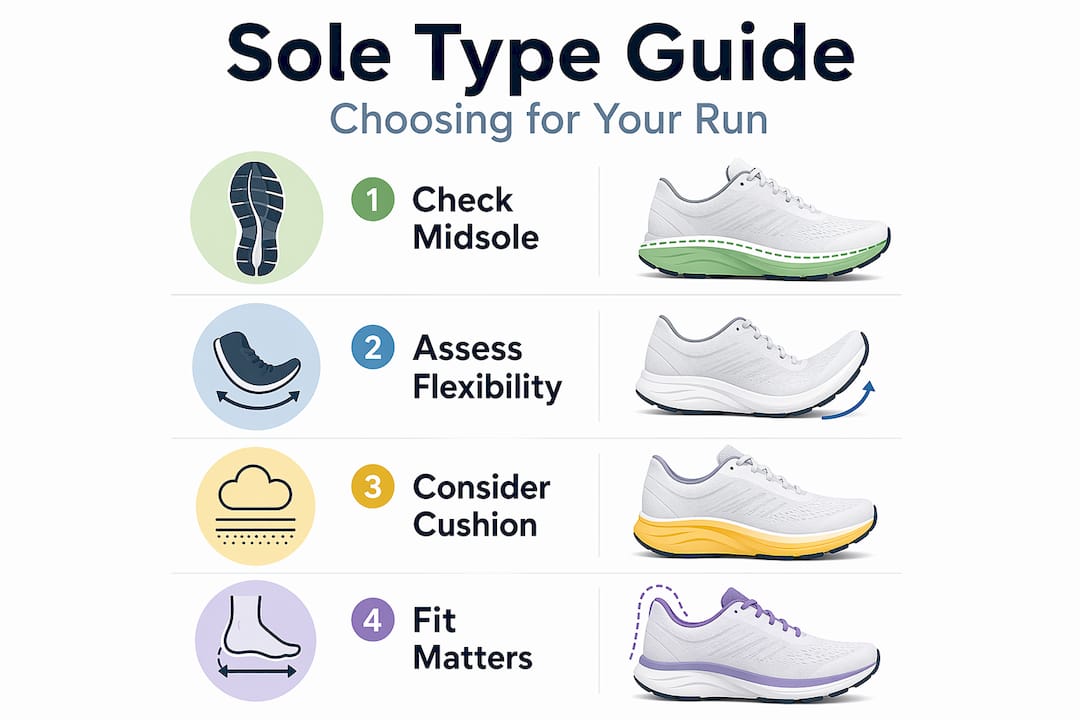
One often-overlooked element of sole design is shape. A rocker sole curves upward at the toe and sometimes at the heel, encouraging a rolling motion through the gait cycle. This reduces load on the forefoot and metatarsals and is increasingly common in both performance and recovery shoes. For runners with forefoot pain or a stiff big toe joint, it can be genuinely transformative.
Pro Tip: When you pick up a shoe in a shop, flex the outsole manually. A road shoe should bend near the forefoot with moderate resistance. If it folds flat with no resistance, it lacks the structural integrity most runners need.
Cushioning types and their biomechanical effects
Here is where the science becomes genuinely surprising, and where most running shoe marketing falls short of the truth.
A widely cited 2025 study of 25 male runners tested four midsole hardness levels and found that softer cushioning increases impact peak while actually reducing loading rate. That sounds contradictory until you understand what the body is doing. Runners do not passively absorb impact through cushioning. They actively adjust muscle and tendon stiffness to maintain dynamic stability, regardless of what is underfoot.
The same research revealed something equally striking about joint behaviour. Ankle stiffness increases with softer midsoles, while knee stiffness decreases. This is a neuromuscular strategy. Your body compensates at the ankle to regulate overall limb stiffness when the shoe provides less resistance. This adaptation was significant at running speeds of both 2.3 and 3.3 metres per second, meaning it occurs whether you jog or run at a moderate tempo pace.
What this tells you practically is that midsole cushioning is a complex variable. Putting on a maximalist shoe does not automatically protect your knees. It shifts load distribution and triggers a biomechanical response that varies between runners.
Here is a quick summary of how the main cushioning types compare:
| Foam type | Cushioning feel | Energy return | Durability | Weight |
|---|---|---|---|---|
| Standard EVA | Moderate, neutral | Low to moderate | Good | Light |
| PEBA | Plush yet responsive | High | Moderate | Very light |
| TPU | Firm, structured | Moderate | High | Moderate |
| Dual-density EVA | Varies by zone | Low to moderate | Good | Moderate |
For road running, prioritising advanced foam quality such as PEBA or high-grade EVA is worth the investment if you run more than 40 kilometres per week. The energy return compounds over long distances, and the superior joint protection justifies the price difference over budget materials.
Pro Tip: Do not buy a shoe because the foam name sounds impressive. Ask how the midsole performs after 400 kilometres, not just on your first run. Foam compression set is the real test of value.
Stack height, flexibility, and foot health
Stack height is simply the total thickness of material between your foot and the ground, measured in millimetres at the heel and forefoot. Stack height balances cushioning and weight, but the trade-offs go deeper than those two variables.
Higher stack shoes (above 35mm at the heel) deliver obvious cushioning benefits for long runs and high-mileage weeks. But they also:
- Reduce proprioception, the sensory feedback your foot receives from the ground
- Raise your centre of gravity slightly, which can compromise lateral stability
- Add weight that compounds across thousands of strides
- Decrease the natural flexibility of the shoe through the forefoot
Lower stack heights (under 25mm) suit faster paces, track work, and runners who prefer ground feel. Many experienced runners find they perform better and feel more in control in a lower-stack shoe, particularly on shorter efforts.
Flexibility in running shoe soles connects directly to how freely your foot can move through its natural range of motion. A sole that is too rigid prevents the toes from extending properly at toe-off, which disrupts the propulsive phase of your stride. A sole with no structure at all fails to protect against surface irregularities and fatigues the foot flexor muscles faster.

Fit compounds all of these effects. Forefoot fit errors are one of the most common causes of running injuries that have nothing to do with sole type at all. A toe box that is too narrow causes nail bed trauma, blisters, and eventually structural toe problems. Podiatrists recommend a heel-to-toe drop between 6 and 10mm for most recreational runners, as this range supports a natural heel-strike without placing excessive load on the Achilles.
Pro Tip: Try on running shoes at the end of the day or after a run, when your feet are at their largest. Your foot swells during activity, and a shoe that fits perfectly in the morning may feel constrictive after 10 kilometres.
Matching sole type to your running style
Knowing the components is one thing. Knowing how to apply that knowledge to your own feet is what separates informed buyers from frustrated runners.
-
Identify your foot type. A flat or low-arched foot tends to overpronate (rolling inward excessively). Stability or motion-control shoes with a dual-density midsole or medial post address this. A high-arched foot typically underpronates (supinates), requiring a neutral shoe with plentiful cushioning and flexibility. You can assess this roughly with a wet foot test on paper, though a podiatrist-assessed gait analysis gives a far more reliable reading.
-
Match the outsole to your terrain. Road running outsoles use smooth or lightly patterned rubber for efficient energy transfer on hard surfaces. Trail running outsoles use deep, multidirectional lugs for grip on loose or uneven ground. Using trail shoes on tarmac accelerates lug wear and increases the energy cost of each stride.
-
Consider your weekly mileage. High-mileage runners benefit from a firmer, more durable midsole. Racing shoes with soft PEBA foam are not designed for 70km training weeks. They compress and lose their properties faster under sustained daily use.
-
Check your current shoe’s wear pattern. Excessive heel wear on the lateral side is normal for heel-strikers. Wear concentrated under the metatarsal heads suggests forefoot-striking. Unusual medial wear often points to overpronation and may indicate a need for more support.
-
Replace on mileage, not on tread appearance. Midsole cushioning degrades before outsole wear becomes visible. Research shows the outsole can last 1.84 times longer than the midsole. Runners who wait until the rubber looks worn are often already running on expired cushioning for weeks. Most training shoes last between 600 and 800 kilometres.
For a broader look at how sole constructions map onto different running categories, Ydauk’s guide to shoe sole types is worth reading alongside this article.
My take: what the research changed for me
I spent years recommending cushioned shoes to runners who complained of knee pain, operating on the assumption that more padding meant less impact. The biomechanics research on midsole hardness changed my thinking fundamentally.
What I’ve learned is that the body is not passive. It recalibrates constantly. When you put on a maximalist shoe, your nervous system detects the softness underfoot and stiffens the ankle accordingly. The joint stiffness modulation is a protective strategy, not a failure. This means the “right” sole is rarely the plushest one. It’s the one that your specific biomechanical profile works best within.
I’ve also seen runners make the same mistake repeatedly: they find a sole that feels extraordinary in a shop and buy three pairs. Then the model gets updated, the foam changes, and they’re back to square one. My advice is to focus on how a shoe fits and moves rather than the foam name on the box. Materials evolve quickly. Foot mechanics change slowly.
The fit issue is one I cannot stress enough. Proper shoe fit prevents far more injuries than any foam compound. I’ve seen runners with textbook-perfect sole selections still develop blisters and black toenails because the toe box was half a size too small. Get the fit right first. Then optimise the sole.
Sole technology is genuinely exciting right now. Carbon plates, bio-based foams, geometrically tuned rocker profiles. But no amount of engineering saves a shoe that does not fit the foot inside it.
— Panagiotis
How Ydauk approaches sole design
Ydauk’s YDA shoe technology brings together biomechanical research and advanced materials to address the exact trade-offs this article covers. Rather than defaulting to maximum cushioning, Ydauk focuses on designing soles that support the foot’s natural mechanics, distributing load intelligently across the midsole and outsole. The emphasis on energy efficiency means that each shoe is built to work with your gait rather than override it. If you want to understand exactly how Ydauk applies these principles in practice, the outsole technology guide explains the materials, construction choices, and biomechanical rationale behind each design decision. It’s a useful next step once you know what to look for.
FAQ
What is the most important layer in a running shoe sole?
The midsole is the most performance-critical layer, as it governs cushioning, energy return, and how your joints respond to impact forces during each stride.
Do softer running shoe soles reduce impact on your joints?
Not automatically. Research shows that softer midsoles increase ankle joint stiffness as a biomechanical response, meaning the body adapts rather than simply absorbing less force.
How do I choose running shoe soles for flat feet?
Flat-footed runners who overpronate benefit most from stability or motion-control shoes with dual-density midsoles or a medial post to limit inward rolling during the gait cycle.
When should I replace my running shoes?
Replace based on mileage rather than outsole appearance. Midsole cushioning degrades significantly before tread wear becomes visible, with most training shoes lasting between 600 and 800 kilometres.
Are running shoes with firm soles better for speed?
Firm, lower-stack soles are favoured for speed work and racing as they improve ground contact feedback and reduce the energy cost of each stride, though they offer less protection on longer runs.