
Louis Vuitton Shoe Size Chart: UK, US and EU Conversions
Louis Vuitton shoes are sized in European sizes, and the fit changes from style to style, so the chart is a starting point rather than the final word. Measure your longer foot in centimetres, find the nearest size in the conversion tables below, then adjust for the style: trainers tend to run large, loafers and dress shoes small and narrow. Always check the size chart on the product page of the exact pair you are buying, because that is the one that applies to that last.
The tables below are indicative conversions drawn from independent size guides. They are useful for orientation, not a guarantee.
TL;DR
- Measure your longer foot in centimetres, in the afternoon, wearing the socks you would wear with the shoes.
- Third-party guides suggest Louis Vuitton trainers can run large, so many buyers go down a size; loafers and dress shoes often run small and narrow, so many go up half a size.
- Conversions between UK, US and EU vary from chart to chart, so use centimetres as your common reference.
- Check width and toe room as well as length: a correct length with a tight midfoot still hurts.
- If you have a foot condition, diabetes or problem feet, ask a podiatrist before buying a narrow, sleek last.
Table of Contents
- How Louis Vuitton sizing works
- Louis Vuitton shoe size chart: women’s
- Louis Vuitton shoe size chart: men’s
- How to measure your foot for a Louis Vuitton size
- Do Louis Vuitton trainers run small or large?
- How loafers, dress shoes and other styles fit
- A worked example
- What to check before you order
- Foot health and a narrow last
- Perspective
- Comfortable everyday shoes built around foot health
- More measuring guides
- FAQ
- Sources
How Louis Vuitton sizing works
Louis Vuitton uses European sizing and sleek lasts, which can give a snug fit in the midfoot and toe area. That is the root of most “do they run small?” questions. The EU number is the anchor. UK, US and centimetre figures are conversions, and different guides convert slightly differently.
One independent guide notes that Louis Vuitton’s own conversions can sit a step lower than generic charts, for example mapping a women’s EU 38 to a US 7. If you shop from a UK size you already know, this matters: a generic converter may put you half a size or a full size away from what the brand intends.
The practical rule is simple. Work from your foot length in centimetres, not from a number in another country’s system. Then use the brand’s own chart for the specific model.

Louis Vuitton shoe size chart: women’s
These are approximate mappings from a 2025 independent conversion table. Treat the centimetre column as the foot length the size is meant for.
| UK | US | EU | Foot length (cm) |
|---|---|---|---|
| 1 | 5 | 34 | 20.1 |
| 4 | 7.5 | 37 | 23.5 |
| 5 | 8 | 38 | 24.4 |
| 8 | 10.5 | 41 | 26.9 |
The table shows only a handful of reference points. The sizes between them follow the usual pattern of roughly one EU size for every two thirds of a centimetre of foot length, but do not interpolate for a purchase. Read the exact line on the product page.
Louis Vuitton shoe size chart: men’s
The same 2025 table gives these approximate men’s mappings.
| UK | US | EU | Foot length (cm) |
|---|---|---|---|
| 4 | 5 | 37 | 23.5 |
| 7 | 8 | 40.5 | 26 |
| 9 | 10 | 43 | 27.7 |
| 11 | 12 | 45.5 | 29.4 |
Men’s Louis Vuitton sizes often appear on the brand’s own pages as a UK-style number (the trainer pages list sizes such as 04, 04.5 and 05). That number is not the same thing as a generic UK size, which is another reason to go by centimetres first.
Why charts disagree
You will find charts that put the same EU size against different US sizes. There are three common reasons:
- Brands round half sizes in different directions.
- Some guides convert from the brand’s own table, others from a generic industry table.
- Men’s and women’s scales overlap, and some guides blur them for unisex styles.
If two charts disagree, trust the one on the product page, then your centimetre measurement, and only then a third-party converter.
How to measure your foot for a Louis Vuitton size
A good measurement removes most of the guesswork. The method is the same whatever the brand.
- Stand on a sheet of paper on a hard, flat floor, with your heel against a wall.
- Mark the tip of your longest toe. It is not always the big toe.
- Measure from the wall to the mark in centimetres.
- Repeat with the other foot and use the longer measurement.
- Wear the socks you would normally wear with the shoes.
This follows the standard method: heel against a wall, measure to the longest toe, both feet, longer foot as the benchmark. Do it in the afternoon, because feet swell naturally during the day, and a morning measurement can leave you with a pair that pinches by evening.
If you want a more detailed walk-through, our guides cover the process step by step: how to find your shoe size accurately at home, measuring in millimetres and width without any device and finding your size in centimetres for UK online shoppers.
Measuring width
Length is only half of the answer. Measure the widest part of the foot, side to side, across the ball, without including the toes. Louis Vuitton has said its shoes were designed with narrower feet in mind but it also offers wider sizes, according to one retailer guide. If your foot measures broad, a size up in length is often not the answer: it gives you the width but leaves heel slip and wasted length. Our guide to measuring shoe width at home in four steps shows how to get a reliable number.

Do Louis Vuitton trainers run small or large?
The consistent message from independent guides is that trainers run large. The LV Trainer in particular can run large, and the brand’s own product page for one trainer colourway tells buyers it runs large and recommends selecting one size down from your usual size. Community advice on forums is often more dramatic, with some owners going down two sizes from a true US size, but that is anecdotal and depends on how the person converts their size in the first place.
A sensible approach:
- Start from your foot length in centimetres and the brand’s chart.
- Take one size down from your usual size for trainers where the product page says so.
- If your foot is wide or you wear thick socks, stay with the size the page recommends rather than going further down.
- If you are between sizes on the chart, think about the lacing. Lace-up trainers give you more adjustment than slip-ons.
How loafers, dress shoes and other styles fit
Style changes the fit more than most buyers expect. According to the same sizing guide, loafers and dress shoes often run small and narrow, Oxfords and derbies fall between true to size and slightly small, and some people size down in trainers and up in loafers. For the Time Out sneaker the guide says it runs a bit large. For loafers, or whenever you are unsure, it suggests going up half a size.
| Style | Typical fit reported | Common adjustment |
|---|---|---|
| Trainers (for example the LV Trainer) | Runs large | Down one size, as the product page advises |
| Time Out sneaker | Runs a bit large | Slightly down, check the page |
| Loafers | Small and narrow | Up half a size |
| Oxfords and derbies | True to size to slightly small | Usually true size, half up if in doubt |
| Flats | Mostly true to EU size, per one guide | Usually true size |
These adjustments are community and guide-level observations, not manufacturer guarantees. They reflect general patterns, and a particular season’s last may differ. That is why the model-specific chart matters.
A worked example
Suppose your longer foot measures 26 cm, you are a UK 7 in most shoes and you are looking at a pair of men’s trainers.
- The centimetre column in the men’s table puts 26 cm at UK 7 / EU 40.5 on that independent chart.
- Trainers run large, and the product page recommends one size down, so you would look at the next size below your usual.
- You check your width. If your foot is narrow, the smaller size is likely to feel secure. If it is broad, you would need to be careful and consider whether that last suits you at all.
- You compare the final choice against the chart on the product page, and if it differs from the table above, the product page wins.
Now take the same person looking at loafers. Same foot, but now the guidance points to half a size up, because the last is narrower and the toe box tighter. The same foot, two styles, two different sizes. That is normal.
What to check before you order
Before paying for anything in this price bracket, run through a short list.
- Length: about a thumb’s width, roughly 1 cm, between your longest toe and the end of the shoe when standing.
- Width: the ball of the foot should sit on the widest part of the shoe without being squeezed.
- Heel: it should not lift or slide when you walk.
- Instep: lace-ups should close without pressure on the top of the foot.
- Returns: check the return conditions before ordering, since a shoe that has been worn outdoors is rarely accepted back.
- Socks: measure and try on with the socks you will wear.
If you buy second-hand, the size on the insole may have worn off or been changed by a previous owner. Ask for the inner length in centimetres and compare it to your own measurement.
Foot health and a narrow last
A sleek, narrow last looks good, but it is not suited to every foot. If you have bunions, hammer toes, swelling, neuropathy or diabetes, a shoe that squeezes the forefoot can cause pressure points, blisters and skin damage. If that applies to you, have your feet measured by a podiatrist or a trained shoe fitter and ask whether a particular last is suitable before you order a fashion shoe. Do not rely on a chart alone.
Perspective
We look at sizing from a foot-health point of view, and the Louis Vuitton question shows why a chart alone is not enough. Two shoes with the same printed number can sit on completely different shapes of foot. A narrow last, a tapered toe box and a flat sole may look elegant, but they ask your foot to adapt to the shoe.
At Ydauk we start from the other end. Our footwear is designed around foot health, comfort and energy efficiency, with proprietary technology intended to stabilise and assist each step. We want you to wear shoes that look good and still let the foot do its job through a full day.
That is why we keep telling people to measure in centimetres, to measure both feet, to check width, and to treat every brand’s chart as a guide to a particular last rather than a universal truth. Once you know your real dimensions, you can shop with any brand more confidently and more calmly.
Panagiotis
Comfortable everyday shoes built around foot health
If measuring your feet has shown you that fashion lasts do not suit you, or you are looking for shoes you can wear all day without compromise, take a look at our high performance footwear. It combines style with comfort, and our technology is designed to support foot health for everyday wear, including for people with problem feet. You can read how it works on our technology of YDA shoes page.
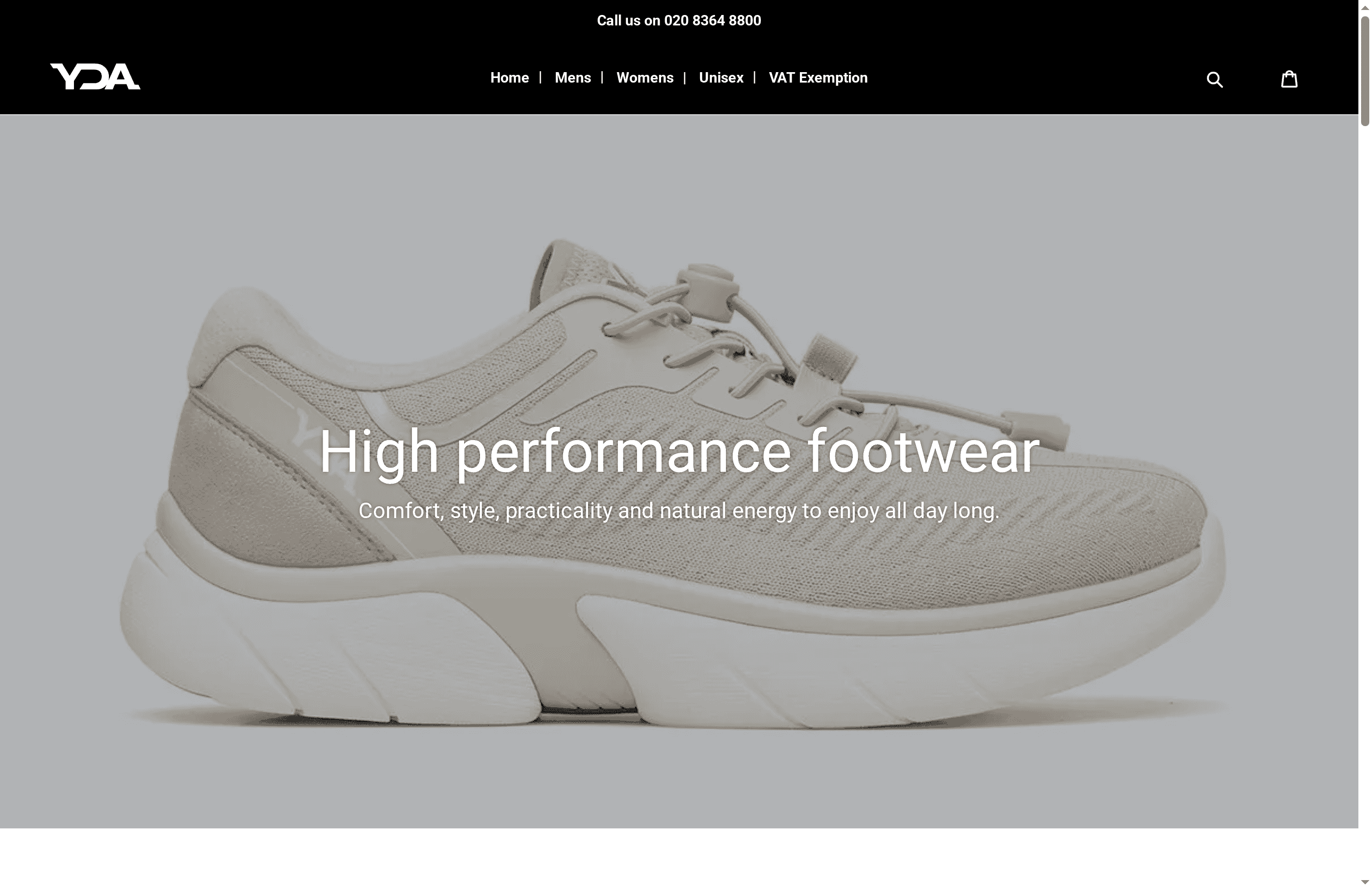
Stock changes often, so check the availability of each style on the site before you plan your purchase.
More measuring guides
If you want to get the numbers right before ordering from any brand, these pages cover the method in different depths:
- How to measure foot size for shoes at home
- Your 2026 home guide to measuring foot size
- Seven podiatrist-aligned steps to measure your shoe size
FAQ
Do Louis Vuitton sneakers run small?
Generally the reverse. Independent guides say the LV Trainer can run large, and the brand’s own page for one trainer recommends one size down from your usual size. Loafers and dress shoes are the styles that more often run small and narrow.
How does Louis Vuitton fit overall?
The brand uses European sizing and sleek lasts, which can feel snug at the midfoot and toe. Fit changes by style, so a person can be one size down in trainers and half a size up in loafers. Use the chart on the specific product page.
What are the different Louis Vuitton sizes?
Shoes are sized on an EU-based scale, with UK, US and centimetre conversions given alongside. Men’s pages may show numbers such as 04 or 05 that are not the same as a generic UK size. Match by foot length in centimetres to avoid confusion.
Should I go up or down a size in Louis Vuitton shoes?
It depends on the style. Go down for trainers where the product page says the shoe runs large, and consider half a size up for loafers or when in doubt. If your foot is wide, check the width options before changing length.
How do I measure my foot for Louis Vuitton shoes?
Stand with your heel against a wall and measure to your longest toe, in centimetres, for both feet. Use the longer foot, wear your usual socks and measure in the afternoon when feet are at their largest.
Sources
- Louis Vuitton Size Chart (size.ly)
- Louis Vuitton Shoe Size Chart: Are LV Shoes True to Size?
- Does Louis Vuitton Shoes Run Small: Sizing Guide 2026
- Louis Vuitton Size Chart - Women’s Shoes
- Louis Vuitton Shoe Size Chart: Are LV Good Fit?