
US shoe size chart: your complete conversion guide
TL;DR:
- A US shoe size chart converts foot length into standardized sizes, with different scales for men and women. Accurate measurement and brand-specific charts are essential to ensure the right fit when buying shoes online, as sizing varies across countries and brands. Using centimetre measurements and adding a fit allowance improves the accuracy of shoe sizing decisions.
A US shoe size chart converts your foot length into a standardised numeric label, with separate scales for men and women that differ from both UK and EU sizing systems. Getting this right before you buy online is the difference between a shoe that fits and one that goes straight back. The chart itself is straightforward once you understand the logic behind it. Men’s and women’s US sizes use the same foot length scale but apply different numeric labels, and neither maps directly onto UK or EU sizes without a conversion step. This guide covers measurement technique, gender differences, international conversions, children’s sizing, and brand quirks.
What is a US shoe size chart and how does it work?
A US shoe size chart maps foot length, measured in inches or centimetres, to a numeric size label using increments of one third of an inch, based on the Brannock device standard. The Brannock device is the metal measuring tool you find in most shoe shops. It has been the US industry standard for decades and forms the basis of every mainstream size chart.
The chart produces different numbers for men and women even when the underlying foot length is identical. Women’s sizes run roughly 1.5 higher than men’s for the same foot length. A US Men’s 8 and a US Women’s 9.5 correspond to the same measurement. That offset catches many shoppers out when they buy unisex or cross-gender styles.
EU sizing works on an entirely different unit called the Paris point, which equals approximately 6.67 mm. EU sizes carry no gender distinction, which makes them a cleaner reference point for international comparisons. UK sizes use the same one third of an inch increment as the US system but start from a different base point, which is why the numbers never match up neatly.
How to measure your foot length for US shoe sizing
Accurate measurement is the foundation of using any size chart correctly. Follow these steps to get a reliable reading.
- Place a sheet of paper on a hard floor against a wall. Stand on the paper with your heel touching the wall.
- Mark the tip of your longest toe with a pencil held vertically. Do not angle the pencil.
- Measure the distance from the wall to the mark in centimetres and in inches.
- Repeat for the other foot. Use the longer measurement for sizing.
- Add a 5–10 mm fit allowance to your measurement before matching it to a chart. This accounts for foot movement and natural swelling during the day.
Measuring at the end of the day matters. Feet swell by up to half a size over the course of a day, particularly after standing or walking. A morning measurement can leave you with shoes that feel tight by the afternoon.
Pro Tip: Always measure both feet. A difference of half a size between left and right is common. Size for the larger foot and use an insole in the smaller shoe if needed.
Once you have your centimetre measurement plus the fit allowance, match it to the US size column in a conversion chart. For reference, a foot length of 26 cm with a 5 mm allowance gives you a working measurement of 26.5 cm, which corresponds to approximately US Men’s 8.5 or US Women’s 10.
How do US, UK, and EU shoe sizes compare?
Understanding the offsets between sizing systems prevents costly mistakes when buying from international retailers.
US men’s versus US women’s sizes
US men’s and women’s sizes share the same foot length scale but apply different numeric labels. The women’s label is consistently 1.5 sizes higher. This matters when buying unisex trainers, which are typically listed in men’s sizes. A woman who wears a US Women’s 8 should order a US Men’s 6.5 in a unisex style.

US versus UK sizes
US and UK sizes differ by approximately 0.5 for men and around 2 full sizes for women. A US Men’s 10 is a UK 9.5. A US Women’s 8 is a UK 6. The UK system carries no gender distinction in its numeric scale, which is one reason the women’s offset looks so large when converting from US.
US versus EU sizes
EU sizes use Paris points and apply equally to men and women. The table below gives a practical reference across the most common adult sizes.
| Foot length (cm) | US Men’s | US Women’s | UK | EU |
|---|---|---|---|---|
| 23.5 | 5.5 | 7 | 5 | 38 |
| 25.0 | 7 | 8.5 | 6.5 | 40 |
| 26.5 | 8.5 | 10 | 8 | 42 |
| 28.0 | 10 | 11.5 | 9.5 | 44 |
| 29.5 | 11.5 | 13 | 11 | 46 |
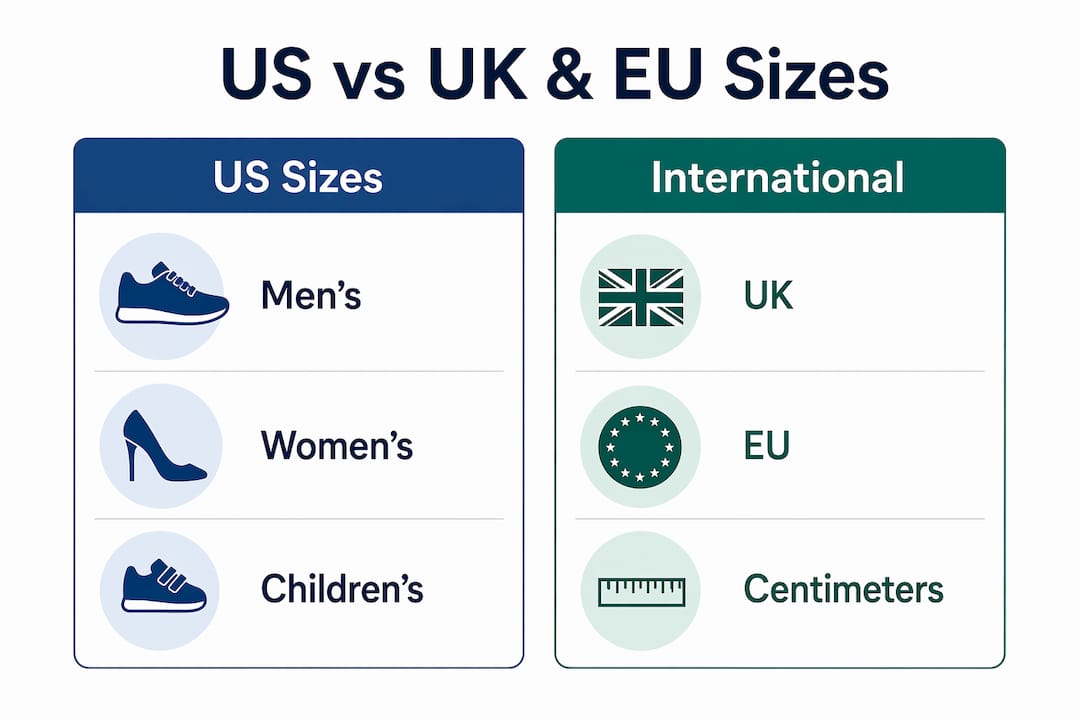
Width designations add another layer of complexity. In the US system, width codes run from 2A (narrow) through D (standard men’s) to 4E (wide). The UK uses similar letter codes but the measurements they represent differ. A US ‘E’ width is not the same as a UK ‘E’ width. Ignoring width designations significantly increases the risk of ill-fitting shoes even when the length sizing is correct.
Pro Tip: If you are buying from a European retailer, use your centimetre foot length as the primary reference rather than converting from a US size. EU charts are built directly from centimetre measurements and give you a more direct match.
Common pitfalls when using US shoe size charts online
Size charts give you a starting point. They do not guarantee a perfect fit because every brand builds shoes on a different internal shape called a last.
- Brand lasts vary widely. Generic size charts are a baseline; brand-specific lasts and construction philosophies cause real variation. Two shoes labelled US Men’s 9 from different brands can fit completely differently.
- Direct conversions can mislead. Never assume a US size converts cleanly to a UK or EU size without checking the specific brand’s chart. Some brands apply their own offsets.
- Extreme sizes are less reliable. For sizes outside the typical adult range, such as US Men’s below 4 or above 13, standard conversion offsets break down. Brand-specific charts become the only reliable reference at these extremes.
- Width affects fit as much as length. A shoe that is the right length but the wrong width causes pressure points, blisters, and long-term discomfort. Always check whether a brand offers width options before ordering.
- Returns are avoidable. Cross-referencing your centimetre foot length with the brand’s own size guide, rather than relying on a generic US size number, reduces the chance of ordering the wrong size.
Pro Tip: Search for the brand name plus “size guide” before you add anything to your basket. Most reputable footwear brands publish their own centimetre-to-size tables, which are more accurate than any third-party conversion chart.
Children’s US shoe sizes: what the letters mean
Children’s sizing uses letter suffixes that are not optional decoration. They carry real information about which scale the number belongs to.
The suffix ‘C’ stands for child and covers smaller sizes, typically from toddler upwards. The suffix ‘Y’ stands for youth and covers the larger children’s sizes that approach adult territory. Size 4Y differs fundamentally from size 4C. A 4Y is significantly larger. Confusing the two results in a shoe that either swamps a small foot or cannot go on at all.
The rollover problem makes this worse. Children’s and youth sizes roll over, meaning the same number appears in both the child and youth scales. Without the suffix visible on the product listing, you cannot tell which scale applies. Always confirm the suffix before purchasing.
| Foot length (cm) | US © | US (Y) | UK | EU |
|---|---|---|---|---|
| 16.0 | 10C | — | 9.5 | 27 |
| 18.0 | 12C | — | 11.5 | 29 |
| 20.0 | 2Y | — | 1.5 | 33 |
| 22.0 | 4Y | — | 3.5 | 36 |
| 23.5 | 5.5Y | — | 5 | 38 |
Children’s feet grow quickly. Measuring foot length every six to eight weeks during growth spurts is the most reliable way to stay ahead of sizing. A centimetre measurement is a more stable reference than a size number because it does not change meaning between brands or regions.
Pro Tip: Leave a 10–12 mm growth allowance when buying children’s shoes, rather than the standard 5–10 mm adult fit allowance. Children’s feet grow fast, and a little extra room prevents you from replacing shoes every few months.
How brands influence US shoe sizing
Most athletic brands use Mondopoint internally, measuring foot length in centimetres, then translate that measurement into US size labels for retail. The translation is not always consistent between brands, which is why the same US size number fits differently depending on who made the shoe.
Practical brand notes that experienced shoppers rely on:
- Nike running shoes tend to run narrow and slightly short. Sizing up by half a size is a common adjustment, particularly in performance trainers.
- Adidas generally aligns closely with Brannock device sizing, making their charts more predictable for most shoppers.
- Vans and Converse canvas styles typically run small. Many shoppers size up by a full size, especially in low-top styles where the fit is less structured.
- New Balance offers genuine width options across many styles, making their size guides more detailed and worth reading carefully.
The practical approach is to use your centimetre foot length as the anchor and then read the brand’s own size notes. If a brand states that a style runs large or small, treat that as a hard instruction rather than a suggestion. Brand-specific sizing notes show real variation in fit even for shoes carrying the same nominal US size label. Checking the brand’s size conversion guide before ordering takes two minutes and saves a return.
For a deeper look at how shoe width sizes affect fit across brands, width-specific guides give you the detail that length charts alone cannot provide.
Key takeaways
The most reliable approach to US shoe sizing combines an accurate centimetre foot measurement with brand-specific chart research, not a generic size number alone.
| Point | Details |
|---|---|
| Measure at day’s end | Feet swell during the day; an evening measurement gives the most accurate sizing baseline. |
| Add a fit allowance | Always add 5–10 mm to your foot length before matching to a US size chart. |
| Account for gender offset | US Women’s sizes run 1.5 higher than Men’s for the same foot length. |
| Check brand-specific charts | Generic conversion charts are a starting point; brand lasts cause real fit variation. |
| Use suffixes for children | Always confirm ‘C’ or ‘Y’ suffixes in children’s sizes to avoid rollover errors. |
Why I trust centimetres more than size numbers
Panagiotis here. After years of buying footwear from US, UK, and European retailers, the single most useful habit I have developed is ignoring the size number until I have confirmed my centimetre measurement against the brand’s own chart.
The number on the box is a label, not a measurement. It tells you roughly where you sit on a scale that was designed decades ago and has been interpreted differently by every brand since. I have worn everything from a US Men’s 9 to a US Men’s 10.5 in different brands, all of which fit my foot correctly. That range should tell you everything about how much the number alone is worth.
The mistake I see most often is shoppers converting a UK size to a US size using a generic table and ordering without checking the brand. The US shoe size chart is a tool, not a guarantee. Width is the other thing people consistently overlook. A shoe that is the right length but too narrow will cause problems within an hour of wear. If you have a wider foot, that detail matters as much as the length conversion.
My honest advice: measure your foot in centimetres, add your fit allowance, and then go directly to the brand’s size guide. Use the US size chart to orient yourself, not to make the final decision.
— Panagiotis
Ydauk’s approach to footwear fit
Getting the size right is only part of the equation. The way a shoe is built around your foot determines whether it actually supports you through a full day of wear.
Ydauk’s YDA Technology is built around foot health and energy efficiency, combining precise construction with materials that work with your foot’s natural movement rather than against it. The result is footwear where sizing accuracy and structural design work together. If you have used a size chart to find your measurement and want to understand how Ydauk translates that into a shoe built for comfort and performance, the YDA technology page gives you the full picture.
FAQ
What is the difference between US men’s and women’s shoe sizes?
US women’s sizes are approximately 1.5 sizes higher than men’s for the same foot length. A US Men’s 8 and a US Women’s 9.5 correspond to the same measurement.
How do I convert a US shoe size to EU?
Use your centimetre foot length as the reference point and match it directly to an EU size column. EU sizes are based on Paris points of approximately 6.67 mm and carry no gender distinction.
Why do shoes from different brands fit differently in the same US size?
Each brand builds shoes on a different internal shape called a last. Brand-specific lasts cause real variation in fit, which is why checking the brand’s own size guide alongside a generic chart gives you a more reliable result.
What do the letters ‘C’ and ‘Y’ mean in children’s shoe sizes?
‘C’ stands for child and ‘Y’ stands for youth. The same number appears in both scales, so the suffix is the only way to tell them apart. A 4Y is significantly larger than a 4C.
How much fit allowance should I add when using a US shoe size chart?
Add 5–10 mm to your measured foot length before matching to a size chart. This allowance accounts for foot movement and swelling during wear.