
Shoe sizes by inches: your complete fitting guide
TL;DR:
- Shoe sizes based on inches are foot length approximations and vary across US, UK, and EU systems. Converting measurements to centimetres and referencing brand-specific size charts ensure accurate sizing. Proper foot measurement, shoe type considerations, and understanding regional standards prevent common fitting mistakes.
Shoe sizes by inches are foot length approximations, not fixed universal measurements. No global standard ties an inch value directly to a shoe size label. The US, UK, and EU systems each use different historical units, which means the same inch measurement produces different size numbers depending on the region. Converting through centimetres, specifically the Mondopoint standard, is the most reliable method for accurate sizing across all systems. This guide explains how to measure your feet correctly, how the major sizing systems relate to inches, and how to avoid the most common fitting mistakes for casual, athletic, and specialist footwear.
How to measure shoe sizes by inches at home
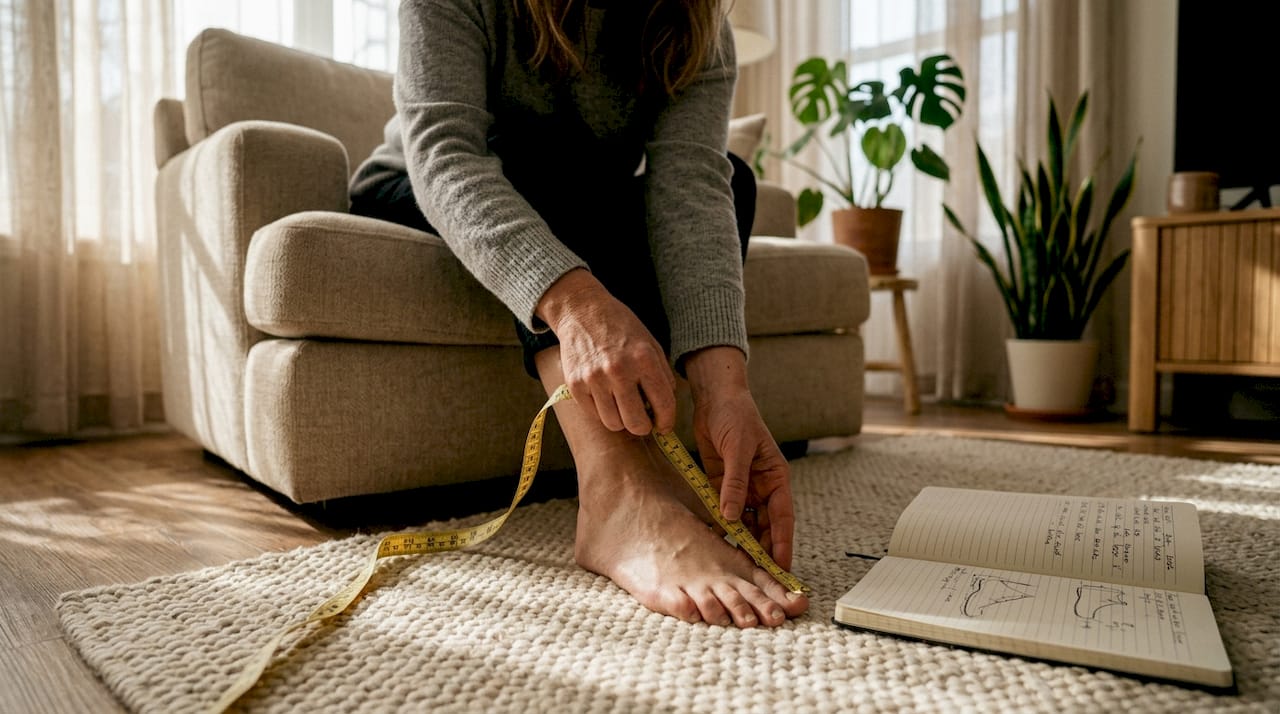
Accurate home measurement is the foundation of good shoe fit. The technique matters as much as the tool, and a few simple steps reduce the risk of ordering the wrong size.
The step-by-step method
- Place a sheet of paper on a hard, flat floor. Stand on it with your heel touching a wall. Do not measure on carpet, as it compresses under your weight and skews the result.
- Mark the tip of your longest toe. Use a pencil held vertically against the toe. The longest toe is not always the big toe, so check carefully.
- Measure from the wall to the mark. Use a ruler or tape measure. Read the measurement in inches to the nearest eighth of an inch. The error margin is approximately 1/8 inch, so avoid rounding up or down when comparing against a brand chart.
- Repeat for both feet. Biological asymmetry means one foot is often half a size larger than the other. Always size to the larger foot and manage the smaller foot’s fit with an insole if needed.
- Record both measurements. Write them down before comparing to any size chart.
Pro Tip: Measure your feet in the late afternoon or evening. Feet expand throughout the day due to weight bearing and natural swelling. Morning measurements consistently underestimate your true size, which leads to shoes that feel tight by mid-afternoon.
Adjusting for shoe type
Casual shoes generally require a snug fit close to your measured length. Athletic shoes need extra room in the toe box, roughly a thumb’s width, to accommodate foot movement during activity. Specialist footwear such as hiking boots or cycling shoes often have their own brand-specific fit guides that go beyond a simple length measurement. Always check the manufacturer’s chart for the specific style you are buying.
What are the major shoe sizing systems and how do they use inches?
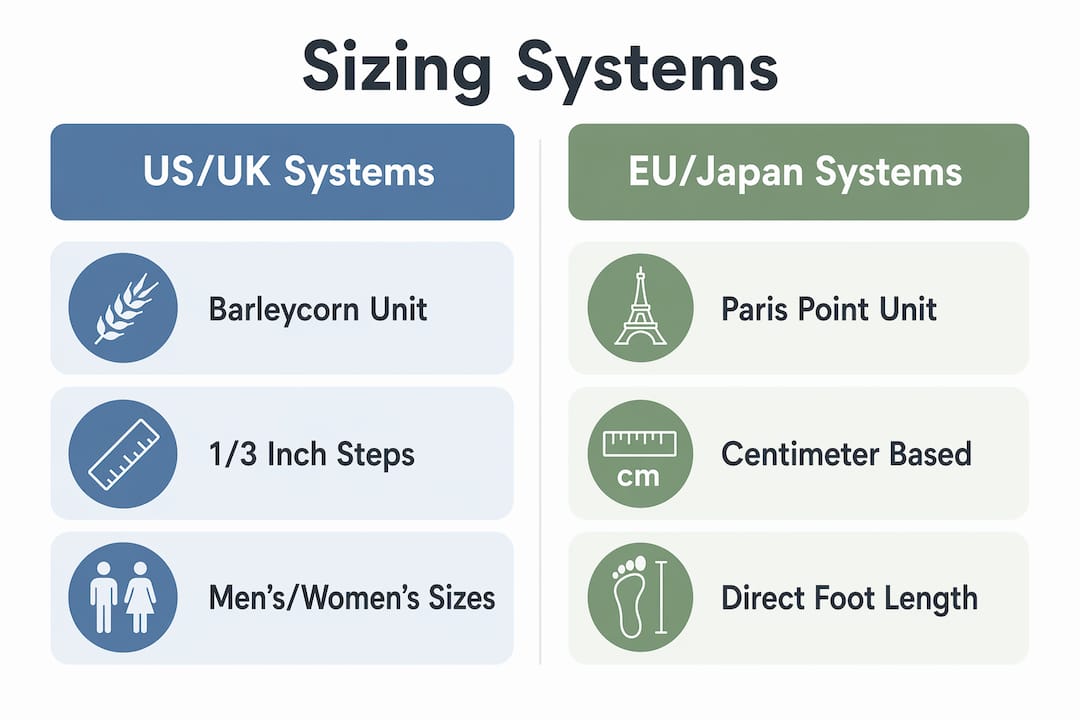
The three dominant systems, US, UK, and EU, each have a different relationship with inches. Understanding their origins explains why the same foot length produces three different size numbers.
US and UK systems: barleycorn increments
Both the US and UK systems use the barleycorn as their base unit, equal to one third of an inch (approximately 8.5 mm). Each full shoe size represents one barleycorn increment. US men’s sizing increases by approximately 1/3 inch per full size, but the two systems start from different points on the scale. A UK size 9 and a US men’s size 10 both correspond to a foot length of roughly 27.0 cm, but the labels differ by one full number. This starting-point difference is the source of most transatlantic sizing confusion.
Women’s sizes in the US system run approximately 1.5 sizes above men’s for the same foot length. UK women’s sizing follows a similar offset. Neither system uses a unisex scale, which adds another layer of complexity when shopping internationally.
EU system: Paris Points
The European system uses the Paris Point, equal to two thirds of a centimetre (approximately 6.67 mm). EU sizing uses Paris Point increments and applies a unisex scale, which removes the men’s and women’s split entirely. A foot length of 27.0 cm converts to approximately EU 43 regardless of gender. Because the Paris Point is metric, mapping it directly to inches introduces rounding errors. Centimetres serve as the natural bridge between EU sizes and inch-based measurements.
Japanese Mondopoint: the most direct system
The Japanese system, based on the ISO Mondopoint standard, expresses shoe size directly as foot length in centimetres. A size 27.0 in the Japanese system means a foot length of exactly 27.0 cm. Mondopoint is the most precise sizing standard because it removes the legacy unit conversion entirely. Many brands calibrate their internal sizing to Mondopoint and then translate to regional labels, which is why the size on the box is often a label rather than an exact physical measurement.
Pro Tip: When converting shoe measurements in inches to a size, convert to centimetres first by multiplying your inch measurement by 2.54. Then use that centimetre figure against the brand’s own size chart. This two-step approach avoids the rounding errors that come from mapping inches directly to barleycorn or Paris Point scales.
| Sizing system | Base unit | Unisex? | Foot length 27.0 cm |
|---|---|---|---|
| US men’s | Barleycorn (1/3 inch) | No | Size 10 |
| UK | Barleycorn (1/3 inch) | No | Size 9 |
| EU | Paris Point (6.67 mm) | Yes | Size 43 |
| JP Mondopoint | Centimetre | Yes | Size 27.0 |
What are the most common mistakes when using shoe measurements in inches?
Relying on inches alone produces sizing errors more often than most shoppers expect. The problems are structural, not accidental.
- Treating foot length and shoe size as the same thing. Foot length is the baseline, but perfect fit depends on footwear style and volume. A dress shoe and a trail runner with identical inch measurements will fit very differently because of differences in toe box shape, last construction, and intended use.
- Ignoring foot width. Length accounts for only one dimension. Narrow or wide feet require width fittings, typically labelled from B (narrow) to EE (wide) in US sizing. A shoe that matches your length but not your width will cause blisters and joint strain regardless of how accurate your inch measurement was.
- Measuring only one foot. Most people have feet of slightly different lengths. Sizing to the smaller foot causes discomfort on the larger side. The larger foot measurement is always the correct reference.
- Measuring in the morning. Morning measurements consistently produce a reading that is smaller than your afternoon foot size. Shoes bought on a morning measurement often feel tight by the end of the day.
- Assuming brand sizes are consistent. Manufacturers adjust labels internally, so a size 10 from one brand may fit differently from a size 10 from another. The inch or centimetre measurement on a size chart is an approximation, not a guarantee.
- Skipping toe box clearance for athletic shoes. Athletic and specialist footwear requires roughly a thumb’s width of space beyond the longest toe. Ignoring this leads to black toenails, numbness, and long-term nail damage during extended activity.
How do you convert shoe sizes between inches and standard systems?
Converting between inches and standard shoe sizes is straightforward when you follow a consistent process. The key is to use centimetres as the intermediary rather than mapping inches directly to size numbers.
The conversion process
Start with your foot length in inches. Multiply by 2.54 to get centimetres. Then match that centimetre figure to the relevant column in a shoe conversion chart for the system you need. For a foot length of 10.6 inches, the calculation is 10.6 × 2.54 = 26.9 cm, which corresponds to approximately US men’s 9.5, UK 8.5, and EU 42.
Always use the brand’s own size chart rather than a generic table. Standard conversion charts are estimates. Brands calibrate their lasts internally, so a generic chart may be off by half a size or more for a specific style.
Practical guidance by shoe type
- Casual shoes: Match your centimetre measurement closely to the chart. A snug fit with minimal extra room is generally correct.
- Athletic shoes: Add approximately 0.5 cm to your measured length before consulting the chart. This accounts for foot expansion during exercise and the thumb’s width clearance rule.
- Specialist shoes (hiking, cycling, ski boots): Follow the brand’s specific fitting guide. Many specialist manufacturers publish their own measurement instructions that go beyond simple length.
- Online shopping: Use the step-by-step fitting guide to measure both feet and record width as well as length before placing an order.
- In-store fitting: A Brannock Device measures length, arch length, and width simultaneously. It remains the most thorough single-tool measurement available and is worth using when buying expensive or specialist footwear.
For a thorough pre-purchase check, the shoe fit checklist covers both length and width considerations across different footwear categories.
Key takeaways
Centimetres, not inches, are the reliable anchor for converting foot length to shoe size across all major sizing systems.
| Point | Details |
|---|---|
| No universal inch standard | US, UK, and EU systems use different legacy units, so inches alone cannot determine a size. |
| Convert via centimetres | Multiply your inch measurement by 2.54, then use the brand’s own size chart for accuracy. |
| Measure both feet, use the larger | Foot asymmetry is common; sizing to the smaller foot causes discomfort. |
| Measure in the afternoon | Feet expand throughout the day; morning measurements consistently underestimate true size. |
| Account for shoe type | Athletic and specialist shoes need extra toe box room beyond your bare foot measurement. |
Why inches are a starting point, not a solution
I have seen the same sizing mistake repeated more times than I can count. Someone measures their foot in the morning, rounds the inch figure to the nearest half, looks up a generic size chart, and orders confidently. The shoe arrives and it pinches. They assume the brand runs small. The real problem is the process, not the product.
Inches give you a rough starting point. They do not tell you anything about the shape of the last, the volume of the toe box, or how a particular brand has calibrated its sizing internally. I have tried on two pairs of shoes from different manufacturers, both labelled the same size, and found a noticeable difference in fit. That is not a defect. It is the natural result of each brand building to its own internal standard.
The afternoon measurement rule is the single most underrated piece of advice in shoe fitting. Feet genuinely do expand over the course of a day. Buying shoes on a morning measurement is like buying trousers after a fast. The fit will not hold by evening.
My honest recommendation is to treat your inch measurement as a starting figure, convert it to centimetres, and then trust the brand’s own chart over any generic conversion table. For specialist or performance footwear, a Brannock Device measurement in store is worth the extra effort. The size label is a label. Your centimetre measurement is the fact.
— Panagiotis
Ydauk’s approach to fit beyond the size label
Getting the right size number is only part of the equation. The construction of the shoe itself determines whether that number translates to genuine comfort across a full day of wear.

Ydauk builds its footwear around YDA Technology, an approach to shoe construction that prioritises foot health and energy efficiency alongside fit. The YDA shoe technology page explains how the manufacturing process addresses the limitations of standard sizing by engineering shoes that support natural foot mechanics rather than simply matching a length measurement. If you have measured carefully and still struggle to find shoes that feel right by the end of the day, the issue is often construction rather than size. Ydauk’s range is designed with that gap in mind.
FAQ
What is the most accurate way to measure shoe size at home?
Stand on a hard floor with your heel against a wall, mark the tip of your longest toe, and measure in inches or centimetres. Measure both feet in the afternoon and use the larger measurement.
How do I convert my foot length in inches to a shoe size?
Multiply your foot length in inches by 2.54 to get centimetres, then match that figure to the brand’s own size chart for US, UK, or EU sizing.
Why do the same shoe sizes fit differently across brands?
Brands calibrate their lasts internally, so size labels are approximations rather than exact physical measurements. A size 10 from one manufacturer may differ noticeably from a size 10 from another.
Do men’s and women’s shoe sizes use different inch measurements?
The inch measurements for a given foot length are the same regardless of gender, but US and UK size labels differ between men’s and women’s scales. EU Mondopoint sizing uses a single unisex scale.
How much extra room should I allow in athletic shoes?
Athletic shoes generally need approximately a thumb’s width of space beyond the longest toe. This accounts for foot expansion during exercise and prevents toe damage on longer runs or hikes.