
US shoe sizes explained: your complete fit guide
TL;DR:
- US shoe sizes are based on the barleycorn measurement system, with each size adding 8.47 millimeters in length. Accurate fitting depends on measuring foot length and width, considering gender differences, and checking brand-specific size charts. Proper measurement and understanding of sizing help prevent discomfort and ensure shoes fit correctly.
US shoe sizes are a standardised measurement system based on the barleycorn unit, designed to quantify foot length and width across distinct scales for men, women, and children. Getting this system wrong costs you money and comfort. Buying shoes online without understanding US shoe sizes means you risk ordering a size that fits the label but not your foot. The Brannock Device, invented in 1925, remains the industry standard for taking these measurements, and brands from Nike to New Balance still reference its conventions. This guide cuts through the confusion so you can buy with confidence every time.
How are US shoe sizes determined and measured?
US shoe sizing is based on the barleycorn, a unit equal to one third of an inch (8.47 mm). Each full size increment adds one barleycorn in length. That means the difference between a US size 9 and a US size 10 is just 8.47 mm, which explains why half sizes matter so much in practice.
The Brannock Device measures both foot length and arch length, then uses the longer of the two to determine your size. Width is measured separately and expressed as a letter code. Standard width codes for men run from A (narrow) through D (standard) to 4E (extra wide). Women’s standard width is B, with wide coded as D.
Foot length alone does not tell the full story. A foot that is long but narrow will fit differently from one that is short but wide. This is why width codes differ between men’s and women’s systems, and why checking both dimensions before buying is non-negotiable.
- Full sizes increase by one barleycorn (8.47 mm) in length
- Half sizes add approximately 4.2 mm
- Standard men’s width: D
- Standard women’s width: B
- Wide men’s width: 2E or 4E
- Wide women’s width: D
Pro Tip: Feet swell by up to half a shoe size throughout the day. Measure your feet in the evening to capture their largest size and avoid buying shoes that feel tight by afternoon.
What are the differences between men’s, women’s, and children’s sizes?
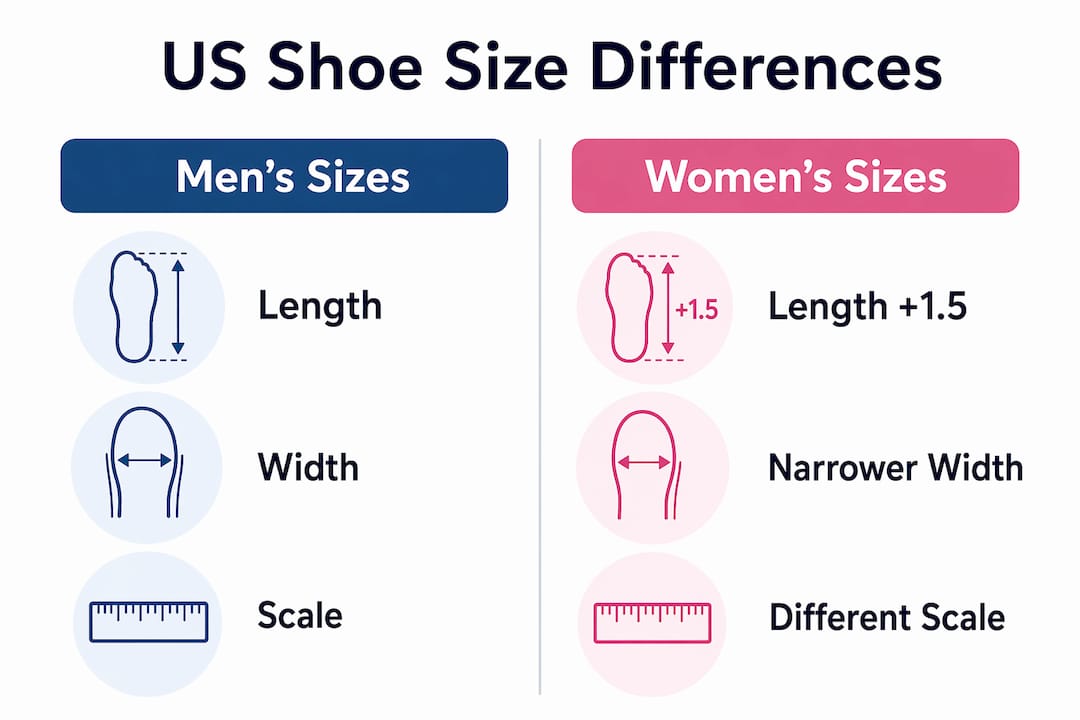
Women’s US sizes run approximately 1.5 sizes larger than men’s for the same foot length. A foot measuring 26 cm corresponds to a women’s size 9 and a men’s size 8.5. This offset trips up shoppers constantly, particularly when buying unisex styles or shopping across gender lines.

Children’s sizing uses a separate scale entirely. Toddler sizes run from 0 to 13.5, then youth sizes pick up from 1 and run to 7, at which point they align with adult sizes. A youth size 7 is equivalent to a women’s size 8.5 or a men’s size 7. Parents buying for older children should check whether a youth size or a small adult size offers better width options for their child’s foot shape.
| Foot length (cm) | Women’s US size | Men’s US size | Youth size |
|---|---|---|---|
| 22 cm | 5 | 3.5 | 4Y |
| 24 cm | 7 | 5.5 | 6Y |
| 26 cm | 9 | 7.5 | — |
| 28 cm | 11 | 9.5 | — |
Width codes also shift between genders. A man buying a women’s shoe in his equivalent size will likely find the width too narrow, because women’s standard B is narrower than men’s standard D. Always cross-reference width when converting between gender scales, not just length.
How do US shoe sizes compare with UK, EU, and international sizing?
US and UK sizes differ by approximately half to one full size, depending on gender. US men’s size 10 equals UK size 9.5. EU sizing uses the Paris Point system, where one Paris Point equals two thirds of a centimetre. EU sizing applies the same scale to both men and women, which makes it simpler for international conversions.
Centimetres are the most reliable anchor when converting between sizing systems. A foot measuring 28 cm corresponds to EU 44, US men’s 10, and UK men’s 9.5. Using your foot length in centimetres removes the guesswork that comes from jumping between regional numbering schemes.
Men’s size conversion table
| Foot length (cm) | US men’s | UK men’s | EU |
|---|---|---|---|
| 25 cm | 7 | 6.5 | 40 |
| 26.5 cm | 8.5 | 8 | 42 |
| 28 cm | 10 | 9.5 | 44 |
| 29.5 cm | 11.5 | 11 | 46 |
Women’s size conversion table
| Foot length (cm) | US women’s | UK women’s | EU |
|---|---|---|---|
| 22 cm | 5 | 2.5 | 35 |
| 24 cm | 7 | 4.5 | 37.5 |
| 26 cm | 9 | 6.5 | 40 |
| 27.5 cm | 11 | 8.5 | 42 |
- Always measure foot length in centimetres before consulting any conversion chart
- EU sizing is consistent across genders, making it the most portable reference point
- UK sizes sit roughly 0.5 below US men’s sizes and roughly 2.5 below US women’s sizes
- Japanese sizing uses foot length in millimetres directly, which removes conversion steps entirely
When shopping from international retailers, look for the centimetre measurement listed alongside the size number. If a retailer only lists one regional size, use a centimetre-based chart rather than a size-to-size conversion to avoid compounding errors.
Why do brand-specific sizing and foot shape affect fit?
Different brands use different shoe lasts, the physical moulds around which shoes are constructed. The same US size fits differently depending on the last a manufacturer uses. A size 9 from one brand may feel roomy where another feels snug, even when both are labelled identically. This is not a quality issue. It is a design choice that reflects each brand’s target foot shape.
The internal width of men’s US size 9 shoes varies from 86.2 mm to 102.4 mm across brands, based on measurements of over 850 shoe moulds. The average sits at 94.4 mm. That 16 mm range is the difference between a comfortable fit and a shoe that causes blisters within an hour. Width variability is the single most underestimated factor in shoe buying.
Consulting a brand-specific size guide before purchasing is the most direct way to account for last differences. Many brands publish their own width measurements alongside standard codes. Customer reviews that mention fit width are also a practical signal, particularly for online purchases where you cannot try before you buy.
- Check the brand’s own size chart, not just the standard US size number
- Read customer reviews specifically for comments on width and fit length
- If a brand runs narrow, size up in width rather than length
- Athletic shoes and dress shoes use different last shapes, even within the same brand
Pro Tip: Shoes rarely stretch significantly after purchase. If a shoe feels uncomfortable at the point of trying it on, it is the wrong size. Do not rely on a break-in period to fix a poor fit.
What practical steps should shoppers take to find the right size?
Measuring your feet accurately at home takes less than five minutes and removes most of the uncertainty from online shoe buying. Follow these steps before consulting any size chart.
- Gather your materials. You need a sheet of paper larger than your foot, a pencil, a ruler, and a flat wall.
- Trace your foot in the evening. Place the paper on a hard floor, stand with your heel against the wall, and trace around your foot. Feet swell throughout the day, so evening measurement captures the largest size.
- Measure length and width. Measure from the heel mark to the longest toe in centimetres. Then measure the widest part of the foot outline for width.
- Measure both feet separately. Size according to the larger foot. Most people have one foot slightly larger than the other, and the smaller foot can always be accommodated with an insole if needed.
- Use centimetres to find your size. Cross-reference your foot length in centimetres against the brand’s own size chart. Do not rely on a previous size from a different brand.
- Check for wiggle room. A properly fitting shoe should have approximately 1 cm of space between your longest toe and the end of the shoe. This prevents pressure injuries during extended wear.
- Read fit-specific reviews. Before confirming an online order, search for reviews that mention whether the shoe runs true to size, long, or short. This is especially useful for brands you have not bought from before.
For a more detailed walkthrough, Ydauk’s step-by-step fitting guide covers professional fitting techniques adapted for home use.
Key takeaways
Accurate shoe fit depends on measuring foot length in centimetres, accounting for gender-specific size scales, and checking brand-specific width data rather than relying on a single size number.
| Point | Details |
|---|---|
| Barleycorn is the base unit | Each US size increment adds 8.47 mm; half sizes add approximately 4.2 mm. |
| Women’s sizes run 1.5 larger | A 26 cm foot is women’s size 9 and men’s size 7.5; always convert by foot length, not label. |
| Width varies widely by brand | Men’s size 9 internal width ranges from 86.2 mm to 102.4 mm across brands. |
| Centimetres anchor conversions | Use foot length in cm to convert between US, UK, and EU systems accurately. |
| Comfort at purchase is final | Shoes do not stretch meaningfully; if it feels wrong in the shop, it is the wrong size. |
Why I always measure first and trust labels second
People assume their shoe size is fixed. It is not. Feet change with age, weight, and even the time of day. I have seen shoppers confidently order a size 9 in a new brand and receive something that fits like a size 8. The label said 9. The last was cut narrow. The result was a return and wasted time.
The most common mistake I encounter is treating a size number as universal. A US size 10 from one manufacturer and a US size 10 from another can differ by more than a centimetre in internal length, and by up to 16 mm in width. That is not a rounding error. That is a completely different shoe.
My advice is simple: measure your feet in centimetres every six months, because feet do change, and always use that measurement as your starting point. Cross-reference it against the brand’s own chart, check the width code against your measured width, and read at least five customer reviews that mention fit. If a shoe feels tight across the toes or loose at the heel when you first try it on, walk away. The break-in myth has caused more bunions and blisters than any other piece of bad footwear advice.
Prioritise your foot shape over the number on the box. The number is a starting point. Your centimetre measurement and the brand’s width data are what actually determine fit.
— Panagiotis
Ydauk’s approach to sizing and foot health technology
Ydauk designs footwear around the principle that fit and foot health are inseparable. The brand’s YDA shoe technology is built to support natural foot mechanics, which means accurate sizing is not just a convenience but a functional requirement for the shoe to perform as intended.

Ydauk publishes detailed size and width charts for every model, making it straightforward to match your centimetre measurements to the right fit. The brand’s shoe width fitting guide covers width codes in depth, including how to identify your width category at home. If you are buying performance footwear for the first time, starting with accurate measurements and Ydauk’s sizing resources removes the guesswork from the process entirely.
FAQ
What is the barleycorn unit in US shoe sizing?
The barleycorn is a unit equal to one third of an inch (8.47 mm). Each US shoe size increment adds one barleycorn in length, and the Brannock Device uses this unit as its measurement basis.
How do I convert US women’s sizes to men’s sizes?
Women’s US sizes run approximately 1.5 sizes larger than men’s for the same foot length. Subtract 1.5 from a women’s size to find the equivalent men’s size, or use foot length in centimetres for greater accuracy.
What is the difference between US and UK shoe sizes?
US men’s sizes are approximately 0.5 larger than UK men’s sizes. US women’s sizes are approximately 2 larger than UK women’s sizes. Using foot length in centimetres is the most reliable way to convert between the two systems.
Why does the same US size fit differently across brands?
Brands use different shoe lasts, the moulds that determine internal shape and width. The internal width of men’s size 9 shoes varies from 86.2 mm to 102.4 mm across brands, so the same size number can produce a very different fit depending on the manufacturer.
When is the best time to measure my feet for shoe size?
Measure your feet in the evening. Feet swell by up to half a shoe size throughout the day, and an evening measurement captures the largest size, giving you the most accurate fit reference for buying shoes.