
Footwear size chart: find your perfect fit
TL;DR:
- Proper shoe fit begins with accurate foot measurements, considering both length and width for comfort and health.
- Using Mondopoint as a universal reference simplifies size conversion across regional systems, reducing fitting errors.
A footwear size chart converts your measured foot length and width into the correct shoe size across international sizing systems, giving you a reliable reference before you buy. Between 63% and 72% of people wear incorrectly fitting shoes, leading to blisters, pain, and long-term foot problems. That figure is striking because the fix is straightforward: measure your feet accurately, consult the right size chart, and cross-reference it with brand-specific guidance. This guide covers every step of that process, from understanding how US, UK, EU, and Mondopoint systems differ, to measuring both feet correctly, to knowing why width matters as much as length.
What are the main footwear sizing systems and how do they compare?
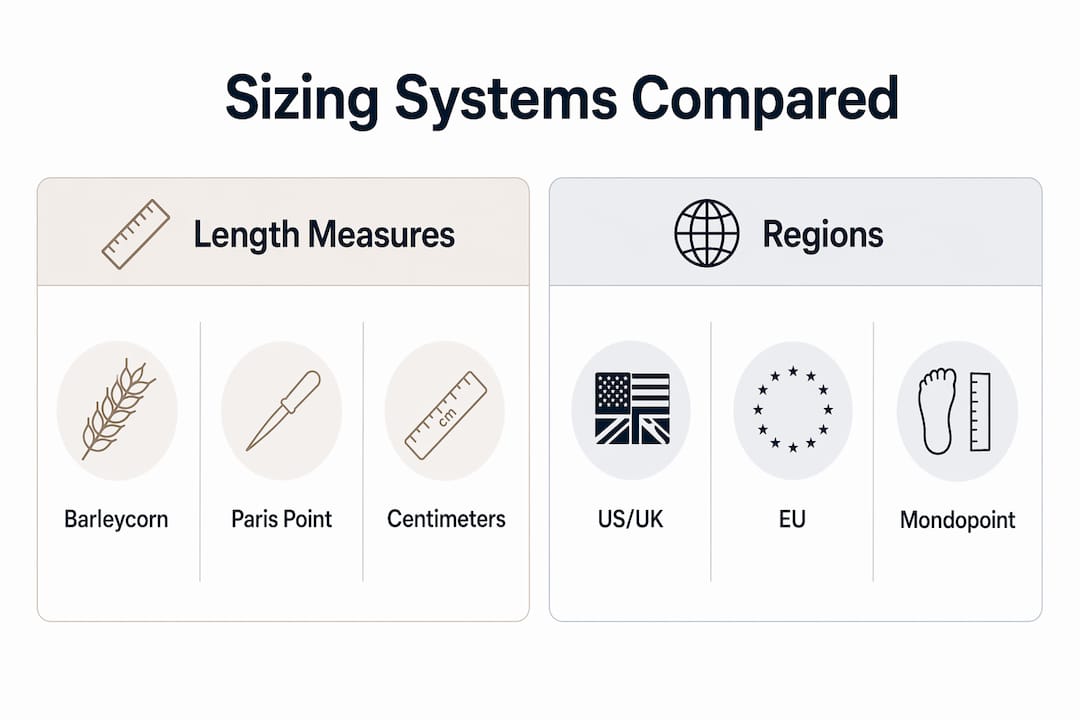
Four major sizing systems dominate global footwear: US, UK, EU, and Mondopoint. Each uses a different unit of measurement and a different starting point, which is why a size 9 in one country bears no obvious relationship to a size 9 in another.
The US system uses barleycorn increments (one barleycorn equals approximately 8.47mm), with separate scales for men and women. US women’s sizes run approximately 1.5 sizes larger than men’s for the same foot length, so a woman with a 26cm foot wears a US 8 while a man with the same foot wears a US 6.5. This gender offset confuses many shoppers buying unisex or cross-gender styles.
The EU system is unisex and based on Paris Point increments of 6.67mm. A EU 42 corresponds to a foot length of roughly 26.7cm. Because the increments are smaller than barleycorn, EU sizes climb faster numerically. The UK system also uses barleycorn but starts at a different zero point, sitting roughly one size below the US men’s scale.
Mondopoint, used widely in Japan, Korea, and military procurement, is the most direct system of all. It simply states the foot length in centimetres or millimetres. A Mondopoint 260 means the shoe fits a 26cm foot. Mondopoint is the most reliable universal reference for comparing sizes across brands and regions because it anchors to a physical measurement rather than an arbitrary scale.
The table below shows how common sizes align across systems for adult feet:
| Foot length (cm) | EU | UK (men) | US (men) | US (women) | Mondopoint |
|---|---|---|---|---|---|
| 24.5 cm | 39 | 5.5 | 6 | 7.5 | 245 |
| 26 cm | 41 | 7 | 7.5 | 9 | 260 |
| 27 cm | 42 | 8 | 8.5 | 10 | 270 |
| 28 cm | 43–44 | 9 | 9.5 | 11 | 280 |
| 29.5 cm | 45 | 10.5 | 11 | 12.5 | 295 |
Half sizes exist in US and UK systems and represent a single barleycorn increment. If your foot length falls between two whole sizes, always choose the half size up rather than down.
Pro Tip: When buying shoes from a brand that uses a different regional system, convert using your Mondopoint measurement first. It removes the guesswork from any size conversion chart.
How to measure your feet accurately for the correct shoe size
Accurate measurement is the foundation of every good shoe purchase. The process takes five minutes and requires only paper, a pencil, and a ruler.
- Prepare your surface. Place a sheet of A4 paper on a hard floor against a wall. Stand on the paper with your heel touching the wall and your full weight on that foot.
- Mark your longest toe. Hold the pencil vertically and mark the tip of your longest toe. For most people this is the big toe, but for some it is the second toe. Mark both feet.
- Measure in the evening. Foot size fluctuates during the day, swelling by up to half a size between morning and evening. Measuring at the end of the day gives you the largest measurement and prevents buying shoes that feel tight by afternoon.
- Use the larger foot. Most people have one foot slightly larger than the other. Always size to the larger foot and use an insole or thicker sock on the smaller foot if needed.
- Measure foot width. Mark the widest point across the ball of your foot, then measure that distance in millimetres. This figure is as important as length for finding a comfortable fit.
- Record in centimetres. Convert your measurement to centimetres. This is your Mondopoint reference and the number you will use against any foot measurement chart.
Pro Tip: The shoe’s internal length should be 5 to 10mm longer than your foot length to allow natural toe splay when walking. If a shoe matches your foot length exactly, it is too short.
A common mistake is measuring while seated, which underestimates foot length because your full body weight is not spreading the foot. Another is measuring only once and assuming the result is permanent. Foot size changes with age, weight fluctuation, and pregnancy, so remeasure at least once a year.

Why shoe width and brand-specific sizing matter beyond length
Length gets most of the attention on a size chart, but width is where fit problems actually originate for a large proportion of shoppers. Width is critical for fit, yet brands use letters like B, D, and 2E without any universal standard governing what those letters mean in millimetres.
In the US system, the standard width for women is B (medium) and for men is D (medium). Widths narrower than standard are labelled AA or AAA; widths wider than standard progress through E, 2E, 3E, and 4E. A person with a wide foot who buys a standard-width shoe in the correct length will still experience pain, pressure on the ball of the foot, and potential long-term issues including bunions and nerve compression.
The situation becomes more complicated because brands do not share a common last. A last is the foot-shaped mould around which a shoe is constructed, and it determines both the internal shape and the effective width at every point. A US size 9 in one brand may differ significantly in length or fit from another brand’s US 9, even if both claim to be standard width.
Consider these real-world examples:
- Nike running shoes are widely reported to run half a size small, particularly in the toe box, so many wearers size up.
- Vans canvas shoes run slightly small and narrow, which matters for anyone with a wider forefoot.
- New Balance is known for offering genuine wide-fit options across multiple widths, making their size charts more granular than most.
“Always check the brand’s own size guide and read customer fit reviews before purchasing. Generic size conversion charts give you a starting point, not a final answer.”
For foot health conditions such as plantar fasciitis, diabetes-related swelling, or hammer toes, width becomes a clinical consideration rather than a comfort preference. In those cases, consulting a podiatrist alongside a foot care specialist can prevent footwear from aggravating an existing condition.
How to use a footwear size chart when shopping online or in-store
Knowing your measurements is only half the process. Applying them correctly when you shop is where most people still go wrong.
- Start with your Mondopoint measurement. This is your foot length in centimetres, measured using the wall method described above. It is the one number that translates directly into any sizing system.
- Identify the sizing system used by the brand. Check whether the brand’s chart lists EU, US, UK, or cm sizes. Most international brands provide all four, but some regional brands use only one.
- Consult the brand’s own size chart. Generic size conversion charts are useful for orientation, but brand-specific charts account for the brand’s last shape and any known fit quirks. Never skip this step when buying online.
- Check the shoe type. Running shoes are typically worn with a thumb’s width of space at the toe for foot expansion during exercise. Dress shoes and boots are often cut narrower and may require sizing up. Casual trainers usually follow standard sizing.
- Factor in your width measurement. If your width measurement places you in a wide or narrow category, filter specifically for those options or contact customer service before ordering.
- Review the return policy before purchasing. Online shoe shopping carries inherent sizing risk. Retailers with free returns allow you to order two sizes and return the one that does not fit, which is a practical strategy when trying a new brand for the first time.
For a structured approach to buying healthy footwear online, cross-referencing your measurements with brand notes and customer reviews reduces the likelihood of a return significantly. Foot comfort products such as comfort insoles can also help fine-tune fit once you have the right size.
Key takeaways
A footwear size chart works best when combined with accurate foot measurements, width awareness, and brand-specific guidance rather than used as a standalone reference.
| Point | Details |
|---|---|
| Measure in the evening | Feet swell throughout the day; evening measurements give the most accurate reading. |
| Use Mondopoint as your anchor | Foot length in centimetres translates directly into any sizing system without conversion errors. |
| Width matters as much as length | Standard width labels (B, D, 2E) vary by brand; always check the specific brand’s width guidance. |
| Consult brand-specific charts | A size 9 in one brand can differ meaningfully from a size 9 in another due to different lasts. |
| Allow 5 to 10mm of toe room | The internal shoe length should exceed your foot length to allow natural movement and toe splay. |
Why I stopped trusting generic size charts years ago
I have spent a long time watching people make the same sizing mistake repeatedly: they find their size on a generic conversion chart, order with confidence, and then return the shoes because the fit is wrong. The chart was not lying. The problem is that a chart tells you what size label to look for, not whether that label will fit your specific foot in that specific shoe.
The insight that changed how I think about this is simple. Shoe size is a label. Foot length in centimetres is a measurement. Those are two different things, and conflating them is the root of most sizing frustration. Once you start thinking in Mondopoint, the fog clears. You know your number, you find the brand’s internal length specification, and you compare directly.
The other thing I would push back on is the idea that shoes need a break-in period. A properly fitting shoe should feel comfortable immediately, not after three weeks of wear. If a shoe hurts on day one, it is the wrong size or the wrong width. Accepting discomfort as normal is how people end up with long-term foot problems that are entirely preventable.
Measure your feet once a year. Width changes with age. Length can shift too. The five minutes it takes to remeasure is worth far more than the cost of a return or, worse, a pair of shoes you wear anyway because you cannot be bothered to send them back.
— Panagiotis
How Ydauk helps you find the right fit from the start
Ydauk designs shoes around YDA Technology, a proprietary approach to foot health that considers both the shape and the biomechanical needs of the foot. Getting the size right is the first step to experiencing what that technology actually does. Ydauk provides detailed sizing guidance alongside its product listings so you can match your foot measurements to the correct size before you order. For a deeper look at the engineering behind the fit, the YDA shoe technology page explains how each design decision connects to comfort and foot health. If you want a structured process for your next purchase, the 7-step fit checklist walks you through every consideration from measurement to final selection.
FAQ
What is a footwear size chart?
A footwear size chart is a reference table that converts your foot length and width measurements into the corresponding shoe size across different regional systems such as US, UK, EU, and Mondopoint. It gives you a starting point for selecting the correct size before purchasing.
How do I measure my foot for a size chart?
Place your heel against a wall on a sheet of paper, mark the tip of your longest toe, and measure the distance in centimetres. Measure both feet in the evening and use the larger measurement, as feet are largest at the end of the day.
Why does my size differ between brands?
Brands build shoes on different lasts, which are the internal moulds that determine shape and fit. A size 9 in one brand can differ meaningfully in length or width from a size 9 in another, which is why brand-specific size charts are more reliable than generic conversion tables.
What does shoe width labelling mean?
Width labels such as B, D, and 2E indicate how wide the shoe is across the ball of the foot. B is narrow for women, D is standard for men, and 2E is wide. These labels lack universal standardisation, so the same letter can represent different measurements across brands.
Should I size up or down if I am between sizes?
Always size up. A shoe that is slightly too long can be managed with a thicker sock or insole, but a shoe that is too short causes immediate pressure on the toes and long-term nail and joint damage. The internal length should be 5 to 10mm longer than your foot.