
Shoe conversion chart: your 2026 sizing guide
TL;DR:
- A shoe conversion chart helps compare sizes across different international systems using foot length as a reference. Measuring your foot accurately in centimetres and consulting brand-specific charts ensures a better fit than relying solely on size labels. Proper sizing reduces the risk of foot problems caused by wearing shoes that are too short or narrow.
A shoe conversion chart translates shoe sizes between international systems, using foot length as the common reference point to help you find the right fit. Without one, buying shoes from a US retailer when you know only your UK size is guesswork. The problem runs deeper than most shoppers realise: 63–72% of consumers wear shoes that do not fit correctly in length or width, largely because they rely on size labels rather than measured foot length. Sizing systems used across the US, UK, Europe, and Asia each use different baselines and units, so a direct number-to-number swap rarely works. The ISO Mondopoint standard (ISO 9407:2019) defines size in millimetres of foot length and is the most reliable cross-brand reference available in 2026. Understanding how these systems relate to each other, and how to measure your feet correctly, is the foundation of every accurate shoe purchase.

What are the main international shoe sizing systems?
Four major sizing systems dominate global footwear: US, UK, EU, and Mondopoint. Each uses a different unit and a different starting baseline, which is why perfect mathematical conversions are impossible. Charts serve as close approximations, not guarantees.
- US sizing uses a scale based on barleycorn units (one barleycorn equals one third of an inch), but applies different baselines for men and women. US men’s and women’s sizes differ by approximately 1.5 sizes, so a woman’s US 8 is not the same foot length as a man’s US 8. This offset catches many shoppers off guard when buying unisex styles.
- UK sizing also uses barleycorn units but starts from a different baseline than the US system. A UK men’s 7 is roughly equivalent to a US men’s 7.5, a difference that compounds across the size range.
- EU sizing is based on Paris points, where one Paris point equals two thirds of a centimetre. EU sizes are unisex by design, which removes the gender offset problem. A EU 42 corresponds to a foot length of approximately 26.5 cm for both men and women.
- Mondopoint (ISO 9407:2019) expresses size directly in millimetres of foot length. A Mondopoint 265 means a foot length of 265 mm. This system is used widely in military, ski boot, and professional athletic footwear because it removes all ambiguity about what a size number actually represents.
The core challenge is that each system was developed independently, with its own historical baseline. Converting between them requires a reference chart rather than a simple formula. Using centimetres or Mondopoint values as your primary reference reduces conversion errors and leads to better fitting shoes than relying on nominal size labels alone.
How to use a shoe conversion chart accurately
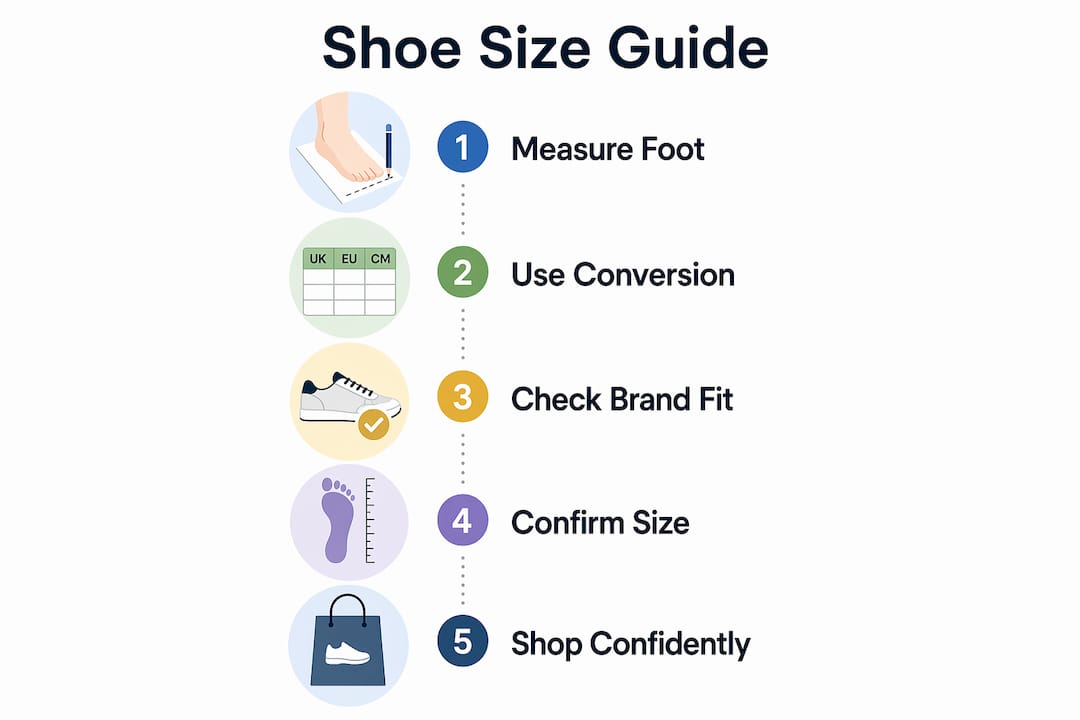
Accurate conversion starts with measuring your feet correctly, not with looking up your usual size number. Follow these steps every time you buy shoes in an unfamiliar sizing system.
- Measure both feet. Foot length differs between your left and right foot for most people. Always measure both and use the larger measurement as your reference.
- Measure at the end of the day. Feet swell slightly throughout the day. An evening measurement gives you the largest realistic foot length.
- Stand on a flat surface. Place a sheet of paper on the floor, stand on it, and mark the heel and the tip of your longest toe. Measure the distance in centimetres.
- Add a 5–10 mm buffer. A shoe needs 5–10 mm of extra space inside for toe splay and comfortable movement. Measure your foot, then select a shoe whose internal length matches your foot length plus that buffer.
- Cross-reference with the brand’s own chart. Once you have your foot length in centimetres, check the specific brand’s size chart rather than a generic conversion table. Brand charts account for their own shoe last dimensions.
- Round up when between sizes. If your foot length falls between two sizes, choose the larger one. A slightly longer shoe is far more comfortable than one that compresses your toes.
Pro Tip: Keep a note of your foot length in centimetres on your phone. When you shop online, compare that number directly against the brand’s internal shoe length rather than converting size numbers.
The table below gives a reference conversion for adult sizes. Use it as a starting point, then verify against brand-specific charts.
| Foot length (cm) | EU size | UK men’s | UK women’s | US men’s | US women’s |
|---|---|---|---|---|---|
| 24.5 | 38 | 5 | 5.5 | 6 | 7.5 |
| 25.5 | 39–40 | 6 | 6.5 | 7 | 8.5 |
| 26.5 | 41–42 | 7 | 7.5 | 8 | 9.5 |
| 27.5 | 43 | 8.5 | 9 | 9.5 | 11 |
| 28.5 | 44–45 | 10 | 10.5 | 11 | 12.5 |
What are the common pitfalls of shoe conversion charts?
Conversion charts are tools, not guarantees. Several factors make direct size conversion unreliable in practice.
- Shoe lasts vary by brand and style. Measured shoe lasts in the same nominal size can vary up to 15% in width between casual and high-performance shoe types. Two shoes labelled EU 42 from different brands can fit completely differently.
- Width sizing has no universal standard. Most brands use letters such as B, D, and 2E to indicate shoe width, with approximately 3.18 mm difference between each width category. A shoe that fits your length perfectly may still be too narrow or too wide.
- Children’s sizing creates duplication. Children’s size labels roll over and repeat numbers with different meanings depending on whether the suffix is C (children) or Y (youth). A size 4C and a size 4Y are not the same shoe. Always read the full label, including the suffix.
- Breaking in shoes does not fix poor fit. Incorrect shoe sizes are directly linked to blisters, bunions, corns, and joint pain. The idea that a shoe will stretch to fit is a common misconception. A shoe that causes discomfort on day one is the wrong size.
- Materials affect fit. Leather shoes may give slightly over time, but synthetic and knit uppers behave differently. A size that works in one material may not work in another, even from the same brand.
“Shoe conversion charts are approximations built on historical sizing conventions. The only reliable anchor is your foot length in centimetres matched against the shoe’s internal measurement.”
The brand-specific size variability problem is particularly acute when buying performance footwear, where lasts are engineered for specific foot shapes and activity types. A running shoe last differs significantly from a dress shoe last, even at the same nominal size.
Tips for buying shoes online using size conversion charts
Buying shoes online across borders adds complexity, but a clear process reduces the risk of a poor fit considerably.
- Lead with foot length, not size numbers. Your foot length in centimetres is the one measurement that translates directly across all sizing systems. Write it down and use it as your primary reference every time.
- Check the brand’s own size chart before ordering. Generic conversion charts give you a starting point. Brand-provided internal shoe length measurements in cm or mm are more reliable than nominal size labels because they account for the specific shoe’s construction.
- Measure your feet regularly. Foot size changes with age, weight change, and pregnancy. Measuring once a year, and more frequently for children, prevents you from ordering based on an outdated measurement.
- Consider width alongside length. If you have wide or narrow feet, check whether the brand offers width fittings. A shoe that fits in length but not width causes the same problems as one that is the wrong length. The ill-fitting shoes and foot health consequences are the same regardless of which dimension is wrong.
- Order from retailers with free returns when possible. Even with accurate measurements and careful chart reading, fit differences between brands mean that trying shoes on remains the most reliable test.
- For leather or non-stretch shoes, size up. These materials offer less give than knit or mesh uppers. When your foot length sits between two sizes, the larger option is the safer choice.
Pro Tip: If you are buying from a brand for the first time, check independent reviews for comments on fit. Phrases like “runs narrow” or “runs large” from verified buyers are more useful than any conversion chart.
A step-by-step shoe purchasing guide can help you build this process into a consistent habit, particularly when shopping across multiple brands and sizing systems.
Key takeaways
A shoe conversion chart is a starting point, not a guarantee. Your foot length in centimetres, matched against a brand’s internal shoe measurement, is the most reliable route to a correct fit.
| Point | Details |
|---|---|
| Measure foot length in cm | Stand and measure both feet at the end of the day; use the larger measurement. |
| Add a 5–10 mm buffer | Choose a shoe whose internal length exceeds your foot length by 5–10 mm for comfort. |
| Use Mondopoint or cm as reference | ISO 9407:2019 Mondopoint values reduce conversion errors across all sizing systems. |
| Check brand-specific charts | Generic charts are approximations; brand charts account for their specific shoe last. |
| Width matters as much as length | Shoe lasts vary up to 15% in width at the same nominal size between shoe types. |
Why I trust foot length over size numbers every time
Size numbers are a shorthand that the footwear industry has never fully standardised. I have seen this cause problems repeatedly, not just for shoppers buying internationally, but for people buying from the same brand in a different style. A EU 42 in a running shoe and a EU 42 in a leather Oxford are not the same internal space. The number is a label. The foot length is the fact.
The most common mistake I see is treating a conversion chart as a definitive answer. It is not. It is a map drawn from historical conventions that were never designed to align with each other. The disconnect between sizing systems is a structural problem, not a gap that better charts will eventually close. Charts narrow the search. Your foot measurement closes it.
Correct sizing also has real health consequences. Wearing shoes that are too short or too narrow over time contributes to blisters, bunions, and joint pain. These are not minor inconveniences. They are injuries that develop gradually and are often attributed to other causes. The footwear selection guide from Ydauk covers this in detail, and I recommend it to anyone who spends significant time on their feet.
My advice is simple. Measure your feet. Write down the centimetre value. Use that number as your anchor for every shoe purchase, regardless of the sizing system on the label.
— Panagiotis
Ydauk footwear: built around your foot measurement
Getting your size right is only half the equation. The shoe itself needs to be built with your foot’s shape and health in mind.

Ydauk designs footwear around YDA Technology, a system focused on foot health, energy efficiency, and correct load distribution. Every shoe in the Ydauk range is built to support the kind of accurate fitting that this guide describes. If you want to understand how shoe construction affects fit and comfort at a technical level, the YDA shoe technology page explains exactly how Ydauk approaches the relationship between shoe design and foot health. For shoppers who have done the work of measuring their feet correctly, Ydauk’s approach to construction means that accurate sizing translates directly into genuine comfort.
FAQ
What is a shoe conversion chart?
A shoe conversion chart maps shoe sizes between international systems such as US, UK, EU, and Mondopoint using foot length as the common reference. It helps shoppers find the equivalent size in a different system when buying footwear from overseas retailers.
How do I measure my shoe size at home?
Stand on a sheet of paper, mark your heel and the tip of your longest toe, and measure the distance in centimetres. Use the larger of your two feet and add 5–10 mm to find the correct internal shoe length.
Why do shoe sizes differ between countries?
Each sizing system was developed independently using different units and baselines. US sizes use barleycorn units with a gender offset, EU sizes use Paris points on a unisex scale, and Mondopoint uses millimetres of foot length directly. These different origins make exact conversion impossible.
Are women’s and men’s shoe sizes the same on a conversion chart?
No. US men’s and women’s sizes differ by approximately 1.5 sizes, so a women’s US 8 and a men’s US 8 represent different foot lengths. EU sizing is unisex, which removes this offset. Always check which gender scale a chart is using.
How do I know if a shoe conversion chart is accurate for a specific brand?
Generic conversion charts are approximations. For accuracy, check the brand’s own size chart and compare your foot length in centimetres against the shoe’s listed internal length. Brand-specific charts account for differences in shoe lasts and materials that generic charts cannot capture.