
Mens and womens shoe sizes: your complete guide
TL;DR:
- Men’s and women’s shoe sizes differ mainly due to an offset of 1.5 sizes in the US system, with a women’s size running higher for the same foot length. Structural differences, such as width and shoe last shape, also significantly affect fit and comfort. Using EU sizing as a unisex and more reliable reference helps prevent misfitting across different brands and international sizes.
Men’s and women’s shoe sizes are not the same number for the same foot. The US sizing system applies a 1.5-size offset between genders, meaning a men’s US 9 and a women’s US 10.5 describe the same foot length. Beyond the number, shoe lasts, width standards, and heel geometry differ significantly between men’s and women’s footwear. International systems like EU sizing offer a unisex baseline that makes cross-gender and global shoe size comparison far more reliable. Getting this right matters: a poor fit causes discomfort, injury, and wasted money.
How do mens and womens shoe sizes differ?
US women’s shoe sizes are 1.5 sizes higher than men’s for the same foot length. A men’s US 9 corresponds to roughly 27 cm of foot length, matched by a women’s US 10.5. That offset is consistent across the US size scale, so the conversion rule applies whether you are a size 6 or a size 13.
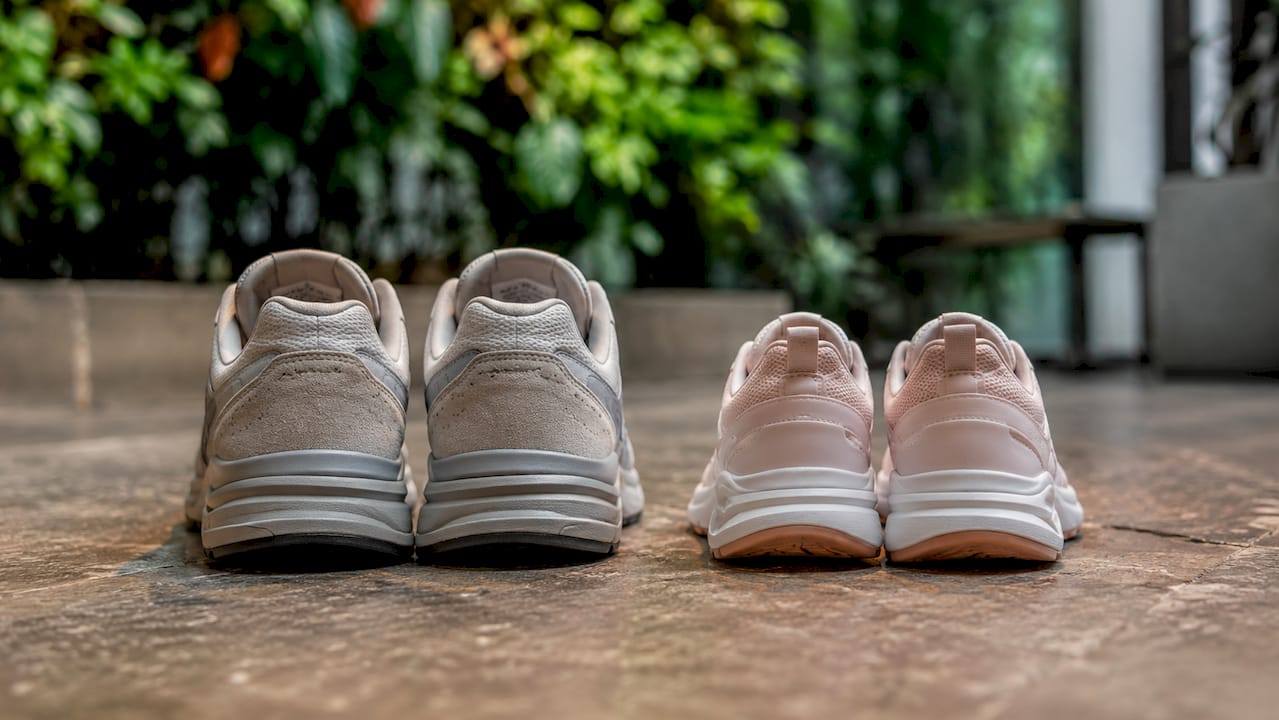
The structural differences go further than the number. Women’s shoes are narrower at the heel and wider at the forefoot, while men’s shoes are wider overall. The internal width at the ball of the foot for a men’s US 9 D width averages 94.4 mm. Women’s shoes built on a female last have a different internal volume entirely, even at the equivalent length.
Shoe lasts are the moulds used to build footwear. Men’s and women’s lasts differ in heel cup depth, arch placement, and overall volume. Buying a men’s shoe in a converted women’s size without checking the last shape often produces a poor fit, even when the length is correct.
Pro Tip: If you are converting between men’s and women’s sizes, always check the brand’s width labelling alongside the size number. A correct length in the wrong width will still cause discomfort.
What are the main international sizing systems?
EU sizing is the most consistent reference point for cross-gender conversions. The EU system uses fixed 6.67 mm increments per size and applies the same scale to men and women. The formula is straightforward: EU size equals foot length in centimetres multiplied by 1.5, plus 2 for toe allowance. That fixed increment makes EU sizing far more reliable than US sizing when converting between genders.
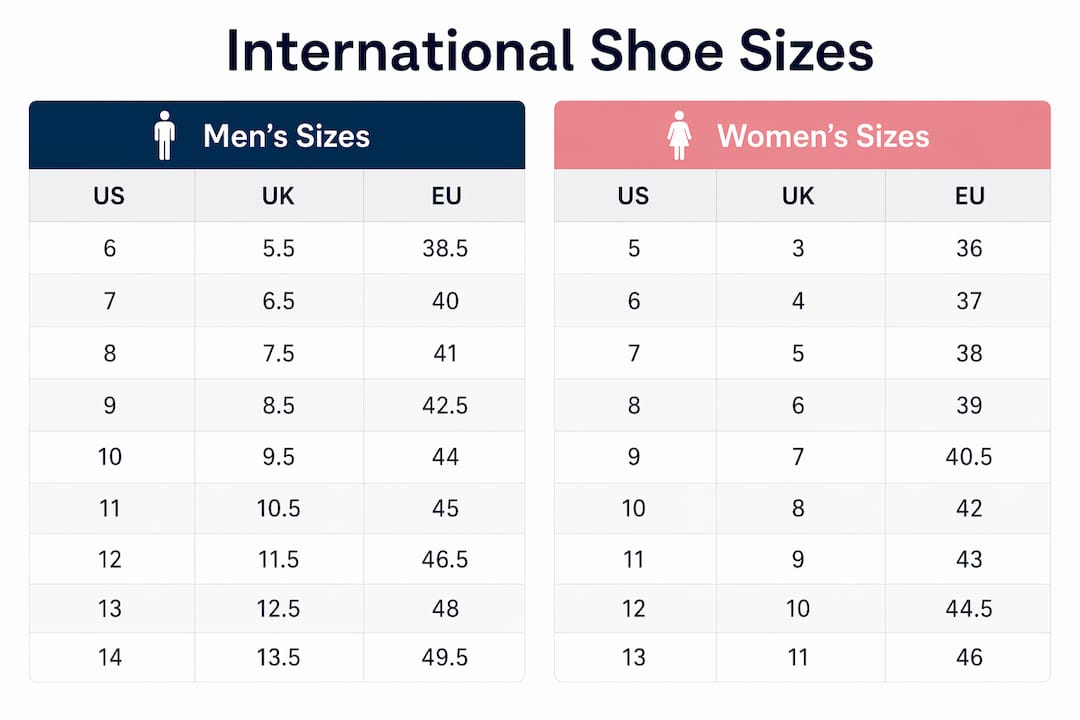
UK sizing works differently from US sizing in one important respect. UK sizes use the same numbers for men and women, unlike the US system which offsets by 1.5 sizes. A UK 7 is a UK 7 regardless of gender. That consistency makes UK sizing a useful check when US conversions feel uncertain.
Japanese and Mondopoint sizing measure foot length directly in centimetres or millimetres. These systems are inherently unisex because they describe the foot itself, not an abstract number. Mondopoint is the standard used in military and ski boot fitting, where precision matters most.
The table below shows how common sizes align across systems for reference.
| Foot length (cm) | EU size | UK men’s | UK women’s | US men’s | US women’s |
|---|---|---|---|---|---|
| 24.5 | 39 | 6 | 6 | 7 | 8.5 |
| 25.5 | 40 | 7 | 7 | 8 | 9.5 |
| 26.5 | 41–42 | 8 | 8 | 9 | 10.5 |
| 27.5 | 43 | 9 | 9 | 10 | 11.5 |
| 28.5 | 44 | 10 | 10 | 11 | 12.5 |
Pro Tip: When buying from an international retailer, use your EU size as the anchor. Convert from EU to the local system rather than converting directly between US men’s and women’s sizes, which introduces more room for error.
Why does shoe width matter as much as length?
Width is the most overlooked factor in shoe fit. Men’s standard width is D, women’s is B, and each letter increment represents approximately 3.18 mm of additional width. A shoe that matches your length but not your width will cause blisters, pressure points, or heel slippage.
Width letters communicate shoe volume differences across the full foot, not just the ball. The common width designations run from AAA (narrowest) through B, D, E, 2E, and 4E (widest). Women shopping in men’s shoes often find the D width too wide at the heel even when the length converts correctly. Men shopping in women’s shoes face the opposite problem: a B width is typically too narrow.
Brand variability makes this more complicated. Internal shoe widths can vary by over 16 mm within the same nominal size. A men’s US 9 has been measured at widths ranging from 86.2 mm to 102.4 mm across different brands. That is a 16.2 mm spread within a single labelled size. The nominal size is a starting point, not a guarantee.
Foot shape differences between men and women compound this further. Women’s feet tend to have a higher arch and a more pronounced taper toward the toes. Men’s feet tend to be flatter and broader. A size conversion based only on length ignores these anatomical differences entirely.
- Measure your foot width at the widest point, usually across the ball of the foot.
- Compare your measurement against the brand’s width chart, not a generic table.
- Check width letters on the shoe label: D is men’s standard, B is women’s standard.
- Try both widths if you are between sizes or converting between men’s and women’s footwear.
- Consult a dedicated shoe width guide before purchasing footwear online.
How to measure your shoe size accurately
Measuring your feet before buying is the single most reliable way to get the right fit. The Brannock device is the standard tool used in shoe shops. At home, a pencil tracing on paper works well. Place your foot flat on the paper, trace around it, then measure from the heel to the longest toe for length, and across the widest point for width.
Follow these steps for an accurate measurement:
- Measure in the afternoon. Feet swell during the day. An afternoon measurement captures your foot at its largest.
- Measure both feet. Feet are rarely identical. Use the larger measurement to select your size.
- Mark the longest toe and widest point. Measure length from heel to longest toe, and width across the ball of the foot.
- Add toe allowance. Insoles should be at least 5 mm longer than your foot length for comfort. For athletic shoes, allow a thumb’s width of space in the toe box.
- Check the brand’s size chart. Sizing varies by brand due to different lasts. A size 9 in one brand may fit like a size 8.5 in another. Use the brand’s own footwear size chart rather than a universal table.
- Read fit reviews when buying online. Shoppers who share their foot measurements in reviews give you the most useful fit data.
- Check the return policy. Even with careful measurement, online purchases sometimes need exchanging. A flexible return policy removes the risk.
Children’s sizing follows a separate scale entirely. Kids’ shoes in the UK run from size 0 (newborn) through size 13, then restart at size 1 for adult junior sizes. Parents should measure children’s feet every few months, as feet grow quickly and an ill-fitting shoe affects developing foot structure.
Key takeaways
Shoe size labels are guides, not guarantees. The most reliable approach to men’s and women’s shoe sizing combines foot measurement, EU size as a reference anchor, and brand-specific width checking.
| Point | Details |
|---|---|
| US sizing offset | Women’s US sizes run 1.5 sizes higher than men’s for the same foot length. |
| EU as anchor | EU sizing uses fixed 6.67 mm increments and is unisex, making it the most reliable conversion reference. |
| Width matters | Men’s standard width is D, women’s is B; width differences affect comfort even when length is correct. |
| Brand variability | Internal widths vary by over 16 mm within the same nominal size across different brands. |
| Measure both feet | Always measure both feet and size to the larger one, adding at least 5 mm for toe allowance. |
Sizing numbers tell only half the story
Shoe size charts are one of the most consulted references in footwear retail, and also one of the most misunderstood. After years of paying close attention to how shoes actually fit versus how they are labelled, I have come to one firm conclusion: the number on the box is a starting point, not a destination.
The 1.5-size US offset between men’s and women’s sizing is well documented, but what most shoppers miss is that converting the number does not convert the shoe. A women’s size 10.5 and a men’s size 9 share a foot length, but the heel cup, arch height, and internal volume are built for different feet. Buying across gender lines without checking the last shape is where most conversions go wrong.
Online shopping has made this worse. Shoppers rely on size charts without reading fit reviews, and brands do not always publish their last specifications. The shoe shopping process deserves more attention than most people give it. I would always recommend reading reviews from people who share your foot measurements, not just your size.
Foot size also changes with age, weight, and activity level. Feet tend to lengthen and widen over time. Measuring your feet once a year and adjusting your size accordingly is a habit that pays off in comfort and foot health. Prioritising comfort over a familiar size label is not vanity. It is the practical choice.
— Panagiotis
Ydauk footwear: built around how your feet actually work
Knowing your size is only useful if the shoe is built to match it. Ydauk designs footwear around YDA Technology, an approach that addresses foot health and energy efficiency at the structural level, not just the surface.

Ydauk’s range is built on lasts that account for real foot geometry, making accurate sizing knowledge directly useful when you shop. The YDA shoe technology page explains how each design decision connects to comfort and foot function. For shoppers who have done the work of measuring their feet and understanding their width, Ydauk’s footwear gives that knowledge somewhere to go. Browse the range and use the shoe chart guide to match your measurements to the right Ydauk size with confidence.
FAQ
What is the size difference between men’s and women’s shoes?
Women’s US shoe sizes are 1.5 sizes higher than men’s for the same foot length. A men’s US 9 and a women’s US 10.5 both correspond to approximately 27 cm of foot length.
How do I convert EU shoe sizes to US sizes?
EU sizing is unisex and uses fixed 6.67 mm increments per size. To convert, use a brand-specific size chart with your EU size as the anchor, then map to the relevant US men’s or women’s column.
Are UK shoe sizes the same for men and women?
Yes. UK sizing uses the same numbers for both men and women, unlike the US system which offsets women’s sizes by 1.5 above men’s. A UK 7 is a UK 7 regardless of gender.
Why do shoes in the same size fit differently across brands?
Brands use proprietary lasts that affect internal volume and shape, not just length. Internal widths within the same nominal size have been measured varying by over 16 mm across different brands, which is why brand-specific size charts are more reliable than universal conversion tables.
How much toe space should I leave in a shoe?
Insoles should be at least 5 mm longer than your foot length. For athletic shoes, allow roughly a thumb’s width of space in the toe box to accommodate foot movement during activity.