
Men's foot size chart: UK, EU, and US conversions
Men’s shoe size chart: UK, EU, US, and foot length
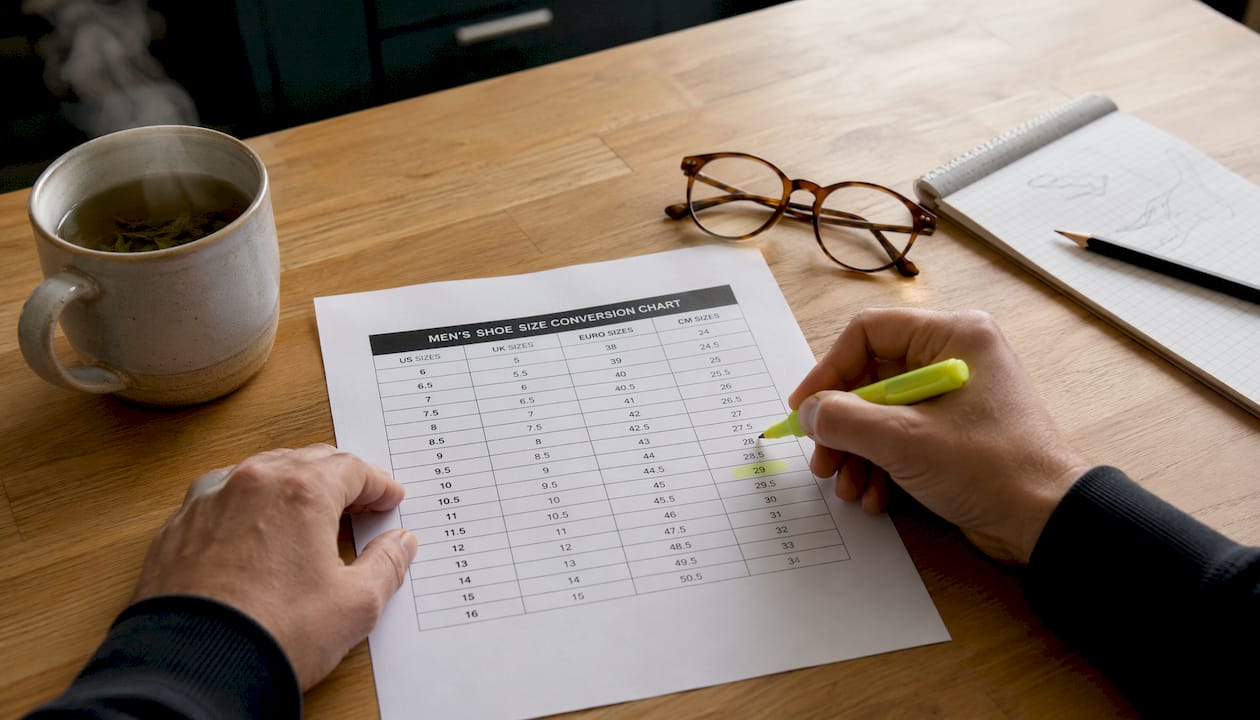
The table below maps UK men’s sizes to their EU and US equivalents, with foot length in both centimetres and inches. A UK size 9 equals EU 43 and US 10, with a foot length of around 27.1–27.3 cm — the most commonly referenced benchmark across major retailers.
| UK Size | EU Size | US Size | Foot length (cm) | Foot length (inches) |
|---|---|---|---|---|
| — | — | —.5 | 24.— cm | 9⅔ |
| —.5 | —.5 | — | — | 9⅚ |
| — | — | —.5 | — | 10 |
| —.5 | —.5 | 8 | — | 10⅙ |
| 8 | — | 8.5 | — | 10⅓ |
| 8.5 | — | 9 | 26.— cm | 10½ |
| 9 | 43 | 10 | 27.1 cm | 10⅔ |
| — | — | 10 | 27.1–27.3 cm | 10⅚ |
| 10 | 44 | — | — | — |
| — | — | — | — | —⅙ |
| — | — | —.5 | 28.8 cm | —⅓ |
| 12 | 46.5 | 12.5 | 29.— cm | —⅔ |
| 13 | 47.5 | 13.5 | 30.5 cm | 12 |
One point worth knowing: EU 44 fits UK 10, not UK 9. That single step catches a lot of people out when buying from European retailers.
Table of Contents
- How to measure your foot accurately at home
- How UK, US, and EU shoe sizes actually convert
- Why fit matters beyond just length
- Ydauk shoes are built around how your foot actually works
- Key takeaways
How to measure your foot accurately at home
Getting the measurement right takes about five minutes and saves you a return. Follow these steps:
- Time it right. Measure in the afternoon when feet are at their largest from daily swelling. Morning measurements can run up to half a size small.
- Stand, don’t sit. Place your full weight on the foot so it spreads naturally, as it would inside a shoe.
- Trace carefully. Put your foot on a sheet of paper against a wall, heel touching the wall. Hold the pen perpendicular to the paper — angling it inward underestimates the length.
- Measure heel to longest toe. Use a ruler or tape measure. Record the distance in centimetres.
- Always use the larger foot. Most people have one foot slightly longer than the other. Size for the bigger one.
- Add 0.5–1 cm. That breathing room accounts for movement and prevents the toe box from pinching during wear.
Once you have your measurement, cross-reference it against the chart above to find your UK, EU, and US size.
How UK, US, and EU shoe sizes actually convert

The three systems measure the same thing differently, which is why the numbers never line up neatly.
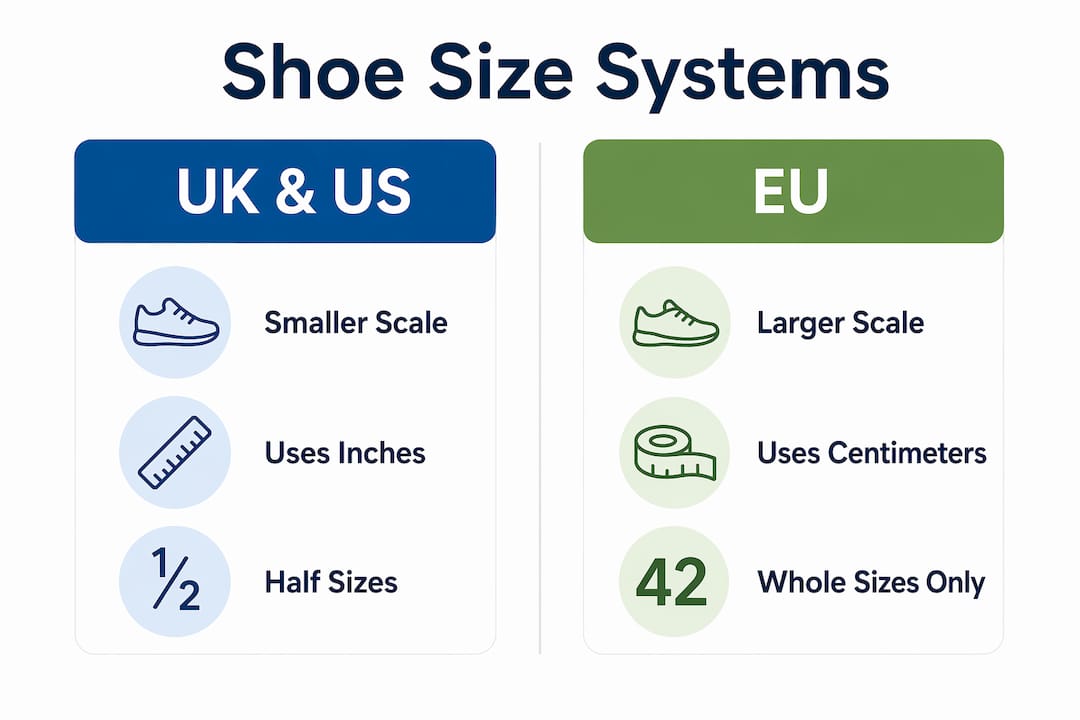
UK sizing uses the barleycorn, a unit equal to one-third of an inch. EU sizing uses the Paris Point, which equals two-thirds of a centimetre. Because these increments don’t divide evenly into each other, conversions occasionally produce half-sizes or rounding differences between brands.
The practical rules:
- UK to EU (men’s): Add approximately 33–34 to your UK size. UK 9 + 34 = EU 43.
- UK to US (men’s): Add 0.5 to 1. UK 9 ≈ US 10.
- EU sizing is unisex. UK and US systems are gender-specific. A women’s UK 9 maps to EU 42, not EU 43 — so using a men’s chart for women’s shoes gives the wrong result.
Brand variation is real. Some manufacturers run a half-size large or small depending on their last shape. Always check the brand’s own size guide before ordering, particularly for athletic footwear where fit tolerances are tighter.
Pro Tip: If you’re converting between systems for the first time, use your foot length in centimetres as the anchor point rather than a size number. Centimetres don’t change between systems; size numbers do.
Why fit matters beyond just length
Length gets you close. Width gets you comfortable. A shoe that fits perfectly in length but is too narrow across the ball of the foot can cause blisters, bunions, and long-term joint strain. Foot width measurement at the widest point of the ball helps you select the right fitting: D is standard, E is wide, and EE is extra wide.
Feet also change. Weight fluctuations, pregnancy, and simply getting older can alter both length and width. The average adult male foot length in the UK sits around 26.—–27.0 cm, corresponding to UK sizes 8.5–9 — but that’s a population average, not a personal guarantee. Remeasure every year or two, especially if your weight has shifted or you’ve noticed shoes fitting differently than they used to.
For a deeper look at correct shoe fitting steps and how to apply them when buying online, Ydauk’s guides cover the full process.
Ydauk shoes are built around how your foot actually works
Most footwear is designed around a standard last. Ydauk takes a different starting point: the biomechanics of the foot itself. The YDA shoe technology is built to support natural foot movement, distribute pressure evenly, and reduce fatigue during everyday wear — not just tick a size box.

If you’ve just worked out your correct size and want footwear that’s actually designed to fit the way your foot moves, Ydauk is worth a look. Browse the current collection at ydauk.com and use your foot length measurement to find the right fit from the start.
Key takeaways
Accurate shoe sizing starts with a centimetre measurement of your foot, not a guess based on a previous size number.
| Point | Details |
|---|---|
| UK to EU conversion | Add 33–34 to your UK size; UK 9 = EU 43, UK 10 = EU 44. |
| Measure in the afternoon | Feet swell during the day; afternoon measurements give the most accurate result. |
| Always size for the larger foot | Most men have one foot slightly bigger; fit to that one to avoid discomfort. |
| Width matters as much as length | D, E, and EE fittings exist for a reason; measure ball width, not just heel-to-toe. |
| Ydauk footwear | Designed around natural foot biomechanics, not just standard last shapes. |