
US to European shoe size: your accurate conversion guide
TL;DR:
- Converting US to European shoe sizes is approximate due to incompatible units and different measurement increments.
- Measuring foot length in centimeters and referencing a brand’s size chart provides the most reliable fit.
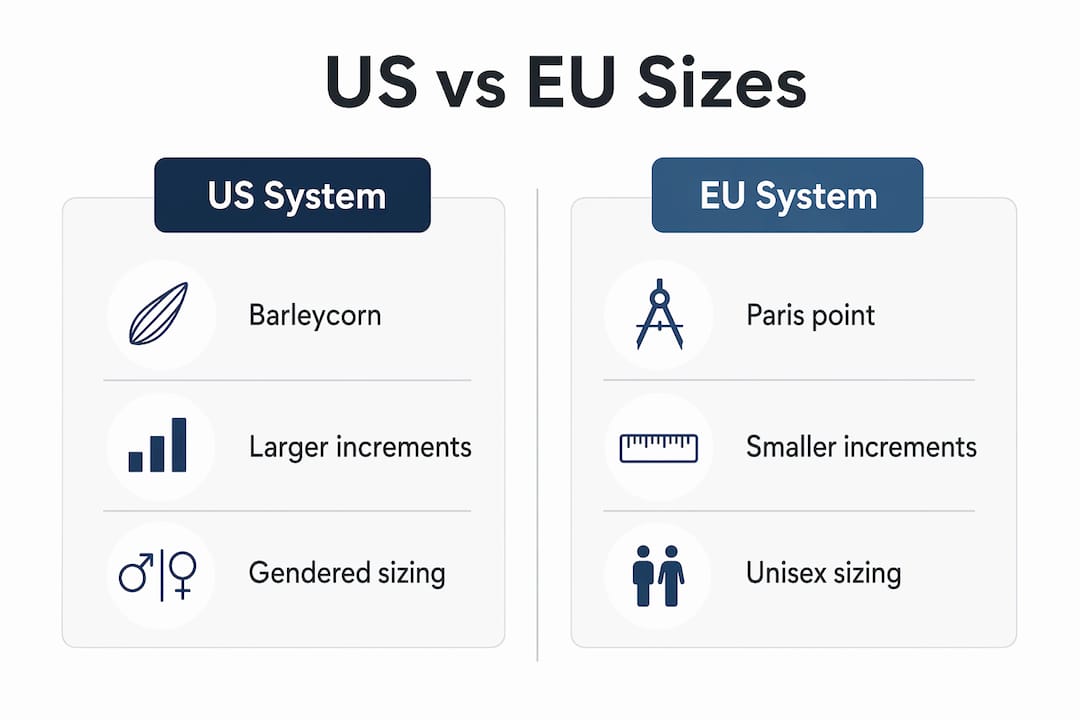
Converting a US to European shoe size is an approximate process, not an exact one. The two systems use different base measurement units, which means no single formula produces a perfect match every time. US and UK sizing relies on barleycorn increments of 8.47mm, while European sizing uses Paris points of 6.67mm. That difference in scale is the root cause of every confusing conversion table you have ever encountered. The most reliable method is to measure your foot length in centimetres and cross-reference it with the brand’s own size chart, rather than relying on a generic number swap.
How do US and European shoe size systems fundamentally differ?
The two systems are built on incompatible units, which is why conversion is approximate, with only 0.5–1 size accuracy typically achievable. US and UK sizes advance in barleycorn increments of 8.47mm. European sizes advance in Paris points of 6.67mm. Because the increments are different lengths, one US size often spans 1.5 EU sizes. That mismatch is why conversion charts show ranges rather than single numbers.
| Feature | US sizing | EU sizing |
|---|---|---|
| Base unit | Barleycorn (8.47mm) | Paris point (6.67mm) |
| Size increment | Half sizes common | Mostly full sizes |
| Gender split | Yes (men’s and women’s differ) | No (unisex scale) |
| Linked to foot length | No | No |
| Half sizes above 45 | N/A | Rarely available |
US and UK sizes share the same increment but start from different points. That produces a typical offset of about 0.5–1 size between UK and US men’s sizes for the same foot. EU sizing employs half sizes mainly up to size 45, but tends to skip them above that threshold.
There is another layer of complexity that conversion tables never show: the last. A last is the mould form used to shape a shoe during manufacture. Lasts vary by brand and style, so a size number alone does not guarantee consistent fit across different makers. Two shoes both labelled EU 42 can feel entirely different on the same foot.
Pro Tip: Always check the brand’s own size chart rather than applying a generic conversion. The last used in production affects fit more than the number on the box.
Why is foot length in centimetres the most reliable conversion method?
Foot length in centimetres is the only measurement that cuts through the confusion of labelled sizes. Mondopoint, the ISO sizing system used in military and specialist footwear, links size directly to foot length in millimetres or centimetres. Every other system, US, UK, and EU alike, uses historical increments and labels that are not directly tied to actual foot dimensions. Mondopoint removes that ambiguity entirely.
Measuring your own foot accurately at home takes under two minutes. Follow these steps:
- Place a sheet of paper on a hard floor and stand on it with your heel touching a wall.
- Mark the tip of your longest toe with a pencil held vertically.
- Measure the distance from the wall to the mark in centimetres.
- Repeat for both feet and use the longer measurement.
- Cross-reference that figure against the brand’s size chart, not a generic conversion table.
Foot length in centimetres is the most stable sizing metric, removing the ambiguity seen in conversions across US, UK, and EU systems. A labelled size can shift between brands, seasons, and even shoe styles within the same brand. Your foot length does not change.
Pro Tip: Measure your feet at the end of the day. Feet swell slightly during the day, so an evening measurement gives you the size that needs to fit comfortably after hours of wear.
How to use a US to European shoe size conversion chart effectively
Conversion charts are a starting point, not a final answer. They provide approximate equivalences, and because EU increments are smaller than US ones, one US size often maps to EU 42 or 43 depending on the brand. That range is not an error in the chart. It reflects the genuine overlap between the two systems.

The table below shows common US sizes alongside their EU equivalents and the corresponding foot length range. Use the foot length column as your primary reference.
| US men’s | US women’s | EU size | Foot length (mm) |
|---|---|---|---|
| 6 | 7.5 | 39 | 245–249 |
| 7 | 8.5 | 40–41 | 254–261 |
| 8 | 9.5 | 41–42 | 261–267 |
| 9 | 10.5 | 42–43 | 267–274 |
| 10 | 11.5 | 43–44 | 274–280 |
| 11 | 12.5 | 45 | 280–287 |
For a more detailed shoe conversion chart with additional sizes and width guidance, Ydauk publishes a regularly updated reference that goes beyond simple number matching.
Common mistakes when using conversion charts include:
- Treating the chart as definitive rather than as a range to narrow down.
- Ignoring the men’s and women’s size offset in US sizing.
- Failing to check whether the brand produces half sizes in the EU range you need.
- Selecting a size based on the number alone without verifying foot length.
- Assuming that a US 9 in one brand fits identically to a US 9 in another. Brand-specific lasts mean this is rarely true.
If you fall between two EU sizes, size up rather than down. A shoe that is slightly long can be adjusted with an insole. A shoe that is too short causes lasting damage to toes and nails.
What practical steps ensure the best fit when buying shoes?
Getting the fit right requires more than a correct size number. Proper shoe fit includes no heel slip, a snug but not tight midfoot, and adequate room in the toe box. That combination is what you are aiming for, regardless of what number appears on the label.
Follow these fitting principles every time you buy shoes across different sizing systems:
- Measure both feet and use the longer one as your reference size.
- Allow 1–1.5 cm of space between your longest toe and the end of the shoe. This accommodates foot splay during walking.
- Prioritise foot length in centimetres over the labelled size when ordering online.
- Perform a walk test. Most consumers underestimate how differently feet behave in motion compared to standing still.
- Account for width. For consumers with wide or uneven feet, width-specific options or insoles improve fit more than simply increasing the length size.
- Check whether the brand offers half sizes in the EU range you need. EU sizing skips half sizes above 45 in most cases.
- If your two feet differ by more than half a size, fit the larger foot and use a thin insole in the other shoe.
Pro Tip: Walk on a hard surface, not carpet, when testing shoes in a shop. Carpet masks heel slip and sole rigidity, two of the most common fit problems that only show up on firm ground.
For a full walkthrough of the fitting process, Ydauk’s step-by-step fitting guide covers heel, midfoot, and toe box checks in detail.
Most adults wear shoes about half a size too small. That statistic reflects how often people rely on labelled sizes rather than measuring their feet. Measuring takes two minutes and prevents months of discomfort.
How do men’s, women’s, and unisex sizing affect EU conversions?
US sizing splits men’s and women’s sizes on the same scale, while EU sizing does not. US women’s sizes run 1.5 sizes higher than men’s for the same actual shoe length. So a US men’s 8 and a US women’s 9.5 both correspond to the same EU 41. EU sizing is unisex, meaning the number refers to foot length regardless of gender.
This distinction creates real confusion when shopping online. Key points to keep in mind:
- Always check whether a product listing specifies men’s or women’s US sizing before converting.
- EU sizes are the same scale for all genders, so EU 41 is EU 41 regardless of who is wearing it.
- UK sizing is generally unisex but carries its own offset from US sizing, typically about 0.5–1 size lower than US men’s.
- When a brand labels a shoe as “unisex” with US sizing, confirm whether it follows the men’s or women’s scale. Brands are inconsistent on this point.
Focusing on foot length in centimetres sidesteps the gender labelling problem entirely. Your measurement does not change based on how a brand has categorised its product.
For a full breakdown of how men’s and women’s conventions interact with EU sizing, Ydauk’s men’s and women’s size guide covers the offsets in detail.
Key takeaways
Foot length in centimetres, combined with a brand’s own size chart, is the most reliable method for converting US to European shoe sizes accurately.
| Point | Details |
|---|---|
| Conversion is approximate | US and EU systems use different base units, so exact matches are rarely possible. |
| Measure foot length in cm | Mondopoint links size to actual foot length, removing label ambiguity. |
| Use brand size charts | Lasts vary by brand, so generic conversion tables cannot guarantee fit. |
| Allow toe box space | Leave 1–1.5 cm between your longest toe and the shoe end for walking comfort. |
| Gender affects US sizing | US women’s sizes run 1.5 higher than men’s; EU sizing uses one unisex scale. |
Why I always start with a tape measure, not a conversion table
After years of buying shoes across US, UK, and European brands, the single lesson I keep relearning is this: the number on the label is a suggestion, not a specification. I have worn everything from EU 42 to EU 44 in shoes that all fit correctly, because the brands used different lasts and different interpretations of what their size numbers mean.
The conversion table is not wrong. It is just incomplete. It tells you where to start looking, not where to stop. The brands that earn my trust are the ones that publish their size charts in centimetres alongside the labelled sizes. That one extra column removes most of the guesswork.
I also re-measure my feet every couple of years. Foot shape changes with age, weight, and activity level. The size I wore at 25 is not necessarily the size I need now. A two-minute measurement with a ruler and a sheet of paper is a far better investment than returning a pair of shoes that almost fit.
My strongest advice: never buy shoes online without checking the brand’s centimetre chart. If the brand does not publish one, that tells you something about how seriously they take fit.
— Panagiotis
Ydauk’s approach to sizing and shoe technology
Ydauk builds its footwear around foot health and fit accuracy, which means sizing is not an afterthought. The YDA shoe technology page details how each design accounts for foot length, foot mechanics, and energy return, giving you a clearer picture of why fit matters beyond simple comfort.

Ydauk publishes detailed size guidance based on foot length in centimetres, so you can cross-reference your measurement directly rather than guessing from a generic chart. If you are converting from US sizing and want a reliable reference before you buy, the US shoe sizes guide on the Ydauk site walks through the process with brand-specific context. Getting the size right the first time is the point.
FAQ
What is the EU equivalent of a US size 9?
A US men’s 9 typically corresponds to EU 42 or 43, depending on the brand. Check your foot length in centimetres against the brand’s own chart for the most accurate result.
Why do conversion charts show a range of EU sizes for one US size?
EU sizes use Paris point increments of 6.67mm, which are smaller than the US barleycorn increment of 8.47mm. One US size therefore spans approximately 1.5 EU sizes, producing a range rather than a single equivalent.
Is EU sizing the same for men and women?
EU sizing uses one unisex scale with no gender split. US women’s sizes run 1.5 sizes higher than men’s for the same foot length, so always confirm which US gender scale a brand is using before converting.
How do I measure my foot for an accurate shoe size conversion?
Stand on paper with your heel against a wall, mark the tip of your longest toe, and measure the distance in centimetres. Use the longer of your two feet and compare the figure to the brand’s centimetre size chart.
What should I do if I fall between two EU sizes?
Size up and use a thin insole if needed. A shoe that is slightly long is adjustable. A shoe that is too short causes toe compression and long-term discomfort.