
Measure Your Shoe Size at Home in 7 Podiatrist Aligned Steps
Measure both feet standing up, at the end of the day, and record the heel-to-longest-toe length in millimetres. Fit your shoes to the larger foot, not the smaller one, and leave roughly 10 to 12 millimetres of space (about a thumb’s width) between your longest toe and the front of the shoe. Everything else, from width to arch length to converting millimetres into a UK, EU, or US number, builds on that one measurement.
TL;DR:
- Measuring foot length at the end of the day while standing ensures the most accurate size, accounting for swelling and foot shape.
- Use the heel-to-toe measurement in millimetres to determine your size, but always verify with the specific brand’s size chart for better accuracy.
- If your arch length suggests a smaller size than the heel-to-toe measurement, prioritize arch fit over toe room to avoid misaligned flex points.
- When buying online, check brand-specific size charts and ensure proper fit by testing toe space, heel slip, and shoe flex after arrival.
- Most fitting errors come from measuring sitting down, ignoring width, or relying on old sizes, so re-measure regularly and follow proper protocol.
Table of Contents
- How to measure your foot length at home
- How do you measure foot width and arch length?
- Converting millimetres into UK, EU and US shoe sizes
- How do you check a shoe actually fits once it’s on?
- Special cases: children, wide feet, and buying online
- Why this method holds up
- A few honest observations on where people go wrong
- How YDA UK helps you get sizing right the first time
- Where to check conversions and fitting protocols
- Sources
- FAQ
How to measure your foot length at home
You don’t need a Brannock device to get a usable measurement. A sheet of paper, a pen, and a ruler will do the job properly if you follow the sequence in order.
- Gather your kit. Two sheets of A4 paper, a pen or pencil held vertically (not at an angle), a ruler or tape measure, and the socks you’ll actually wear with the shoes.
- Time it right. Do this in the late afternoon or evening. Feet swell through the day from walking and standing, so a morning measurement may underestimate size.
- Stand on the paper. Place one foot flat on a sheet on a hard floor, not carpet, and put your full weight on it. Sitting down changes the shape of your foot and gives a shorter, narrower reading than reality.
- Trace the outline. Hold the pen vertically against your skin and trace around the foot, keeping the pen upright the whole way round. Angling it inward will shave millimetres off your outline.
- Mark the two key points. Put a small dot at the back of the heel and another at the tip of the longest toe, which for most people is the big toe but for some is the second toe.
- Measure the distance. Use the ruler to measure a straight line between the two dots, in millimetres. That’s your heel-to-toe length.
- Repeat for the other foot and write both numbers down. Almost everyone has one foot slightly larger than the other, with a noticeable size difference.
Pro Tip: Do the tracing on a hard floor near a wall, and press your heel gently against the wall while you trace. It stops your foot sliding backwards mid-outline, which is the single biggest cause of a wonky home measurement.
Once you have both numbers, measuring your foot correctly becomes the reference point for every shoe you buy from here on, whether online or in a shop.
How do you measure foot width and arch length?
Length is only half the story. Width and arch length decide whether a shoe that’s technically “your size” actually feels right when you walk in it.
- Measure width by finding the widest part of your tracing, usually across the ball of the foot just behind the toes, and measuring straight across it in millimetres.
- Measure arch length by finding the crease point where your big toe joint bends, then measuring from your heel dot to that point. This is the heel-to-ball measurement.
- Why arch length matters: shoes are built to flex at a specific joint. The Brannock device was designed specifically to capture heel-to-ball length alongside overall length, because a mismatch between your arch length and the shoe’s flex point causes the ball of the shoe to fold in the wrong place under your foot, not under your toe joint.
- When arch length overrules toe length: if your arch length points to a smaller size than your heel-to-toe measurement, size to the arch length and accept slightly more room at the toe rather than forcing a shoe that flexes in the wrong spot.
- Wide or narrow feet: if your width measurement sits noticeably outside the standard range for your length, look for a wide or narrow fitting rather than simply going up or down a whole size, which only shifts the length, not the width, and can create heel slip.
Converting millimetres into UK, EU and US shoe sizes
Your millimetre measurement is the one number that stays constant across every country and every brand. Everything built on top of it, UK sizes, EU sizes, US sizes, is a conversion, and conversions are where most people get caught out.
The reason conversions wobble is that sizing systems don’t share a common unit. UK and US sizing generally uses the barleycorn (roughly 8.47mm per size), while European sizing uses the Paris point, a two-thirds-of-a-centimetre unit. Because these units don’t divide evenly against each other, a “clean” conversion between a UK 8 and an EU size is really an approximation, not a mathematical equivalence.
As a rough exemplar only, foot length tends to map like this:
- Around 260mm: approximately UK 6.5, EU 40, US 8
- Around 270mm: approximately UK 7.5, EU 41, US 9
- Around 280mm: approximately UK 8.5, EU 42.5, US 10
Treat that table as a starting point, never a final answer. Manufacturers cut shoes on different lasts (the foot-shaped mould a shoe is built around), so a EU 42 from one brand can measure noticeably differently from a EU 42 in another. Always check the brand’s own size chart against your millimetre measurement rather than trusting the number on the label alone, and remember that style also shifts fit, since a running shoe and a dress shoe built to the same nominal size rarely feel identical.
How do you check a shoe actually fits once it’s on?
The size on the box tells you where to start. These checks tell you whether it’s actually right.
- Toe room test. Stand up and press your thumb down in front of your longest toe, inside the shoe. You should feel roughly a thumb’s width of space before you hit the front of the shoe.
- Heel slip check. Walk a few steps. A small amount of heel movement, a few millimetres, is normal in most lace-up shoes. If your heel lifts out of the shoe entirely with each step, the shoe is too big, too narrow at the heel, or wrongly styled for your foot shape.
- Flex point check. Bend the shoe gently or take a step on your toes. It should fold at the ball of your foot, not further back under your arch. If it doesn’t, the arch length is mismatched.
- Ten-step walk test. Walk around the shop or your hallway for at least ten steps. Pay attention to any pinching across the width, rubbing at the heel, or pressure on the top of your toes, since these rarely improve with wear.
Special cases: children, wide feet, and buying online
Children’s feet grow fast, sometimes by half a size every few months during growth spurts, so measure every couple of months rather than assuming last season’s size still fits. Kids’ sizing also resets at a different starting point from adult sizing in most systems, so don’t assume a straight numeric jump from a child’s size to an adult one.
If your feet are wide, resist the urge to solve it by buying a longer shoe. That width mismatch at the ball of the foot doesn’t go away with extra length, it just adds heel slip on top of the original problem, and going up a size to fix a width issue tends to create more difficulties than it solves. Ask for a wide fitting instead.
For diabetics or anyone with a diagnosed foot condition, depth and room matter as much as length and width, and clinician advice should take priority over any general rule in this guide. When buying online, run through a short checklist before you order: measure both feet properly, check the brand’s specific size chart rather than a generic conversion table, read the returns policy before you buy, and try the shoes on at home wearing the socks you actually plan to wear with them.
Why this method holds up
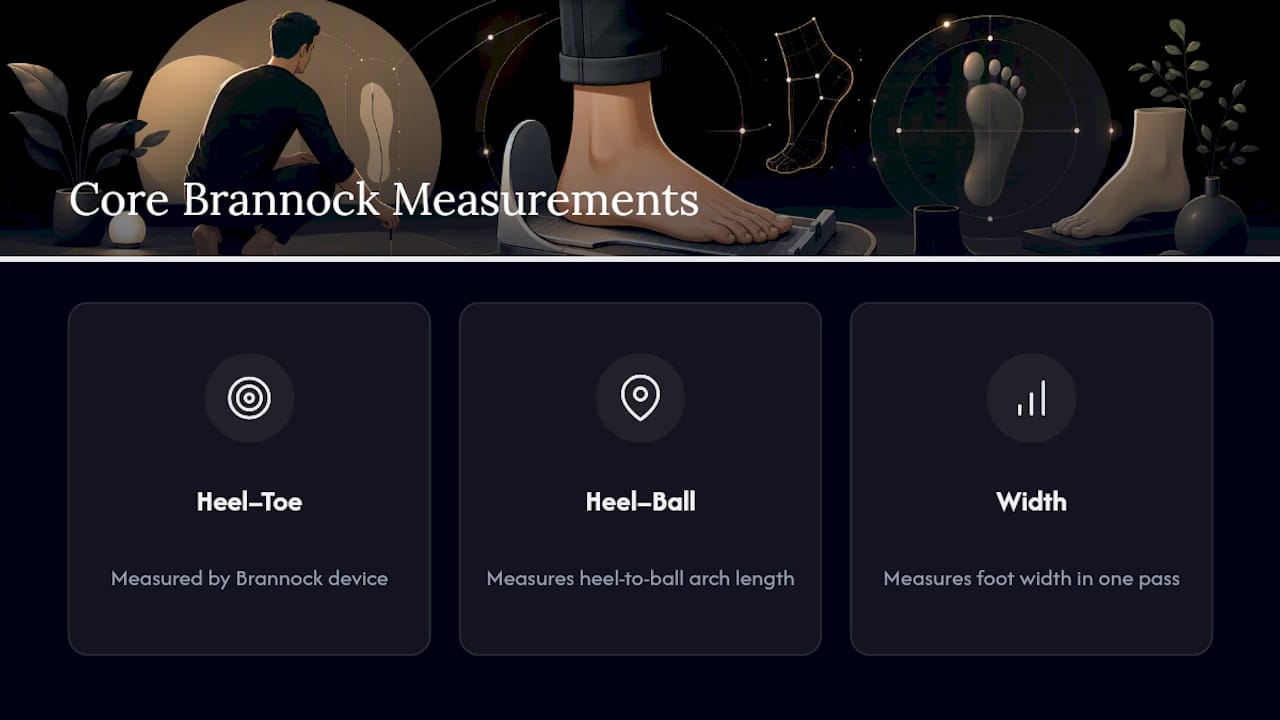
This approach isn’t a shortcut invented for convenience. It follows the same logic used by the Brannock device, the tool most podiatrists and shoe fitters have relied on for decades, which measures heel-to-toe length, heel-to-ball arch length, and width in one pass. The standing, end-of-day measurement and the thumb’s-width toe rule both come from podiatrist fitting guidance, not marketing convention.
If you want to go further, YDA UK’s conversion chart and fit checklist both build on the same measurements covered here.
A few honest observations on where people go wrong
Most fitting mistakes come from three habits: measuring while sitting down, ignoring width because the length “felt fine” in the shop, and trusting a size bought five years ago as if feet don’t change. Keep it simple: measure both feet, measure late in the day, write the number down in millimetres, leave that thumb’s width of toe room, and walk ten steps before you decide. Re-measure every year or two. Feet shift more than people expect.
— Panagiotis
How YDA UK helps you get sizing right the first time
Getting the millimetre measurement right is only useful if the shoe you buy translates it properly, and that’s exactly where an approach to fit focused on foot health principles can help.

Every pair on the site is designed around the same foot health principles covered in this guide: proper toe room, supportive width, and a build that respects how your arch actually flexes. The YDA Technology behind each shoe focuses on comfort and energy efficiency rather than a generic last stretched across every size, which matters most for anyone who’s struggled with standard sizing in the past, including people managing diabetes or other foot conditions who need extra depth and room. Once you’ve got your millimetre measurement and checked it against a brand chart, ordering is straightforward: measure, check the chart, order your usual size against your recorded length, and use the returns process if the fit needs adjusting once the shoes arrive. Start by measuring both feet tonight, then browse the current range to see which build suits your foot shape.
Where to check conversions and fitting protocols
For primary references, the Brannock Device Company’s instructions cover measurement protocol in full, the Wikipedia entry on shoe size explains the Paris point and barleycorn systems, and Zappos’ sizing guide is a solid reference for brand-by-brand conversion variance.
Sources
- How to find the right shoe fit: Podiatrist guide 2026 — Michigan Foot Doctors
- Instructions & fitting tips | The Brannock Device Company
- Shoe size — Wikipedia
- Measure and convert your shoe size | Zappos
FAQ
Is a size 38 a UK 7 or 8?
Neither, typically. European sizes convert approximately to UK sizes based on foot length, but exact matches depend on the brand’s last, so always check against your millimetre measurement rather than the label alone.
What is a EU size 42 in UK and US sizing?
A EU 42 generally converts to around a UK 8 and a US 9 for men, but this shifts slightly between brands, which is why checking a brand-specific chart against your foot length in millimetres is more reliable than any single conversion table.
How do I find my UK shoe size accurately?
Measure your heel-to-longest-toe length in millimetres while standing, at the end of the day, then match that figure against a UK size chart, ideally the specific brand’s own chart rather than a generic one.
Can I measure my shoe size using my phone?
Some phone camera apps can estimate foot length, but a paper tracing with a ruler, following the Brannock-style protocol of standing measurement plus thumb’s-width toe room, remains a dependable and free method with no app-related margin of error.