
How to measure foot size: your 2026 home guide
TL;DR:
- Measuring foot size at home helps prevent discomfort and costly returns caused by ill-fitting shoes.
- Use the wall baseline method, measure in the evening, and record both length and width for accurate sizing.
Foot size measurement is the process of capturing your foot’s length and width accurately using household tools and proper technique. Getting it right prevents blisters, pinching, and costly returns caused by ill-fitting shoes. The Brannock Device remains the professional gold standard, but the weight-bearing method and wall baseline technique deliver comparable accuracy at home. This guide covers every step you need to find your correct shoe size with confidence.
How to measure foot size at home: tools and timing
The right conditions matter as much as the right technique. Measuring on a hard floor rather than carpet prevents the paper from shifting and distorting your outline. You need a sheet of plain paper large enough for your foot, a pencil, and a ruler or tape measure.
Wear the socks you plan to use with the shoes you are buying. Measuring with socks accounts for the extra volume they add, which can be the difference between a snug fit and a tight one. Thin trainer socks and thick walking socks produce noticeably different results.
Timing is a factor most people overlook. Foot size increases by up to half a size later in the day due to gravity and activity. Measuring in the late afternoon or evening captures your foot at its largest, so your shoes will fit comfortably all day rather than just first thing in the morning.
A helper improves accuracy. Asking someone to hold the pencil vertically while you stand still removes the most common source of error: pencil tilt.
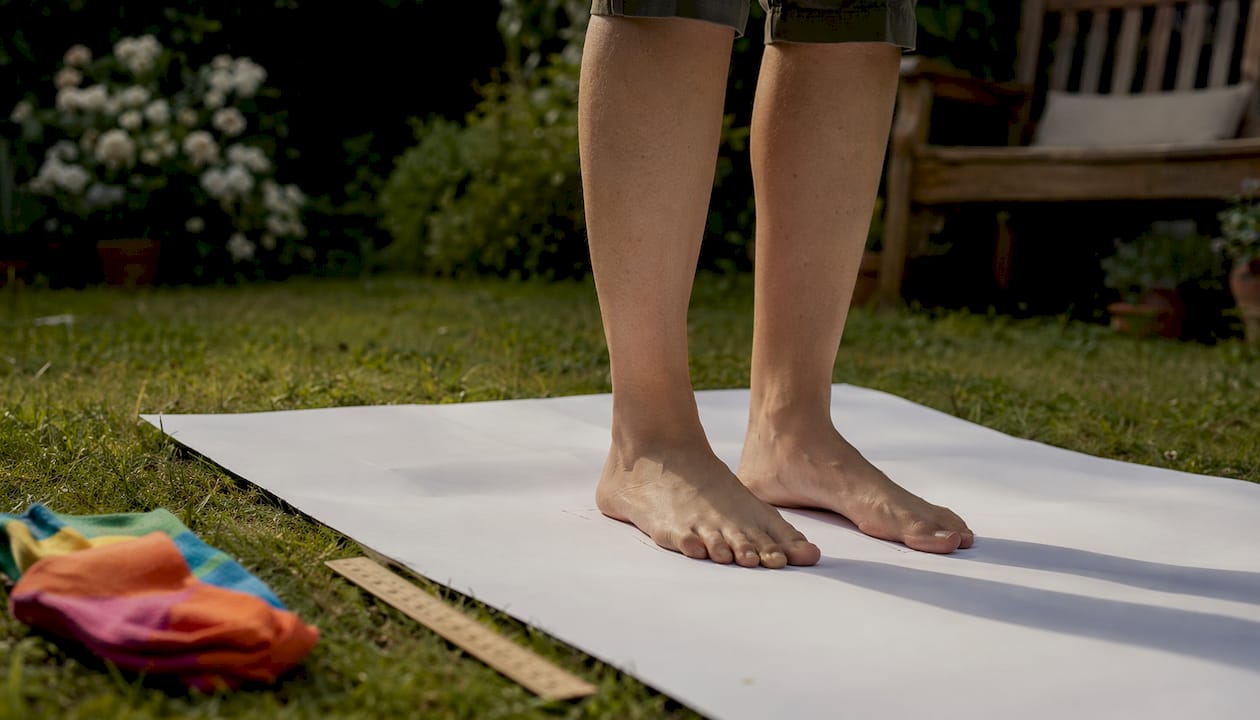
Pro Tip: Place the paper against a skirting board or low step to keep it from sliding while you stand on it.
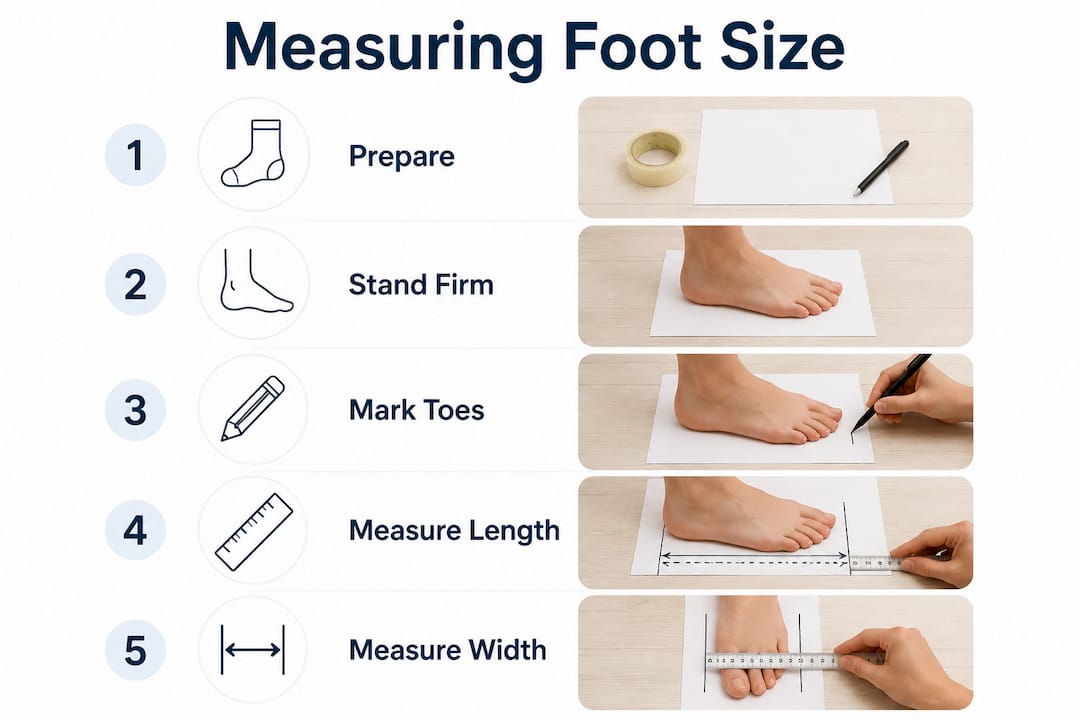
Step-by-step guide to measuring foot length
The wall baseline method is the most reliable home technique for measuring foot length. It eliminates the tracing errors that come from holding a pencil at an angle.
- Place a sheet of paper flat on a hard floor, with one short edge touching a wall.
- Stand with your heel pressed firmly against the wall, foot centred on the paper.
- Distribute your weight evenly across both feet. Standing with full weight simulates natural foot elongation, giving you a true measurement rather than an unloaded one.
- Have a helper place a mark at the tip of your longest toe, holding the pencil perfectly vertical.
- Measure from the wall to the mark with a ruler. Record the result in centimetres.
- Repeat for the other foot.
One detail catches many people out. The second toe is often longer than the big toe. Marking the big toe by default can result in buying shoes that are too short, leading to nail bruising and discomfort on longer walks.
Always record both measurements and use the larger of the two when selecting a size. One foot is biologically often larger than the other, and sizing to the smaller foot guarantees a poor fit.
Pro Tip: Write the date alongside your measurements. Foot size changes with age, weight fluctuation, and pregnancy, so a measurement from two years ago may no longer be accurate.
“Accurately measuring feet at home reduces costly returns and improves foot health by avoiding ill-fitting shoes.”
How to measure foot width and why it matters
Foot width is the measurement most shoppers ignore, yet it is responsible for a large share of fit complaints. A shoe can be the correct length and still cause blisters if the width is wrong.
Follow these steps to get an accurate width reading:
- Stand on the paper with your full weight on the foot you are measuring.
- Mark the widest points on either side of your foot. These points sit across the ball of the foot, the broad area just behind your toes.
- Measure the distance between the two marks with a ruler.
- Record the result and repeat for the other foot.
Measuring width at the ball of the foot is the standard method for identifying the correct width category. Width categories typically run from Narrow through Standard to Wide, and they align with the same forefoot measurements used by professional tools like the Brannock Device.
| Width category | Typical description | Common fit issue if wrong |
|---|---|---|
| Narrow | Slimmer than average forefoot | Foot slides inside shoe |
| Standard | Average forefoot width | Generally fits most styles |
| Wide | Broader forefoot | Pinching and restricted circulation |
Ignoring width leads to pinching across the forefoot, rubbing on the outer edge of the foot, and blisters on the little toe. Selecting the right width category solves these problems without needing to size up in length.
Common mistakes that skew your measurements
Most measurement errors are easy to avoid once you know what to look for.
- Measuring while seated. Sitting removes your body weight from the foot. The arch does not flatten and the foot does not spread to its true size. Always stand.
- Measuring on carpet. Carpet compresses unevenly and allows the paper to shift. Use a hard floor only.
- Angling the pencil. A tilted pencil adds millimetres to your measurement. Keep it vertical at all times.
- Measuring only one foot. Both feet must be measured every time. Assuming they are identical is the single most common sizing error.
- Measuring in the morning. Morning measurements underestimate your foot’s true size. Measure in the afternoon or evening.
- Forgetting socks. The type of sock changes the effective fit. Always wear the socks intended for the shoes you are buying.
Pro Tip: If your two feet differ by more than half a size, buy to fit the larger foot and use a heel pad or supportive insole in the other shoe. Shoe inserts address minor asymmetry without compromising comfort on either foot.
How to convert your measurements into a shoe size
Your foot length in centimetres is the starting point for finding your shoe size. Most size charts list foot length against UK, EU, and US sizes, making conversion straightforward.
- Measure in centimetres for the most accurate conversion. Inches work but introduce more rounding error.
- Use the footwear size chart as a starting point, then cross-reference with the specific brand’s guide.
- Check the size guide on each product page. Shoe sizing varies by brand, style, and materials, so a size 7 in one range may fit like a 7.5 in another.
- Account for shoe style. A structured leather shoe fits differently from a knitted trainer even at the same nominal size.
- Children’s feet change quickly. Measure children’s feet every two to three months and never assume last season’s size still applies.
- Adults are not immune to size changes. Foot size shifts with age, weight change, and prolonged standing work. Measure annually at minimum.
| Foot length (cm) | UK size | EU size | US women’s | US men’s |
|---|---|---|---|---|
| 22.5 | 4 | 37 | 6 | 4.5 |
| 24.0 | 5.5 | 38.5 | 7.5 | 6 |
| 25.5 | 7 | 40.5 | 9 | 7.5 |
| 27.0 | 8.5 | 42 | 10.5 | 9 |
| 28.5 | 10 | 44 | 12 | 10.5 |
A shoe conversion chart helps when buying from international brands where sizing systems differ. Always verify against the brand’s own guide before purchasing. For high-top canvas styles where fit around the ankle matters, checking the specific men’s or women’s size guide before ordering saves a return trip.
Key takeaways
Measuring both foot length and width while standing, in the afternoon, wearing the intended socks, gives you the most accurate foundation for finding a well-fitting shoe.
| Point | Details |
|---|---|
| Use the wall baseline method | Press your heel to the wall and mark your longest toe for the most accurate length reading. |
| Measure in the afternoon | Feet expand by up to half a size during the day; afternoon measurements reflect your true size. |
| Always measure both feet | One foot is often larger; size to the bigger foot to avoid discomfort. |
| Width matters as much as length | Measure across the ball of the foot and match to Narrow, Standard, or Wide categories. |
| Cross-check brand size guides | Size charts are a starting point; always verify against the specific brand’s product page. |
Why I think most people are measuring their feet wrong
People treat foot measurement as a one-off task done in childhood. That assumption costs them money and comfort every single time they buy shoes online.
The most common error I see is not the pencil angle or the morning timing. It is the refusal to accept that feet change. Adults genuinely believe their size is fixed. Feet spread with age, flatten with weight gain, and swell with prolonged standing. A person who was a size 8 at 25 may well need a size 9 at 45, and no amount of forcing the old size will change that reality.
Home measurement gets a bad reputation because people do it carelessly. Standing on a piece of paper in the kitchen at 7 AM in bare feet and then wondering why the shoes feel tight by 3 PM is not a measurement failure. It is a preparation failure. The wall baseline technique, done properly in the evening with the right socks, is genuinely close to what a Brannock Device delivers in a shop.
My advice is to treat foot measurement as part of your regular footwear routine, not a one-time event. Measure before every significant purchase. Keep a note of both feet’s length and width on your phone. The five minutes it takes will save you far more time in returns and far more discomfort in shoes that never quite fit.
— Panagiotis
Ydauk footwear and your measurements
Knowing your exact foot length and width means you can shop with confidence rather than guessing between sizes. Ydauk designs its footwear around YDA Technology, which focuses on foot health, energy return, and everyday comfort. That engineering only delivers its full benefit when the shoe fits correctly from the start.

Use your measurements alongside the YDA shoe technology page to understand how each design supports different foot shapes and activity levels. The shoe fit checklist on the Ydauk site walks you through matching your numbers to the right style. Accurate measurement is the first step. Ydauk’s size guides make the second step just as straightforward.
FAQ
How do I measure my foot size at home?
Stand on a sheet of paper on a hard floor with your heel against a wall, mark the tip of your longest toe, and measure the distance with a ruler. Repeat for both feet and use the larger measurement.
When is the best time to measure my feet?
Measure in the late afternoon or evening. Feet expand by up to half a size during the day due to gravity and activity, so evening measurements give the most accurate result for all-day shoe comfort.
Should I measure both feet?
Always measure both feet. One foot is biologically often larger than the other, and you should always size your shoes to fit the larger foot.
What is foot width and how do I measure it?
Foot width is the distance across the widest part of your foot, measured at the ball. Stand with full weight on the foot, mark the widest points on each side, and measure between them to find your width category.
Why does my shoe size vary between brands?
Shoe sizing varies by brand, style, and materials, so the same nominal size fits differently across ranges. Always check the specific brand’s size guide on the product page rather than relying solely on a general size chart.