
Toe boxes explained: how shoe shape affects foot health
TL;DR:
- The toe box shape, depth, and material are crucial for foot health and avoiding deformities.
- Poorly designed toe boxes cause conditions like bunions, neuromas, hammertoes, and chronic foot pain.
- Proper evaluation and choosing shoes with an anatomically shaped, deep, and flexible toe box improve comfort and prevent damage.
Most people buy shoes based on length and general width, never stopping to consider what’s happening around their toes. Yet the toe box, the front section of a shoe that surrounds and protects your toes, may be the single most important factor in whether your footwear helps or harms your feet. Narrow or shallow toe boxes cause blisters, corns, calluses, ingrown nails, bunions, hammertoes, neuromas, and lasting deformities by compressing toes and altering natural foot mechanics. If you live with foot discomfort, bunions, hammertoes, or diabetes, understanding toe box design is not optional. It is essential.
Table of Contents
- What is a toe box and how does it affect your feet?
- Common problems caused by narrow or shallow toe boxes
- How to identify the right toe box for your feet
- Toe boxes in athletic and specialist footwear
- Special situations: bunions, hammertoes, and tailored toe boxes
- Why most people misunderstand toe boxes—and what truly matters
- Find shoes designed for comfort and healthy toe boxes
- Frequently asked questions
Key Takeaways
| Point | Details |
|---|---|
| Toe box definition | The toe box is the front part of a shoe that surrounds and protects your toes. |
| Health risks | Narrow or shallow toe boxes can cause bunions, hammertoes, and long-term foot pain. |
| Ideal fit features | A healthy toe box should be rounded, wide enough for toe splay, deep, and made of soft flexible materials. |
| Assessing fit | You should be able to wiggle your toes, see your foot within the insole’s outline, and have a thumb’s width of space in front. |
| Special needs | People with bunions or hammertoes need extra depth, soft uppers, and anatomical shapes in the toe box for best comfort. |
What is a toe box and how does it affect your feet?
The toe box is the part of a shoe that encases your toes from the ball of the foot forward. It is not just the tip of the shoe. It includes the width across the forefoot, the height or depth above your toes, the shape of the front (pointed, square, rounded, or anatomical), and the material used in that section.
Each of these elements plays a direct role in how your foot behaves inside the shoe. A toe box that is too narrow forces your toes together, restricting their natural spread. One that is too shallow presses down on the tops of your toes, which can cause corns, nail problems, and aggravate conditions like hammertoes. A pointed toe box pushes the big toe inward, which over time can trigger or worsen bunions.
The key shoe features that make footwear genuinely supportive all connect back to the toe box. According to podiatric guidance, an ideal toe box is rounded or anatomical in shape, wide enough for toe splay where your toes fit within the insole outline, deep enough to allow about a thumb’s width (roughly 1 cm) of space from your longest toe to the end, and constructed from soft, flexible materials that move with your foot rather than against it.
Key functions of the toe box in everyday footwear:
- Protects toes from impact and external pressure
- Allows or restricts natural toe splay during the push-off phase of walking
- Determines how much vertical pressure is placed on the tops of toes
- Influences the alignment of the big toe relative to the others
- Affects how efficiently your foot can generate propulsion with each step
| Feature | Impact on foot health |
|---|---|
| Shape (rounded vs. pointed) | Rounded allows splay; pointed forces toes inward |
| Width (narrow vs. wide) | Wide supports natural spread; narrow compresses forefoot |
| Depth (shallow vs. deep) | Deep prevents top-of-toe pressure; shallow causes corns/hammertoes |
| Material (rigid vs. flexible) | Flexible adapts to foot shape; rigid creates pressure points |
“The toe box is where the shoe either works with your foot or against it. Get this wrong, and everything else about the shoe becomes secondary.” — Podiatric consensus on footwear design
Common problems caused by narrow or shallow toe boxes
The list of conditions linked to poor toe box design is longer than most people expect. Compression from a narrow or shallow toe box does not just cause temporary discomfort. It creates a mechanical environment where the foot is constantly fighting against the shoe, and over time, the foot loses.
Narrow or shallow toe boxes cause blisters, corns, calluses, ingrown nails, bunions, hammertoes, neuromas, foot pain, and deformities by compressing toes and altering natural foot mechanics. These are not minor inconveniences. Bunions, for example, involve a bony prominence at the base of the big toe that can require surgery if left unaddressed. Neuromas, which are thickened nerve tissue between the toes, can cause burning, tingling, and sharp pain with every step.
The statistics are striking. Two-thirds of elderly women wear shoes too narrow at the toe box, contributing directly to forefoot pain and deformities that are largely avoidable. This is not a problem confined to older age groups either. Research shows that wearing narrow toe box shoes during ages 20 to 39 increases the risk of hallux valgus (bunion formation) with an odds ratio of 1.96 to 2.70 compared to wearing very wide shoes. In plain terms, the shoes you wear in your twenties and thirties are shaping the feet you will have in your sixties.
Conditions directly linked to inadequate toe box space:
- Blisters and skin breakdown from friction
- Corns and calluses on the tops and sides of toes
- Ingrown toenails from lateral nail compression
- Bunions (hallux valgus) from big toe deviation
- Hammertoes from toes being held in a bent position
- Morton’s neuroma from repeated nerve compression
- Metatarsalgia (ball-of-foot pain) from altered weight distribution
People with existing conditions like bunions or hammertoes face an additional challenge. They need even more depth and room than the average person, yet many shoes marketed as “wide fit” only address overall shoe width rather than the specific shape and depth of the toe box. Exploring bunion protection footwear and understanding why it is important to avoid tight shoes can make a meaningful difference in daily comfort.
Pro Tip: Do not rely solely on a “wide fit” label when shopping. A shoe can be wide overall but still have a shallow or pointed toe box that causes just as much harm as a standard-width shoe. Always inspect the specific shape and depth of the forefoot area.
How to identify the right toe box for your feet
Knowing what to look for transforms shoe shopping from guesswork into a reliable process. The good news is that assessing toe box fit does not require specialist equipment. It requires attention and a few simple checks.
The three key tests are: checking that your toes can wiggle freely inside the shoe, standing on the insole removed from the shoe to confirm your foot fits within its outline, and verifying that there is roughly a thumb’s width of space between your longest toe and the end of the shoe. The ideal toe box is rounded or anatomical in shape, wide enough for toe splay, deep enough to avoid pressure on the tops of toes, and made from soft, flexible materials.
Step-by-step guide to assessing toe box fit in-store:
- Remove the insole from the shoe and stand on it in socks. Your foot should sit entirely within the outline without any toes hanging over the edges.
- Put the shoe on and stand upright. Press down gently on the toe area. You should feel no toes pressing hard against the upper.
- Wiggle all five toes. They should move freely without the shoe restricting their spread.
- Walk a few steps and pay attention to any pinching, rubbing, or pressure on the tops or sides of your toes.
- Check the thumb’s width rule: press your thumb between your longest toe and the end of the shoe. You should feel a clear gap of approximately 1 cm.
- Assess the material. Flex the toe box with your hands. It should give without resistance.
| Feature | Poor toe box | Ideal toe box |
|---|---|---|
| Width | Toes compressed together | Full toe splay possible |
| Shape | Pointed or square with inward taper | Rounded or anatomical |
| Depth | Toes press against upper | Clear space above toes |
| Material | Stiff, rigid upper | Soft, flexible, breathable |
| Length | Toes touch the end | Thumb’s width of space |
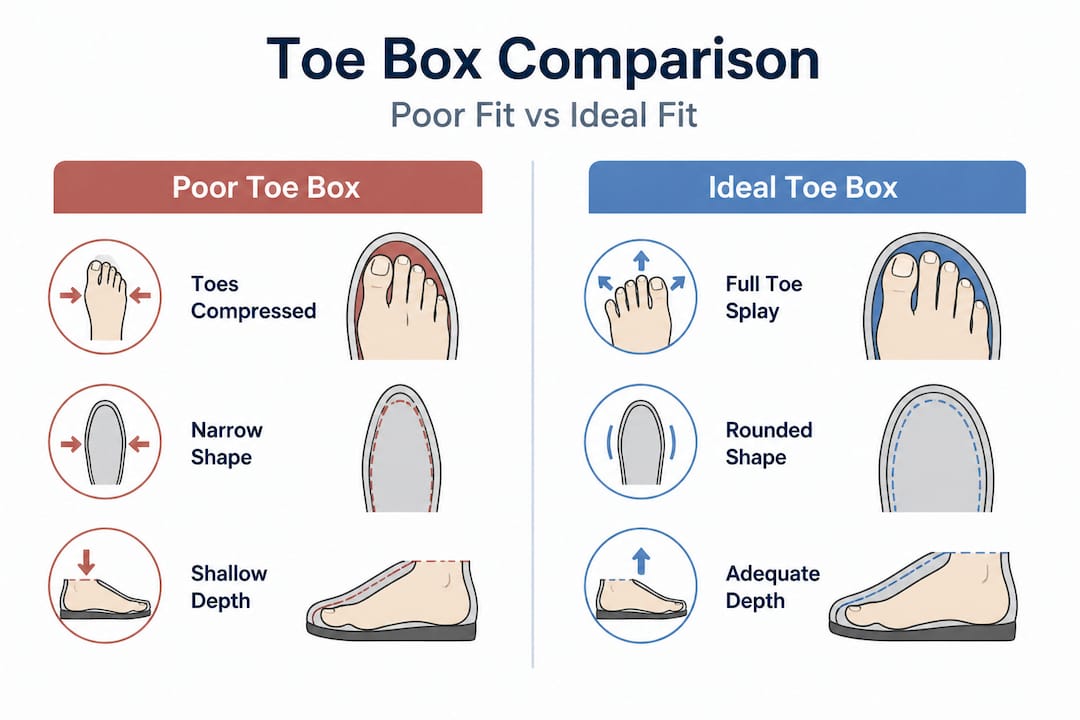
Learning how to approach testing shoe comfort systematically is one of the most practical skills anyone with foot concerns can develop.
Pro Tip: If you are transitioning from narrow, conventional shoes to a wider or anatomical toe box for the first time, do it gradually. Your foot muscles and tendons need time to adapt. Start with a few hours per day and increase wear time over several weeks to avoid discomfort or injury.
Toe boxes in athletic and specialist footwear
Toe box design becomes especially important when you consider the demands placed on feet during sport and high-activity situations. Different activities create different forces on the forefoot, and the toe box must accommodate these forces without restricting movement.
Research published in 2025 found that an enlarged toe box using a 3mm TADL (toe allowance design length) extension improves dynamic basketball movement performance by enhancing foot mobility and force transmission. This is significant because it demonstrates that a more generous toe box is not just about comfort. It can actively improve athletic output by allowing the foot to function more naturally during explosive movements.
Running shoes, cross-trainers, and basketball shoes all have different forefoot demands, yet many still feature toe boxes that are narrower than the natural foot shape. The trend towards more anatomical designs in athletic footwear reflects a growing understanding that restricting the forefoot costs performance as well as comfort. Exploring athletic shoe innovations reveals just how rapidly this area is evolving.
For those with bunions or hammertoes, specialist athletic footwear requires even more careful selection. Extra depth, soft uppers, and a rounded shape are essential. A shoe labelled “wide” but with a pointed or shallow toe box can still cause significant harm, even in a sports context.
Key features to look for in medical and orthopaedic toe boxes:
- Extra depth to accommodate toe deformities without pressure
- Soft, stretchable uppers that conform to the foot’s shape
- Seamless interior construction to prevent friction points
- Removable insoles to accommodate custom orthotics
- Rounded or squared toe shape rather than pointed
- Adjustable closures (laces or straps) to manage forefoot volume
Some advanced foot conditions will exceed what even the best off-the-shelf specialist shoe can offer. In these cases, fully custom footwear accommodation may be necessary, and a podiatrist or orthotist should be consulted.
Special situations: bunions, hammertoes, and tailored toe boxes
For people with developed deformities such as severe bunions or rigid hammertoes, the relationship between toe box design and symptom relief is more nuanced than it first appears. The instinct is to simply go wider and deeper, and in most cases that is the right starting point. However, the evidence reveals some important limits.
Research published in a peer-reviewed journal found that in women with moderate to severe hallux valgus, habitual footwear toe box shape did not correlate with increased medial forefoot pressures. The reason is that people with established deformities tend to self-select shoes that already accommodate their condition. In other words, if you have a severe bunion and you have been managing it for years, you have likely already found footwear that does not actively worsen it.
“In established severe hallux valgus, a wider toe box may not reduce pressures further if the patient has already self-accommodated. At this stage, materials and duration of wear matter as much as shape.” — Clinical finding from toe box pressure research
This does not mean toe box design stops mattering. It means that for advanced conditions, the focus shifts. Material flexibility, how long you wear the shoes each day, and whether the shoe allows any pressure relief over the bunion prominence become the critical variables.
When to seek specialised advice or prescription footwear:
- When standard wide-fit shoes still cause pain or skin breakdown
- When a bunion or hammertoe has progressed to a rigid deformity
- When you have diabetes and any foot pressure carries ulceration risk
- When you experience nerve symptoms such as burning or numbness in the toes
- When over-the-counter orthotics do not adequately address your discomfort
Reviewing shoes for foot problems and understanding the risks of ill-fitting shoes are both valuable steps before committing to a new pair, particularly if your foot health is already compromised.
Why most people misunderstand toe boxes—and what truly matters
Here is the uncomfortable truth: most people shopping for “comfortable” or “wide fit” shoes are solving the wrong problem. They focus on overall shoe width, or they trust a label, and they walk away thinking they have done the right thing. But width alone is only one dimension of a three-dimensional problem.
The critical distinction between a wide shoe and a wide toe box is one that even experienced shoe shoppers miss. A wide shoe addresses the overall volume of the midfoot and heel. A wide toe box specifically addresses the forefoot shape, depth, and room for toe splay. These are not the same thing, and confusing them leads people to buy shoes that still cause harm despite carrying a “wide” designation.
Shape and depth deserve far more attention than they currently receive. A shoe with a rounded, deep toe box in a standard width will often outperform a wide shoe with a shallow, tapered toe box for someone with bunions or hammertoes. The material matters too. A rigid upper in the toe box area will maintain its shape regardless of your foot’s shape. A soft, flexible upper will yield and accommodate.
Our perspective, shaped by working closely with people who have genuine foot health concerns, is that fashion and width labels are the two biggest distractions in footwear shopping. The people who find lasting relief are those who learn to evaluate toe box shape and depth as their primary criteria, then consider everything else. Exploring must-have shoes for foot problems with this framework in mind changes what you look for entirely.
Pro Tip: Always try on shoes in the evening or after a period of activity. Feet swell throughout the day, sometimes by as much as half a size. A shoe that fits perfectly in the morning may compress your toes by late afternoon. Testing at your foot’s largest gives you the most realistic picture of daily comfort.
Find shoes designed for comfort and healthy toe boxes
If this article has shifted how you think about toe boxes, the next step is finding footwear that actually applies these principles rather than just marketing them. At YDA, every shoe in our range is designed with foot health at its core, including careful attention to toe box shape, depth, and material flexibility. Whether you are managing bunions, hammertoes, or simply tired of footwear that leaves your feet aching by mid-afternoon, we have built our collection around the features that genuinely make a difference.
The technology behind YDA shoes reflects years of focus on combining anatomical design with real-world comfort. Our toe boxes are shaped to allow natural toe splay, built with depth to prevent top-of-toe pressure, and constructed from materials that move with your foot rather than against it. If you are ready to experience what properly designed footwear feels like, browse our current range and see the difference that thoughtful toe box design makes in practice.
Frequently asked questions
How do I check if my shoe’s toe box is the right size?
Check that your toes can wiggle freely, your foot fits within the insole outline when you stand on it, and there is about a thumb’s width of space in front of your longest toe. These three fit tests together give you a reliable picture of whether the toe box suits your foot.
Why is a rounded toe box better than a pointed one?
A rounded toe box allows room for natural toe splay, which helps prevent the toes from being pushed inward and reduces the risk of bunions, corns, and other forefoot problems.
Can wearing shoes with a narrow toe box cause permanent damage?
Yes, consistently wearing shoes with a narrow toe box can lead to bunions, hammertoes, and long-term deformity that may eventually require medical intervention to address.
What should people with bunions look for in a toe box?
People with bunions should prioritise extra depth, soft uppers, and a rounded shape to reduce pressure on the bunion prominence and allow comfortable toe positioning throughout the day.
Does a wide shoe guarantee a wide toe box?
No. A shoe marked “wide” may address overall shoe volume without providing a properly shaped or deep toe box. Always check the forefoot shape and depth independently of any width labelling on the box.
Recommended
- Why Shoe Fit Matters for Foot Health and Comfort – YDA UK
- Why avoid tight shoes: protecting your foot health – YDA UK
- Why check shoe interiors? Foot health and comfort explained – YDA UK
- Why avoid ill-fitting shoes for foot health comfort – YDA UK
- A Perfect Fit: How to Measure Shoe Size at Home | Fashion & Style Tips | Fashion Feed| Coveti