
Find Your Exact Shoe Size in Centimetres for UK Online Shoppers
Measure your foot length standing up, from heel to the tip of your longest toe, in centimetres. Do both feet and take the larger number. Add roughly 1.0cm for toe room, then match that final figure against a size chart or calculator, ideally using the Mondopoint (cm) scale, since it stays consistent across brands where UK, US, and EU numbering does not.
TL;DR:
- Measuring foot length in centimeters and adding a 1.0cm allowance provides a more stable sizing reference than relying solely on brand labels.
- Feet should be measured in the afternoon or evening on a hard surface to account for natural swelling and avoid inaccuracies from carpet or morning measurements.
- Sizing up is recommended when foot measurements fall between two sizes, especially considering variations in width, last shape, and foot shape complexities.
- Foot shape and arch height significantly influence shoe fit, with high arches requiring more space across the instep and wide or bunion-prone feet needing broader options.
- Regular re-measurement at least once a year is essential for accommodating changes due to aging, weight fluctuations, pregnancy, or injuries.
Table of Contents
- How to measure your feet for shoe size at home
- How do you convert foot length into a shoe size?
- How do you check the fit once you try shoes on?
- Common measurement mistakes that throw off your size
- When should you re-measure your feet?
- Why trust this guide
- Choosing the right size for athletic, formal, and boot styles
- How foot shape and arch height affect the size you should buy
- Our take: measure once, trust the number, stop guessing between sizes
- Buying with confidence once you know your measurement
- Sources
- FAQ
How to measure your feet for shoe size at home
You need four things: a sheet of paper bigger than your foot, a pen, a ruler or tape measure, and the socks you actually plan to wear with the shoes. Nothing fancy, and nothing you don’t already own.
- Place the paper on a hard floor against a wall. Carpet compresses under your heel and throws off the reading.
- Stand on the paper with your heel touching the wall and your weight evenly spread, the way you’d stand queuing at a till.
- Hold a pen straight down, not tilted, and mark the point where your longest toe ends. For most people that’s the big toe, but roughly one in five have a longer second toe, so check.
- Step off and measure from the wall edge to your mark, in centimetres.
- Repeat for the other foot. Feet are rarely identical. Use whichever measurement is larger.
- Do this in the afternoon or evening rather than first thing in the morning. Feet swell over the course of the day, and the difference can be enough to shift you into a different size..
Width matters too, though it’s a secondary check once length has set your baseline size. Wrap the tape around the widest part of your foot, usually just behind the toes at the ball of the foot, while standing. If that width measurement feels notably wide or narrow relative to your length, a proper foot measurer such as a Brannock device gives a more complete read on length, width, and arch length together, which matters more for performance or medical footwear than for casual trainers.
Pro Tip: Trace around your whole foot instead of just marking the toe. A full outline shows you exactly where your foot bulges or narrows, which helps enormously when comparing against a brand’s printed size chart later.
How do you convert foot length into a shoe size?
This is where most people go wrong; they skip straight to “I’m a UK 8” without ever measuring, then wonder why a size 8 from one brand feels a full size out from another. Foot length in centimetres, known formally as Mondopoint under ISO 9407, is the only truly stable reference point because it describes the actual foot rather than a brand’s internal numbering.
A few standard formulas convert length into approximate sizes. For men’s US sizing, the rough calculation is (3 × foot length in inches) minus 22; for women’s, it’s (3 × foot length in inches) minus 21, though these are baseline estimates and brands vary in how closely they follow them. Before applying any formula, most reliable calculators add a fitting allowance of about 1.0cm to your raw measurement, since a shoe that matches your foot length exactly leaves no room for your toes to move.
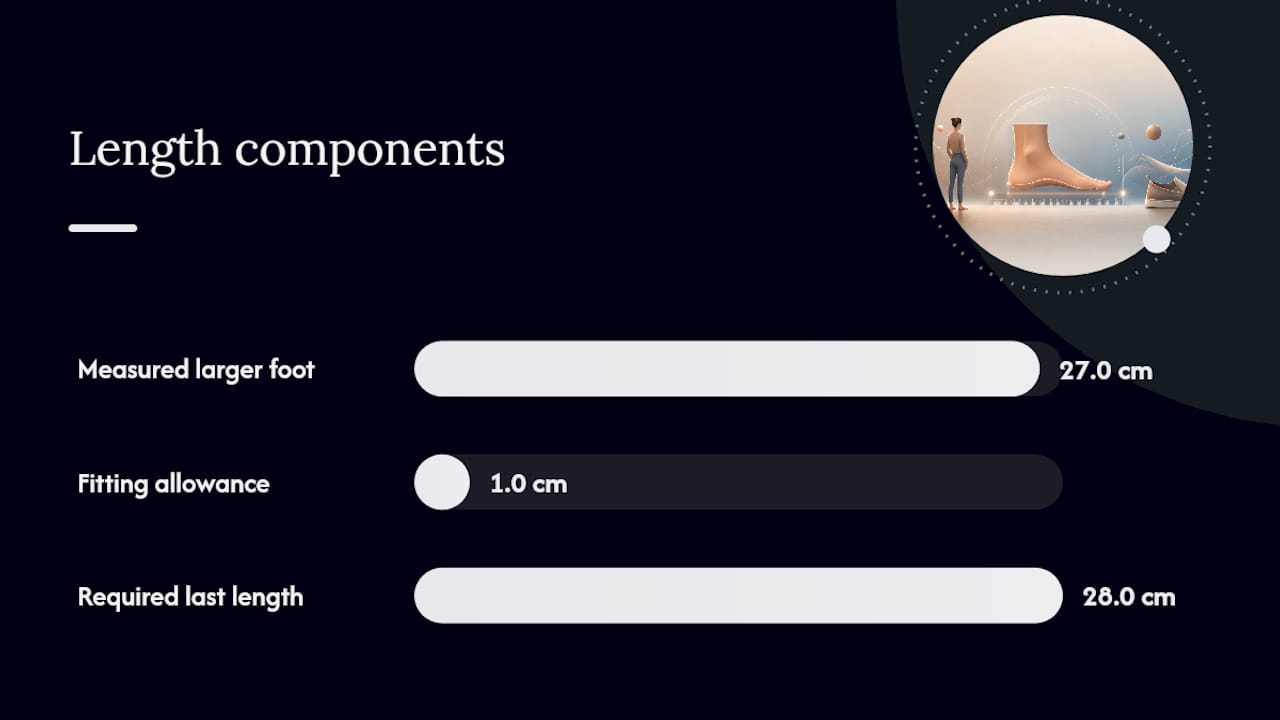
Here’s a worked example. Say your larger foot measures 27.0cm. Add the 1.0cm allowance and you get a required last length of 28.0cm. Matched against typical size charts, that lands you around a US men’s 10, a UK 9, or an EU 43, though the exact cutoff shifts slightly between manufacturers.
A few things to keep in mind before you trust any single number:
- Sizes round differently across markets, so a length sitting right on a boundary might round up in one brand’s chart and down in another’s.
- Narrow lasts and wide lasts change the effective fit at the same stated size.
- When your measurement falls between two listed sizes, sizing up is usually the safer call for length; sizing down almost never gives your toes enough room.
Ydauk’s own conversion guide walks through US to European sizing in more detail if you’re shopping across regions.
How do you check the fit once you try shoes on?
A number on a size chart is a starting point, not a guarantee. Once the shoe is on your foot, run through a handful of quick checks before deciding it’s right.
- Toe room: you should be able to fit roughly a thumb’s width, about 1cm, between your longest toe and the front of the shoe.
- Heel hold: a small amount of heel movement is normal when walking, but if your heel lifts out with every step, or you feel a blister forming within minutes, the fit is wrong.
- Walk test: wear the shoes for five to ten minutes around the shop or your living room. Pressure across the top of the foot or pinching at the sides won’t disappear with wear, whatever the assistant tells you.
- Standing test: stand still for a moment and wiggle your toes. If you can’t wiggle them freely, go up half a size or try a wider fit before assuming the size itself is wrong.
Getting this wrong is common. Research into foot pain and footwear fit found incorrectly sized shoes are widespread, and poor fit is directly linked to ongoing foot discomfort, so these checks are worth the extra two minutes in the shop.
Common measurement mistakes that throw off your size
Small errors in technique produce surprisingly large differences in the final size, so it’s worth checking your method against these four culprits.
- Measuring first thing in the morning. Feet are at their smallest then. Measure in the afternoon or evening instead, when swelling has settled in properly.
- Holding the pen at an angle, or measuring on carpet. Both distort the mark. Use a hard floor and keep the pen perfectly vertical when marking your toe.
- Only measuring one foot. Most people have a size difference between feet, sometimes a full size. Always measure both and size to the larger one.
- Skipping socks, or wearing the wrong ones. If you’re buying boots you’ll wear with thick socks, measure in those socks. A bare-foot measurement for winter boots will leave you a size short.
When should you re-measure your feet?
Feet don’t stay the same shape forever. Ageing, weight change, pregnancy, and injury all alter foot length and width over time, which is why podiatrists generally recommend re-measuring at least once a year rather than trusting a measurement from several years ago.
Children need checking far more often, sometimes every few months during growth spurts, since a shoe that fitted at Christmas can be too small by Easter. Adults recovering from an injury, managing a condition like diabetes, or going through pregnancy should treat measurement as a priority rather than an afterthought, and speak to a specialist if fit-related pain persists.
Why trust this guide
This guide draws on Ydauk’s ongoing sizing research, including practical measurement guidance from Panagiotis on the Ydauk blog. High-performance footwear built around dedicated foot health technology only works properly when the underlying measurement is right. Getting your centimetre figure correct isn’t a formality here; it’s the input that determines whether the shoe’s design actually does its job.
Choosing the right size for athletic, formal, and boot styles
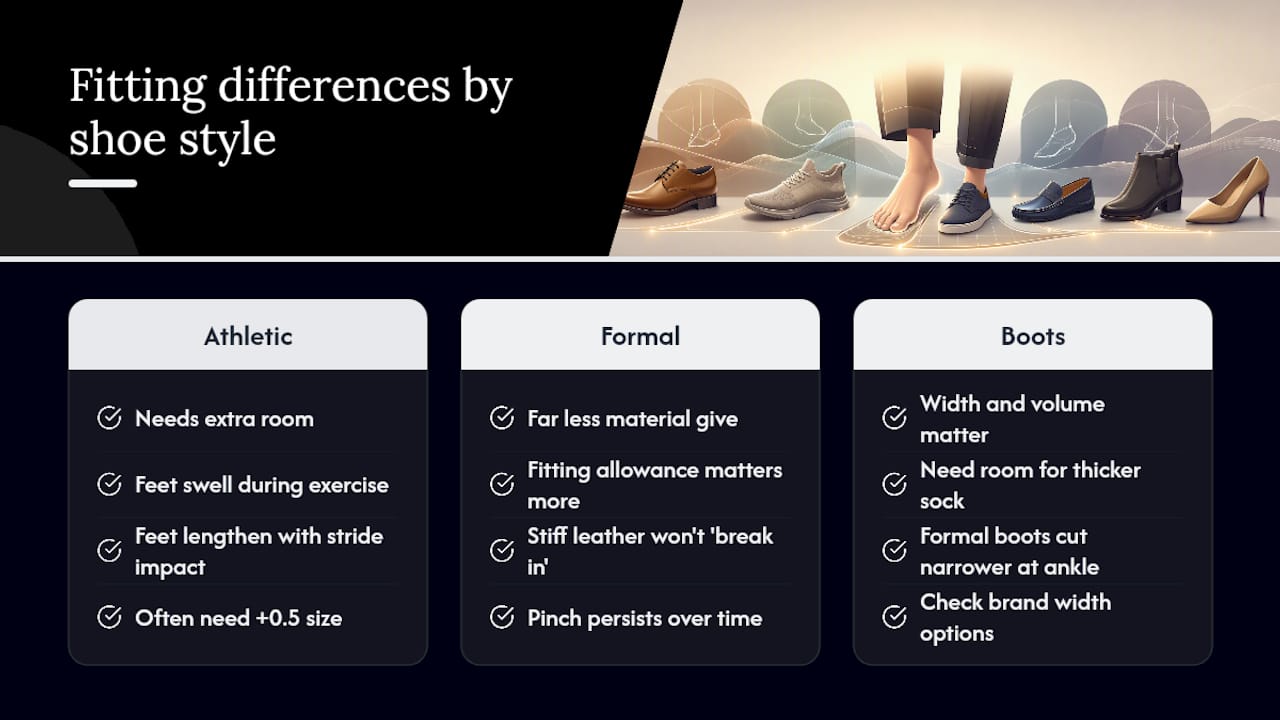
The size that works for one category of shoe rarely transfers cleanly to another, because each style fits the foot differently around the width, volume, and toe box.
Athletic shoes need more room than you’d think. Feet swell during exercise and lengthen slightly with each stride’s impact, so running shoes in particular often need half a size larger than your measured length plus allowance suggests. A snug trainer that felt fine standing in a shop can turn painful three miles into a run.
Formal shoes, especially leather dress shoes, are built with far less give than trainers. There’s no mesh or foam to compress, so the fitting allowance matters more here, not less. Buying a formal shoe “to break in” over time is a common mistake; a shoe that pinches on day one in stiff leather will pinch for months.
Boots bring width and volume into play more than length. A walking boot needs enough room for a thicker sock and some foot swelling on long days, while a formal or fashion boot is often cut narrower through the ankle even at the correct length size. If your foot is notably wide, checking a brand’s width options matters as much as getting the length right.
Across all three categories, the same rule holds: measure once, apply the allowance, then judge the specific pair by how it actually behaves on your foot, not just by the number on the box.
How foot shape and arch height affect the size you should buy
Two people can share an identical foot length and still need different sizes, because shape and arch height change how a shoe behaves once weight is on it.
A high arch tends to shift pressure toward the heel and the ball of the foot, with less contact along the middle. Shoes that fit well in length can still feel tight across the instep on a high-arch foot, since there’s less flex room where the arch sits. A flat or low arch, by contrast, spreads contact more evenly along the sole, which usually means more of the foot touches down and can make a shoe feel a touch shorter than the same size does on a higher arch.
Foot shape matters just as much. A foot with a pronounced bunion or a wide forefoot but narrower heel, sometimes called a “combination” foot, is genuinely hard to size from length alone; the ball of the foot may need a wider fit while the heel needs a snugger one, which no single number captures. This is exactly the situation where the Brannock-style measurement, covering length, width, and arch length together, earns its place over a tape measure and a wall.
If you’ve ever bought the “correct” size on paper and still found it uncomfortable, arch height or shape is usually the reason, not a measuring mistake. Trying shoes on and running the fit checks from earlier in this guide catches what a length-only calculation can’t.
Our take: measure once, trust the number, stop guessing between sizes
The advice most shoppers get is backwards. They’re told to “know their size” as if it’s a fixed fact, like a shirt collar measurement, when feet actually shift by a full size or more across a lifetime and even within a single day. The single biggest improvement anyone can make to their shopping is treating a shoe size as a calculation, not a memory.
Where most guides fall short is stopping at the length measurement and ignoring how much brand-specific rounding and last shape actually move the final result. Two shoes labelled the same UK size can differ by several millimetres in genuine internal length. That’s not a flaw in the sizing system; it’s exactly why the centimetre figure matters more than the label built on top of it.
If you take one thing from this guide, prioritise the raw measurement over anything you think you already know about your size. Measure both feet, in the evening, on a hard floor. Everything else, the formula, the allowance, the brand chart, is just arithmetic applied to that one honest number.
— Panagiotis
Buying with confidence once you know your measurement
Once you’ve got your foot length in centimetres, the guesswork most shoppers deal with when browsing sizes online disappears. Some footwear is built around fit-specific technology, and knowing your exact measurement lets you match against product-level fit notes rather than relying on a generic size label.

The Technology of YDA Shoes page explains how each design’s foot health features, from support structures to energy-return properties, depend on the shoe actually fitting the foot it’s built for. If your measurement lands between two sizes, or your foot shape suggests you might need a specific width, customer service teams can guide you through which product notes apply before you order. Take your centimetre measurement, check it against the technology page’s fit guidance, and order the size that matches, not the size you’ve always assumed was yours.
Sources
- Shoe size — Wikipedia
- Shoe Size Calculator - Find Your US, EU & UK Shoe Size
- Ways to measure your feet for shoe size — USA Today
- Journal of Foot and Ankle Research (relevant article)
FAQ
What UK shoe size is a 7?
A UK size 7 corresponds roughly to a US men’s 9 and EU 41, though exact cutoffs vary slightly by brand.
How do I find my UK shoe size?
Measure your foot length in centimetres from heel to longest toe, add about 1.0cm for toe room, then match that figure against a UK size chart or conversion guide.
Can I measure my shoe size with my phone?
Some apps use your phone’s camera to estimate foot length, but a simple paper, wall, and ruler measurement is just as accurate and doesn’t rely on camera angle or lighting.
Can I calculate my shoe size online?
Yes. Enter your measured foot length in centimetres into a shoe size calculator, which applies a fitting allowance and standard formulas to suggest your UK, US, or EU size.
How often should I re-measure my feet?
At least once a year, and sooner after significant weight change, pregnancy, injury, or if you’re measuring a child’s growing feet.