
Shoe size width chart: your UK fitting guide
TL;DR:
- Measuring the ball of your foot in millimetres while standing helps determine your UK shoe width. Most people fit a standard D width for men or B for women, with each step wider or narrower adding about 6 mm. Using brand-specific charts and actual millimetre measurements ensures the best fit and reduces sizing errors.
If your ball-of-foot width measures around 90–95 mm, you most likely need a standard UK width, which is generally indicated by the letter D for men and B for women. Each width step corresponds to an approximately 6 mm increment in circumference at the ball of the foot. Measure the widest part of your foot while standing, then use the table below to find your starting point. Always check the brand’s own chart before buying, and when two widths seem equally close, go with the wider one.
| Ball-of-foot width | Likely UK width | Description |
|---|---|---|
| — | B (men) / AA (women) | Narrow |
| — | D (men) / B (women) | Standard |
| — | E (men) / D (women) | Wide |
| — | EE (men) / E (women) | Extra wide |
| — | EEE+ (men) / EE+ (women) | Very wide |
Measure both feet, use the larger measurement, then confirm against the specific brand chart before you buy.
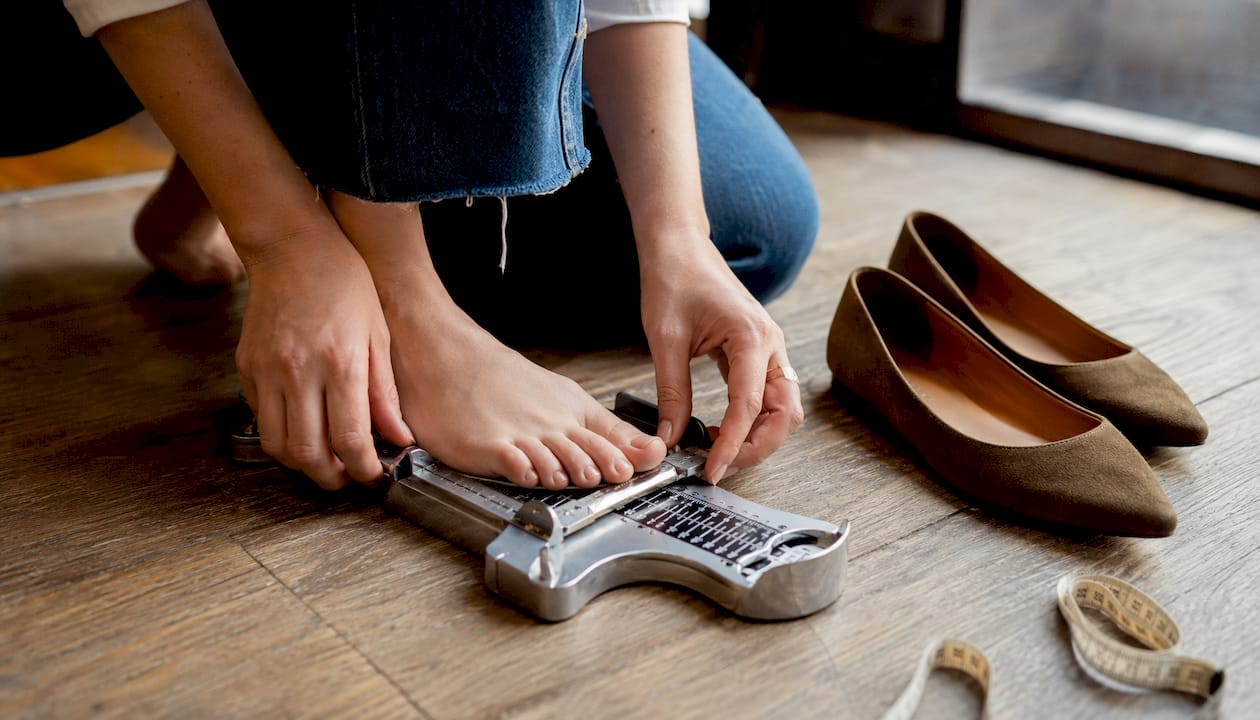
Table of Contents
- How to measure your foot width accurately at home
- UK shoe width chart: men, women, and children
- What the width letters actually mean
- Why widths vary between brands and how to handle it
- Quick answers to common width questions
- Common measurement mistakes and how to fix them
- How Ydauk approaches sizing and width
- Key takeaways
- Width fitting: what the charts don’t tell you
- Ydauk’s sizing tools make finding the right width straightforward
- Useful sources and further reading
How to measure your foot width accurately at home
The measurement you need is the ball-of-foot width: the distance across the widest part of your forefoot, taken while you are standing with your full weight on the foot. Two methods work reliably at home.
The trace method (recommended)
- Place a sheet of plain paper on a hard floor against a wall.
- Stand with your heel touching the wall, foot flat on the paper.
- Hold a pencil upright and trace around the entire foot, keeping the pencil vertical.
- Mark the two widest points on either side of the ball of the foot (roughly behind the toes).
- Use a ruler to measure the distance between those two marks in millimetres.
- Repeat for the other foot. Record both measurements.
The trace method is fast, accurate, and repeatable for consumer use, making it the go-to approach for home measuring.
The Brannock-style alternative

If you have access to a Brannock device (the metal foot-measuring tool found in most shoe shops), it measures ball-of-foot width directly. Without one, wrap a soft tape measure or a piece of string around the widest part of your foot, mark where it meets, then measure that length flat against a ruler. This gives you the circumference rather than the straight width, so it reads slightly larger — useful as a cross-check but not a direct substitute for the trace measurement.
Pro Tip: Measure later in the afternoon or evening. Feet swell by up to a full size during the day, so an evening measurement gives a more realistic fit for shoes you will wear for extended periods. For dress shoes, measure standing with your weight evenly distributed; for trainers, lean very slightly forward to simulate walking gait.
UK shoe width chart: men, women, and children
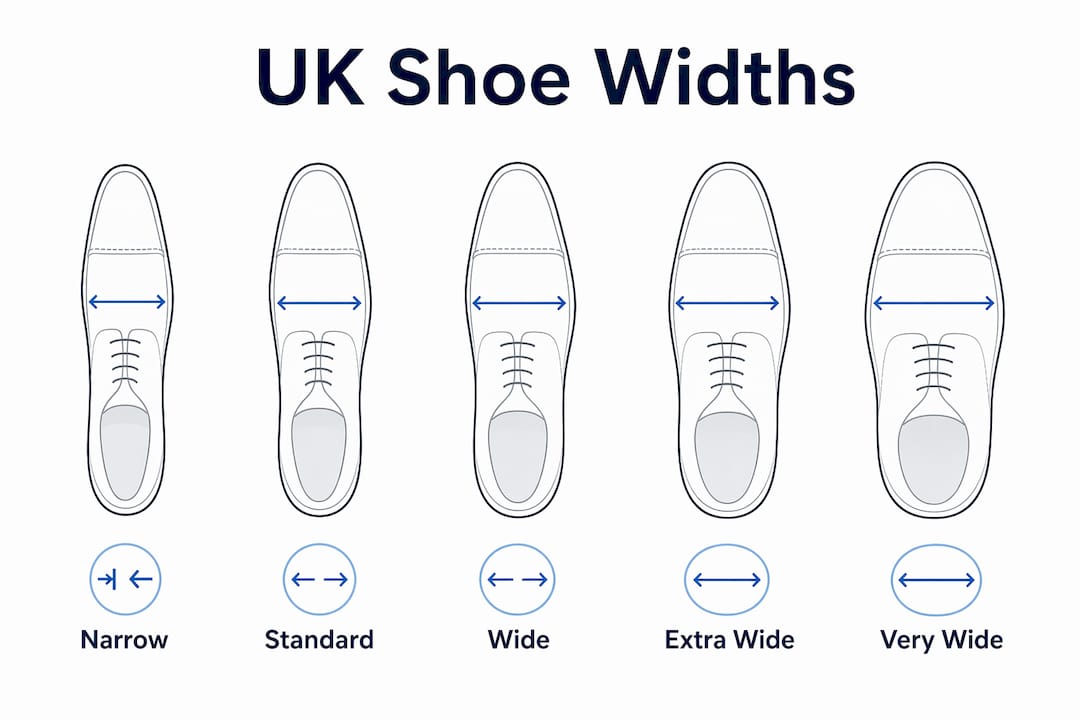
Use your ball-of-foot width in millimetres as the primary input. The table below is a general reference; exact cut-offs shift slightly depending on your shoe size and the brand’s last. Always confirm with the manufacturer’s chart for the specific product.
Men’s UK width chart
| UK width code | Ball-of-foot width (mm) | Ball-of-foot width (inches) | Description |
|---|---|---|---|
| B | — | — | Narrow |
| D | — | — | Standard (default) |
| E | — | — | Wide |
| EE | — | — | Extra wide |
| EEE | — | — | Very wide |
Women’s UK width chart
| UK width code | Ball-of-foot width (mm) | Ball-of-foot width (inches) | Description |
|---|---|---|---|
| AA | — | — | Narrow |
| B | — | — | Standard (default) |
| D | — | — | Wide |
| E | — | — | Extra wide |
| EE | — | — | Very wide |
Children’s UK width chart
| UK width code | Description |
|---|---|
| C | Narrow |
| D | Standard |
| E | Wide |
| F | Extra wide |
| G | Very wide |
Children’s width scales use different baselines from adult codes, so never assume an adult chart applies to a child’s foot. Use a kids-specific chart and re-measure every few months, as children’s feet change quickly. The table above gives letter codes only; exact mm values vary significantly by children’s shoe size, so always cross-reference the brand’s own children’s sizing page.
What the width letters actually mean
A width letter describes forefoot girth, not foot length. Two shoes with the same length number but different width codes have the same heel-to-toe distance; what changes is the internal space across the ball of the foot. A D-width and an EE-width in the same length are built on different lasts, with the EE offering noticeably more room across the widest part.
Key UK width codes at a glance:
- B — narrow (men’s); standard (women’s)
- D — standard (men’s); wide (women’s)
- E — wide (men’s); extra wide (women’s)
- EE — extra wide (men’s); very wide (women’s)
- EEE / EEEE — very wide to extra-extra wide (men’s specialist sizing)
The standard medium width is D for men and B for women across most systems, and around 60% of people fit a standard width. That still leaves a large proportion who need a narrower or wider option, yet most high-street ranges stock only D or E for men and B or D for women.
Each width letter increment represents approximately 1/4 inch (about 6 mm) difference in circumference at the ball of the foot. Some manufacturer charts define each E-step as about 3 mm rather than 6 mm, resulting in different quoted figures. When in doubt, measure in millimetres and compare directly to the brand’s published mm values.
A note on international conversions. UK width letters do not map one-to-one with US, EU, or JIS systems. The same letter can represent a physically different dimension depending on the country of origin. Measurement-based conversion using mm or cm is more reliable than letter-to-letter mapping when shopping internationally. For a worked example of how UK and US sizing diverge, the US shoe sizes guide at Ydauk walks through the common labelling differences.
Why widths vary between brands and how to handle it
There is no universal physical standard for width codes. A brand’s “E wide” is defined by its own last, which is the foot-shaped mould the shoe is built around. Two brands can both label a shoe “E” while the internal forefoot space differs by several millimetres.
Common reasons widths vary:
- Last shape — each manufacturer designs its own last; a narrow last produces a tighter fit even at the same letter.
- Insole thickness — a thick cushioned insole reduces effective width; a thin insole leaves more room.
- Upper material — leather stretches over time; synthetic uppers generally do not, so a synthetic shoe in your usual width may feel tighter after a long day.
- Target market — brands that specialise in wide-fit footwear often build their “standard” on a wider baseline than a fashion-led brand.
When your measurement sits on the boundary between two widths, choose the wider option. A shoe that is very slightly too wide is far more comfortable over a full day than one that is fractionally too narrow. If the brand publishes mm-based internal measurements, use those directly; manufacturer mm charts give the most precise mapping for that brand’s lasts and are the recommended approach for cross-brand purchases.
Pro Tip: Before buying online, search for the specific brand’s sizing page rather than relying on a generic conversion chart. Many brands publish a PDF or table with actual internal width measurements by size. A five-minute search can save a return.
Quick answers to common width questions
How do I know which shoe width I need? Measure the ball-of-foot width in millimetres while standing, then compare it to the brand’s width chart. The mini conversion table at the top of this article gives a reliable starting point.
Is D wider than EE? No. EE is wider than D. In men’s UK sizing, D is standard, E is wide, and EE is extra wide. Each step up adds approximately 6 mm (about 1/4 inch) of circumference at the ball of the foot.
Do widths change as shoe size increases? Yes. Width codes are relative to length. As shoe size increases, the absolute mm measurement for each width code also increases, which is why a size 10 D is physically wider than a size 7 D, even though both carry the same letter.
What are the standard UK shoe widths? UK widths run from narrow (B for men, AA for women) through standard (D for men, B for women) to extra wide (EE for men, E for women) and beyond. Children’s widths use a separate C–G scale.
Can I just go up a size instead of choosing a wider width? Rarely a good solution. Going up a length to fix a tight ball of foot leaves the heel too loose and changes the shoe’s flex point. Choosing width over length changes forefoot space without altering the heel fit.
Common measurement mistakes and how to fix them
Most measurement errors come from posture, time of day, and the wrong sock thickness. Here are the most frequent mistakes and their corrections:
- Measuring while sitting — your foot spreads when you stand; always measure with full weight on the foot.
- Measuring only one foot — feet are rarely identical; measure both and use the larger reading.
- Wearing thin socks (or none) when you plan to wear thick ones — measure in the socks you will actually wear with the shoe.
- Not pressing the pencil vertically — angling the pencil inward underestimates width; keep it perpendicular to the paper.
- Measuring in the morning — feet are at their smallest first thing; an evening measurement gives a more accurate picture for all-day wear.
- Rounding down — when your measurement falls between two widths, record the larger value and choose accordingly.
Pro Tip: When trying shoes in a shop, go at the end of the day and bring the socks you plan to wear. Walk on a hard surface, not just carpet. If the widest part of your foot presses against the upper when you flex your toes, the width is too narrow regardless of what the label says.
How Ydauk approaches sizing and width
Ydauk uses millimetre-based internal measurements and size-by-width charts across its range to reduce returns and improve comfort for everyday wear. The brand’s sizing resources include:
- A dedicated shoe width chart guide covering the full range of UK width codes with practical guidance for retail purchases.
- A home measurement guide with step-by-step instructions and measurement hygiene tips.
- A width sizes fitting guide that explains how width codes apply specifically to Ydauk products.
- YDA Technology, which informs the construction of each shoe with foot-health and energy-efficiency principles, meaning width and last design are integral to the product rather than an afterthought.
- Customer support via phone for readers who want bespoke sizing advice before purchasing.
Each product still has its own published chart, so check the individual product page before ordering. For hands-on tools, Ydauk’s shoe chart guide is a practical starting point.
Key takeaways
Correct shoe width comes down to one measurement: ball-of-foot width in millimetres, taken while standing, compared against the brand’s own chart.
| Point | Details |
|---|---|
| Measure both feet while standing | Use the larger ball-of-foot width in mm; feet often differ, and the larger one sets your fit. |
| Standard UK widths are D (men) / B (women) | A large portion of people fit standard width.; the rest need a narrower or wider option. |
| Each width step is approximately 6 mm | One letter increment equals approximately 1/4 inch (6 mm) in ball-of-foot circumference. |
| Choose wider when between widths | A slightly wider shoe is more comfortable long-term than one that is fractionally too narrow. |
| Ydauk publishes mm-based width charts | Use Ydauk’s sizing guides and YDA Technology page to match your measurement to the right product. |
Width fitting: what the charts don’t tell you
Width charts are useful, but they are a starting point, not a verdict. The number that surprises most people is how much a brand’s last shape matters once you move away from standard widths. A shoe labelled EE by a fashion brand and EE by a specialist wide-fit brand can differ by several millimetres internally, even when both pass the same letter test. The chart gets you into the right postcode; the brand’s mm data gets you to the right door.
There is also a tendency to treat width as a fixed personal characteristic. Feet change with age, weight, and activity level. Someone who wore a D comfortably at 30 may genuinely need an E at 50. Measuring once and assuming the result holds for life is how people end up with shoes that fit badly and blame the brand.
The other thing worth saying plainly: going up a shoe size to compensate for narrow width is one of the most common and least effective fixes in footwear. It shifts the heel, changes the flex point, and usually makes the problem worse. The width letter exists precisely to solve this, and most UK retailers now stock at least two widths across their core ranges.
Ydauk’s sizing tools make finding the right width straightforward
Getting width right the first time means fewer returns and shoes that actually feel good after a full day on your feet. Ydauk builds its footwear around YDA Technology, which integrates foot-health principles directly into the last and construction of each shoe, so width is a design decision rather than a label applied after the fact.

Ydauk publishes detailed width charts and mm-based measurement tools across its range, giving you a concrete number to match rather than a letter to guess at. Whether you need a standard D, a wide E, or something further along the scale, the sizing resources are there to help you land on the right option without trial and error.
Visit the YDA Technology page to see how the footwear is built and to access the full sizing guide for each product. If you are still unsure after measuring, the customer support team is reachable by phone and can advise on the best width for your specific measurement.
Useful sources and further reading
- Shoe size — Wikipedia — comprehensive overview of international shoe sizing systems, including UK, US, EU, and Mondopoint standards.
- Shoe width chart — men’s, women’s & kids’ width guide — practical reference tables for men, women, and children with standard width codes and descriptions.
- International shoe width chart — US, UK, EU, JP sizes — explains why letter codes differ across countries and why measurement-based conversion is more reliable.
- Men’s shoe width chart — sizes 6–16, B through 6E — detailed men’s width data including mm and inch values across a wide size range.
- How to measure your foot length and width at home — step-by-step trace method instructions with guidance on measurement hygiene.
- Shoe width chart and how to measure foot width — Hockerty — consumer-focused guide covering the trace method and how to compare measurements to brand charts.
- Ydauk shoe width chart guide — Ydauk’s own UK-specific width reference with guidance on using mm measurements for their product range.
- Ydauk home measurement guide — step-by-step home measuring instructions tailored to Ydauk’s sizing system.
When buying internationally, always check the brand’s country-of-origin width chart rather than converting letters directly. Metric measurements (mm) travel across systems without distortion; letters do not.