
Shoe sizes in inches: your complete UK fitting guide
What shoe sizes in inches actually mean for UK shoppers
Your shoe size in inches is simply the length of your foot from the back of your heel to the tip of your longest toe. That measurement, taken while you are standing, is the foundation every sizing system in the world builds on. The difference lies in what each system does with that number afterwards.
UK sizes do not map directly onto inches. Instead, the British system uses barleycorn units, where one barleycorn equals one third of an inch. A UK men’s size 7, for example, corresponds to a foot length of roughly 9.75–10.125 inches, depending on the shoe last design and the brand producing it. That fractional relationship is why you cannot simply read your foot length in inches and find a matching UK number without a conversion chart.
Here is a general guide for common UK men’s sizes and their corresponding foot lengths, acknowledging that measurements vary by brand and shoe last.
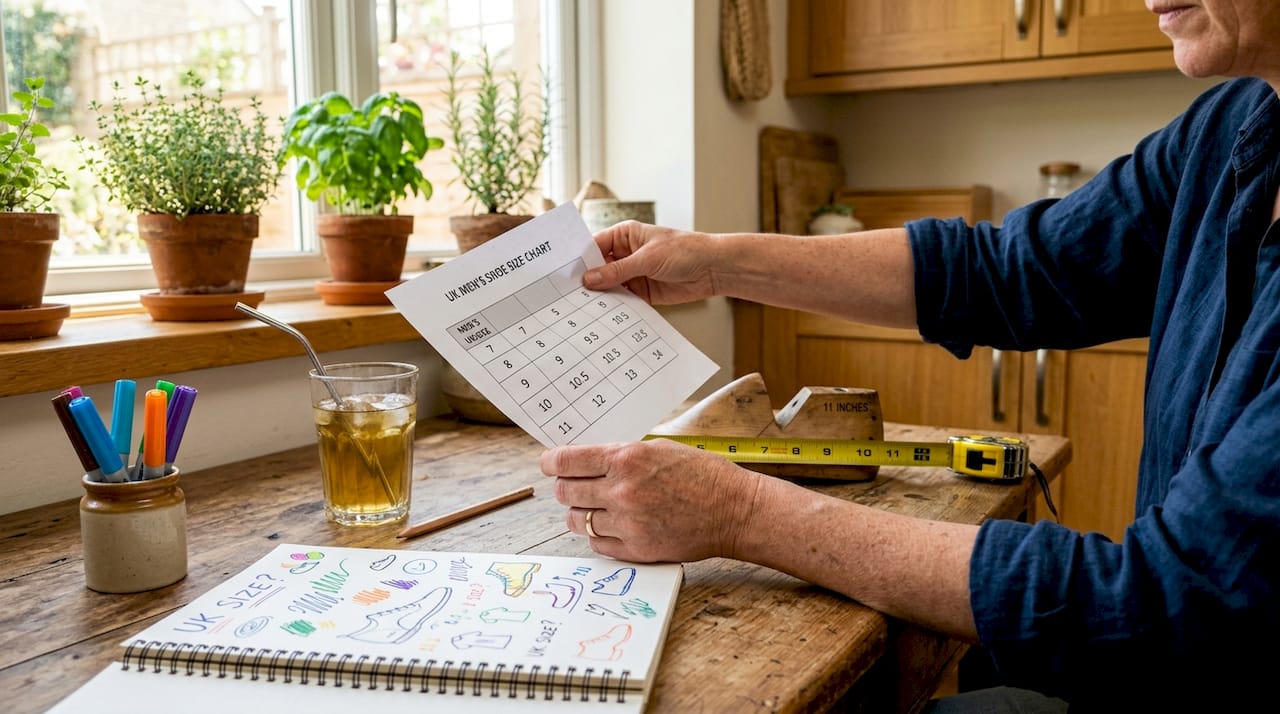
These figures are approximate. Brand-specific lasts, the internal shape a shoe is built around, mean two pairs labelled the same UK size can feel noticeably different. Always treat any chart as a starting point, not a guarantee.
How to measure your foot size accurately in inches
Getting the measurement right matters more than the tool you use. Standing with full weight on your foot changes its length compared with sitting, and that difference can shift you by half a size or more.
- Measure at the end of the day. Feet swell naturally through the day, so an evening measurement captures your foot at its largest and reduces the risk of shoes that feel tight by afternoon.
- Stand barefoot on a hard, flat surface. Carpet compresses and distorts the outline. A wooden or tiled floor gives a clean result.
- Place a sheet of paper against a wall. Stand on it with your heel touching the wall, then trace around your entire foot with a pencil held vertically.
- Mark the longest point. For most people that is the big toe, but for some it is the second toe. Measure from the heel mark to whichever toe extends furthest.
- Measure the distance in inches. Use a ruler or tape measure. One inch equals 2.54 centimetres, so you can convert easily if your ruler shows only centimetres.
- Repeat for the other foot. Feet are rarely identical. Always use the larger measurement when selecting a size.
- Add toe clearance. Adding roughly ⅜ inch (about 1 cm) of recommended toe clearance to your raw measurement before consulting a size chart gives your toes room to move without the shoe feeling loose.
- Measure foot width too. Wrap a soft tape measure around the widest part of your foot, usually across the ball. Width affects comfort as much as length, particularly in fitted or performance footwear.
- Re-measure periodically. Foot size changes with age, weight, and pregnancy. A measurement taken five years ago may no longer be reliable.
Pro Tip: Wear the type of socks you plan to use with the shoe when you trace your foot. A thick hiking sock adds measurable volume; a thin trainer sock does not. Matching the sock thickness to the shoe type prevents a common sizing error.

Shoe size conversion charts for men, women, and children
The ISO/TS 19407:2015 standard provides the formulae that underpin most published conversion tables, covering UK, US, EU, and Mondopoint systems for adults and children. The tables below use those relationships as their basis. Half sizes sit between the whole-size rows; when your foot measurement falls between two sizes, round up rather than down.
Men’s shoe size conversion chart
| Foot length (inches) | UK size | US size | EU size | Mondopoint (mm) |
|---|---|---|---|---|
| 9.0 | 4 | 5 | — | — |
| 9.0 | 5 | 6 | — | — |
| 9.25 | — | 6.5 | —.5 | — |
| 9.5 | 6 | 7 | — | — |
| 9.75 | 7 | 8 | — | — |
| 10.125 | — | — | —.5 | — |
| 10.25 | 8 | 9 | 42 | 260 |
| 10.5 | 9 | 10 | — | 267 |
| — | 9.5 | 10.5 | — | — |
| — | 10 | 11 | —.5 | 279 |
| 11.25 | 11 | 12 | 46 | 286 |
| 11.5 | 12 | 13 | 47 | 292 |
Women’s shoe size conversion chart
Women’s sizes run approximately 1.5 sizes larger than men’s for the same foot length, a difference that catches many shoppers out when buying unisex or men’s styles.
| Foot length (inches) | UK size | US size | EU size | Mondopoint (mm) |
|---|---|---|---|---|
| — | 3 | — | 36 | 216 |
| 9.0 | 3.5 | 6 | 36.5 | — |
| 9.0 | 4 | 6.5 | — | — |
| 9.25 | 4.5 | 7 | —.5 | — |
| 9.5 | 5 | — | — | — |
| 9.75 | — | 8 | —.5 | — |
| 10.0 | 6 | — | — | 254 |
| 10.25 | 6.5 | 9 | 40 | 260 |
| 10.5 | 7 | 9.5 | — | 267 |
| — | — | 10 | —.5 | — |
| — | 8 | 10.5 | 42 | 279 |
A US women’s size 7 corresponds to a foot length that varies by brand. Use that figure as a cross-check when shopping from American retailers.
Children’s shoe size conversion chart
Children’s sizing uses a separate scale that resets at the transition to adult sizes. Manufacturers typically build in slightly more length allowance for growing feet, so children’s charts should be treated as guides rather than fixed rules.
| Foot length (inches) | UK size | US size | EU size |
|---|---|---|---|
| 4.75 | 1 (infant) | 1 | 17 |
| — | 3 (infant) | 4 | 20 |
| 6.25 | 6 (infant) | 7 | 23 |
| 6.75 | 8 (toddler) | 9 | 25 |
| 7.25 | 10 (toddler) | 11 | 27 |
| 7.75 | 12 (junior) | 13 | 30 |
| 8.25 | 1 (junior) | 1.5 | 33 |
| 9.0 | 3 (junior) | 3.5 | 36 |
For a broader shoe size conversion chart covering additional sizes and styles, Ydauk’s sizing guide expands on these tables with brand-specific notes.
How the main international sizing systems relate to inches
Four systems dominate global footwear, and each handles inches differently.
The UK system is built on barleycorn increments of one third of an inch. Size 1 starts at a specific heel-to-toe length, and each subsequent size adds one barleycorn. There is no direct inch equivalent for any given UK size number, which is why conversion charts exist. UK children’s sizes and adult sizes also use different starting points, adding another layer of complexity.
The US system runs one size ahead of UK for men and roughly 1.5 sizes ahead for women, for the same foot length. US men’s sizing approximates foot length in inches minus a fixed offset; US women’s sizing uses a slightly different formula. The practical result is that a UK 8 man and a US 9 man have the same foot, while a UK 5 woman and a US 6.5 woman share the same measurement.
The EU system works in Paris points, where one Paris point equals two thirds of a centimetre. Because it uses centimetres rather than inches, converting EU sizes to inches requires a two-step calculation: multiply the EU size by 0.667 to get centimetres, then divide by 2.54. An EU 42 works out to roughly 10.25 inches of foot length for a man.
Mondopoint is the cleanest system for inch comparisons because it expresses foot length directly in millimetres. Divide any Mondopoint value by 25.4 to get the equivalent in inches. A Mondopoint 267 shoe, for instance, fits a foot of approximately 10.5 inches. The system also incorporates foot width, which no other major system does as standard.
Key facts to keep in mind when comparing systems:
- UK and US sizes share the same barleycorn increment but start at different points on the scale.
- EU sizes use Paris points, not barleycorns or inches, so direct conversion always requires an intermediate step.
- Mondopoint values divide cleanly by 25.4 to give inches, making them the most transparent system for inch-based shoppers.
- Children’s sizing resets independently of adult sizing in every major system.
- No international standard forces manufacturers to follow these formulae exactly, so brand variation is the norm rather than the exception.
Why shoe sizes vary between brands and genders
The single biggest source of sizing confusion is the last, the three-dimensional mould a shoe is built around. Two brands can both label a shoe “UK 9” and produce footwear that fits completely differently, because their lasts reflect different assumptions about foot shape, arch height, and toe box width. A running shoe last is typically narrower through the heel and more tapered than a casual leather shoe last, even at the same nominal size.
Gender differences compound this. Women’s lasts are not simply scaled-down men’s lasts. They account for a narrower heel relative to the forefoot, a higher instep, and a different arch profile. When women buy men’s styles or unisex footwear, they often need to size down by 1.5 sizes, but the fit through the heel and instep may still feel off because the underlying last shape differs. The gender size offset of approximately 1.5 sizes applies to length, not to the three-dimensional geometry of the shoe.
Athletic and fashion footwear brands also size differently from one another within the same gender. A size 7 from a performance running brand may run longer than a size 7 from a fashion label, because performance brands tend to build in more toe clearance by default. Checking the brand’s own size chart against your foot measurement in inches, rather than relying on your usual size number, is the only reliable approach.
How to use your foot measurement in inches to find the right size
Your inch measurement is most useful as a cross-reference tool rather than a direct lookup. Start by measuring both feet as described earlier, then take the larger figure and add your toe clearance allowance of roughly ⅜ inch. That adjusted number is your working measurement.
With that figure in hand, go to the specific brand’s size chart rather than a generic conversion table. Most reputable brands publish charts that map foot length in centimetres or inches to their own sizing, and those charts reflect the actual last they use. For Ydauk’s footwear, the sizing guide provides this brand-specific detail alongside the general conversion framework.
When a brand’s chart is not available, use the generic conversion tables as a starting point and then read customer reviews for comments on fit. Phrases like “runs narrow,” “runs long,” or “size up” in reviews carry real information. If you are between sizes on a chart, size up for closed-toe styles and size down for open-toe or sandal styles, where excess length is more visible and less of a comfort issue.
For width, compare your measured circumference at the ball of the foot against the brand’s width guide if one exists. Standard UK fittings run from D (narrow) through to H (wide) for men, and B through to E for women, though not every brand offers the full range.
What is Mondopoint sizing and how does it relate to inches?
Mondopoint is an international shoe sizing standard developed to eliminate the confusion caused by regional systems. It expresses shoe size as foot length in millimetres, sometimes combined with foot width in millimetres as a secondary figure. A shoe marked “270/100” fits a foot 270 mm long and 100 mm wide at the ball.
Converting Mondopoint to inches is straightforward: divide the millimetre value by 25.4. A Mondopoint 254 corresponds to 254 millimetres; converting to inches requires dividing by 25.4. This directness makes Mondopoint the most transparent system for anyone working from an inch measurement, because there is no offset or formula to memorise beyond the basic millimetre-to-inch conversion.
The system is used widely in military and ski boot applications, where precise fit is critical and a universal standard reduces logistical complexity. Korean shoe sizing uses the same millimetre-based approach, which is why Korean sizes and Mondopoint values are often identical or very close. In everyday retail, Mondopoint rarely appears on consumer labels in the UK, but understanding it helps when shopping from specialist or international suppliers who use it.
To convert your Mondopoint equivalent from an inch measurement: multiply your foot length in inches by 25.4 to get millimetres, then round to the nearest 5 mm. A foot measuring 10.25 inches becomes approximately 260 mm, which is Mondopoint 260.
Expert advice for finding your accurate shoe size in inches
Measuring accurately is only half the task. Applying that measurement well across different brands and styles is where most sizing errors actually occur.
- Measure at day-end. Feet reach their maximum length and width by evening. A morning measurement can underestimate your true size by up to half a size.
- Bear full weight. Sitting measurements compress the foot less than standing, producing a shorter result. Always stand when tracing or measuring.
- Use your inch figure as a foundation, not a final answer. Convert it to the brand’s own size using their published chart, not a generic table. Generic tables are accurate on average but can be off by half a size for any specific brand.
- Account for last shape, not just length. A shoe that matches your length but uses a narrow last will still feel tight. Width fittings and last descriptions in product notes matter.
- Re-measure every year or two. Foot size changes gradually with age, and significant weight changes or pregnancy can alter both length and width more quickly.
- Check both feet every time. The dominant foot is often slightly larger. Buying for the smaller foot and hoping the other stretches is a reliable route to blisters.
Pro Tip: If you are ordering online from a brand you have not worn before, search for the brand name alongside “sizing” or “runs large” before committing. A two-minute search through customer feedback often surfaces consistent patterns that no size chart will tell you.
The US shoe size guide from Ydauk covers additional cross-system comparisons if you are buying from American retailers and need to translate your UK inch measurement into a US size quickly.
Key takeaways
Your foot length in inches is the single most reliable starting point for finding the right shoe size across any regional system, but it must always be matched against a brand-specific chart rather than a generic table.
| Point | Details |
|---|---|
| Measure standing, at day-end | Standing with full weight at the end of the day captures your foot at its largest, reducing sizing errors. |
| Add ⅜ inch toe clearance | Adding roughly ⅜ inch to your raw measurement before consulting a chart improves fit comfort. |
| UK sizes use barleycorn units | UK sizes increment by one third of an inch, so no direct inch-to-UK-size mapping exists without a chart. |
| Women’s sizes run 1.5 sizes above men’s | For the same foot length, women’s sizes are approximately 1.5 sizes larger than men’s across most systems. |
| Mondopoint divides cleanly by 25.4 | Dividing any Mondopoint value by 25.4 gives the foot length in inches, making it the most transparent system. |