
Shoe size 42: your complete fit and conversion guide
TL;DR:
- Shoe size 42 is based on the Paris Point system, indicating foot lengths of around 26.0 to 26.5 centimeters.
- Actual fit varies across brands and shoe categories because of different lasts, toe allowances, and width standards.
Shoe size 42 is a European measurement based on the Paris Point system, indicating a foot length of approximately 26.5 cm for men and 26.0 cm for women. That single number maps to multiple US and UK equivalents depending on gender, brand, and shoe category. A man wearing EU 42 typically falls between US 8.5 and 9.0, while a woman in the same European size lands closer to US 10.0 to 10.5. No universal standard locks these conversions in place, which is why the same label can produce a noticeably different fit across brands.
What does shoe size 42 actually mean?
Shoe size 42 is defined by the Paris Point system, the measurement standard used across continental Europe. Each size increment equals exactly 6.67 mm, calculated as foot length in centimetres multiplied by 1.5, plus a toe allowance of 2. That formula places EU 42 at a foot length of roughly 26.5 cm for men and 26.0 cm for women.

The Paris Point system is unisex by design. The number 42 carries the same mathematical meaning regardless of gender. What changes is how that number maps to UK and US sizes, because those systems use a different unit called the barleycorn, which equals one third of an inch. That fundamental difference in base units is why EU to US conversions are always approximate rather than exact.
UK sizing adds another layer of complexity. A EU 42 typically corresponds to a UK men’s 8 or 8.5, but some brands label the same last as a UK 9. Women’s UK sizing for EU 42 generally falls around a UK 7.5 to 8. These gaps are not errors. They reflect genuine differences in how each country’s sizing tradition developed.
How does shoe size 42 convert to UK and US sizes?
The table below shows standard conversion ranges for EU 42 across the most common sizing systems. Treat these as starting points, not guarantees.
| EU size | Foot length | UK men’s | US men’s | UK women’s | US women’s |
|---|---|---|---|---|---|
| 42 | 26.0–26.5 cm | 8–8.5 | 8.5–9.0 | 7.5–8 | 10.0–10.5 |
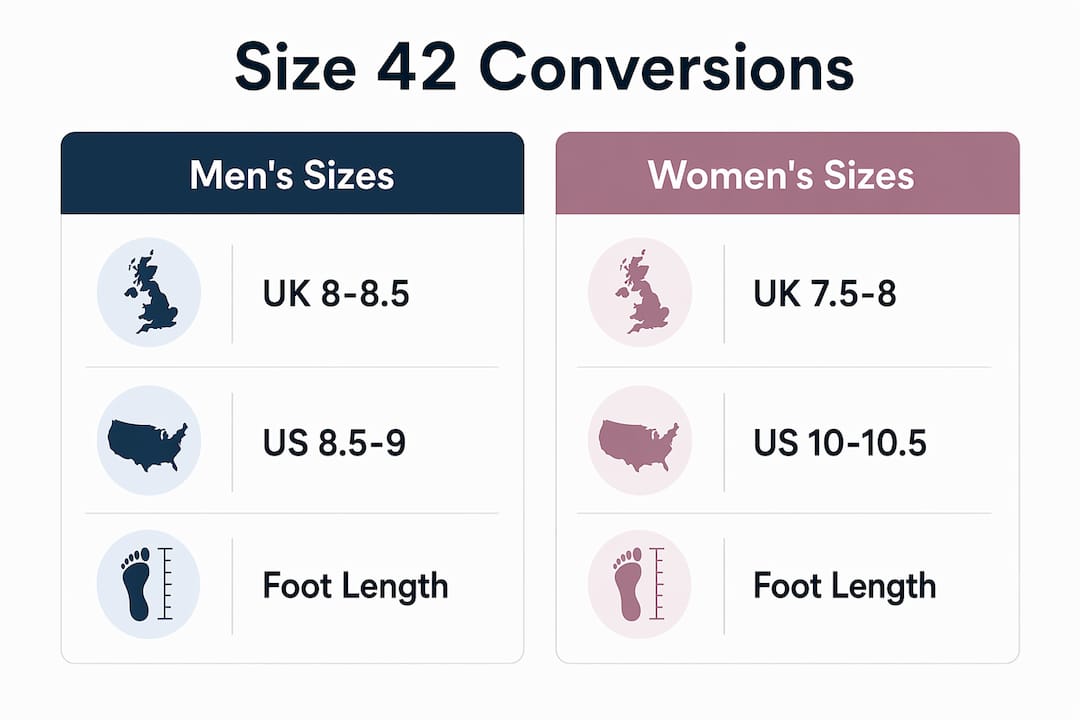
EU sizing is unisex, meaning the number 42 applies to both men’s and women’s shoes. The difference appears only when converting to US or UK equivalents, where men’s and women’s scales diverge by roughly 1.5 to 2 sizes. A woman buying EU 42 shoes in a US store needs to search the women’s 10 to 10.5 range, not the men’s equivalent.
Conversion charts vary because brands mould shoes on different lasts. A last is the foot-shaped form around which a shoe is built, and it determines the shoe’s internal volume, not just its length. Two shoes labelled EU 42 can have meaningfully different widths, arch heights, and toe box shapes depending on the last used.
Pro Tip: Measure your foot length in centimetres rather than relying on a size label. Place a sheet of paper on a hard floor, stand on it with your full weight, and mark the heel and the longest toe. Measure the distance with a ruler. That number is your most reliable guide when consulting any shoe size chart.
Why does fit vary so much in size 42 shoes?
A size 42 label does not guarantee a consistent fit. Brand-specific lasts and toe allowances mean a shoe labelled 42 in one brand can feel like a 41 or a 43 from another. The number describes length. It says nothing about width, arch height, or instep volume.
Shoe category also plays a significant role. Sneakers and dress shoes use different toe allowances by design. A running shoe typically includes 10–12 mm of extra space at the toe to accommodate foot movement during activity. A dress shoe is cut closer, often with a narrower toe box and less volume overall. Buying a EU 42 dress shoe using the same logic as a EU 42 trainer will frequently result in a poor fit.
Timing matters too. Foot volume increases during the day due to natural swelling from standing and walking. A shoe that fits well in the morning may feel tight by the afternoon. Trying shoes on later in the day, or accounting for this when ordering online, reduces the chance of a poor fit.
Key factors that cause size 42 fit to vary:
- Last design: The internal shape of the shoe, not just its length, determines real fit.
- Toe allowance: Varies by shoe category and brand convention.
- Width fitting: EU sizing does not specify width; brands use their own standards.
- Material stretch: Leather stretches with wear; synthetic materials generally do not.
- Insole thickness: A thicker insole reduces internal volume and can make a 42 feel like a 41.
Pro Tip: Always check the manufacturer’s fit notes before buying online. Phrases like “runs narrow,” “order half a size up,” or “true to size” are not marketing copy. They reflect real data from customer returns and fit issue reports.
How to find the right size 42 shoe accurately
Accurate foot measurement is the foundation of a good fit. Measuring at home using paper and a ruler, standing with your weight evenly distributed, gives you the centimetre figure you need to consult any brand’s chart with confidence.
Follow these steps to select the right size 42 shoe:
- Measure both feet. Feet are rarely identical. Use the measurement from the larger foot.
- Measure in the afternoon. Foot volume is at its highest later in the day, giving you a more realistic fit baseline.
- Find your centimetre length. Mark your heel and longest toe on paper, then measure the distance. For most people, EU 42 corresponds to 26.0–26.5 cm.
- Consult the brand’s own chart. Generic conversion tables are a starting point. The brand’s chart reflects the actual last they use.
- Read fit notes and customer reviews. Reviews from people with a similar foot shape are more useful than star ratings alone.
- Check the return policy. When ordering online, a free returns policy removes the risk of a poor fit entirely.
Common pitfalls to avoid when buying size 42 shoes online include ordering based on a generic conversion chart without checking the brand’s specific sizing, ignoring width fittings, and assuming that the same size in one shoe category will work in another. A complete sizing guide that covers these variables will save you multiple return trips.
Online sizing tools that ask for your foot length in centimetres rather than your current size label are the most reliable. They bypass the conversion problem entirely by working from the raw measurement.
What shoe types and features work best in size 42?
Size 42 is a well-stocked size across most shoe categories. Sneakers, casual trainers, dress shoes, boots, and sandals are all widely available in EU 42, making it one of the more accessible sizes for both men and women. Women shopping for EU 42 shoes should note that some brands stock this size in their men’s range only, so checking both sections of a retailer’s site is worth doing.
When choosing footwear in this size, the features that most affect comfort and longevity are:
- Cushioning technology: Midsole materials like EVA or memory foam reduce impact and support all-day wear.
- Arch support: Built-in arch support matters more in flat or casual shoes than in structured dress shoes.
- Breathable upper materials: Mesh or perforated leather reduces heat build-up during extended wear.
- Flexible outsole: A sole that bends with the foot reduces fatigue on long days.
- Removable insole: Allows you to insert custom orthotics if your foot health requires it.
Brands that publish detailed last specifications and offer multiple width fittings give size 42 shoppers the best chance of a first-time fit. Ydauk’s approach to footwear centres on YDA Technology, which addresses the gap between size label and actual fit through engineered lasts and materials designed for foot health. For shoppers who have struggled with fit consistency across brands, that kind of specification detail makes a real difference.
Key takeaways
Shoe size 42 is a European standard based on the Paris Point system, but accurate fit depends on foot length in centimetres, brand-specific lasts, and shoe category, not the number alone.
| Point | Details |
|---|---|
| EU 42 foot length | Size 42 corresponds to approximately 26.0–26.5 cm, the most reliable fit reference. |
| Conversion is approximate | EU 42 maps to US men’s 8.5–9.0 and US women’s 10.0–10.5, but varies by brand. |
| Lasts determine real fit | Two shoes labelled 42 can feel entirely different due to last design and volume. |
| Measure in the afternoon | Foot volume is highest later in the day, giving a more accurate measurement baseline. |
| Check fit notes first | Manufacturer fit notes and customer reviews reduce return rates and improve first-time fit. |
Why I always tell people to ignore the label first
People fixate on the number. I understand why. A size 42 feels like a fixed fact, something you can type into a search bar and trust. The problem is that the number describes a length, not a shoe. I have worn EU 42 shoes from three different brands in the same week and had one fit perfectly, one pinch at the toe, and one slip at the heel. The label was identical. The lasts were not.
The shift that actually improves shoe buying is measuring your foot in centimetres and treating the size label as a rough filter rather than a final answer. Once you have your centimetre measurement, you can consult a brand’s own chart and read their fit notes with real context. That combination, your measurement plus their notes, is far more reliable than any generic conversion table.
Women shopping in EU 42 face an additional frustration. Some retailers stock this size only in men’s lines, or list it without noting that the last runs narrow. Reading customer reviews from people who describe a similar foot shape is genuinely useful here, not just reassuring. It is the closest thing to trying the shoe on before it arrives.
Patience and a good return policy are underrated tools. The best-fitting shoe I own took three attempts to get right. The brand’s fit notes said “true to size” but the last ran narrow for my foot shape. A half size up solved it. That kind of adjustment is normal, not a failure of the sizing system.
— Panagiotis
Ydauk’s approach to size 42 fit
Finding footwear that genuinely fits in EU 42 takes more than a conversion chart. Ydauk builds its shoes around YDA Technology, an approach to footwear engineering that prioritises foot health, energy efficiency, and consistent fit across sizes. The lasts used in Ydauk’s designs account for the volume and support needs that a size label alone cannot communicate.

For shoppers who have dealt with inconsistent sizing, narrow toe boxes, or shoes that feel right in the morning but uncomfortable by afternoon, Ydauk’s collection is worth exploring. Each product page includes detailed sizing guidance to help you match your centimetre measurement to the right fit. Browse the full Ydauk range and use your foot length as your starting point.
FAQ
What is shoe size 42 in UK sizing?
EU size 42 typically corresponds to a UK men’s 8 or 8.5 and a UK women’s 7.5 to 8, though exact equivalents vary by brand due to differences in last design.
What is a size 42 shoe in US sizes?
EU 42 maps to approximately US men’s 8.5–9.0 and US women’s 10.0–10.5. The difference between men’s and women’s US equivalents reflects the 1.5-size offset built into American sizing conventions.
How long is a size 42 shoe in centimetres?
A EU 42 shoe corresponds to a foot length of approximately 26.0–26.5 cm. Measuring your foot in centimetres and comparing it to a brand’s own chart gives the most accurate fit result.
Why does size 42 fit differently across brands?
Each brand builds shoes on a different last, which determines the shoe’s internal volume, width, and shape. Two shoes with the same EU 42 label can fit like different sizes because the last, not the number, defines the actual fit.
Is EU size 42 the same for men and women?
The EU number 42 is unisex and refers to the same foot length for both men and women. The difference appears in US and UK conversions, where men’s and women’s scales are offset, so the equivalent US or UK size will differ by gender.