
Shoe width chart: your complete sizing guide
TL;DR:
- Nearly half of all shoppers wear shoes that damage their feet because they ignore width measurements.
- Measuring foot width accurately involves tracing the foot under full body weight and using centimetre measurements.
- Width labels are inconsistent across brands, so comparing actual measurements is essential for proper fit.
A shoe width chart is a standardised tool that translates foot width measurements into lettered size categories, helping you select footwear that fits correctly and supports long-term foot health. Most people shop by length alone and ignore width entirely. That single oversight causes blisters, bruised toenails, and chronic foot pain that could be avoided with one extra measurement.
60% of people fit standard widths, while 40% need a different width to avoid discomfort. That means nearly half of all shoppers are walking around in shoes that are quietly damaging their feet. Standard width is D for men and B for women. Every other letter code represents a step away from that midpoint, either narrower or wider.
What does a shoe width chart actually show?
A shoe width chart maps a specific millimetre or centimetre measurement of your forefoot to a letter code. The chart does not guess. It gives you a direct translation between your foot’s widest point and the width category a shoe manufacturer uses on its label. Without it, you are choosing width by feel alone, which is unreliable.
The letter codes used most commonly in the UK and US run from AAA (very narrow) through B, D, E, EE, and EEE to EEEE and beyond (extra wide). Each step represents a meaningful change in physical space inside the shoe. Podiatric guidance states that men need wider shoes when forefoot width exceeds 10.5 cm, and women when it exceeds 9.6 cm. Those thresholds give you a concrete number to compare against the chart.
How to measure your foot width at home
Accurate measurement is the foundation of using any shoe sizing guide correctly. Skipping this step and relying on memory or an old shoe size is the most common mistake shoppers make.
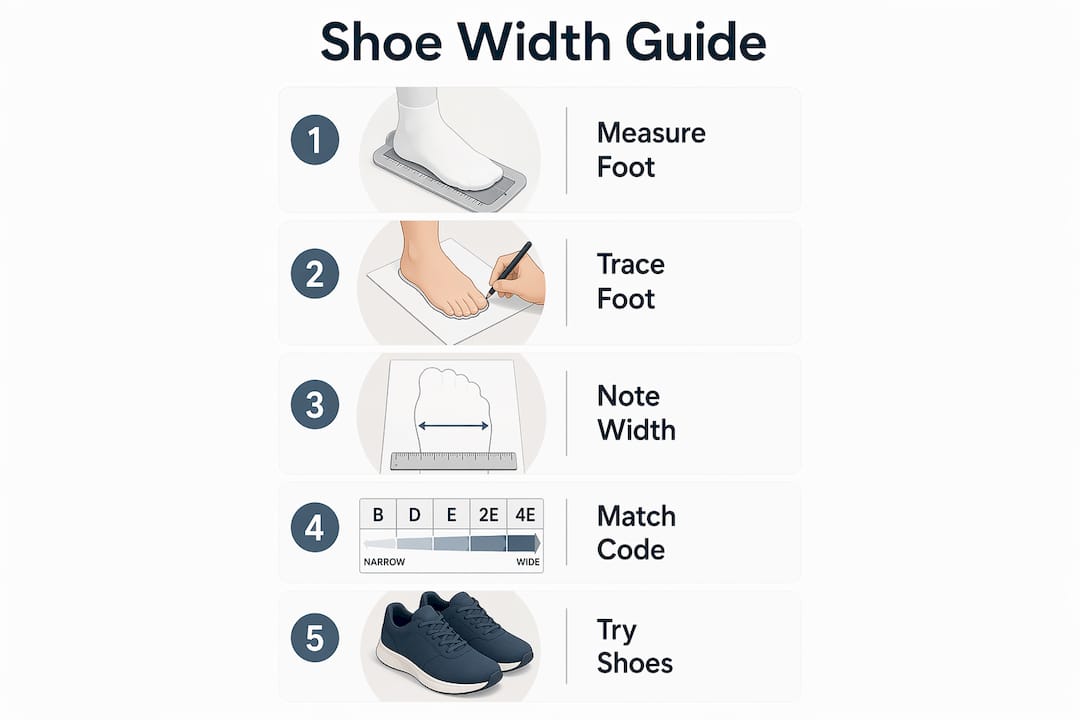
Follow these steps for a reliable measurement:
- Gather your materials. You need a sheet of plain paper, a pen or pencil, and a ruler or tape measure.
- Stand on the paper. Place the paper on a hard floor and stand on it with your full body weight. Do not sit. Sitting reduces the spread of your foot and gives a narrower reading.
- Trace your foot. Ask someone to trace around your foot, holding the pen vertically. A pen held at an angle adds width to the tracing and skews the result.
- Measure the widest point. Use your ruler to measure across the widest part of the tracing, which is typically across the ball of your foot.
- Repeat for both feet. Fit shoes to the larger foot always. Most people have feet that differ slightly in width or length.
- Convert your measurement. Note whether the brand’s chart uses centimetres or inches, and convert accordingly before comparing.
The tracing method matters because feet are not rectangular. Foot tracing under body weight reduces measurement error to approximately 1/16 inch, which is significantly more accurate than pressing a ruler directly against the side of your foot.
Pro Tip: Measure your feet in the afternoon rather than the morning. Feet swell by 4–8% during the day. An afternoon measurement captures your foot at its widest and prevents you from buying shoes that feel tight by evening.
Understanding shoe width codes and what they mean
Shoe width codes follow a letter system, but the letters do not mean the same thing for men and women. A B width is standard for women but narrow for men. A D width is standard for men but wide for women. This distinction trips up a large number of shoppers, particularly when buying across categories.
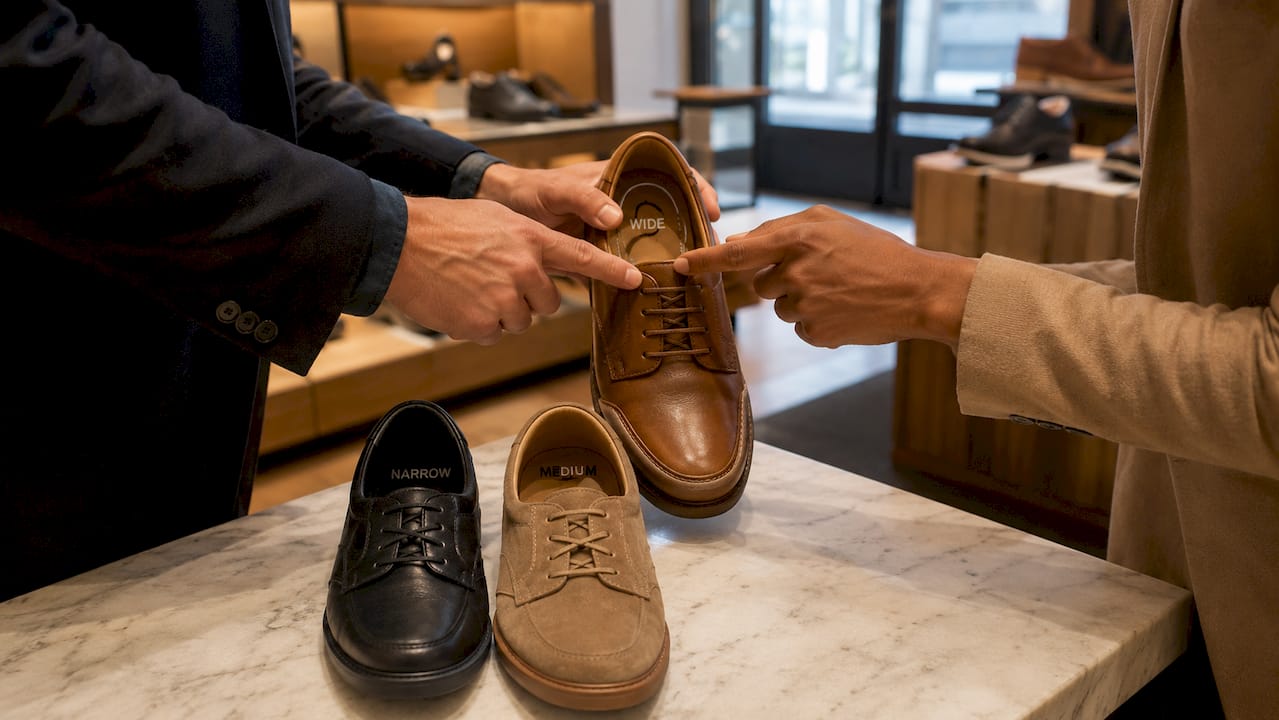
Each additional E in the code adds approximately 0.32 cm at the ball of the foot. That increment is small but significant. The difference between a D and an EE is 0.64 cm, which is enough to determine whether a shoe causes pressure or sits comfortably around the forefoot.
| Width code | Typical forefoot width | Suitable for |
|---|---|---|
| B (women’s standard) | 8.1–8.8 cm | Standard women’s width |
| D (men’s standard) | 9.4–10.2 cm | Standard men’s width |
| E | 10.5–10.8 cm | Slightly wide men’s foot |
| EE (2E) | 10.8–11.1 cm | Wide foot, men and women |
| EEE (3E) | 11.1–11.4 cm | Extra wide foot |
| EEEE (4E) | 11.4 cm and above | Very wide or high-volume foot |
One critical fact: width labels lack global standardisation. A shoe labelled “wide” by one brand may measure the same as a standard width from another. This is not a minor inconsistency. It means a shoe width comparison between two brands is only reliable when you compare actual centimetre measurements, not just the letter codes. Always consult the specific brand’s chart rather than assuming the letter translates directly.
For a deeper look at how these codes apply to UK sizing, the shoe width sizes guide from Ydauk covers the full range of width categories and their practical implications.
Why width alone does not guarantee a good fit
Width measurement gives you a starting point. It does not guarantee comfort on its own. Shoe comfort depends on toe box shape, volume, and foot conditions, and width numbers alone do not capture those factors.
Consider these additional fit factors:
- Toe box shape. A pointed toe box compresses the forefoot even in a correctly sized width. A rounded or square toe box gives toes room to spread naturally.
- Toe box depth. Shoppers with high insteps or conditions like hammer toe need vertical space, not just horizontal width. A shoe can be wide enough but still press painfully on the top of the toes.
- Foot conditions. Bunions shift the widest point of the foot outward. A standard wide shoe may not accommodate the specific angle of a bunion. Dedicated bunion protection footwear addresses this with specific design features.
- Material flexibility. Rigid leather or synthetic uppers do not stretch to accommodate width variation. Softer, more flexible materials provide more forgiveness, particularly during extended wear.
- Shoe style. A Derby shoe has an open lacing system that allows more width adjustment than a closed Oxford. Style affects how much the shoe can adapt to your foot shape.
Breaking in shoes does not fix an incorrect width. A shoe that is too narrow compresses the bones and restricts circulation from the first wear. A shoe that is too wide creates friction and instability that worsens over time. The fit must be right from the moment you put the shoe on.
Pro Tip: When trying shoes, wear the same type of socks you plan to use regularly. Thick padded liner socks add measurable volume inside the shoe and can shift a correctly sized width into feeling tight.
How to use a shoe width chart when shopping
Applying a shoe width chart effectively requires a slightly different approach depending on whether you are shopping online or in a physical shop.
- Consult brand-specific charts. Never assume one brand’s E width matches another’s. Pull up the specific chart for the brand you are buying from and compare your centimetre measurement directly.
- Measure regularly. Foot width changes with age, weight fluctuation, and pregnancy. A measurement taken three years ago may no longer reflect your current foot. Re-measure at least once a year.
- Try shoes with the right socks. Fit shoes wearing the socks you intend to use. Non-slip no-show socks have a different thickness profile from sports socks and will affect how the width feels.
- Check for common fit problems. Bulging at the sides of the shoe indicates the width is too narrow. Excess material folding inward at the sides suggests the width is too wide. Both are clear signals to move one width category.
- Assess the toe box separately. After confirming the width feels right, check that your longest toe has roughly a thumb’s width of space at the front. Width and length work together.
- Read the label carefully. Some brands use descriptive terms like “wide” or “narrow” rather than letter codes. Cross-reference these terms with the brand’s measurement chart to confirm the actual width in centimetres.
The shoe fit checklist from Ydauk walks through each of these steps in detail, including how to assess width fit when you cannot try shoes in person.
Key takeaways
Selecting the correct shoe width requires accurate foot measurement, understanding letter codes in context, and recognising that width is one part of a broader fit assessment.
| Point | Details |
|---|---|
| Measure both feet | Always fit to the larger foot; most people’s feet differ slightly in width. |
| Measure in the afternoon | Feet swell 4–8% during the day; afternoon readings reflect true maximum width. |
| Use the tracing method | Tracing under full body weight reduces error to 1/16 inch, more accurate than ruler measurement. |
| Check brand-specific charts | Width labels lack global standardisation; always compare centimetre measurements, not just letter codes. |
| Width is not the whole picture | Toe box shape, depth, material, and foot conditions all affect fit beyond the width code. |
What I have learned from years of watching people buy the wrong shoes
Most shoppers treat shoe width as a secondary concern. They focus on length, colour, and style, then wonder why their feet ache after a full day of wear. I have seen this pattern repeat constantly, and the root cause is almost always the same: people trust the label without verifying the measurement.
The single most overlooked step is measuring both feet. The majority of people have one foot that is measurably wider or longer than the other. Fitting to the smaller foot is a guaranteed path to discomfort. Fitting to the larger foot and adjusting the other side with an insole or thicker sock is the correct approach, yet most shoppers never think to check.
I am also struck by how many people underestimate the impact of timing. Measuring your feet first thing in the morning and then buying shoes based on that reading is a mistake. By the time you have been on your feet for six hours, your foot has expanded. That expansion is real, and it is the difference between a shoe that fits and one that pinches.
The other misconception I encounter regularly is the belief that a shoe will stretch to fit over time. It will not fix a width problem. A shoe that compresses your forefoot on day one will compress it on day one hundred. The discomfort may become familiar, but the physical damage accumulates. Choosing the right width from the start is not a small detail. It is the foundation of foot health over years of wear.
— Panagiotis
Ydauk’s approach to width and foot health
Ydauk designs footwear around the principle that width accommodation and foot health are inseparable. The YDA Technology built into each shoe addresses the structural needs of diverse foot shapes, not just standard widths.

For shoppers who have struggled to find shoes that fit their specific foot width, the YDA Shoes technology page explains how Ydauk’s engineering approach supports a range of foot widths and shapes. The focus is on comfort that holds up through a full day of wear, backed by foot health principles rather than style alone. If width has been a persistent problem for you, Ydauk’s range is worth a close look.
FAQ
What is a standard shoe width for men and women?
Standard shoe width is D for men and B for women. These designations represent the midpoint of the width scale and fit approximately 60% of the population.
How do I measure my foot width at home?
Stand on a sheet of paper, trace around your foot while bearing your full weight, then measure across the widest part of the tracing. Measure both feet and use the larger measurement when consulting a shoe sizing guide.
What does EE or 2E mean on a shoe?
EE (also written 2E) indicates a wide width, adding approximately 0.64 cm compared to a standard D width at the ball of the foot. Each additional E adds roughly 0.32 cm.
Why do wide shoes from different brands fit differently?
Shoe width designations lack global standardisation. A “wide” label from one brand may measure the same as a standard width from another. Always compare your foot measurement in centimetres against the specific brand’s width chart.
Can wearing the wrong width damage my feet?
Shoes that are too narrow compress the bones and restrict circulation. Shoes that are too wide cause friction and instability. Both lead to foot problems over time, and ill-fitting shoes cannot be corrected by breaking them in.