
Wide shoes measurement: your complete fitting guide
TL;DR:
- Measuring your foot’s widest part accurately in the late afternoon ensures a proper fit, especially for wide shoes.
- Choosing the correct width based on brand-specific charts prevents discomfort and foot problems caused by narrow or overly wide footwear.
Wide shoes measurement is the exact horizontal distance across the widest part of your foot, and getting it right is the single most important step towards comfortable, health-supporting footwear. Approximately 63 to 72% of people wear shoes that do not fit correctly in length or width, leading to foot pain and discomfort. That figure is striking because most people only ever measure their foot length. Width is equally critical. Shoes that are too narrow compress the metatarsal bones, restrict circulation, and cause blisters. Shoes that are too wide create lateral movement and friction. The correct width measurement, matched against a brand-specific chart, solves both problems before you spend a penny.
How to measure wide shoe width accurately at home
The process takes roughly three to five minutes and requires only paper, a pencil, and a ruler or tape measure. The technique matters as much as the tools.

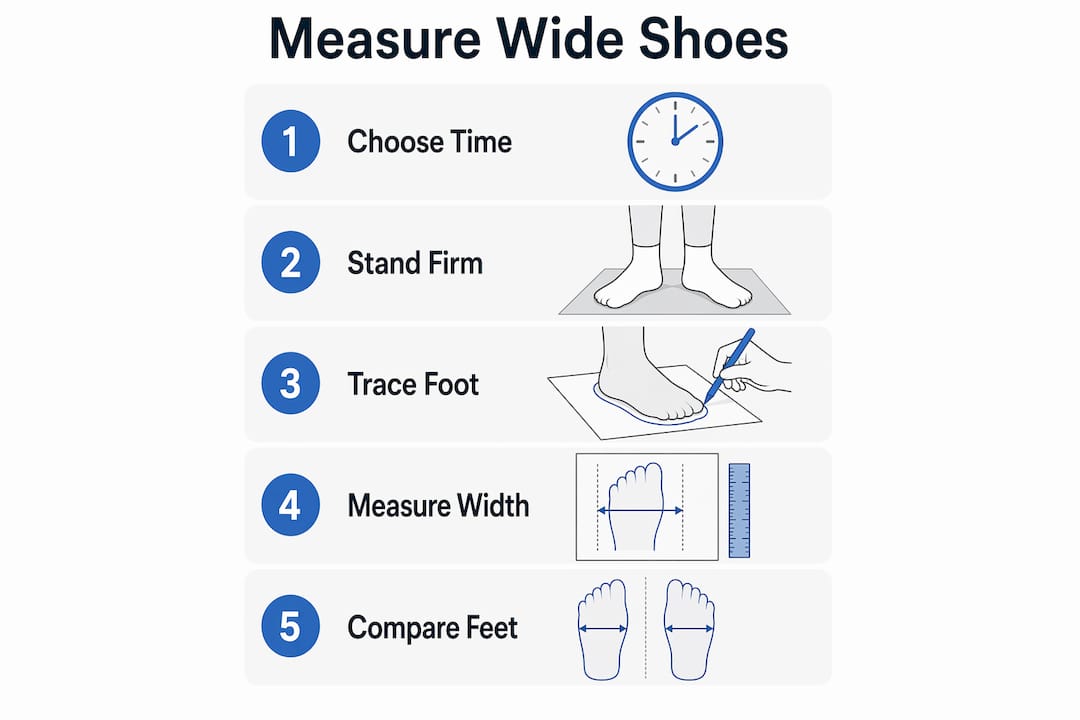
Step 1: Choose the right time. Feet swell by 4 to 8% during the day, which means a morning measurement will underestimate your actual foot dimensions. Measure in the late afternoon or evening, when your feet are at their largest. This single timing adjustment prevents more poor purchases than any other piece of advice.
Step 2: Stand on a firm surface. Place a sheet of plain paper on a hard floor and stand on it with your full body weight. Sitting removes the natural spread of the foot under load, giving you a narrower reading than your foot actually needs.
Step 3: Trace your foot outline. Hold a pencil vertically against the side of your foot and trace around the entire outline. An angled pencil skews the outline inward, producing a measurement that is narrower than reality. Keep the pencil perpendicular to the paper at every point.
Step 4: Measure the widest part. Use a ruler to measure the horizontal distance across the widest section of the traced outline, typically across the ball of the foot. Record this figure in millimetres for the most precise result.
Step 5: Measure both feet. Most people have asymmetric feet, with one foot slightly wider than the other. Always use the larger measurement when selecting your shoe width. Fitting to the smaller foot means the wider foot is squeezed all day.
Pro Tip: Wear the socks you intend to use with the shoes when you take your measurement. A thick walking sock adds several millimetres of effective width and will change your size category if you ignore it.
What do shoe width codes actually mean?
Shoe width codes are the letter system brands use to communicate the horizontal dimension of a shoe’s interior. Understanding them is non-negotiable for anyone with wider feet, because the codes are not universal.
The most common codes in the UK and US market run from narrow to extra wide: A or B (narrow), C or D (medium/standard), E (wide), EE or 2E (extra wide), and EEE or 3E (extra extra wide). Each additional E raises the width by approximately 4 millimetres. That increment is small, but across the full width of the foot it is the difference between comfort and pain.
The confusion arises when you cross between sizing systems. US and UK width codes differ fundamentally. A US men’s D is a standard medium width. A UK men’s E is the equivalent standard medium. If you buy a UK shoe labelled E and assume it is wide because E means wide in the US system, you will end up in a standard-width shoe. The table below clarifies the most common equivalents.
| Width category | US men’s code | UK men’s code | Approximate width increase vs medium |
|---|---|---|---|
| Narrow | B | C | Approx. 4mm narrower |
| Standard / medium | D | E | Baseline |
| Wide | E / 2E | F | Approx. 4mm wider |
| Extra wide | 3E / 4E | G | Approx. 8mm wider |
| Extra extra wide | 5E / 6E | H | Approx. 12mm wider |
Women’s width coding follows a different baseline. A women’s B is the standard medium, equivalent to a men’s D. This means a woman moving from women’s to men’s sizing for a wider fit needs to account for the baseline shift, not just the letter.
The Mondopoint system, used widely in continental Europe and by some specialist brands, uses centimetre measurements as a universal baseline, which removes the letter-code ambiguity entirely. If you buy across multiple countries or from international brands, recording your foot width in millimetres gives you a reliable reference point regardless of the local coding system.
Pro Tip: Before purchasing from any brand, download or open their specific width chart. A brand’s E width and another brand’s E width can differ by several millimetres depending on their last design. The letter is a starting point, not a guarantee.
Common mistakes that lead to a poor wide shoe fit
Most fitting errors come from misunderstanding what width actually does to comfort, and from habits that seem logical but produce the wrong result.
- Measuring in the morning. Feet are at their smallest first thing. A morning measurement can underestimate your width by a full size category, sending you into shoes that feel fine in the shop but pinch by mid-afternoon.
- Buying a longer shoe to compensate for width. People often mistake width problems for length issues, buying a longer shoe when the real problem is that the shoe is too narrow. A longer shoe creates heel slip, blisters at the back, and instability. The correct solution is always a wider width at the same length.
- Expecting leather to stretch enough. Leather shoes offer minimal width stretch. If a shoe pinches at first wear, it will continue to pinch. Buying a wider size is the only reliable fix.
- Measuring only one foot. Foot asymmetry is common. Measuring only the dominant or more convenient foot risks fitting the narrower foot and ignoring the wider one.
- Ignoring regional code differences. Assuming a UK E is the same as a US E leads to buying a standard-width shoe when you need a wide one. Always check the brand’s own chart rather than relying on the letter alone.
- Choosing a narrow shoe to “break it in”. This is one of the most damaging habits in footwear. Wearing shoes that are too narrow causes bunions, corns, and nerve compression over time. No amount of wear will add the millimetres your foot needs.
If you have a specific foot condition such as diabetes, the consequences of poor width fit are more serious. Compression from a narrow shoe can restrict blood flow and cause wounds that are slow to heal. Understanding shoe width for diabetics is a separate and critical topic for anyone managing that condition.
How to choose the right wide shoe for your foot condition
Selecting the right wide shoe goes beyond finding the correct width measurement. The style, construction, and fit process all affect the final result.
- Prioritise width over length. If you are between sizes, choose the wider width at your correct length rather than a longer shoe at a narrower width. Width compression causes more damage than a slightly longer toe box.
- Choose adjustable lacing styles. Derby-style lacing shoes offer significantly more width flexibility than closed Oxford types because the quarters open outward. For wider feet, this design difference is material, not cosmetic.
- Consult each brand’s width chart before buying. This applies every time, even for brands you have bought from before. Brands update their lasts, and a shoe that fitted well two years ago may have a different internal width today.
- Try or measure in the afternoon. If you are buying in a shop, go in the afternoon. If you are buying online, take your measurement at the same time of day you plan to wear the shoes most.
- Account for foot conditions. Bunions, hammertoes, and oedema all increase the effective width your foot needs. A foot with a bunion may measure as a standard E width but require an EE or EEE to avoid pressure on the joint. When buying shoes online for foot health, factor in the condition’s effect on width, not just the raw measurement.
- Use socks and insoles to fine-tune fit. A borderline measurement between two width categories can often be resolved with a thinner or thicker sock, or by adding or removing an insole. This is a legitimate fitting tool, not a workaround.
- Look for brands that publish detailed width options. Many mainstream brands offer only medium width and label it as standard. Specialist footwear brands publish multiple width options and design their lasts specifically for wider feet, which produces a genuinely better fit rather than a stretched version of a narrow last.
Understanding why foot width matters for long-term comfort and circulation is the foundation for every decision in this list.
Key takeaways
Accurate wide shoes measurement, matched against brand-specific width charts and taken in the late afternoon, is the most reliable method for achieving a comfortable, health-supporting shoe fit.
| Point | Details |
|---|---|
| Measure in the afternoon | Feet swell by 4 to 8% during the day; afternoon measurement reflects your true width. |
| Use both feet | Measure both feet and fit to the wider one to avoid compression on your larger foot. |
| Width codes vary by country | UK E is a standard medium; US E is wide. Always check the brand’s own chart. |
| Never size up in length | Buying a longer shoe to compensate for width causes heel slip and instability. |
| Leather does not stretch enough | If a shoe pinches at first wear, buy a wider size rather than expecting break-in to solve it. |
Why I think most people are solving the wrong problem
By Panagiotis
After years of working with footwear and watching people struggle with fit, the pattern I see most often is this: someone buys a shoe that hurts, concludes that the brand runs small, and orders a half size up next time. The pain moves from the ball of the foot to the heel. They try another brand. The cycle repeats.
The actual problem, in the majority of cases I have observed, is width. Not length. The foot is being compressed laterally, and the body responds by shifting weight in ways that cause secondary pain in the heel, the arch, and eventually the knee. Sizing up in length does not fix lateral compression. It just redistributes it.
What changed my own approach was recording my foot width in millimetres and carrying that number when I shop, rather than relying on a shoe size. A size 43 in one brand is not the same internal volume as a size 43 in another. But 98mm of foot width is 98mm regardless of the brand. When I started asking for width charts and comparing my measurement directly, the number of poor purchases dropped to almost nothing.
The other thing I would say is this: measure your feet every year. Feet change with age, weight, and activity. The measurement you took five years ago may no longer reflect your actual foot. Spending three minutes with a piece of paper and a pencil once a year is a small investment against the cost of ill-fitting shoes and the foot problems that follow.
— Panagiotis
Find your fit with Ydauk’s wide shoe technology

Ydauk designs shoes around the principles covered in this guide. The YDA shoe technology is built specifically to support foot health, accommodate natural foot width variation, and deliver comfort across a full day of wear. Rather than offering a single standard width and calling it universal, Ydauk’s approach starts with the foot’s actual dimensions. If you have measured your foot width, understood your width code, and are ready to find a shoe designed to match it, Ydauk’s range is the logical next step. Explore the full collection at ydauk.com and use your measurement to find the right fit from the first wear.
FAQ
What is wide shoes measurement?
Wide shoes measurement is the horizontal distance across the widest part of your foot, typically at the ball. It determines which shoe width category, such as E, EE, or 2E, you need for a correct fit.
When is the best time to measure foot width?
Measure your foot width in the late afternoon. Feet swell by 4 to 8% during the day, so an afternoon measurement gives you the largest and most accurate dimension to fit against.
How do UK and US shoe width codes differ?
A UK men’s E is a standard medium width, while a US men’s E is a wide width. Always consult the specific brand’s width chart rather than assuming the letter means the same thing across sizing systems.
Should I buy a longer shoe if my foot is wide?
No. Buying a longer shoe to compensate for width causes heel slip and instability without resolving the lateral compression. The correct solution is to select the same length in a wider width category.
How often should I remeasure my foot width?
Measure your foot width at least once a year. Feet change with age, weight fluctuation, and activity levels, and a measurement taken several years ago may no longer reflect your current dimensions.