
Shoe size in cm: your complete sizing guide
TL;DR:
- Shoe size in centimeters measures your foot length from heel to toe and provides the most reliable sizing reference. Using foot length in centimeters helps avoid conversion errors across regional systems like US, UK, and EU sizes. Accurate measurement of both feet at the end of the day ensures a comfortable fit, considering foot width and appropriate fit allowances.
Shoe size in centimetres is defined as the direct measurement of your foot length from heel to the tip of your longest toe. It is the most reliable sizing reference available, because it represents a physical dimension rather than an abstract regional number. The ISO Mondopoint standard (ISO 9407:2019) formalises this by expressing shoe size as actual foot length in centimetres or millimetres. US, UK, and EU systems all use offset scales that vary by brand and region, making cm the only consistent baseline for buying footwear with confidence.
How to measure your shoe size in cm accurately
Measuring your foot correctly takes less than five minutes and removes all guesswork from shoe buying. The result is a single number in centimetres that you can cross-reference against any sizing chart in the world.
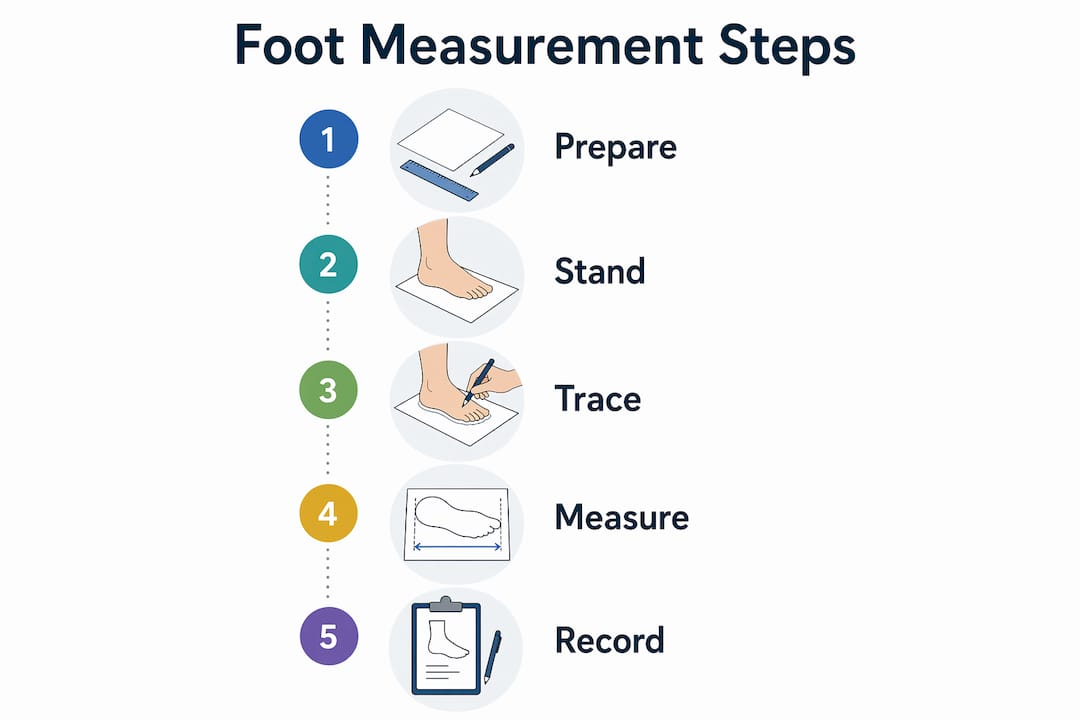
Step-by-step foot measurement
Follow these steps for a reliable reading:
- Place a sheet of paper on a hard floor. Stand on it with your full weight distributed evenly.
- Hold a pen vertically and trace the outline of your foot. Keep the pen perpendicular to the paper, not angled inward.
- Mark the heel point and the tip of your longest toe. Use a ruler to measure the distance between these two marks in centimetres.
- Repeat for your other foot. Most people’s feet differ in length by 3–8 mm, so always record both measurements.
- Use the larger of the two measurements as your reference size.
Measuring both feet is not optional. Sizing to the smaller foot creates painful pressure on the larger one, particularly across the ball of the foot.
When and how to measure for best results
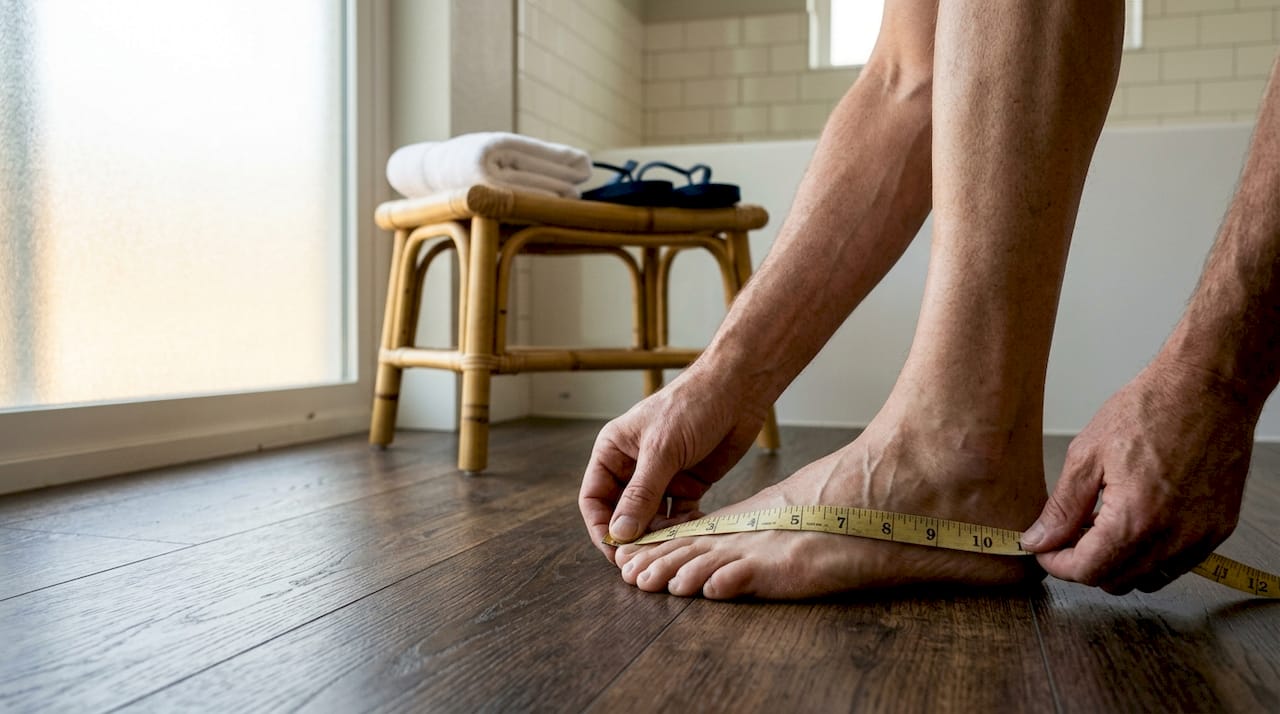
Measure your feet at the end of the day, not first thing in the morning. Feet expand with activity and heat throughout the day. A shoe that fits your morning foot may feel tight by early evening.
Stand rather than sit during measurement. Sitting reduces the load on your foot arch, which causes it to contract slightly. The standing measurement captures the foot at its widest and longest.
Pro Tip: Take three separate measurements and average them. Small shifts in pen angle or foot position can introduce a 2–3 mm error, which is enough to push you into the wrong size.
What are the main shoe sizing systems and how does cm unify them?
The three dominant sizing systems in global retail are US, UK, and EU. None of them share the same scale, and none of them directly express foot length. That gap is where conversion errors happen.
US, UK, and EU sizing compared
US men’s size 9 corresponds to approximately 27 cm of foot length. UK size 9 corresponds to roughly 27.5 cm. EU size 42 corresponds to approximately 26.5 cm. Three different numbers, three different foot lengths, all labelled “size 9” or its regional equivalent. That divergence is the core problem with regional sizing.
EU sizes use Paris Points, where one point equals two thirds of a centimetre. US and UK sizes use barleycorns, where one barleycorn equals one third of an inch. Neither unit maps cleanly onto centimetres without a formula, and those formulas vary slightly between brands.
How Mondopoint solves the problem
Mondopoint expresses shoe size as foot length in cm or mm with no conversion formula required. Japan uses this system directly: a Japanese size 27 means a 27 cm foot. South Korea and China use millimetres: Korean size 270 means a 270 mm foot. No offsets, no barleycorns, no Paris Points.
The table below shows typical equivalencies across systems for reference. Use your cm measurement as the anchor and read across.
| Foot length (cm) | US men’s | UK men’s | EU | Mondopoint |
|---|---|---|---|---|
| 25.0 cm | 7 | 6.5 | 39 | 250 |
| 26.0 cm | 8 | 7.5 | 40 | 260 |
| 27.0 cm | 9 | 8.5 | 42 | 270 |
| 28.0 cm | 10 | 9.5 | 43 | 280 |
| 29.0 cm | 11 | 10.5 | 44–45 | 290 |
Pro Tip: Save your cm measurement in your phone. When buying from an international retailer, you can cross-reference it against their specific chart rather than converting from a US or UK size, which introduces an extra rounding step.
For a detailed cross-system reference, the shoe conversion chart guide from Ydauk covers updated equivalencies across all major sizing systems.
Why foot width matters as much as length
Foot length in cm gives you a starting point. It does not give you a complete fit. Width is the second dimension that determines whether a shoe is comfortable or damaging.
The 5–10 mm fit allowance rule
Shoe internal length must exceed foot length by 5–10 mm to allow for natural toe splay and forward foot movement during walking. A shoe sized exactly to your foot length will feel tight the moment you take a step. This extra room is called the fit allowance, and it is built into the shoe’s last during manufacture.
Shoe size labels refer to the foot length the shoe is designed for, not the internal shoe length. The internal length is always longer. Understanding this distinction prevents the common mistake of sizing down because a shoe “feels too long” when tried on standing still.
Width categories and their effect on fit
Foot width is measured across the widest part of the foot, typically the metatarsal heads. Standard widths are labelled D for men and B for women in the US system. Wide widths are labelled 2E or 4E for men and D for women. Narrow widths are labelled B for men and AA for women.
Ignoring width causes shoes to fit lengthwise but feel painfully tight across the metatarsals. This is one of the most common sources of foot pain from footwear. For a thorough explanation of how to measure and account for width, the wide shoes fitting guide from Ydauk covers the full process.
Common fitting pitfalls to avoid:
- Buying based on length alone and ignoring width measurement
- Assuming the same size fits across all shoe types (running shoes, dress shoes, and boots all use different lasts)
- Choosing a shoe that fits snugly when standing but has no room for toe splay during movement
- Ignoring the fit allowance and sizing down because the shoe feels slightly long
- Failing to account for foot asymmetry and sizing to the smaller foot
Pro Tip: Measure foot width at the end of the day, just as you do with length. Feet widen with use, and a shoe that accommodates your widest point will remain comfortable throughout the day.
How to use your cm measurement to buy shoes confidently
Your cm measurement is the most stable reference you have. Brand labels shift. Regional systems diverge. Your foot length in centimetres does not change unless your feet do.
Applying cm to online purchases
Shoe manufacturers vary their lasts significantly, meaning a size 10 from one brand can fit differently from a size 10 in another. Measurements across a large sample of shoes show internal lengths varying noticeably within the same nominal size. This is why using your cm measurement as the primary reference, rather than your labelled size, reduces the risk of a poor fit.
When buying online, locate the brand’s specific sizing chart and match your cm measurement directly to their listed foot length column. Do not convert from your US or UK size. That conversion adds an extra step and an extra opportunity for rounding error.
Read customer reviews specifically for comments on fit. Phrases like “runs long,” “runs narrow,” or “fits true to size” tell you how the brand’s last compares to its stated sizing. Cross-reference these notes with your cm measurement and the shoe chart guide from Ydauk for brand-specific guidance.
Practical rules for different shoe types
Different shoe categories require different fit allowances beyond the standard 5–10 mm:
- Running shoes: Add 10–12 mm beyond foot length. Feet swell during sustained exercise and the foot slides forward on downhill terrain.
- Hiking boots: Size up half a size from your standard cm equivalent. Thick socks and ankle swelling on long days require extra room.
- Dress shoes: The standard 5–10 mm allowance applies, but narrow lasts mean width is often the limiting factor rather than length.
- Casual trainers: Fit close to your cm equivalent, but check the specific last shape, as some run narrow through the toe box.
Measure your feet every year or two. Foot size changes with age, weight fluctuation, and pregnancy. Relying on a measurement from five years ago is a common reason for persistent discomfort.
Key takeaways
Centimetres are the most reliable shoe sizing reference because they represent actual foot length, not a regional offset scale.
| Point | Details |
|---|---|
| Cm equals foot length | Measure heel to longest toe while standing to get your true cm size. |
| Mondopoint is the standard | ISO 9407:2019 uses cm or mm directly, removing conversion errors. |
| Add 5–10 mm for comfort | Internal shoe length must exceed foot length to allow natural toe movement. |
| Width is non-negotiable | Ignoring foot width causes metatarsal pain even when length is correct. |
| Use cm, not labelled sizes | Brand lasts vary; cm measurement is the only stable cross-brand reference. |
Why I trust centimetres over labelled sizes every time
I have spent years watching people buy shoes based on the number on the box and then return them because they hurt. The problem is almost never the shoe. It is the assumption that a labelled size means the same thing across brands and regions.
The first time I measured my own feet in centimetres and used that number directly against a brand’s chart, the difference was immediate. I stopped second-guessing half sizes. I stopped buying the same number I had always bought out of habit. I started fitting the foot I actually have, not the foot I had ten years ago.
The most common mistake I see is treating foot length as shoe size. These are not the same number. Your foot might measure 26.5 cm, but the shoe you need has an internal length of 27.0–27.5 cm. That gap is not slack. It is the space your foot needs to function. Understanding the role of the shoe last in creating that space changes how you read sizing entirely.
My firm advice: measure both feet, use the larger measurement, and always check the brand’s cm chart rather than converting from a regional size. Width is not optional. A shoe that fits in length but not in width will cause pain within an hour of wear.
— Panagiotis
Ydauk’s approach to fit precision and foot health
Getting shoe sizing right starts with accurate measurement, but it does not end there. The shoe’s internal construction determines whether that measurement translates into genuine comfort.

Ydauk builds its footwear around YDA Technology, a foot health-focused approach that accounts for both foot length in centimetres and the structural demands of everyday wear. The goal is a shoe that supports the foot’s natural mechanics rather than simply covering it. If you want to understand how advanced shoe construction affects fit beyond the size label, the YDA shoe technology page explains the engineering behind each design. Accurate cm measurement gives you the right starting point. Ydauk’s construction takes it from there.
FAQ
What does shoe size in cm actually measure?
Shoe size in cm measures the length of your foot from heel to the tip of your longest toe. It is a direct physical measurement, not an offset scale like US or EU sizing.
How do I convert my cm measurement to a US or EU size?
Match your cm foot length to the brand’s specific sizing chart. As a general reference, 27 cm corresponds to approximately US men’s 9, UK men’s 8.5, or EU 42, but these equivalencies vary by brand.
Why does my cm measurement differ from my usual shoe size?
Your labelled shoe size reflects a regional offset scale, not your foot length. Shoes also include a 5–10 mm fit allowance beyond foot length, so the internal shoe length is always longer than the foot it fits.
Should I measure my feet at a specific time of day?
Measure at the end of the day when your feet are at their largest. Feet expand with activity and heat, and a measurement taken in the morning may underestimate your true size by several millimetres.
Does foot width affect which cm size I should choose?
Yes. If your foot is wide relative to its length, you may need a wider fitting or a half size up to accommodate the extra volume. Length and width together determine the correct fit, not length alone.