
How footwear choices impact your back pain and comfort
Most people blame their office chair or mattress when back pain strikes. Very few think to look down at their feet. Yet the shoes you wear every single day may be doing more damage to your spine than any piece of furniture in your home. Research consistently shows that improper footwear causes misalignment from the ground up, creating a ripple effect that reaches your lower back, hips, and beyond. This article explains exactly how that happens, which shoes to avoid, what science actually supports, and how to make smarter choices that protect your spine for the long term.
Table of Contents
- How foot mechanics influence your spine
- Common footwear pitfalls that worsen back pain
- Evidence and misconceptions: what science really says
- What actually helps: features of back-friendly shoes
- Footwear habits and lifestyle tips for ongoing relief
- Discover supportive shoes for back-friendly living
- Frequently asked questions
Key Takeaways
| Point | Details |
|---|---|
| Foot mechanics matter | The way your shoes support or misalign your feet directly impacts stress through your knees, hips, and back. |
| Not all ‘support’ helps | Features like extra cushioning or arch support only help when matched to individual needs and body mechanics. |
| High heels increase risk | Frequent use of high heels significantly raises the likelihood of lower back strain or spinal imbalance. |
| Replace shoes regularly | Worn or unsupportive shoes should be replaced every 5000 to 10000 daily steps to prevent recurring pain. |
| Personal habits play a role | Rotating shoes and paying attention to comfort signals can enhance the effectiveness of back-friendly footwear. |
How foot mechanics influence your spine
Your body works as a connected system. Every step you take sends force upward through your feet, ankles, knees, hips, and into your spine. Podiatrists and physiotherapists call this the kinetic chain. When one link in that chain is off, every link above it compensates. Your feet are the foundation, and if that foundation is unstable, your spine pays the price.
Two of the most common foot misalignments are overpronation (where the foot rolls inward excessively) and supination (where it rolls outward). Both alter the way force travels up the leg. Foot misalignment from poor footwear leads to uneven pressure on the knees, hips, and spine, which over time causes persistent lower back pain. Choosing podiatrist recommended footwear is one of the most effective ways to correct these patterns before they become chronic.
| Foot issue | Effect on body | Shoe feature needed |
|---|---|---|
| Overpronation | Knee tracking issues, hip tilt, lumbar strain | Medial arch support, motion control |
| Supination | Lateral ankle stress, IT band tension, back pain | Cushioning, neutral or curved last |
| Flat feet | Reduced shock absorption, knee and back pain | Firm arch support, structured midsole |
| High arches | Poor shock distribution, spinal compression | Extra cushioning, flexible sole |
As one biomechanics specialist puts it: “The foot is the body’s first point of contact with the ground. Everything above it adapts to what happens below.” A footwear evidence review confirms that disruption at foot level consistently propagates stress upward through the kinetic chain. Understanding the lightweight shoes benefits for foot health is a useful starting point when reassessing your current footwear.
Common footwear pitfalls that worsen back pain
Not all bad shoes look obviously wrong. Some of the most damaging footwear is also the most fashionable or the most familiar. Here are the main offenders.
High heels are the most well-documented culprit. They shift your body weight forward, forcing your lower back to curve inward more than it should. This increases lumbar lordosis, compressing spinal discs and facet joints and placing sustained strain on the muscles of the lower back. Even a modest heel makes a measurable difference: a one-inch heel increases forefoot pressure by 22%, while a three-inch heel increases it by 76%.
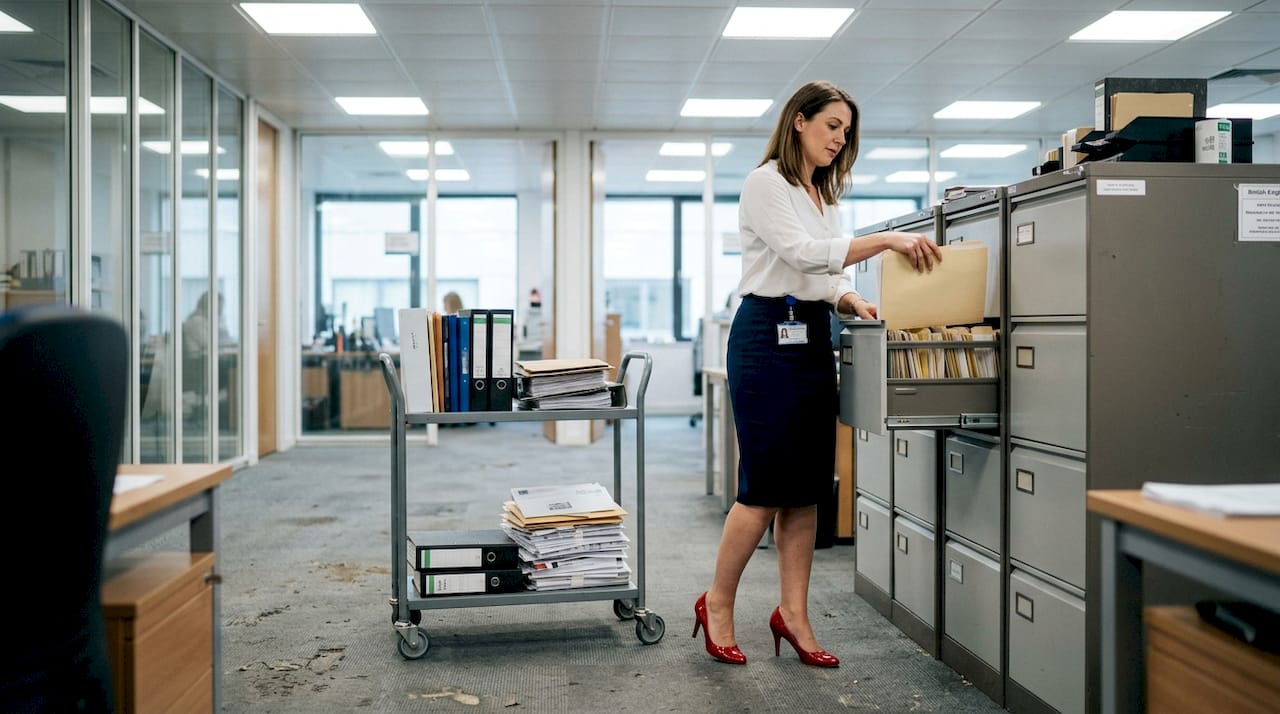
Worn-out trainers are a subtler problem. Once the midsole compresses and the outsole wears unevenly, worn shoes alter your gait, creating muscular imbalances that affect your ankles, knees, and back. Many people keep shoes well past their useful life simply because they still look acceptable on the outside.
Unsupportive flats offer little to no arch support or cushioning. While they do not tilt the pelvis forward the way heels do, they fail to absorb impact and leave the foot without structural guidance.
Features and habits that increase back pain risk:
- Heel height above 4 cm with no compensating arch support
- Shoes with a collapsed or asymmetrically worn outsole
- Footwear with no removable insole (limits orthopaedic customisation)
- Wearing the same pair every day without rotation
- Choosing shoes based on appearance rather than fit
- Ignoring foot width, particularly in the toe box
Pro Tip: Most shoes should be replaced after 500 to 700 kilometres of use, or roughly every six to twelve months for daily wearers. If you notice uneven wear on the sole or reduced cushioning underfoot, that is your signal to replace them. Explore types of health-oriented footwear to understand which categories suit your lifestyle, and read about how to reduce foot pain with shoes through smarter everyday choices.
Evidence and misconceptions: what science really says
The footwear industry is full of bold claims. “Maximum cushioning.” “Superior arch support.” “Clinically proven comfort.” But what does the research actually support?
A major review found little evidence for cushioning or arch support benefits in healthy individuals during normal walking. Raised heels showed detrimental effects. This does not mean supportive features are useless, but it does mean the picture is more nuanced than marketing suggests.
Three common misconceptions worth addressing:
- “All arch support is good for everyone.” Arch support helps those with specific foot mechanics, such as overpronation or flat feet. For people with neutral or high arches, the wrong support can actually increase discomfort.
- “More cushioning always means less pain.” Excessive cushioning can reduce proprioception (your foot’s ability to sense the ground) and may alter gait in ways that increase joint load rather than reduce it.
- “Minimalist shoes are always risky.” Minimalist shoes can strengthen foot muscles and improve natural movement patterns, but only when the transition is gradual. Jumping straight into zero-drop, thin-soled shoes after years of cushioned footwear is a reliable way to cause injury.
As the evidence review notes, the primary mechanism linking poor footwear to back pain is kinetic chain disruption rather than any single shoe feature. Understanding shoe weight and foot health is part of building a more complete picture of what your feet actually need.
What actually helps: features of back-friendly shoes
Now for the practical part. When shopping for shoes that genuinely support your spine, these are the features that matter.
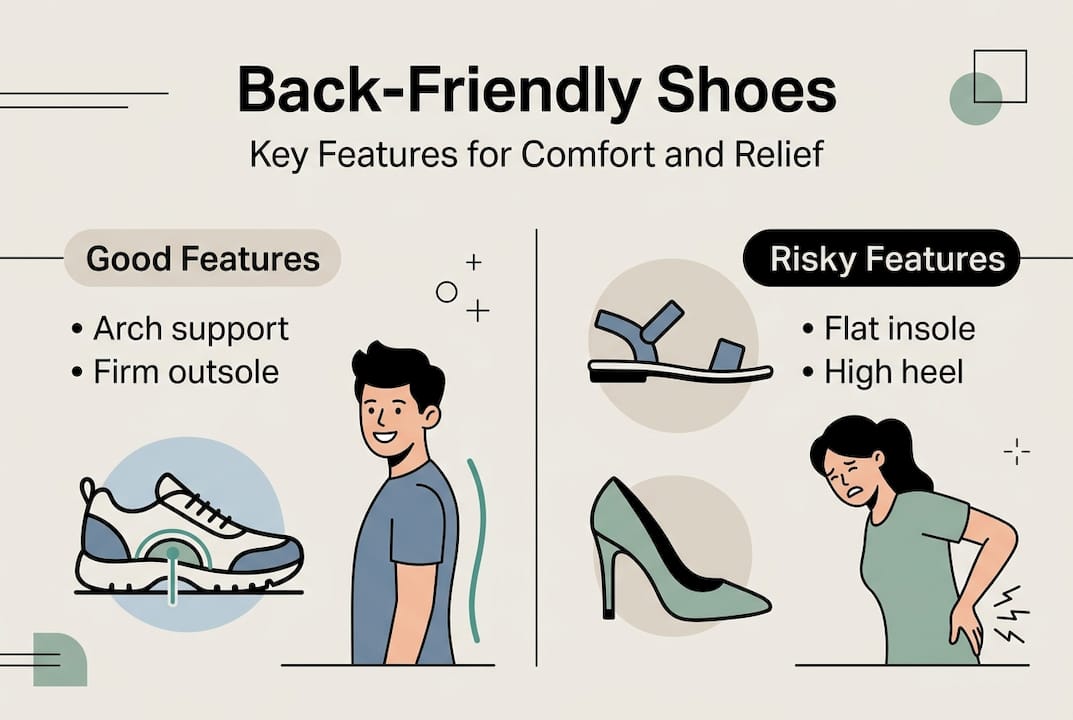
| Back-friendly feature | Risky feature |
|---|---|
| Firm, contoured arch support | Flat, unsupported insole |
| Moderate cushioning in heel and forefoot | Excessive stack height with no ground feel |
| Rocker sole to reduce forefoot pressure | Rigid, inflexible sole |
| Removable insole for custom orthotics | Fixed, non-removable insole |
| Wide toe box for natural toe splay | Narrow, pointed toe box |
| Low, stable heel (under 2 cm) | High or unstable heel |
Podiatrists recommend shoes with arch support, cushioning, and rocker soles for back pain sufferers, while advising against high heels, unsupportive flats, and worn-out footwear. Therapeutic shoes go a step further: research shows they produce greater ankle dorsiflexion and less plantar flexion compared to generic shoes, altering movement in ways that reduce strain on the lower back.
Your shoe shopping checklist:
- Check fit at the end of the day when feet are slightly swollen
- Ensure at least a thumb’s width between your longest toe and the shoe end
- Press the arch area to confirm it matches your foot’s natural curve
- Flex the sole: it should bend at the ball of the foot, not the middle
- Confirm the heel counter (the back of the shoe) is firm, not floppy
- Look for a removable insole if you use custom orthotics
Pro Tip: Wear new shoes for short periods initially, around one to two hours per day, and assess how your back and feet feel after two weeks. If discomfort increases rather than decreases, the shoe is not right for your mechanics, regardless of how well-reviewed it is. For more guidance, read our advice on buying shoes for foot pain.
Footwear habits and lifestyle tips for ongoing relief
Even the best shoes will not help if your habits undermine them. Small daily decisions compound over time, for better or worse.
- Rotate your footwear. Wearing the same pair every day accelerates midsole compression. Alternating between two pairs allows the cushioning to recover and extends the life of both.
- Replace on schedule. Worn-out shoes alter gait and create muscular imbalances. Do not wait until the upper falls apart. Check the midsole and outsole regularly.
- Add foot exercises. Toe spreads, calf raises, and short-foot exercises strengthen the intrinsic muscles that support your arch, reducing reliance on the shoe alone.
- Transition gradually. If you are moving from heavily cushioned shoes to a more minimal style, reduce stack height incrementally over several weeks. Research shows that soft midsole cushioning affects ankle stiffness and impact patterns, so your body needs time to adapt.
- Match shoes to activity. Walking shoes, running shoes, and standing-all-day shoes have different requirements. Using the wrong type for extended periods adds unnecessary strain.
Pro Tip: Keep a simple daily note on your phone or in a notebook. Rate your back comfort out of ten each evening and note which shoes you wore. After two to three weeks, patterns become obvious. This habit takes thirty seconds and can save you months of trial and error. Explore the lightweight footwear advantages that come with making more considered daily choices.
Discover supportive shoes for back-friendly living
If this article has made you look at your shoe rack differently, that is exactly the point. The right footwear is not a luxury; it is a genuine tool for managing and preventing back pain.
At YDA UK, we specialise in shoes for problem feet that combine everyday style with serious foot health technology. Our health-oriented footwear range is built around the principles covered in this article: proper arch support, appropriate cushioning, and designs that work with your body’s natural mechanics rather than against them. If you want to understand what sets our approach apart, the YDA shoe technology page explains the engineering behind each pair. For persistent or severe back pain, we always recommend consulting a podiatrist or walking specialist alongside any footwear change.
Frequently asked questions
How quickly can changing shoes reduce back pain?
Many people notice improvement within a few weeks of switching to properly supportive shoes, as better support corrects foot and gait alignment and reduces the strain travelling up the kinetic chain.
Are expensive shoes always better for back pain?
Not necessarily. The most important factors are fit and support, not price. Evidence for the general population is limited, and the primary mechanism is kinetic chain disruption from poor foot support, which an affordable well-fitted shoe can address just as effectively.
Can minimalist shoes help or harm back pain?
They can help if you transition gradually, allowing foot muscles to strengthen over time. Adopting them too quickly risks injury from rapid transition and can worsen pain rather than relieve it.
Should orthopaedic shoes always be used for back issues?
Orthopaedic shoes are best suited to specific medical needs. Research shows they produce altered ankle kinematics compared to generic shoes, which is beneficial for some conditions but not universally necessary for all back pain sufferers.
How often should shoes be replaced to avoid back pain?
Most shoes need replacing every 500 to 700 kilometres of use. Once worn shoes alter your gait through uneven sole wear or compressed cushioning, the muscular imbalances they create will affect your ankles, knees, and back.