
DC shoes size chart: find your perfect fit in 2026
TL;DR:
- The DC shoes size chart is a reliable guide when paired with accurate foot measurements. It accounts for model-specific fit differences and foot width, which are crucial for comfort and proper sizing. Consistently measuring your feet and consulting model-specific charts help prevent fit issues and enhance foot health.
The DC shoes size chart is the definitive reference for matching your foot length and width to the correct DC footwear size, covering US, UK, EU, and Mondopoint conversions across all shoe categories. DC shoes run true to size for most wearers, with a medium (D) width profile that suits average feet comfortably. Shoppers with wider feet or those planning to wear thick socks should consider sizing up by half a size. Getting this right from the start saves you the frustration of a return and protects your foot health long term.
How to read the DC shoes size chart correctly
The DC size chart maps foot length in centimetres to US, UK, and EU sizes, with consistent half-size increments. A US men’s size 9 corresponds to roughly 26.9 cm of foot length, and each half size adds approximately 0.5 cm. That progression is consistent across most DC styles, though model-specific cushioning and construction can shift how a size feels in practice. Consulting the size chart for the specific model you are buying, rather than relying on a generic chart, gives you the most accurate result.

DC also produces snowboard boots, which use a different system entirely. Snowboard boots use the Mondopoint system, which is based on the internal liner length in centimetres rather than standard footwear sizing. To find your correct Mondo size, measure the insole of a pair of well-fitting trainers rather than relying on your usual shoe size. This distinction matters because a size 9 trainer does not automatically translate to a Mondo 27.
Men’s DC shoe size conversion table
| US Size | UK Size | EU Size | Foot length (cm) |
|---|---|---|---|
| 7 | 6 | 39 | 25.0 |
| 8 | 7 | 41 | 26.0 |
| 9 | 8 | 42 | 26.9 |
| 10 | 9 | 43 | 27.9 |
| 11 | 10 | 44 | 28.6 |
| 12 | 11 | 46 | 29.5 |
Pro Tip: Always cross-reference the size chart on the specific DC product page before purchasing. Cushioning and last shape vary between models, so a size 9 in one style may feel noticeably different from a size 9 in another.
How to measure your foot for DC shoes
Accurate foot measurement is the single most reliable way to use a DC shoes sizing guide effectively. Foot size is not fixed. Foot swelling can increase foot size by several millimetres over the course of a day, which is why measuring in the late afternoon gives you the most accurate reading. Measuring in the morning often leads to buying shoes that feel tight by evening.
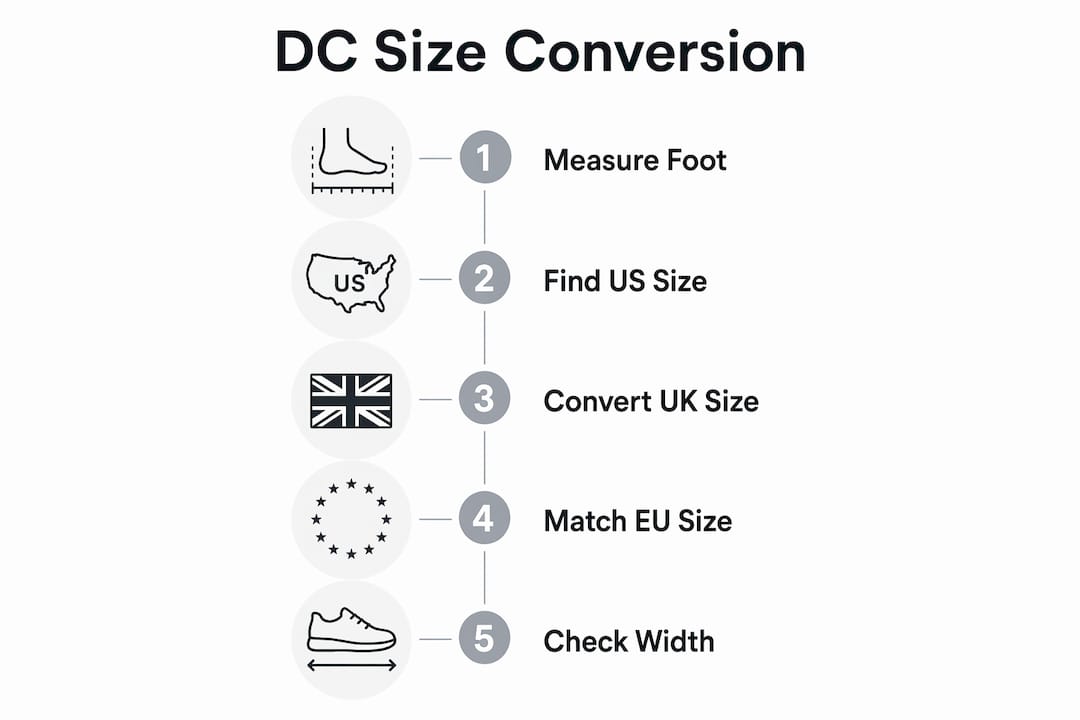
Follow these steps for a reliable measurement at home:
- Gather your tools. You need a sheet of paper, a pencil, a ruler or tape measure, and a hard floor. Carpet compresses underfoot and distorts your reading.
- Stand on the paper. Place the paper against a wall and stand with your heel touching the wall. Weight-bearing changes foot shape, so never measure sitting down.
- Trace both feet. Draw around each foot carefully, keeping the pencil upright. Angling the pencil inward makes the tracing smaller than your actual foot.
- Measure heel to longest toe. Use your ruler to measure from the back of the heel tracing to the tip of the longest toe. Record both feet.
- Use the larger measurement. Most people have one foot slightly larger than the other. Selecting size based on the larger foot prevents pinching and discomfort.
- Add toe space. Allow approximately 1 inch between your longest toe and the end of the shoe. This space accommodates natural toe splay during movement.
Pro Tip: Measure your foot width at its widest point, usually across the ball of the foot. Compare this to DC’s width specifications for the model you are considering. DC shoes are built on a medium (D) width last, so wide-footed shoppers should check the shoe width chart before committing to a size.
How DC shoe models vary in fit
Internal shoe volume varies significantly even within the same nominal size, depending on the last shape, materials, and cushioning stack. DC produces a broad range of styles, from slim low-profile skate shoes to chunky padded trainers, and each category fits differently. Knowing which category your chosen model falls into is as important as knowing your foot length.
Here is how fit typically breaks down by model category:
- Slim and low-profile models (such as the Stevie Williams slim line) run approximately half a size smaller due to a tighter last and reduced internal volume. Shoppers should size up half a size in these styles.
- Chunky and padded models provide more room around the toe box and midfoot. The extra cushioning absorbs impact well, which makes them popular for skateboarding, but the added padding can make the shoe feel snug initially before it settles.
- Performance and athletic styles prioritise a close fit for board feel or court responsiveness. These tend to fit true to size but leave less room for thick socks.
- Casual and lifestyle styles generally offer the most relaxed fit and are the most forgiving for wider feet.
DC’s extra cushioning makes some models feel snug at first, but this is by design for impact absorption rather than a sign that the shoe will stretch to fit. Shoppers wearing thicker socks for skateboarding or winter use should size up half a size regardless of model category.
Pro Tip: If you are choosing between a slim skate model and a padded lifestyle model, think about your intended use first. Slim models give better board feel; padded models give better all-day comfort. Your size choice should follow that decision, not precede it.
Common fit issues with DC shoes and how to avoid them
Buying based on size label alone, without measuring your foot, is the most common cause of a poor fit. Podiatrist Dr Matthew McQuaid states that comfortable shoe fit matters more than label size and that shoes rarely alter their fit enough through wear to correct a poor initial choice. This is a critical point for anyone tempted to buy a slightly tight pair and hope they will break in.
Watch out for these common mistakes:
- Ignoring foot width. Length is only half the equation. Width variation across models is significant, and a shoe that fits in length can still cause blisters or numbness if it is too narrow. Wide-footed shoppers should read a dedicated wide shoes fitting guide before selecting a DC style.
- Measuring in the morning. Morning measurements underestimate foot size. Always measure in the afternoon or evening.
- Buying children’s sizes without growth allowance. Children’s feet grow rapidly. Sizing up slightly and allowing room for growth prevents the need to replace shoes within weeks. For more on this, the advice on shopping for kids amid size changes is worth reading before purchasing DC kids’ footwear.
- Assuming size consistency across brands. Sizing varies between brands due to different lasts and manufacturing standards. A size 9 in one brand does not guarantee a size 9 in DC. Always re-measure and check the DC-specific chart.
- Neglecting to re-measure over time. Foot size changes with age, weight fluctuation, and pregnancy. Re-measuring every year or two keeps your size reference current.
For a thorough walkthrough of the full fitting process, the step by step shoe fitting guide from Ydauk covers every stage from measurement to final selection.
Key takeaways
The DC shoes size chart works best when combined with accurate foot measurement, model-specific fit knowledge, and awareness of foot width.
| Point | Details |
|---|---|
| Measure in the afternoon | Foot swelling through the day means afternoon measurements give the most accurate size. |
| Use the larger foot | Most people have one foot slightly bigger; always size to the larger measurement. |
| Check model-specific fit | Slim DC models run half a size small; chunky padded styles offer more room. |
| Width matters as much as length | DC uses a medium (D) width last; wide-footed shoppers should size up or check width guides. |
| Snowboard boots need Mondopoint | DC snowboard boots use internal liner length in cm, not standard shoe sizing. |
Why I always tell people to measure twice before buying DC shoes
The most common complaint I hear from shoppers who bought DC shoes online is that the size felt “off” despite ordering their usual size. Nine times out of ten, the issue is not the brand. It is that the shopper used a size from a different brand as their reference point, or they bought a slim model without accounting for the tighter last.
My honest view is that the DC size chart is genuinely reliable, but only if you feed it accurate information. A measurement taken standing up, in the afternoon, from the correct foot, will serve you far better than any size label from a previous pair of shoes. The chart cannot compensate for a measurement taken sitting down at 8 in the morning from the smaller foot.
The other thing I would stress is the width question. Most people think about shoe length and nothing else. But a shoe that fits in length and pinches in width will cause blisters, bunions, and fatigue. DC’s medium width last suits most people, but if you have ever found shoes uncomfortable across the ball of the foot, width is almost certainly the issue. Checking a shoe width sizing guide before you buy takes five minutes and saves a great deal of discomfort.
— Panagiotis
Ydauk’s approach to finding the right shoe fit
Getting the right fit is not just about comfort. It affects posture, energy, and long-term foot health.
Ydauk combines foot health technology with performance footwear design to help shoppers move beyond guesswork and find shoes that genuinely fit. The YDA technology page explains how Ydauk’s approach to shoe construction addresses the fit challenges that standard size charts alone cannot solve. If you have struggled with sizing across brands or need a shoe built around foot health as well as style, Ydauk’s range is worth exploring. For a broader view of how size charts work across footwear categories, the footwear size chart guide from Ydauk is a practical starting point.
FAQ
Do DC shoes run true to size?
DC shoes run true to size for most wearers with average-width feet. Shoppers with wider feet or those wearing thick socks should size up by half a size.
What size DC shoes should I buy if I am between sizes?
Size up to the next half size. Shoes that are slightly too long are easier to manage than shoes that are too short or too narrow.
How do I convert my DC shoe size to UK or EU?
A US men’s size 9 equals a UK size 8 and an EU size 42. Use the DC size chart for the specific model, as cushioning and construction can affect how a size fits in practice.
Are DC snowboard boots sized differently from regular DC shoes?
Yes. DC snowboard boots use the Mondopoint system, which measures the internal liner length in centimetres. Measure the insole of a well-fitting pair of trainers to find your correct Mondo size rather than relying on your standard shoe size.
How often should I re-measure my feet for DC shoes?
Re-measure at least once a year. Foot size changes with age, weight, and lifestyle, so a measurement from two or three years ago may no longer be accurate.