
Wide toe shoes: benefits for foot health and comfort
Wide toe shoes let your toes splay naturally, which reduces forefoot pressure, improves balance, and lowers the risk of toe trauma during everyday movement and sport. The evidence is strongest for reduced toe deformation and altered ground reaction forces, particularly in runners. Benefits for bunion progression, neuroma irritation, and intrinsic foot muscle strength are well-supported by podiatric guidance, though some performance claims need cautious interpretation. The sections below cover who gains most, what the research actually shows, how to choose the right pair, and how to transition without setting yourself back.
Key takeaways
Wide toe shoes deliver their most reliable benefits through one mechanism: permitting toe splay, which reduces forefoot compression, improves load distribution, and activates the intrinsic muscles that support the arch.
| Point | Details |
|---|---|
| Strongest evidence | Reduced hallux deformation and lower GRFs in runners (p < 0.001 in a 25-runner crossover RCT). |
| Conditions helped most | Bunions, Morton’s neuroma, hammertoes, and bruised toenails all respond to reduced lateral compression. |
| Transition timeline | Allow 2–6 weeks of gradual progression; support adaptation with toe spreads and short-foot exercises. |
| Key fit check | Width at the fifth MTP joint plus secure heel hold; a roomy forefoot with a loose heel causes blisters. |
| Ydauk’s approach | YDA footwear is designed with forefoot clearance, heel cup security, and ball-of-foot sole flex to support the benefits described here. |
Table of Contents
- How a wider toe box changes your foot mechanics
- The main benefits of wide toe shoes, ranked by evidence
- Who gains most from wide toe footwear?
- What the research actually shows
- How to choose the right wide toe-box shoe
- How to transition safely into wide toe shoes
- When wide toe shoes may not be the right choice
- How Ydauk’s design choices support the evidence
- Realistic expectations after switching: an editorial perspective
- Ydauk: footwear built around the foot, not the other way round
- Sources
How a wider toe box changes your foot mechanics
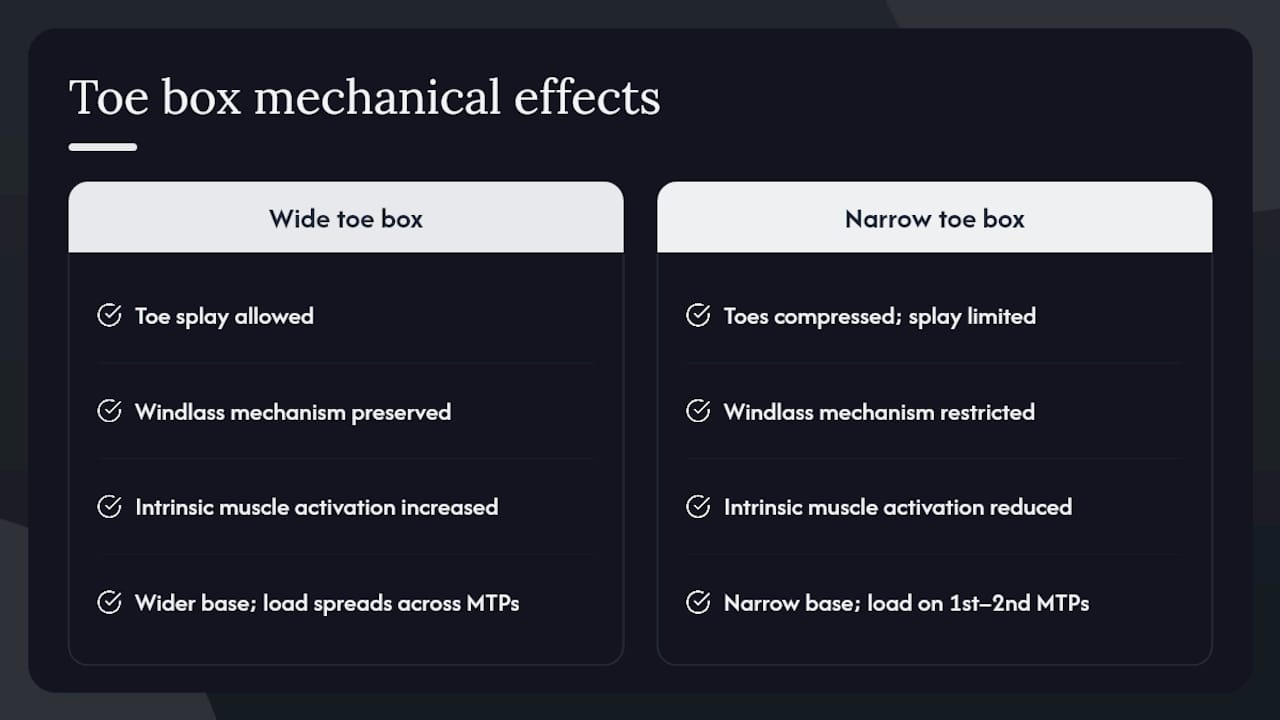
The core mechanical shift is straightforward: a roomy toe box permits toe splay, the natural outward spreading of the toes during weight-bearing. Most conventional shoes taper toward the front, compressing the forefoot into a narrower profile than the foot naturally wants to occupy. That compression limits the windlass mechanism, the tension system running from the plantar fascia through the toes that stiffen the arch at push-off, and reduces activation of the intrinsic foot muscles that stabilise the arch from within.
When toes can splay, the base of support widens. That wider base alters ground reaction forces during the stance phase of walking and running, distributing load more evenly across the metatarsal heads rather than concentrating it on the first and second. Toe splay supports balance and distributes load more evenly, while restrictive toe boxes reduce intrinsic muscle function and may contribute to forefoot deformities over time.
Statistic callout: A randomised crossover study of 25 male marathon runners found that raised, wider toe boxes produced significant reductions in vertical ground reaction forces (p = 0.001) and antero-posterior ground reaction forces (p = 0.015), alongside a marked decrease in hallux deformation severity (p < 0.001).
The intrinsic muscle angle matters beyond comfort. Stronger intrinsic muscles stiffen the arch dynamically, which may improve shock absorption and reduce the energy cost of each stride. The evidence here is plausible but not yet definitive; most studies measure mechanical outputs rather than long-term muscle adaptation.
Pro Tip: If you want to understand how shoe shape affects foot health at a design level, look at the width at the fifth metatarsophalangeal (MTP) joint, not just the overall shoe width. That single measurement tells you more than any marketing label.
The main benefits of wide toe shoes, ranked by evidence
1. Reduced forefoot pressure and immediate comfort
The most consistent finding across clinical guidance and user reports is reduced pressure across the metatarsal heads and toe tips. Wide toe box footwear reduces forefoot pressure and improves toe health, with small studies and clinical experience both pointing toward symptom relief for people whose pain stems from compression. For everyday wear, this is the benefit most people notice within the first few days.
2. Lower risk of subungual haematoma (bruised toenails)
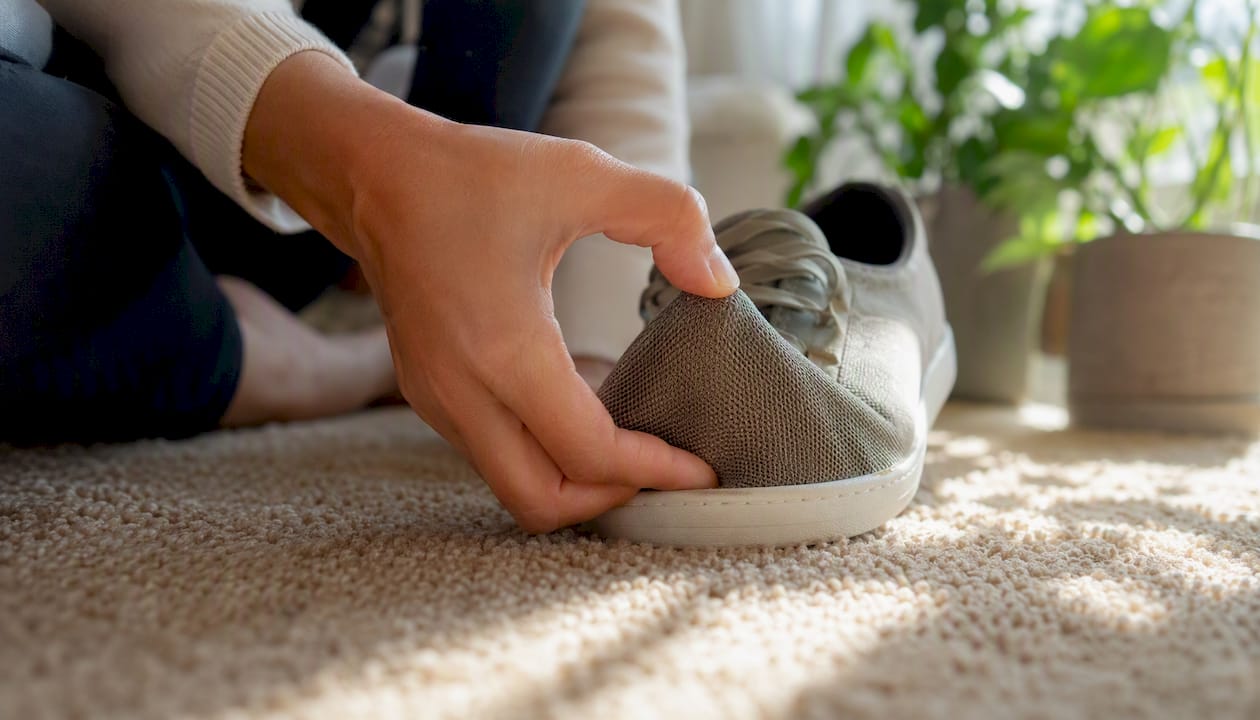
Runners and hikers who repeatedly bruise or lose toenails are almost always wearing shoes where the toe box is too shallow or too narrow. The toes strike the front of the shoe on downhill sections, and repeated micro-trauma causes bleeding under the nail. A deeper, wider toe box eliminates that contact. The PMC crossover study measured in-shoe foot displacement directly and found reduced hallux impact, which maps directly onto this mechanism.
3. Slower progression of bunions (hallux valgus)
A bunion forms when the big toe is pushed laterally over time, deforming the first MTP joint. Narrow footwear is a well-established contributing factor. Wide toe boxes reduce the lateral compression implicated in bunions, slowing progression of the deformity. The critical caveat: a wide toe box will not reverse an established structural change. Once the joint has remodelled, footwear alone cannot undo it.
4. Reduced irritation from Morton’s neuroma
Morton’s neuroma is a thickening of the nerve tissue between the third and fourth metatarsals, typically aggravated by lateral compression. Reducing that compression by switching to a wider forefoot is one of the first conservative interventions podiatrists recommend. Many people with neuroma report meaningful symptom reduction within weeks of the switch, though severe cases usually need additional intervention.
5. Improved balance and stability
Wider toe splay increases the effective base of support, which has a direct mechanical effect on balance. This benefit is particularly relevant for older adults, where balance deficits are a significant fall-risk factor, and for athletes who need lateral stability during cutting movements. The mechanism is supported by biomechanical reasoning and the GRF data from the marathon runner study, though dedicated balance-outcome trials are limited.
6. Intrinsic foot muscle activation and strengthening
Conventional shoes do much of the foot’s stabilising work passively, through their structure. A wide toe box, especially when paired with a flexible forefoot sole, asks the intrinsic muscles to do more. Over weeks and months, this can translate into measurable strength gains in the foot’s small muscles, which supports arch function and reduces fatigue. This is the principle behind the barefoot and minimalist movement, and the role of footwear in injury prevention is closely tied to how much the foot is allowed to work.
7. Better toenail health
Compressed toes create abnormal pressure on nail beds, contributing to ingrowing toenails and fungal infections that thrive in warm, moist, compressed spaces. A wider toe box reduces that pressure and allows better air circulation. For people who have had repeated ingrowing toenail problems, footwear width is often the overlooked variable.
8. Potential improvement in running biomechanics
The marathon runner study found reduced GRFs with a wider toe box, which suggests less mechanical loading per stride. Whether that translates into fewer overuse injuries over a full training cycle has not been tested in long-term randomised trials, but the biomechanical signal is coherent. Runners who switch often report feeling less forefoot fatigue on long runs.
9. Diabetic foot pressure redistribution
For people with diabetes, pressure ulcers on the forefoot are a serious clinical risk. Wide toe box footwear is frequently used as part of conservative diabetic foot management to redistribute plantar pressure away from vulnerable areas. This is not a standalone solution; it sits within a broader care plan that includes regular podiatric review and, often, custom orthotics.
Who gains most from wide toe footwear?
The short answer: people with forefoot compression problems, wide natural forefeet, and runners who experience toe trauma. The benefits are most clearly supported for these groups.
- Bunion sufferers: A wider forefoot reduces the lateral force pushing the big toe out of alignment. Ohio State Health guidance confirms wide toe box shoes can help people with bunions, while noting they are not universally suitable and should not be so roomy that the foot slips.
- People with hammertoes: Hammertoes are aggravated by vertical compression from a low toe box ceiling. Extra depth and width reduce that contact pressure.
- Morton’s neuroma patients: Lateral compression is the primary mechanical trigger; a wider forefoot directly addresses it.
- Runners with bruised toenails: Reduced in-shoe displacement means less repeated impact on the nail bed.
- People with naturally wide forefeet: Many people are simply wearing the wrong shape of shoe. A wide toe box is not a therapeutic intervention for them; it is just the correct fit.
- Children during foot development: Children’s feet are still forming, and prolonged compression during growth can influence toe alignment. Roomy footwear during childhood is a sensible preventive measure.
- People at risk of diabetic pressure ulcers: Pressure redistribution is a clinical priority; see the role of footwear in ulcer prevention for a detailed breakdown.
When to see a podiatrist: If you have an established structural deformity (a bunion that has already caused joint remodelling, severe hammertoes, or significant neuroma symptoms), footwear change alone is unlikely to be sufficient. A podiatrist can assess whether orthotics, padding, or other interventions are needed alongside the footwear change. People with peripheral neuropathy or active diabetic foot complications should not self-manage with footwear changes alone.
What the research actually shows
The evidence base is growing but still limited by small sample sizes and short study durations. Here is an honest summary of what the best available research supports.
The strongest single study is the randomised crossover trial of 25 male marathon runners, which measured in-shoe foot displacement and ground reaction forces across different toe box shapes. It found significant reductions in vertical GRFs (p = 0.001), antero-posterior GRFs (p = 0.015), and a marked decrease in hallux deformation (p < 0.001) with raised, wider toe boxes. The limitation is clear: 25 male runners is a narrow population, and the study measured acute biomechanical outcomes rather than injury rates over a season.
Population-level observational data adds context. Epidemiological studies link narrow footwear to higher rates of hallux valgus across generations and cultures, with populations that habitually wear narrow shoes showing significantly higher rates of forefoot deformity than those who do not. This is correlational, not causal, but the pattern is consistent.
| Study / Source | Population | Main outcome | Practical takeaway |
|---|---|---|---|
| PMC crossover RCT | 25 male marathon runners | Reduced vertical and AP GRFs; reduced hallux deformation (p < 0.001) | Wide toe box reduces mechanical loading and toe impact in runners |
| Observational epidemiology (Framingham et al.) | General population, cross-cultural | Narrow footwear correlates with higher hallux valgus prevalence | Long-term narrow shoe use is a risk factor for forefoot deformity |
| Clinical podiatry guidance | Forefoot compression patients | Symptom relief for bunions, neuroma, hammertoes with wider footwear | Conservative first-line measure for compression-related forefoot pain |
Limitations to keep in mind: Most studies are short-term, use small samples, and test specific shoe designs that may not generalise to all wide toe box products. Long-term randomised trials on injury prevention are absent. The evidence supports the mechanism and short-term outcomes; it does not yet prove long-term injury reduction at a population level.
How to choose the right wide toe-box shoe
The most important thing to check is width at the fifth MTP joint, not the overall shoe width. A “wide shoe” is broader throughout the entire last; a “wide toe box” provides room specifically in the forefoot and toe area. These are different products, and confusing them is the most common buying mistake.
Fit checklist:
- Toe splay room: With the shoe on and laced, you should be able to spread all five toes without feeling resistance from the upper.
- Depth: The toe box ceiling should clear your longest toe (which may not be the big toe) by roughly a thumb’s width.
- Heel hold: The heel must sit firmly with no slipping. A roomy forefoot combined with a loose heel causes blisters and reduces stability.
- Forefoot flexibility: The sole should flex at the ball of the foot, not mid-arch. A rigid forefoot defeats the purpose of toe splay.
- Sole drop: For everyday wear, a moderate drop (4–8 mm) suits most people transitioning from conventional shoes. Runners moving toward lower drop should do so gradually.
Activity-specific notes:
- Running: Prioritise a secure heel counter and a flexible forefoot. Check that the toe box does not create lateral movement during push-off.
- Hiking: Protective sole thickness matters more here; a wide toe box with a thin sole may not provide adequate underfoot protection on rough terrain.
- Diabetic footwear: Protective sole depth and seamless interiors are non-negotiable. Consult a podiatrist before selecting; orthotic-friendly footwear may be needed to accommodate custom insoles.
- Children: Prioritise natural materials and flexibility over structure. Children’s feet need room to develop, not rigid support.
How to transition safely into wide toe shoes
Start gradually. Most foot discomfort during the transition comes not from the wider toe box itself but from the change in load distribution and the activation of muscles that have been underused for years.
Suggested progression (2–6 weeks):
- Week 1: Wear the new shoes for short walks only (30–45 minutes), alternating with your usual footwear.
- Week 2: Extend to full-day wear on low-activity days; keep running or hiking in your old shoes.
- Week 3–4: Introduce the new shoes for shorter runs or hikes. Monitor for new aches in the arch or calf, which are common as the foot adjusts.
- Week 5–6: Transition fully for most activities, retaining old shoes only for very long efforts until the foot has fully adapted.
Supporting exercises:
- Toe spreads: actively splay all five toes and hold for 5 seconds; repeat 10 times per foot.
- Short-foot exercise: draw the ball of the foot toward the heel without curling the toes, activating the arch intrinsics.
- Single-leg balance: 30 seconds per side, barefoot on a firm surface, to build proprioceptive adaptation.
Pro Tip: Pair your transition with a review of high-performance footwear for injury prevention to understand which sole and heel features to prioritise as your foot adapts.
Warning: People with peripheral neuropathy or severe structural deformities should not self-manage this transition. A fast switch without clinical oversight risks new pressure points forming in areas where sensation is reduced.
When wide toe shoes may not be the right choice
Wide toe shoes are not universally suitable, and a few situations call for caution or professional input before switching.
Main drawbacks:
- Slippage: A toe box that is too roomy without adequate heel hold causes the foot to slide forward, creating blisters and reducing propulsion efficiency.
- Insufficient arch support: Wide toe box shoes, particularly minimalist versions, often have little medial arch support. For people with significant overpronation or plantar fasciitis, this can worsen symptoms without an orthotic.
- Not a cure for structural deformity: As podiatry guidance confirms, wide toe boxes slow the progression of bunions and hammertoes but do not reverse established structural changes.
Red flags that need podiatry review:
- New or worsening pain in the arch, heel, or ankle after switching footwear
- Any open wound, ulcer, or skin breakdown on the foot
- Sudden change in gait or balance
- Diabetic foot complications of any kind
- Numbness or tingling that develops or worsens with the new shoes
When you attend a podiatry appointment, bring the shoes you have been wearing, a brief activity history (mileage, terrain, duration), and photos of any visible deformity or skin changes. That information cuts the assessment time significantly and leads to more specific advice.
How Ydauk’s design choices support the evidence
Ydauk builds its footwear around the same biomechanical priorities the research supports: forefoot clearance that permits genuine toe splay, a heel cup designed to hold the rear foot securely while the forefoot moves freely, and sole flex positioned at the ball of the foot rather than mid-arch. The YDA Technology approach maps directly onto the mechanisms discussed throughout this article: wider toe geometry, appropriate sole drop for everyday use, and materials chosen for both durability and foot-health outcomes. For readers who want to go deeper on the design rationale, the footwear technology trends page covers how these choices translate into measurable foot health benefits.
Realistic expectations after switching: an editorial perspective
Most people notice immediate comfort improvement within the first few days. The forefoot pressure reduction is felt quickly, especially by anyone who has been wearing pointed or narrow shoes for years. What takes longer is the structural adaptation.
Realistic timescales:
- Pain reduction (forefoot compression, neuroma irritation): days to 2–3 weeks for mild cases; longer for established deformities.
- Balance and stability improvements: 4–8 weeks of consistent wear and supporting exercises.
- Intrinsic muscle strength gains: 8–12 weeks minimum, and only if the shoe is flexible enough to demand that muscle work.
Outcomes vary considerably based on baseline foot health, how long narrow shoes have been worn, and activity level. Someone who has worn conventional shoes for 30 years will adapt more slowly than a younger person making the switch early. That variability is worth acknowledging rather than glossing over; the benefits are real, but they are not instant.
Ydauk: footwear built around the foot, not the other way round
The evidence in this article points toward one consistent conclusion: the foot performs better when it is not compressed. Ydauk’s range is designed from that starting point, with toe geometry that allows natural splay, heel cups that prevent slippage, and sole construction that flexes where the foot does.
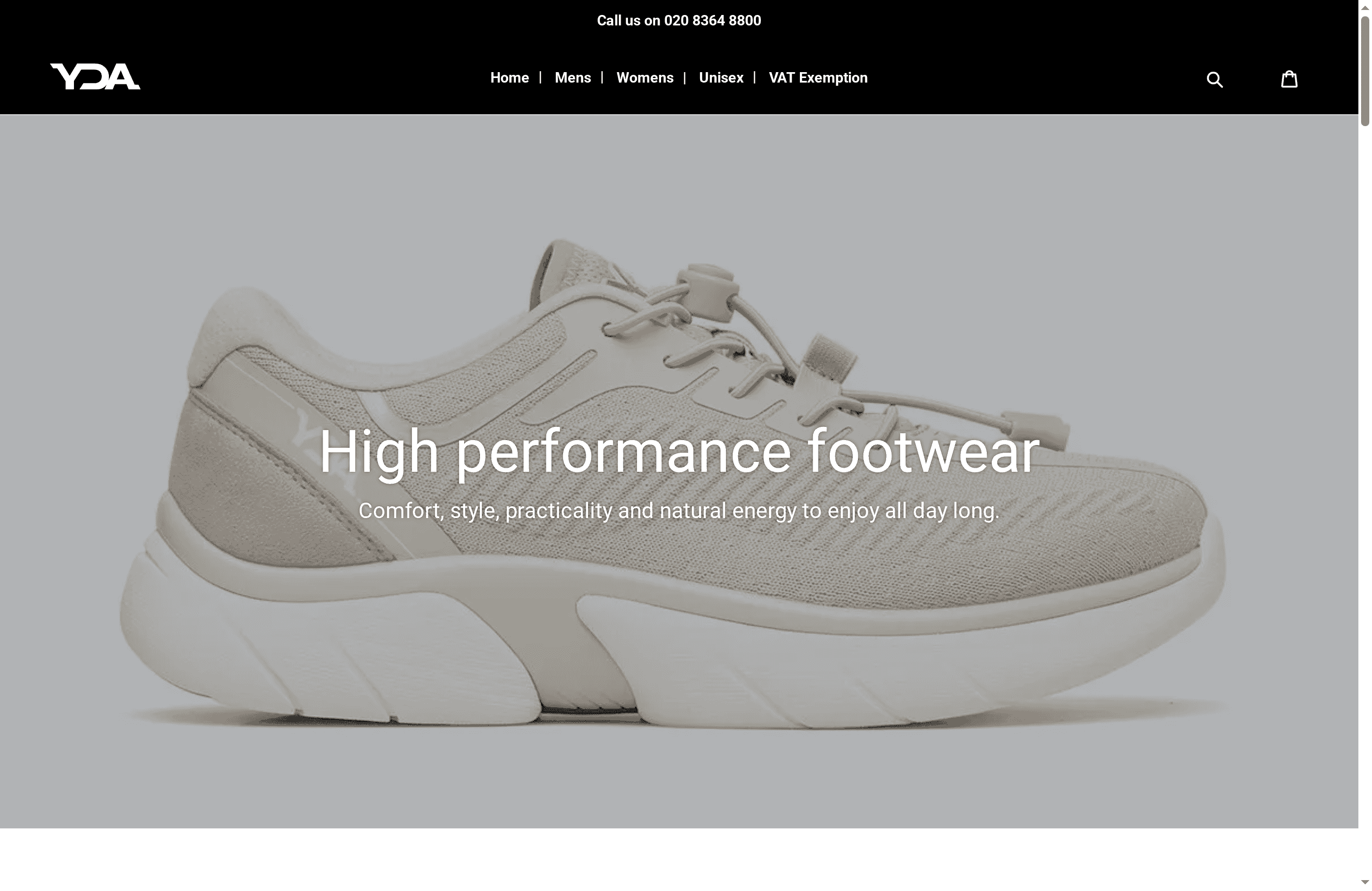
If you have been managing forefoot discomfort, bruised toenails, or bunion irritation with conventional footwear, the difference a properly designed wide toe box makes is worth experiencing directly. Ydauk shoes combine the foot-health principles discussed here with everyday wearability, so you are not choosing between comfort and function.
Visit the YDA Technology page to see exactly how each design feature maps to the biomechanical benefits covered in this article, and find the right model for your activity and foot shape.
Sources
- Toe Box Shape of Running Shoes Affects In-Shoe Foot Displacement and Deformation: A Randomized Crossover Study - PMC
- Are barefoot shoes good for you? | Ohio State Health & Discovery
- Wide Toe Box vs Standard Fit Shoes 2026 | Podiatrist
- Wide Toe Box Shoes: Benefits for Foot Health - Arch Support One
This article provides general information on footwear and foot health. It is not a substitute for professional podiatric or medical advice. If you have a diagnosed foot condition, diabetes, or persistent pain, consult a qualified clinician before changing your footwear.