
Orthopedic shoe advantages: 10 benefits for your feet
TL;DR:
- Orthopaedic shoes offer support, cushioning, and pressure redistribution to alleviate pain and improve gait stability.
- Choosing the right fit and structural criteria is essential for clinical success and long-term foot health.
Orthopaedic shoes improve arch support, redistribute plantar pressure, reduce joint strain and stabilise gait. For anyone dealing with heel pain, bunions, diabetic feet or simply long days on their feet, they address the mechanical root of the problem rather than masking it. Here are the core advantages at a glance:
- Arch support and alignment — medial posting and firm heel counters reduce excessive pronation and the downstream strain it places on knees, hips and the lower back.
- Heel cushioning and shock absorption — specialist midsole materials absorb impact that standard shoes transfer directly to the heel and plantar fascia.
- Pressure redistribution — rocker soles and heel-offloading designs shift load away from vulnerable forefoot and heel zones.
- Gait stability — improved foot control reduces stumbling and builds confidence for people with chronic injuries or balance concerns.
- Orthotic accommodation — a removable footbed with 15–20mm of interior depth lets custom orthotics sit correctly without crowding the toes.
- Circulation and swelling management — wider, non-binding uppers reduce constriction in feet prone to oedema or neuropathy.
- Ulcer and pressure-sore prevention — offloading designs protect vulnerable skin in diabetic and post-surgical feet.
- Reduced secondary joint strain — better foot mechanics lower the load transferred to ankles, knees and hips over time.
The sections below unpack each of these benefits, the clinical evidence behind them, who stands to gain most, and the practical clinician tips that determine whether a pair actually works for you.
Table of Contents
- What are the main orthopedic shoe advantages for pain and function?
- Who benefits most from orthopaedic footwear?
- How do you find the right fit: off-the-shelf vs custom options?
- What does the evidence actually show about outcomes?
- Clinician tips: heel drop, break-in and wearing in pairs
- Key takeaways
- The case for taking foot mechanics seriously
- Ydauk’s approach to foot-health footwear
- Useful sources and further reading
What are the main orthopedic shoe advantages for pain and function?
Arch support, alignment and downstream joint strain
A firm heel counter combined with medial arch posting controls excessive pronation — the inward rolling of the foot that, left unchecked, rotates the tibia and loads the knee medially. Over a full day’s walking that adds up. Reducing pronation at the foot level tends to reduce secondary strain at the knee, hip and lumbar spine, which is why podiatrists often recommend orthopaedic footwear to patients presenting with knee pain rather than foot pain alone.
Cushioning, shock absorption and plantar fasciitis
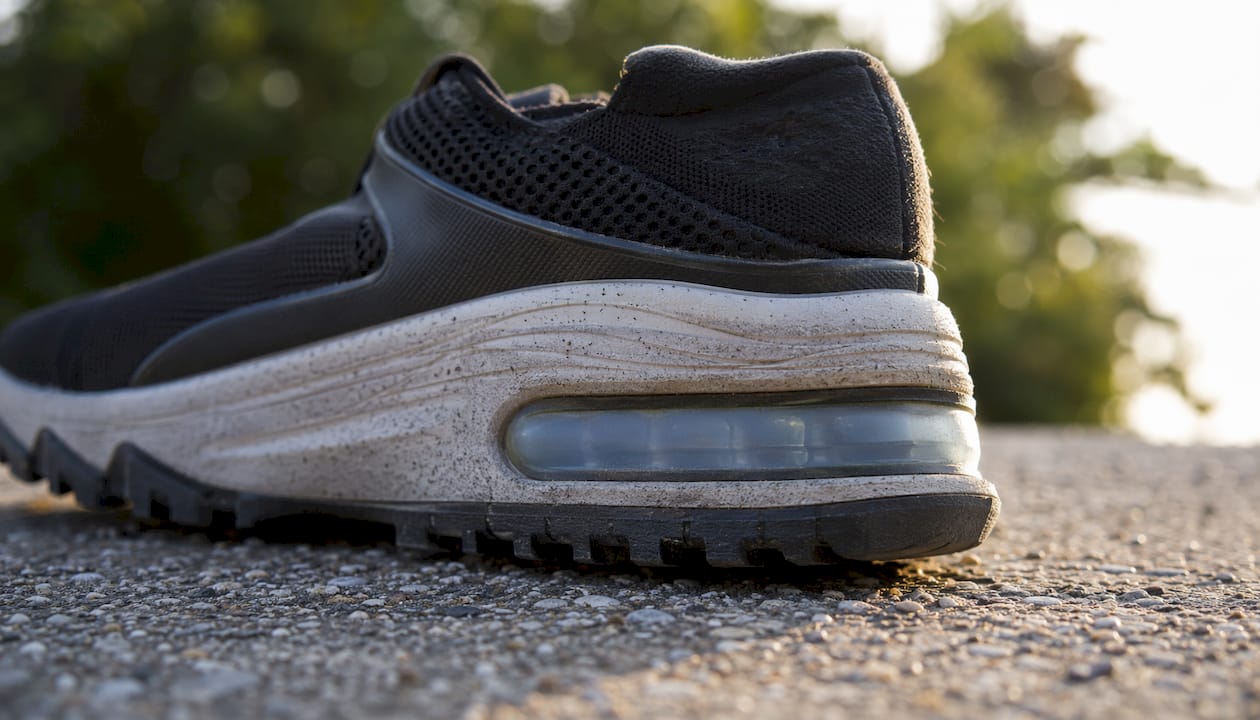
The midsole is where most of the work happens. Denser foam compounds and gel heel inserts absorb the impact spike that occurs at heel strike, spreading it over a longer time window. For plantar fasciitis specifically, peer-reviewed trials have demonstrated clinically meaningful pain reductions for therapeutic footwear lines compared with standard shoes. Not every brand has that trial data, which is worth remembering when you are comparing options.
Pressure redistribution: rocker soles and heel offloading
This is where the engineering gets interesting. A baropodometric study comparing orthopaedic sole designs found that heel-offloading models reduced forefoot pressure by up to 83%, while rocker soles reduced forefoot loading by up to approximately 30% in some designs, which benefits conditions such as hallux rigidus and metatarsalgia. The difference between sole types is not trivial if you have a specific forefoot pathology.
Gait stability and proprioception
An observational gait study found that orthopaedic shoes improved local dynamic stability by 7–10% across axes and reduced pain scores by 29% on average in patients with chronic foot and ankle injuries. Better foot control means less compensatory movement at the ankle and knee, which reduces the risk of stumbling on uneven ground.
Orthotic accommodation and interior depth
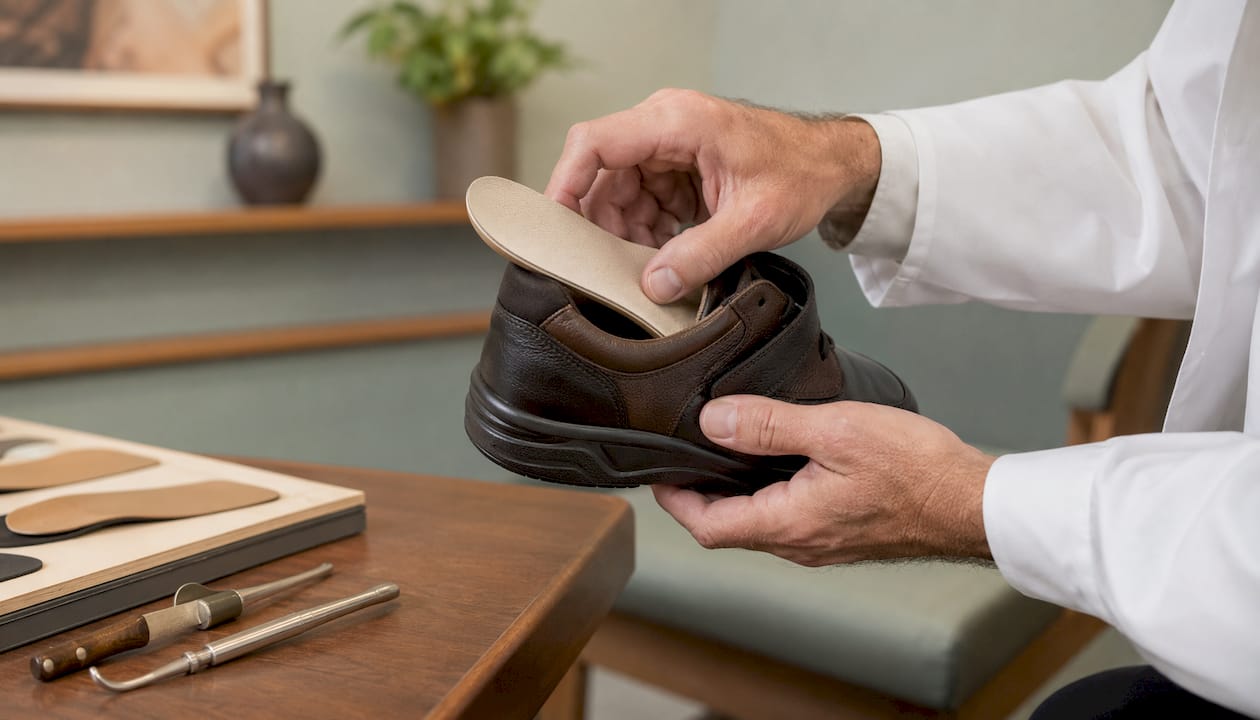
Standard fashion shoes provide limited insole depth. Orthopaedic shoes provide significantly deeper interiors, sufficient for a custom orthotic to sit flat and function correctly. Without that space, the orthotic compresses the toes upward and the device cannot control the foot as intended. For orthotic-friendly footwear, this depth is non-optional.
Circulation, swelling and non-binding uppers
Extra width and soft, non-binding uppers reduce circumferential pressure on the foot. For people with peripheral neuropathy or diabetes, even mild constriction can impair circulation and increase the risk of skin breakdown. Wider toe boxes also allow toes to splay naturally during push-off, which improves balance and reduces pressure on bunion joints.
Pro Tip: When checking width, stand in the shoe and press the upper fabric at the widest point of your foot. You should feel no lateral compression at all — not just “a little room”. Any pinching at the fifth metatarsal head is enough to negate the circulation benefit.
Who benefits most from orthopaedic footwear?
The clearest candidates are people with existing diagnoses, but the list is broader than most expect.
Common indications:
- Plantar fasciitis or chronic heel pain
- Bunions (hallux valgus) and hammertoes
- Diabetic feet, whether at risk or with healed ulcers
- Rheumatoid arthritis affecting the forefoot or midfoot
- Chronic ankle instability or recurrent sprains
- Postsurgical recovery (with clinician approval)
- Prolonged standing at work (retail, healthcare, hospitality)
- Flat feet (pes planus) or high arches causing secondary pain
Seek a podiatry assessment first if you have:
- An open ulcer or active infection on the foot
- Recent foot or ankle surgery without written clinician clearance
- Severe peripheral vascular disease or neurovascular compromise
- Acute Charcot arthropathy
A quick self-triage checklist:
- Do you have foot pain that lasts more than a few days and is not linked to a new activity? Try orthopaedic footwear.
- Do you have a diagnosed condition from the list above? Try orthopaedic footwear, ideally after a podiatry review.
- Do you have an open wound, active infection or recent uncleared surgery? See a clinician before buying anything.
- Has your GP or podiatrist mentioned prescription footwear? Request a referral rather than buying off the shelf.
The NHS provides podiatry services for people with diabetes, rheumatoid arthritis and other qualifying conditions, so a referral is often the most cost-effective starting point.
How do you find the right fit: off-the-shelf vs custom options?
Ready-made orthopaedic shoes versus prescription footwear
Off-the-shelf orthopaedic footwear suits the majority of people with mild to moderate foot problems. It is immediately available, costs significantly less than bespoke prescription shoes, and clinical guideline-level recommendations support its use for patients with deformity or abnormal foot function where custom shoes are not indicated. Prescription footwear is reserved for complex deformities, post-amputation fitting, or cases where standard widths and depths cannot accommodate the foot.
Prefabricated orthotic insoles sit between the two: they add arch support and cushioning to a shoe that already has adequate depth, at a fraction of the cost of custom devices. The trade-off is that they are not moulded to your specific foot shape, so they work better for common presentations (mild pronation, heel pain) than for complex or asymmetric problems.
For readers curious about how bespoke orthopaedic footwear is actually constructed, custom shoe manufacturing involves last-making from foot casts, specialist material selection and iterative fitting — a process that explains both the cost and the lead time.
Practical fit checks: what to look for
- Toe-box width — no lateral compression on the fifth toe; toes should lie flat without curling.
- Removable footbed — confirms the shoe has adequate depth and allows you to insert a custom orthotic.
- Interior depth — 15–20mm minimum; measure with the insole removed.
- Firm heel counter — press the back of the shoe inward with your thumb. It should resist firmly, not collapse.
- Torsional stability — hold the shoe at heel and forefoot and try to twist it. A structurally sound orthopaedic shoe resists; a shoe that collapses under torsion provides no midfoot support.
- Closure type — laces or Velcro allow width adjustment for swelling; slip-ons do not.
Pro Tip: The torsion test is the single most useful check most people never do. Pick up the shoe, hold the heel in one hand and the toe box in the other, and try to wring it like a wet cloth. If it twists easily, put it back — torsional collapse means zero midfoot control, regardless of what the marketing says.
For a step-by-step guide to selecting orthopaedic shoes that balance support and style, Ydauk’s buying guide covers the key decisions in plain language.
What happens at a podiatry or orthotics appointment?
A first appointment typically involves a gait assessment, pressure mapping and a review of your footwear history. If custom orthotics are indicated, a cast or 3D scan of the foot is taken. Lead times for custom devices in the UK run from two to six weeks depending on the provider. Ready-made orthopaedic shoes can be fitted and taken home the same day.
What does the evidence actually show about outcomes?
The clinical picture is encouraging but not uniform. Here is where the evidence is strongest and where it is more mixed.
- Rheumatoid arthritis: Systematic review evidence shows within-group reductions in pain and improvements in physical function after 30 days to several months of wearing ready-made orthopaedic footwear, though effects on health-related quality of life are mixed.
- Gait and stability: The observational study cited earlier recorded a 29% reduction in pain scores and a 7–10% improvement in local dynamic stability, which are meaningful gains for daily function.
- Pressure redistribution: Heel-offloading designs produced forefoot pressure reductions of up to 83% in baropodometric testing; rocker soles reduced forefoot loading by up to approximately 30% in some designs.
- Plantar fasciitis: Peer-reviewed trials support clinically meaningful pain reductions for specific therapeutic footwear lines, though results vary by brand and design.
The evidence in numbers: heel-offloading orthopaedic soles can reduce forefoot pressure by up to 83% in controlled testing, and gait studies record an average 29% reduction in pain scores for patients with chronic foot and ankle injuries.
| Condition | Evidence level | Typical outcome | Timeframe |
|---|---|---|---|
| Rheumatoid arthritis | Systematic review | Pain reduction, improved function | 30 days to several months |
| Chronic foot/ankle injury | Observational gait study | 29% pain reduction, 7–10% stability gain | Weeks to months |
| Forefoot pressure (heel offloading) | Baropodometric study | Up to 83% forefoot pressure reduction | Immediate on wearing |
| Plantar fasciitis | Peer-reviewed trials | Clinically meaningful pain reduction | Weeks |
On cost versus surgery: conservative footwear intervention costs a fraction of surgical correction and carries no recovery period or surgical risk. For conditions such as bunions or plantar fasciitis, orthopaedic footwear is typically the first-line recommendation before any surgical pathway is considered. This is general information rather than medical advice; confirm the right pathway for your situation with a podiatrist or GP.
Clinician tips: heel drop, break-in and wearing in pairs
These are the practical details that determine whether your orthopaedic shoes actually deliver the benefits above, and they rarely appear on a product page.
Heel drop
- Understand what heel drop means — it is the height difference between the heel and forefoot inside the shoe. A heel drop of 8–12mm is what many podiatrists recommend for symptomatic patients because it offloads the Achilles tendon and plantar fascia without placing the foot in an extreme position.
- Avoid zero-drop if you are symptomatic — zero-drop shoes place the Achilles under full stretch throughout the gait cycle. For someone already dealing with plantar fasciitis or Achilles tendinopathy, that is the wrong starting point. Zero-drop is appropriate for healthy feet transitioning to minimalist running, not for rehabilitation. Ydauk’s heel drop guide explains the measurements in plain terms.
- Match heel drop to your condition — higher heel drop (above 12mm) suits acute Achilles or plantar fascia presentations; moderate drop (8–12mm) suits most chronic conditions; lower drop suits people with strong, pain-free feet who want proprioceptive feedback.
Break-in schedule
- Start with two to three hours per day — clinical guidance recommends a gradual increase in wear time over days to weeks rather than immediate all-day use. Muscles and tendons that have adapted to unsupportive footwear need time to adjust.
- Increase by one to two hours every two to three days — monitor for soreness in the calf, Achilles or arch. Mild awareness is normal; sharp or persistent pain means slow down.
- Reach full-day wear by week two to three — most people complete the transition within a fortnight, though those switching from very flat or very cushioned shoes may need longer.
Wearing in pairs
- Always wear orthopaedic shoes on both feet — wearing a single orthopaedic shoe creates a limb-length discrepancy that can cause pelvic tilt, back pain and altered gait. The research on paired footwear confirms that wearing both shoes reduces these secondary effects and improves walking speed compared with unilateral use.
Pro Tip: If you are post-surgical and have been given one offloading boot, ask your clinician explicitly whether a compensating heel raise on the other foot is appropriate. Many patients are not told this and develop lower-back pain during recovery as a result.
Key takeaways
Orthopaedic shoes deliver measurable gains in pain relief, gait stability and pressure redistribution, but only when the shoe meets structural criteria and is worn correctly from the outset.
| Point | Details |
|---|---|
| Pressure redistribution is significant | Heel-offloading designs reduce forefoot pressure by up to 83%; rocker soles reduce forefoot loading by up to approximately 30% in some designs. |
| Interior depth determines orthotic function | A minimum of 15–20mm is needed for a custom orthotic to sit and work correctly; standard fashion shoes provide only 5–8mm. |
| Torsional stability predicts success | A shoe that collapses under a twist test provides no midfoot support, regardless of price or marketing claims. |
| Break-in gradually | Increase wear time over two to three weeks to avoid tendon soreness; abrupt all-day use is the most common cause of early dissatisfaction. |
| Ydauk’s YDA Technology | Ydauk designs shoes around foot-health principles; the technology page details the structural features relevant to orthopaedic support. |
The case for taking foot mechanics seriously
There is a tendency to treat orthopaedic footwear as a last resort — something you consider after the pain has become bad enough to interrupt daily life. That framing gets it backwards. The structural damage that leads to bunion surgery or chronic plantar fasciitis accumulates over years of inadequate support. By the time most people seek help, the conservative window is narrower than it would have been.
What the evidence actually shows is that the gains from orthopaedic footwear are front-loaded. The 29% pain reduction recorded in gait studies, and the forefoot pressure reductions of up to 83% in baropodometric testing (with rocker soles reducing forefoot loading by up to approximately 30% in some designs), are not long-term cumulative effects. They happen on the first day of wearing a correctly fitted shoe. The challenge is that most people never get a correctly fitted shoe because they skip the structural checks: the torsion test, the heel counter firmness, the interior depth measurement.
The other thing worth saying plainly: not all orthopaedic shoes are equal, and price is a poor proxy for quality. Structural integrity — torsional stability and a firm heel counter — is the most consistent predictor of clinical success, not the brand name or the cost. A £40 shoe that passes the torsion test will outperform a £200 shoe that collapses under it.
Ydauk’s approach to foot-health footwear
If you have read this far, you are probably past the stage of wondering whether orthopaedic support matters. The practical question is where to find shoes that actually meet the structural criteria above without looking clinical.
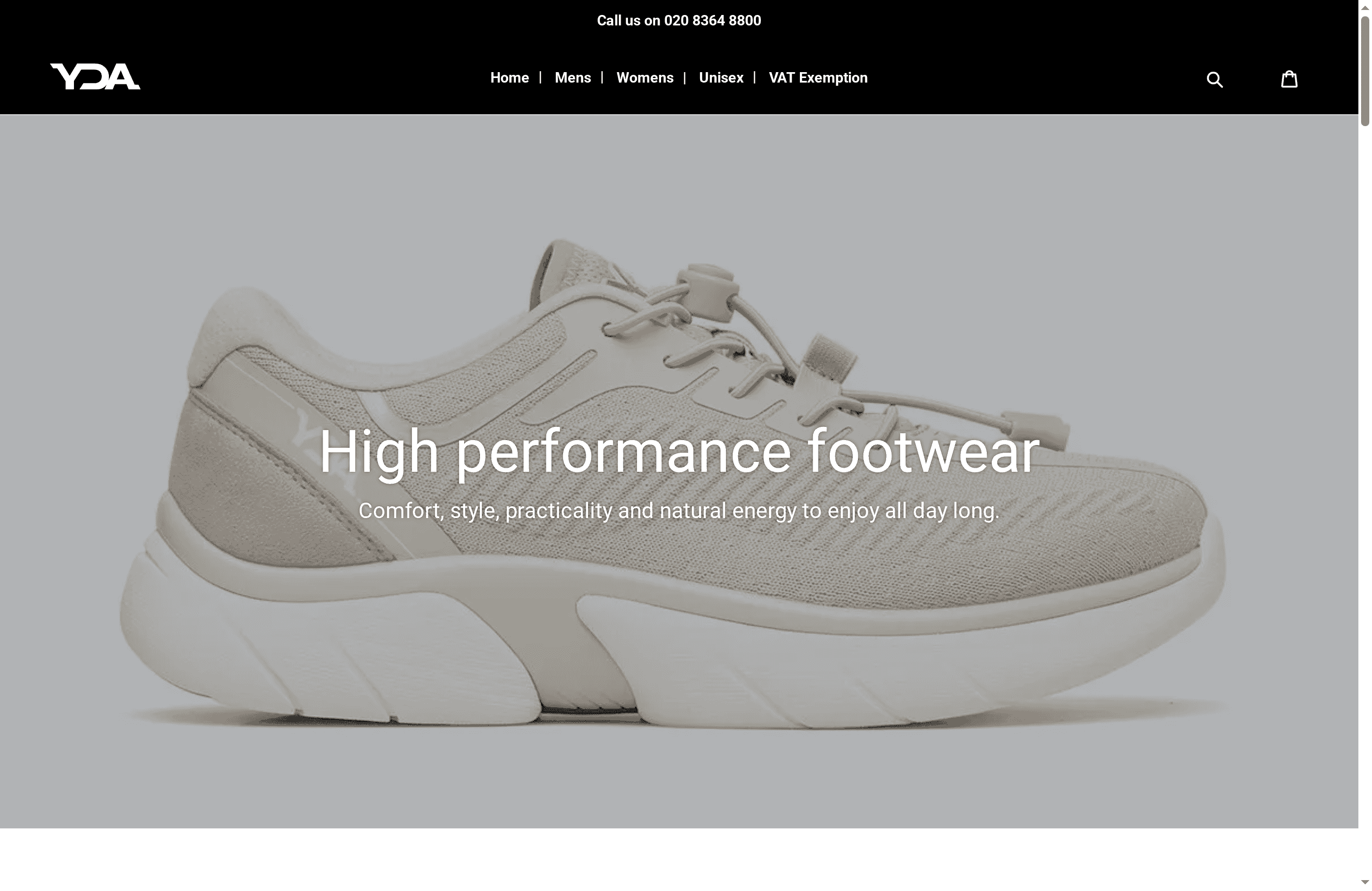
Ydauk builds footwear around the same structural principles this article covers: firm heel counters, removable footbeds with adequate depth, torsional stability and appropriate heel geometry. The YDA Technology page explains the specific design choices and how they relate to foot health, which makes it a useful reference before you buy. When trying a pair, measure both feet (they are rarely identical), bring your custom orthotics if you use them, and run the torsion test before committing. Ydauk’s customer support team can advise on fit and width options, and the buying guide for foot pain walks through the full selection process step by step. Start there, apply the break-in schedule from section six, and you will have a clear picture of whether the shoes are working within the first two weeks.
Useful sources and further reading
- Orthopaedic footwear for people with lower-limb conditions (NCBI Bookshelf) — systematic review and clinical guideline summary covering RA, diabetic foot and related conditions; the strongest evidence base for ready-made orthopaedic footwear recommendations.
- Do orthopaedic shoes improve local dynamic stability? (PMC) — observational gait study reporting 29% pain reduction and 7–10% stability improvements; useful for understanding gait outcomes.
- Baropodometric comparison of orthopaedic footwear (PMC) — pressure-mapping study comparing sole designs; source of the 83% forefoot pressure reduction figure and the paired-footwear findings.
- Harvard Health: why your feet change with age — accessible overview of age-related foot changes that make orthopaedic support increasingly relevant over time.
- NHS Podiatry services — starting point for UK readers seeking NHS-funded assessment, particularly for diabetes and rheumatoid arthritis.
- College of Podiatry (UK) — professional body for podiatrists in the UK; useful for finding registered practitioners and understanding clinical standards.
- Ydauk: YDA Technology — product-level detail on the structural and foot-health features built into Ydauk footwear; relevant for readers moving from research to purchase.
- Ydauk: types of orthopaedic shoes — overview of rocker, motion-control and offloading designs for readers deciding between styles.