
Workout footwear tips: Expert advice for optimal comfort
TL;DR:
- Choosing activity-specific shoes ensures proper support and reduces injury risk during training. Prioritize fit, comfort, and foot biomechanics over brand and aesthetics for optimal performance. Rotating multiple pairs extends shoe lifespan and enhances foot health over time.
Choosing the wrong training shoes is one of the most common and costly mistakes active people make. Most of us are guilty of picking footwear based on colourway, logo, or what our favourite athlete is wearing. Yet activity-specific shoe selection matters enormously: running shoes designed for linear motion can actively undermine your stability during lifts or lateral drills. This guide strips away the brand noise and gives you a practical, evidence-backed framework for finding shoes that protect your feet, match your training, and genuinely improve your performance.
Table of Contents
- Understand the key features of workout footwear
- Match your shoes to your activity
- Consider rotating your workout shoes
- Footwear technology and advanced options
- Fit and comfort: The ultimate success factors
- Why personalisation beats shoe hype: A hard lesson from experience
- Explore footwear solutions for every workout need
- Frequently asked questions
Key Takeaways
| Point | Details |
|---|---|
| Choose activity-specific shoes | Your training outcome and injury risk both depend on picking shoes based on the primary type of workout you do. |
| Prioritise fit and comfort | Comfort and a proper fit are more important than shoe brand or price for preventing injuries and optimising your performance. |
| Rotate multiple pairs | Rotating between different shoes for your workouts can reduce your risk of injury by up to 39 percent. |
| Technology is not everything | Advanced shoe technologies can improve performance in specific scenarios, but personal fit and comfort are always key. |
| Gradual transition for minimalist footwear | If you try minimalist or barefoot shoes, make changes gradually to avoid high injury risks. |
Understand the key features of workout footwear
Before you start comparing models or browsing price points, it helps to know exactly what you are looking for. Great workout footwear is not simply “comfortable” in a vague sense. It has specific, measurable characteristics that either support your movement or compromise it.
According to expert key shoe characteristics, the following elements define a well-designed training shoe:
- Sole flexibility: The shoe should bend slightly at the forefoot but stay firm overall. A sole that collapses too easily provides poor support during lateral cuts or loaded movements.
- Cushioning balance: Adequate cushioning absorbs impact without feeling like you are training on a marshmallow. Excessive softness actually reduces proprioception, which is your foot’s ability to sense the ground beneath you.
- Breathable upper: A mesh or engineered upper allows airflow, which reduces moisture build-up and lowers the risk of blisters and skin irritation during long sessions.
- Wide toe box: You should have roughly a thumb’s width (approximately 3/8 to 1/2 inch) of space between your longest toe and the end of the shoe. Cramped toes lead to black toenails, bunions, and altered gait over time.
- Snug heel counter: The stiff rear section of the shoe should cup your heel without any slipping. Even 2 to 3 mm of heel movement per stride accumulates into significant friction and instability over an hour-long session.
Understanding these features transforms you from a passive shopper into an informed buyer. You stop being influenced by aesthetics alone and start evaluating whether a shoe actually works for your foot.
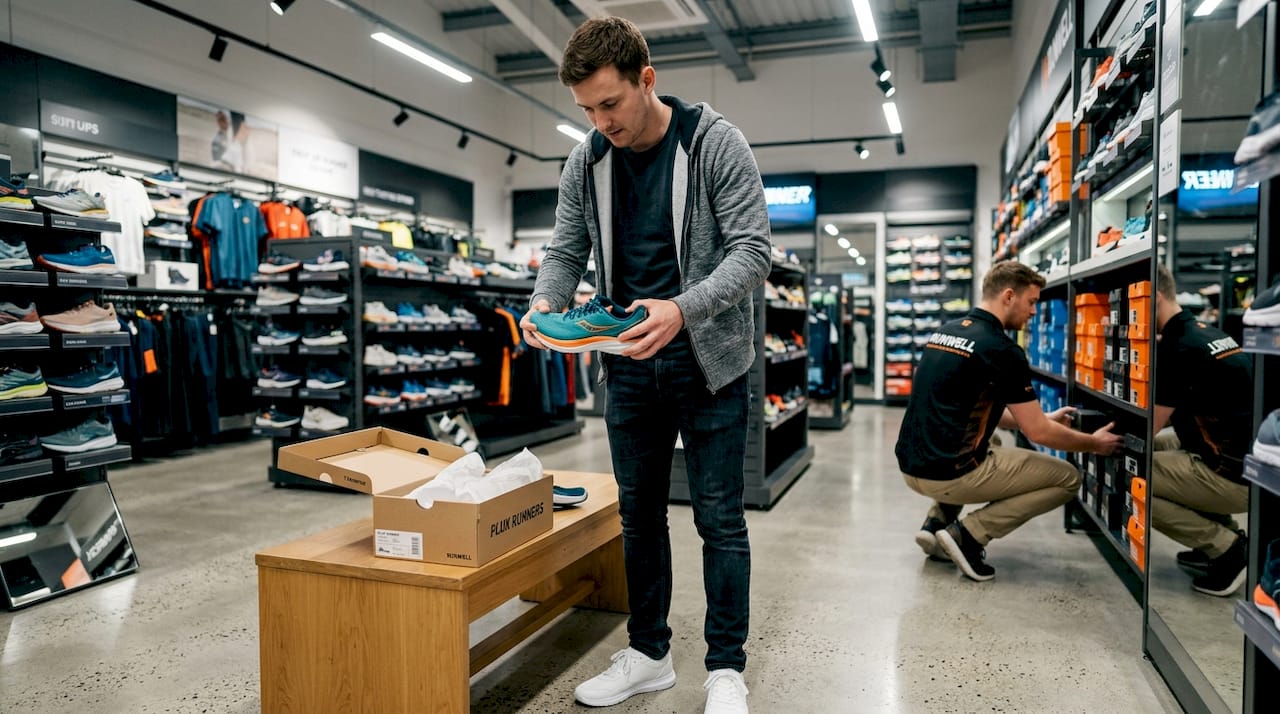
Pro Tip: When testing a shoe in store, hold it at each end and try to twist it like a wet cloth. If it collapses easily, the torsional rigidity is poor and it will struggle to support your foot during multidirectional movements.
For a broader overview of footwear suited to an active lifestyle shoe guide, it is worth reviewing guidance specific to your sport before narrowing down your options.
Match your shoes to your activity
One pair of shoes cannot serve every purpose equally well. This is not a marketing trick to sell you more footwear. It is basic biomechanics. The demands on your foot during a 10k run are entirely different from those during a deadlift or a HIIT session with lateral shuffles.
Here is a breakdown of how training type should shape your choice:
- Running: Prioritise cushioning, especially in the heel and forefoot. Running shoes are engineered for repetitive forward motion, with elevated heel-to-toe drops (typically 8 to 12 mm) that reduce Achilles tendon strain over long distances.
- Cross-training and HIIT: These sessions involve rapid direction changes, jumping, and lateral movements. You need a firmer midsole, a lower heel-to-toe drop, and wider base contact for stability.
- Weightlifting: Flat, hard-soled shoes are ideal. Any softness in the midsole bleeds away the force you are trying to drive into the ground, reducing lift efficiency and increasing joint instability.
As activity-specific shoes guidance confirms, wearing running shoes for lifting is a genuine injury risk because the elevated, cushioned heel shifts your centre of gravity and compromises your base of support.
| Training type | Cushioning | Heel-to-toe drop | Midsole firmness | Lateral support |
|---|---|---|---|---|
| Running | High | 8 to 12 mm | Medium | Low |
| Cross-training | Medium | 4 to 8 mm | Firm | High |
| Weightlifting | Minimal | 0 to 4 mm | Very firm | Medium |
| Walking | Medium | 8 to 10 mm | Medium | Medium |
This table is a starting point, not an absolute rule. Your individual foot shape, gait pattern, and injury history will all nudge you towards specific models within each category. Exploring the best shoes for each activity can help you refine that choice further.
Pro Tip: If you do only one type of training, invest in a single specialist pair. If your week mixes running and gym work, budget for two pairs rather than compromising on one. The cost difference is far smaller than the cost of a physiotherapist.
Consider rotating your workout shoes
Most dedicated athletes own multiple pairs of shoes, and this is not vanity. It is strategy. Rotating between 2 to 3 pairs of running shoes reduces injury risk by a striking 39%, and the same principle applies to general workout footwear.
Why does rotation work? When you train in the same pair every day, the foam and cushioning materials do not have sufficient time to decompress and recover. A shoe that feels supportive on Monday may have lost 20 to 30% of its cushioning capacity by Wednesday if worn for back-to-back intense sessions. Rotation gives each pair time to fully restore its structural integrity before the next use.
Here is what a smart rotation might look like:
- Pair 1: Running shoes for all outdoor cardio sessions.
- Pair 2: Cross-training shoes for gym, HIIT, and studio classes.
- Pair 3: A minimalist or flat shoe for mobility work, lifting days, or short recovery walks.
“Alternating between multiple pairs of running shoes significantly reduces overuse injury risk and allows each shoe’s midsole foam to recover fully between sessions. This is one of the most under-utilised injury prevention strategies available to everyday athletes.”
Minimalist or barefoot options can absolutely feature in your rotation, but they demand a gradual introduction. Barefoot training strengthens foot muscles but requires a careful, progressive transition. Jumping straight from cushioned trainers to zero-drop minimalist shoes is a reliable way to develop stress fractures or plantar fasciitis. A safe approach is to introduce minimalist shoes for 10 to 15 minutes per session initially, increasing exposure over 8 to 12 weeks.
The shoe rotation benefits for long-term foot health are well established, and it is one of the lowest-effort, highest-reward changes most active people can make.
| Rotation strategy | Estimated injury risk reduction |
|---|---|
| Single pair, daily use | Baseline (no reduction) |
| 2 pairs in rotation | Up to 25% reduction |
| 3 or more pairs in rotation | Up to 39% reduction |
Footwear technology and advanced options
The footwear industry has produced genuine innovations over the past decade, but it has also generated enormous amounts of hype. Understanding where technology genuinely helps and where it becomes a distraction is critical for making smart purchases.
Advanced footwear technology (AFT), often called “super shoes,” uses carbon fibre plates and highly resilient foam compounds to improve running economy by 2 to 4%. That margin is meaningful in a race. At elite level, 2% separates podium finishes from mid-pack results. However, these shoes also reduce ankle joint loads in ways that may increase stress fracture risk in the metatarsals during sustained daily training. They are race-day tools, not everyday trainers.
For the majority of your training volume, traditional stability trainers deliver more consistent support and durability. They are forgiving of imperfect form, resilient across varied terrains, and far easier on your budget.
The footwear technology guide at YDA breaks down these distinctions clearly for athletes at every level. And before you decide that a stability shoe is not for you, consider that no definitive evidence currently shows that neutral, stability, or minimalist shoes are categorically better at preventing injury. What the data consistently shows is that perceived comfort is the strongest single predictor of injury-free training.
Key takeaways on footwear technology:
- Super shoes: Reserve for races or time trials. Avoid using them for every run.
- Traditional trainers: Your safest, most versatile option for high training volumes.
- Minimalist shoes: Effective for building intrinsic foot strength but require gradual adaptation. See minimalist shoe insights for a structured introduction.
- Stability shoes with motion control: Useful if you overpronate significantly, but not universally superior to neutral shoes.
Pro Tip: If a shoe feels uncomfortable in the shop, it will not “break in” adequately during training. Discomfort from day one is your foot giving you honest feedback. Trust it.
Fit and comfort: The ultimate success factors
All the technology, category knowledge, and rotation strategies in the world are secondary to one simple question: does this shoe actually fit your foot? Prioritising fit and comfort over brand is the most reliable path to injury-free training, and it is the advice most frequently ignored.
Follow these steps to get a precise fit:
- Measure both feet at the end of the day. Feet swell with activity and heat. Measuring in the morning can leave you under-sizing your shoes by half a size.
- Check toe clearance. With your heel seated firmly at the back, you should have a thumb’s width of space at the toe. Too little causes compression injuries. Too much causes the foot to slide and creates friction blisters.
- Test heel grip. Walk briskly and check that the heel does not slip. Even minor slipping at the heel amplifies over thousands of strides and creates hotspots.
- Assess width. The widest part of your foot should sit within the widest part of the shoe without any bulging over the edges. If the upper balloons outward, the shoe is too narrow.
- Walk and jog before committing. Most specialist retailers actively encourage this. Never buy training shoes without moving in them.
“Fit is the most important factor in choosing workout footwear. A perfectly designed shoe in the wrong size or width is worse than a basic shoe that fits properly.”
Consider visiting a specialist retailer for a gait analysis. This is a free service at most running and sports shops, and it takes about 10 minutes. An experienced fitter can identify overpronation, supination, or unusually high arches that will determine which category of shoe suits you. Complement this with choosing for comfort and fit research so you arrive at the appointment informed.
Pairing your shoe selection with basic foot strengthening exercises, such as single-leg calf raises, toe spreads, and short-foot exercises, further reduces injury risk regardless of which shoe you choose. The considering comfort in minimalist shoes blog provides a useful exercise framework alongside footwear guidance.
Why personalisation beats shoe hype: A hard lesson from experience
Here is an uncomfortable truth about the footwear industry: the shoe that wins every lab test and dominates social media may be genuinely wrong for your foot. We have seen this pattern repeatedly. A runner spends significant money on a carbon-plated super shoe after reading about AFT performance superiority, only to develop metatarsal pain within three weeks because the stiff plate interacts badly with their specific foot strike.
The hype cycle around footwear technology is powerful. Brands invest heavily in creating the impression that their latest innovation is the solution to every runner’s problems. And some of that technology is genuinely impressive. AFT super shoes are measurably superior for racing performance. Traditional stability shoes offer measurably better support for high-mileage weeks. But “measurably superior on average” does not mean “right for you specifically.”
What footwear tech really means for the average athlete is this: the gains are real but marginal, and they disappear entirely if the shoe creates discomfort or alters your gait in a way your body cannot adapt to. Long-term satisfaction in footwear comes from honest self-assessment, not from chasing trends.
The athletes who stay consistently injury-free over years and decades share a common habit. They pay close attention to how their feet feel during and after sessions. They act on early warning signs rather than pushing through discomfort. They rotate shoes intelligently and replace worn pairs without waiting for obvious damage. These behaviours are unglamorous, but they are far more effective than any single shoe technology currently on the market.
The lesson we keep coming back to is simple: your feet will tell you what they need. Learn to listen to them before the discomfort becomes an injury.
Explore footwear solutions for every workout need
Finding the right shoe is a process, not a single purchase decision. The good news is that you do not have to navigate it alone.
At YDA, we specialise in high-performance, health-oriented footwear built around the principles covered in this guide: proper fit, activity-specific design, and real foot health technology. Whether you are looking for cross-training shoes with firm midsole support, options engineered for wider feet, or footwear backed by YDA Technology for energy efficiency and comfort across long sessions, our range is designed with your performance in mind. Explore the full catalogue at ydauk.com and take the first step towards footwear that genuinely works for your training.
Frequently asked questions
How often should I replace my workout shoes?
Workout shoes should be replaced every 300 to 500 miles or when you notice reduced cushioning, uneven wear, or discomfort that was not present in earlier sessions.
Is it safe to train in minimalist or barefoot shoes?
Minimalist shoes can strengthen foot muscles effectively, but they require a gradual adaptation period of at least 8 to 12 weeks to avoid overuse injuries like stress fractures or plantar fasciitis.
Does shoe price or brand matter for performance?
Fit and comfort are consistently stronger predictors of injury prevention and performance than price point or brand name. An expensive shoe that fits poorly will underperform a budget option that fits well.
Is rotating workout shoes worth the effort?
Yes. Shoe rotation across 2 to 3 pairs can reduce injury risk by up to 39% and prolongs the lifespan of each pair by allowing foam midsoles to decompress between sessions.
What is the best way to ensure a correct shoe fit?
Try shoes at the end of the day when feet are at their largest, confirm a thumb’s width of toe space, and verify there is no heel slippage before committing to a purchase.
Recommended
- How to prevent foot injuries with high-performance footwear – YDA UK
- Selecting Shoes for Energy: Achieve Comfort and Performance – YDA UK
- Footwear Selection Guide 2025: Choose Shoes for Health and Comfort – YDA UK
- How to test shoe comfort: practical steps for healthier feet – YDA UK
- Dětský sandál: jak vybrat zdravou obuv pro vaše dítě