
Men's shoe width chart: measure and match your fit
TL;DR:
- Most men fit a UK D width, which is the standard, but about 40 percent need narrower or wider shoes.
- Measuring the widest point across the ball of the foot in millimeters ensures selecting the correct width, as measurements vary between brands and foot health needs.
D width, also labelled M (medium), is the standard men’s width in the UK. If your shoe box carries no width marking, that is what you have. Measure the widest point across the ball of your foot in millimetres while standing, late in the afternoon, and match that figure to the chart below. Always use the larger foot’s measurement.
- B (Narrow): suits a slimmer forefoot; less common in mainstream UK retail
- D (Medium/Standard): the default for most UK men’s shoes
- E (Wide): one grade up from standard; roughly 4 mm wider across the ball
- EE / 2E (Extra Wide): noticeably broader fit; common in specialist and comfort ranges
- EEE / 3E (Very Wide): for significantly broader feet or certain medical needs
About 60% of people fit a standard D width, while roughly 40% need something narrower or wider. A three-minute measurement is more reliable than guessing from symptoms, so measure before you buy.
Table of Contents
- The UK men’s shoe width chart: letters, mm, and what they mean
- How to measure your foot width accurately at home
- Why mm measurements don’t map perfectly across brands
- Why width matters as much as length for foot health
- Practical fitting tips and common mistakes to avoid
- Key takeaways
The UK men’s shoe width chart: letters, mm, and what they mean
Width letters encode girth, not just a flat measurement. Each adjacent grade changes forefoot base width by approximately 4 mm and girth by approximately 6 mm. The table below converts your measured ball-of-foot width (in mm) to the most common UK width letters for typical men’s sizes. Measurements are taken standing, at the widest point across the ball.
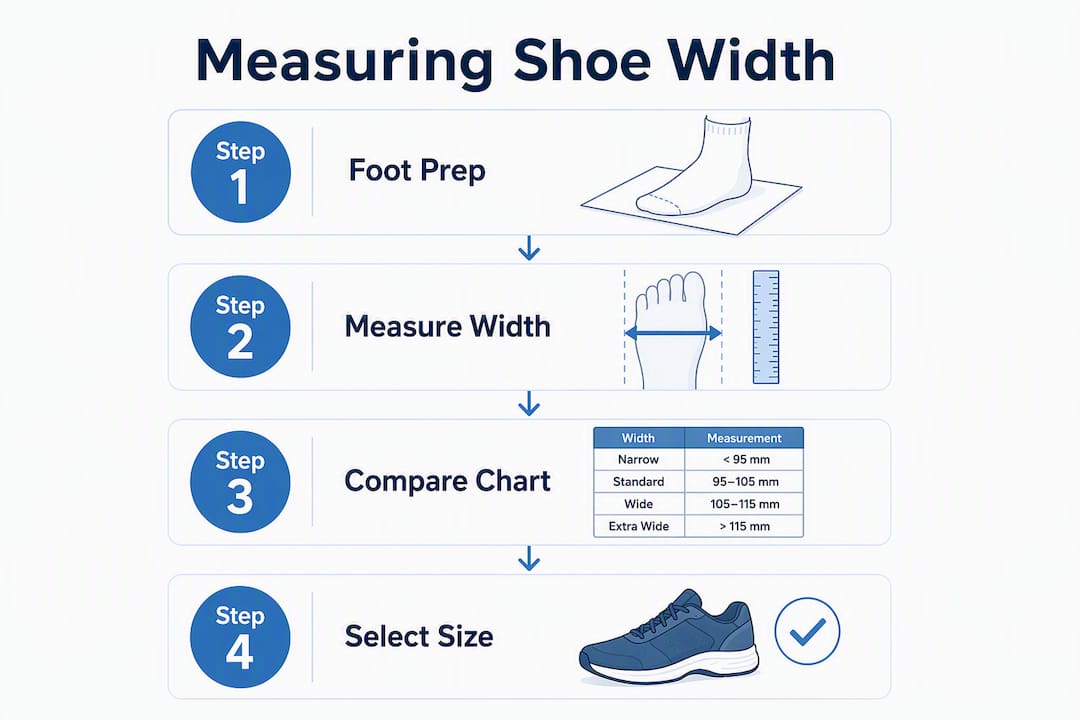
UK sizes are approximately one size below US equivalents. Measurements are ball-of-foot width.
Width letter quick reference:
| Letter code | Common label | What it means |
|---|---|---|
| B | Narrow | Slimmer forefoot; less common in UK high street |
| D (M, R) | Medium / Standard | Default width; no marking on box means D |
| E | Wide | One grade wider than standard |
| EE / 2E | Extra Wide | Two grades wider; widely available in specialist ranges |
| EEE / 3E | Very Wide | Three grades wider; specialist and therapeutic use |
A word on brand variation: some UK heritage makers use entirely different letters, with F or G denoting wide in certain ranges. Treat this chart as a baseline. Always cross-check the specific brand’s own width guide for the shoe length you are buying. Our complete shoe width sizing guide covers brand-specific conventions in more detail.
How to measure your foot width accurately at home
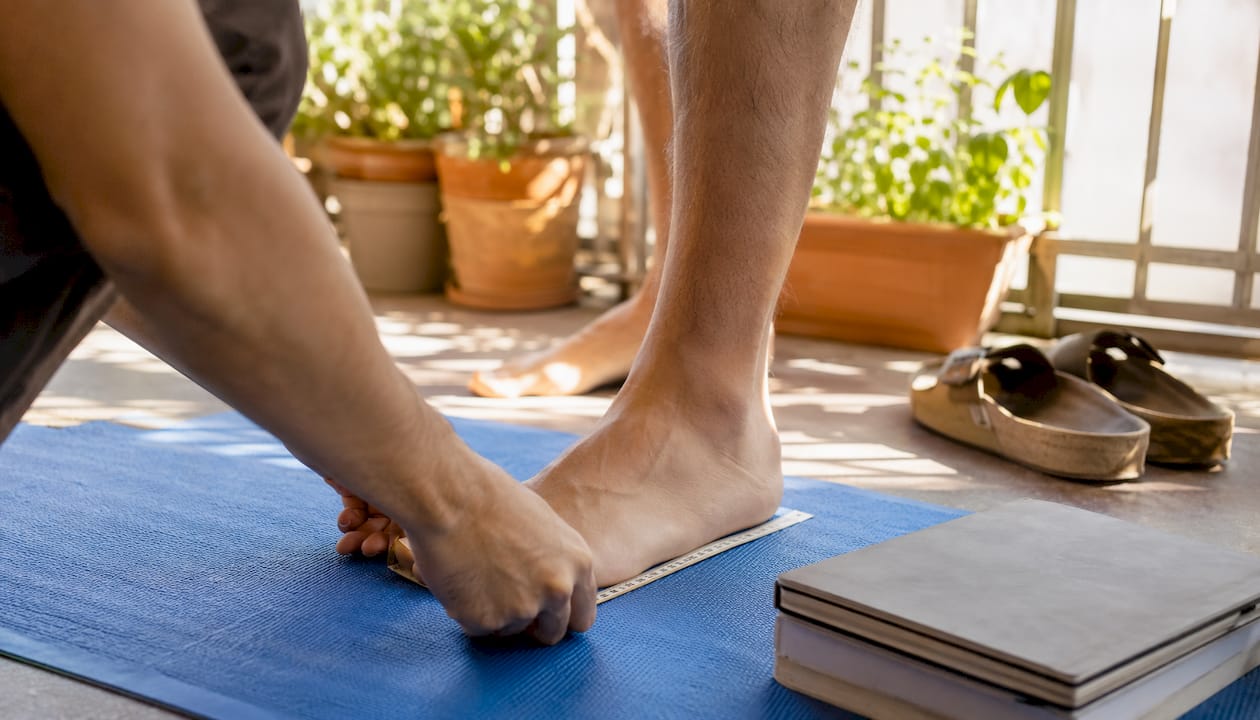
Measure standing, in the late afternoon, wearing the socks you plan to use with the shoes. Feet can increase in volume by 4–8% over the course of a day, so a morning measurement will often undersize you. Use the larger foot’s figure for your final width choice.
- Prepare a flat surface. Place a sheet of plain paper on a hard floor. Stand on it with your full weight evenly distributed.
- Trace your foot. Hold a pencil vertically against the side of your foot and draw around the entire outline. Keep the pencil upright throughout; angling it inward narrows the trace and gives a false reading.
- Mark the widest points. Identify the widest part across the ball of the foot (roughly behind the toes, not the arch). Draw two short parallel lines touching the outer edges at that point.
- Measure in millimetres. Use a ruler to measure the straight distance between those two lines. A standard 30 cm ruler is sufficient; digital calipers give marginally more precision but are not necessary for most buyers.
- Repeat for both feet. Trace and measure the second foot separately. Record both figures.
- Use the larger measurement. Match that number to the chart above.
Pro Tip: Wear the exact sock thickness you intend to use with the shoes. A thick walking sock adds 2–4 mm to your effective width and can push you into the next grade.
For a full home measurement walkthrough, including length conversion, see Ydauk’s step-by-step foot measurement guide.
Why mm measurements don’t map perfectly across brands
Your measured mm value gives you a starting letter, not a guaranteed fit. Width letters encode girth, which means they capture the three-dimensional circumference of the forefoot, not just the flat width you measured on paper. Two shoes labelled E can differ by several millimetres depending on the last the maker used.
Width grades change multiple measurements simultaneously: forefoot base width, heel base width, instep girth, and ball girth all shift between adjacent grades. A single flat mm reading captures only one of those dimensions, which is why the same letter can fit differently across makers.
Each adjacent grade alters forefoot base width by roughly 4 mm and girth by roughly 6 mm. That step is consistent within a maker’s range but not between makers. Brand examples confirm this: the same nominal width designation can differ measurably between different manufacturers for the same shoe size, which is why a width that fits perfectly in one brand may feel tight or sloppy in another.
When a brand publishes mm templates or a downloadable foot gauge, use those in preference to a generic chart. When only letters are available, check customer reviews for that specific model and note whether buyers with your foot type report the fit running true, narrow, or wide. Our men’s foot size chart includes UK, EU, and US conversion tables that help when shopping across markets.
Why width matters as much as length for foot health
Getting the width wrong causes problems that a longer shoe cannot fix. A shoe that is too narrow across the ball compresses the metatarsals, causes blisters at the widest point, and forces lateral movement inside the shoe that leads to bruised toenails and arch strain. Correct width keeps the foot stable through the gait cycle.
- Blisters and hot spots at the ball of the foot are usually a width problem, not a length problem
- Persistent heel slip often means the shoe is too long because the buyer went up a size to relieve forefoot tightness
- Bruised or blackened toenails in a shoe that feels long enough are a sign the forefoot is being pushed forward by lateral compression
- Long-term issues including bunion aggravation and metatarsalgia are linked to chronic width mismatch
Increasing shoe length to relieve tightness across the ball moves the widest part of the shoe away from the foot’s widest point and typically causes heel slip. The correct fix is a wider width designation.
Leather and break-in help marginally. Shoes can stretch a little with wear, but practitioners note that initial width mismatch causes chronic issues that stretching cannot resolve. Buy the right width from the start. For a deeper look at the health consequences of tight shoes, Ydauk’s guide on avoiding tight shoes covers the clinical picture clearly.
Practical fitting tips and common mistakes to avoid
Fast fit checks when trying shoes on:
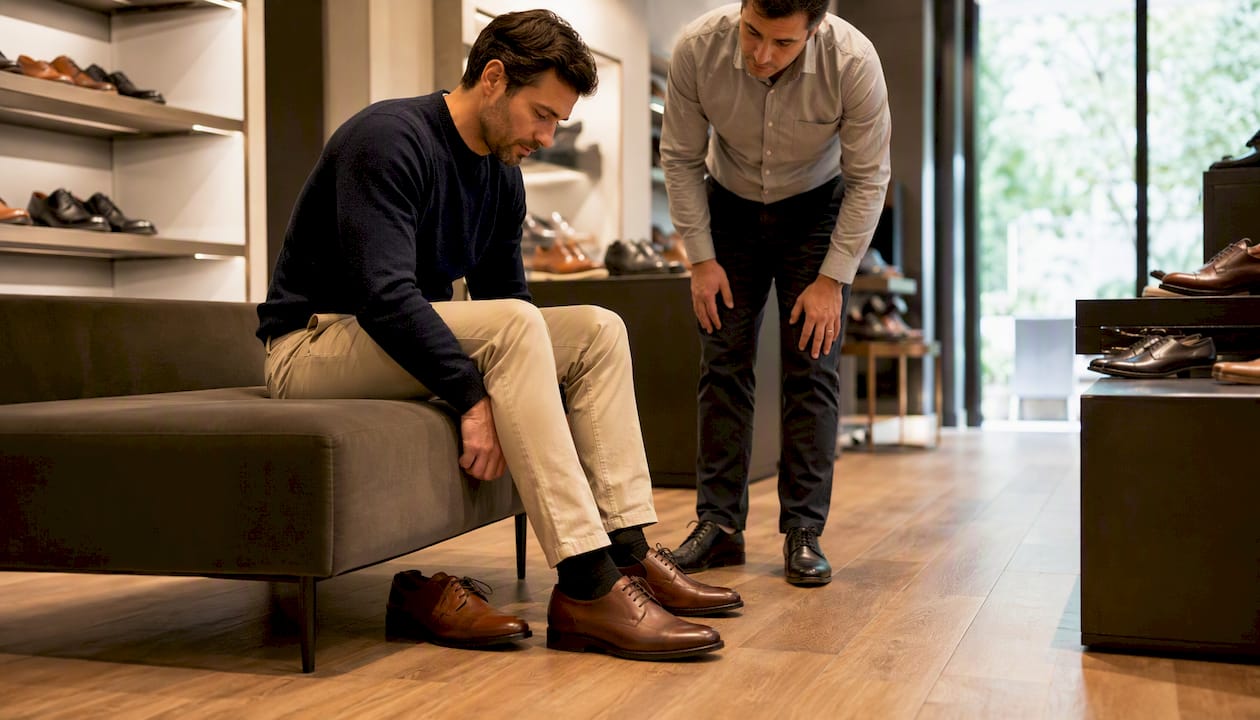
- The ball of your foot should sit at the widest part of the shoe with a secure, even hold across the top, no pinching at the sides
- You should be able to wiggle all toes freely without the shoe feeling loose at the heel
- No persistent pressure on either the inner or outer edge of the forefoot after two minutes of standing
- Heel should not slip more than a few millimetres when walking
Common mistakes:
- Measuring in the morning, when feet are at their smallest
- Buying a longer shoe to relieve width pressure, which causes heel slip and arch discomfort
- Ignoring sock thickness when measuring or trying on
- Assuming both feet are the same width (they often are not)
If one foot is wider, fit to the wider foot and use an insole or light padding on the narrower side. For persistent pressure despite correct width selection, open-lacing Derby shoes give more forefoot room than Oxford styles. Insoles and orthotics should only be added after confirming the base width is correct; adding volume to an already-tight shoe makes things worse. Our guide on wide shoe measurement covers the practical steps for buyers moving into E or EE territory.
About this guide and its measurement method
The charts and steps here are based on industry fitting practice and the empirical shoemaking metrics used by professional fitters: standing measurements, late-day timing, and the larger foot as the reference point.
This guide was written by Panagiotis, a footwear fitting specialist at Ydauk. The measurement steps and width grades reflect standard practitioner methods, including the girth-per-grade conventions used across the industry. Readers with persistent fit problems or medical conditions affecting foot shape should consult a podiatrist or a specialist fitting service.
Key takeaways
Measuring the ball of your foot in millimetres, standing in the late afternoon, gives you the single most reliable figure for choosing the correct width.
| Point | Details |
|---|---|
| D is the UK standard | No width marking on the box means D (medium); about 60% of men fit this grade. |
| Measure standing, late in the day | Feet increase in volume by 4–8% during the day; morning measurements undersize many buyers. |
| Use the larger foot | Always select your width based on the wider or broader foot’s measurement. |
| Letters encode girth, not just flat width | Each adjacent grade changes forefoot width and girth by small increments; brand charts override generic ones. |
| Ydauk for health-focused widths | Ydauk’s range includes health-oriented footwear for men who need specialist width options beyond standard D. |
Width is the measurement most men skip
Men tend to obsess over shoe length and treat width as an afterthought, if they think about it at all. The result is a wardrobe full of shoes that are technically the right size but cause discomfort within an hour of wearing them. What I see repeatedly is men who have been buying D width for twenty years when they are clearly an E, simply because no one ever measured them properly and the shoe felt fine in the shop after two minutes.
The measurement itself takes three minutes. The difference it makes to daily comfort is not marginal. If you have recurring hot spots, heel slip, or toenail bruising, the answer is almost certainly a width change rather than a different brand or a thicker insole. For men with diabetes, circulation issues, or structural foot conditions, getting width right is not a comfort preference; it is a clinical necessity. Ydauk’s specialist footwear for problem feet covers that territory in detail.
Ydauk footwear for men who need the right width
About 60% of men find the standard D width perfectly adequate once they have actually measured their feet. For those who land in E, EE, or beyond, the options on the high street narrow quickly. Ydauk’s health-focused range is built around the principle that width and foot health are inseparable, with construction designed to support the forefoot correctly rather than simply stretch to accommodate it.
If you need a wider fit or shoes built around foot health rather than fashion, explore Ydauk’s problem-feet footwear range or read about the engineering behind each pair on the YDA shoe technology page. Fitting support is available directly through the site.
Useful sources and further reading
- How to choose the right shoe width for a perfect fit — John White Shoes
- Men’s shoe width chart (sizes 6–16, B through 6E) — ShoeWidthChart.com
- Shoe width and girth explained — AR FITS
- Shoe width chart and how to measure foot width — Hockerty
- How to measure shoe size — RunRepeat
- Shoe width chart (men’s, women’s and kids’) — ShoeWidthChart.com
- Shoe width chart: your complete sizing guide — Ydauk
- How to measure foot size: your 2026 home guide — Ydauk
- Men’s foot size chart: UK, EU, and US conversions — Ydauk