
Stop Fit Returns: 3 Podiatrist Aligned Checks to Know Your Shoe Size at Home
Stand with your full weight on both feet in the evening, mark the heel and longest toe on a sheet of paper, then measure heel-to-toe and ball width in centimetres. Fit your size to the larger foot’s measurement, not the smaller one, then match those centimetres to a proper size chart. If the number falls between two sizes, round up rather than down.
TL;DR:
- Measuring in the evening with weight evenly distributed ensures more accurate shoe size, as feet swell throughout the day and under load.
- Focus on the width at the ball of the foot; widths over 10 centimeters for women or 11.3 centimeters for men suggest considering wide-fitting shoes.
- Centimetre measurements reliably convert to UK, EU, and US sizes, but variations between brands require checking specific size charts.
- Leave about one centimetre of space in the toe box and ensure the heel fits snugly to avoid pinching, slipping, or discomfort during walking.
- Re-measure regularly and see a specialist if foot shape, pain, or medical conditions like diabetes complicate sizing accuracy.
Table of Contents
- How to measure your foot length step by step
- How do you measure foot width for a better fit?
- Converting your measurement to a UK, EU, or US size
- What should a well-fitting shoe actually feel like?
- Common measurement mistakes and how to fix them
- Why this method follows podiatric best practice
- Sizing specialty footwear: orthotics, wide, and narrow styles
- When DIY measurement is enough, and when to see a specialist
- Foot health starts with getting the size right
- Where this guidance comes from
- Sources
- FAQ
How to measure your foot length step by step
You don’t need special kit for this. A hard floor, a sheet of paper bigger than your foot, a pen, and a ruler or tape measure will get you a measurement accurate enough to shop with confidence.
Do it in the evening. Feet swell over the course of a day and reach their largest size after hours of walking and standing, so a measurement taken first thing in the morning will read smaller than reality, according to podiatric guidance on timing. Wear the socks you’d normally wear with the shoes you’re buying, since a thick winter sock changes the fit calculation.
Here’s the process:
- Place the paper flat against a wall on a hard floor (carpet compresses and skews the reading).
- Stand on the paper with your heel touching the wall, distributing your weight evenly across both feet.
- Mark the point of your heel and the tip of your longest toe (often the second toe, not the big toe).
- Step off and measure the straight-line distance between the two marks in centimetres.
- Repeat the whole process for the other foot, since most people have one foot slightly longer than the other.
- Record both numbers and use the larger one when you check a size chart.
This mirrors the tracing method recommended in shoe-fitting guides, which involves standing on paper, marking heel and toe points, and measuring both feet before settling on a size, as detailed by WikiHow’s fitting guide. Standing matters more than people assume: feet lengthen by roughly 5 to 10 millimetres under load compared with sitting, which is enough to shift you a half size on paper alone.
Pro Tip: Trace and measure three times rather than once, then use your largest reading. A single trace can wobble by a couple of millimetres depending on how you shift your weight, and taking the largest of three readings cancels out that error.
How do you measure foot width for a better fit?
Length gets all the attention, but width causes more return requests than any other fit problem. Find the ball of your foot (the widest part, just behind your toes) and mark both edges while standing on your traced outline. Measure straight across in centimetres.
There isn’t one universal cutoff, but general rule-of-thumb guidance suggests it’s worth considering a wide fitting once ball width exceeds roughly 10 centimetres for women and 11.3 centimetres for men. Treat that as a prompt to try a wide option, not a hard diagnosis, since foot shape and brand lasts vary enormously.
- Width is usually labelled with letters: B or M is standard/narrow, D is standard for men, 2E and 4E indicate progressively wider fits.
- A shoe that’s the right length but the wrong width will pinch across the ball or leave the heel swimming, because narrow and wide versions of the same size aren’t just scaled copies of each other.
- If your traced outline looks noticeably wider than the shoe’s insole shape when you lay one over the other, that’s your width mismatch showing up visually before you even try the shoe on.
Converting your measurement to a UK, EU, or US size
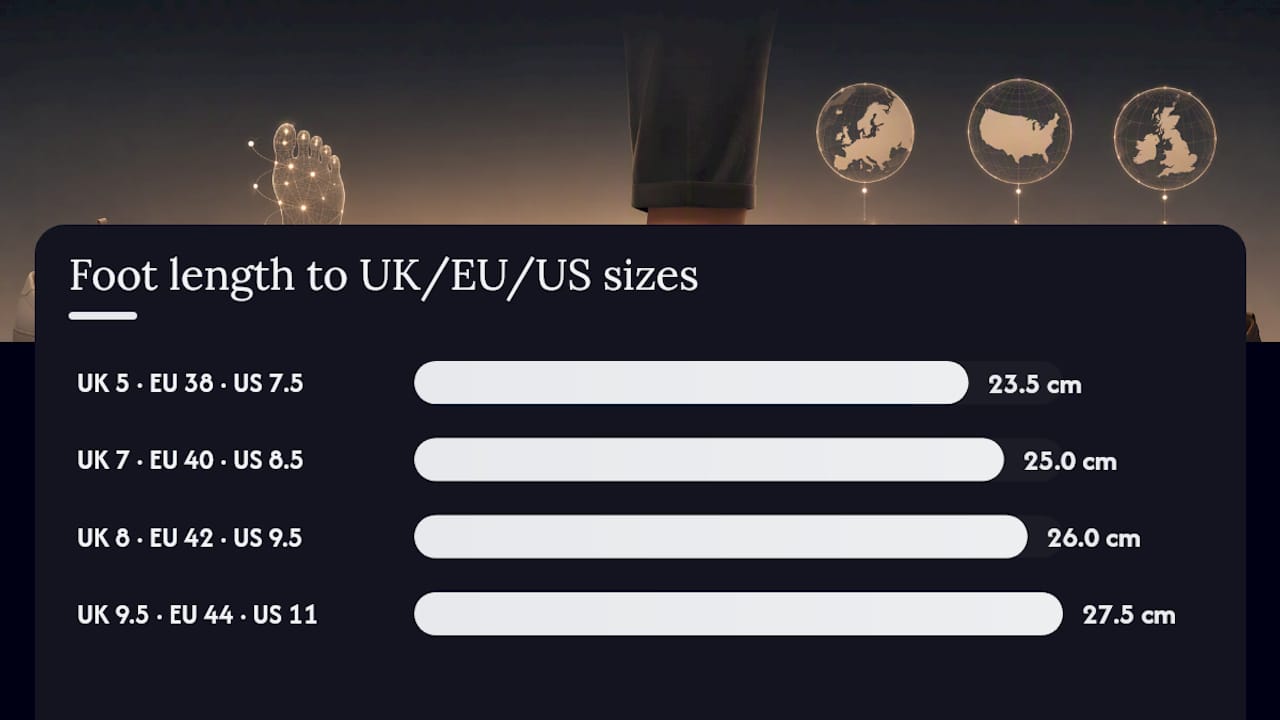
Centimetres are the one measurement that stays consistent no matter which brand or country made the shoe, which is exactly why it’s worth writing that number down and keeping it. A foot measuring 26 centimetres, for example, typically lands around a UK size 8, EU 42, and US men’s 9. But “typically” is doing real work in that sentence, because lasts differ between manufacturers.
| Foot length (cm) | UK size (approx.) | EU size (approx.) | US size (approx.) |
|---|---|---|---|
| 23.5 | 5 | 38 | 7.5 |
| 25.0 | 7 | 40 | 8.5 |
| 26.0 | 8 | 42 | 9.5 |
| 27.5 | 9.5 | 44 | 11 |
If your measurement sits between two rows, round up. A shoe slightly too big can be tightened with a thicker sock or an insole; a shoe slightly too small compresses toes and can cause blisters or nail damage over time, a point echoed in fitting advice that favours erring larger when in doubt, per Michigan Foot Doctors’ sizing guidance.
There’s also a second length measurement worth knowing: arch length, or heel-to-ball, rather than heel-to-toe. If you have unusually long toes, a flat arch, or a long second toe, fitting to heel-to-ball rather than heel-to-toe can give a truer size, since it’s arch position, not toe tip, that determines where a shoe should bend. Whichever method you use, always try the shoe with the actual socks or orthotic inserts you plan to wear, because brand variation between manufacturers is real and consistent even at the “same” listed size, according to USA Today’s consumer fit reporting.
What should a well-fitting shoe actually feel like?
The tape measure gets you close. The final check happens on your feet, walking around.
- Leave roughly a thumb’s width, about a centimetre, between your longest toe and the front of the shoe.
- Your heel should sit snugly with no slipping when you walk or climb a step.
- There should be no pinching or pressure across bunions or the ball of the foot.
- The widest part of the shoe should line up with the widest part of your foot, not sit ahead of or behind it.
- Walk a short distance in the shoe and watch for heel slip, toe creasing at an odd angle, or any pinch point that wasn’t obvious standing still.
If you wear orthotics, always fit shoes with the orthotic inserted rather than the stock insole, since that changes internal volume more than most buyers expect.
Pro Tip: If width feels tight but length feels right, try a half size up before jumping straight to a “wide” label. Sometimes an extra half size buys enough ball-width room without leaving excess space at the toe.
Common measurement mistakes and how to fix them
Most sizing complaints trace back to one of three errors, and all three are fixable in under a minute.
- Measuring seated or on carpet. Sit-down measurements and soft flooring both shrink the reading. Stand on a hard floor with full weight on the foot instead.
- Fitting to the smaller foot. Almost everyone has a length difference between feet, sometimes several millimetres. Always size to the larger foot.
- Ignoring width and arch length. A correct heel-to-toe number with the wrong width still produces a bad fit. Re-measure the ball width and, for long-arched or flat feet, check heel-to-ball length too.
Why this method follows podiatric best practice
This procedure draws on measurement guidance compiled by Panagiotis alongside YDA UK’s own fitting resources, built around the same principles podiatrists use in clinical practice. The professional benchmark is the Brannock device, the metal foot-measuring tool found on most shoe shop floors, which reads heel-to-toe length, arch length, and width simultaneously in one motion, as described in podiatrist-reviewed measurement guidance. The paper-and-ruler method at home approximates those same three readings closely enough for online shopping, typically within about half a size of the Brannock result. For deeper conversion detail, YDA UK’s guide to finding your exact shoe size in centimetres walks through matching a centimetre measurement to UK stock sizes.
— Panagiotis
Sizing specialty footwear: orthotics, wide, and narrow styles
Standard measurement steps still apply to specialty footwear, but the numbers need a second pass. Orthotic-friendly shoes are built with extra internal volume, so measure your foot with the orthotic held against the paper trace, not the bare foot alone, or you’ll size a shoe too small to actually hold the insert.
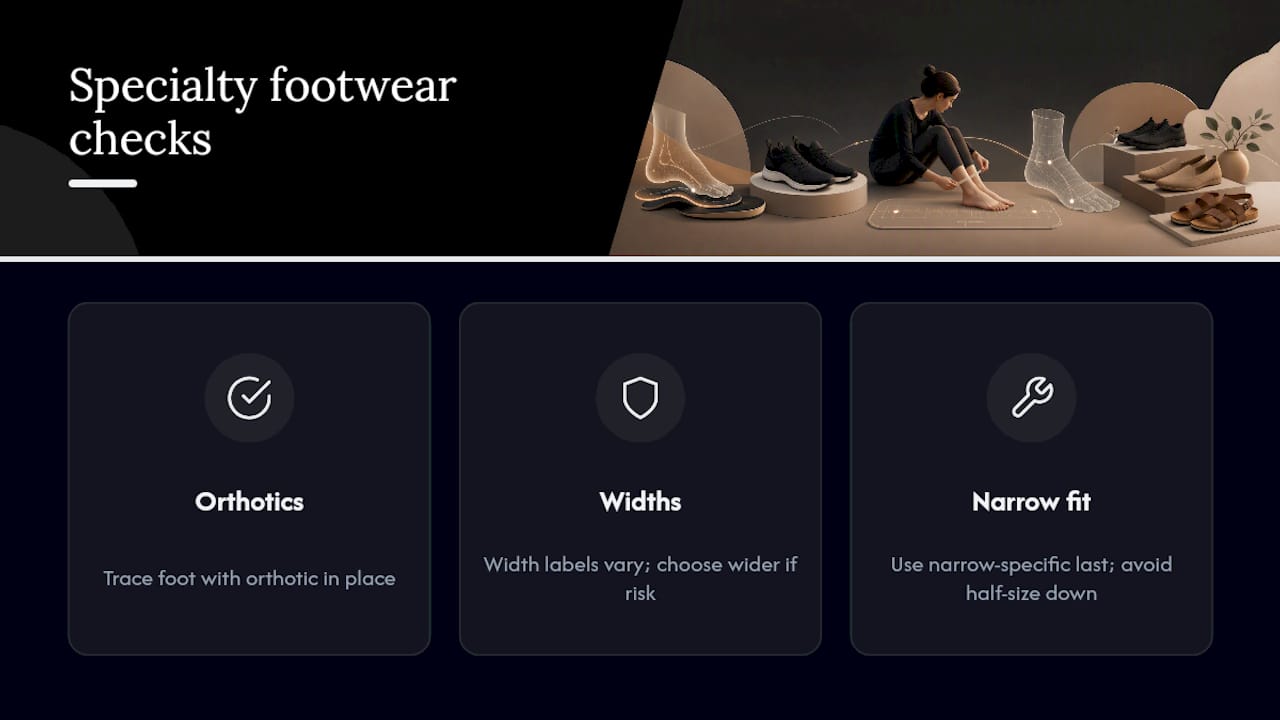
Wide and narrow styles complicate straightforward length-to-size conversion because manufacturers don’t scale width uniformly across their range. A 2E width in one brand’s size 9 isn’t guaranteed to match a 2E in a different brand’s size 9, so treat width labels as a starting point rather than a guarantee. If your ball-width measurement sits close to a threshold between standard and wide, and you have a foot condition such as diabetes or neuropathy where pressure points carry real medical risk, lean towards the wider option and the more forgiving upper material.
Narrow feet face the opposite problem: standard-width shoes that leave the heel loose even when the length is correct. A narrow-specific last, rather than just a smaller overall size, usually solves heel slip that a half-size-down “fix” doesn’t.
When DIY measurement is enough, and when to see a specialist
Home measurement gets most people within about half a size of accuracy, which covers the vast majority of everyday shopping. See a specialist fitter for persistent pain, unusual foot shapes, or when a diabetic or neuropathic condition means fit errors carry real medical risk. Re-measure every year, and far more often for children, since young feet can grow half a size in just a few months, per Naples Podiatrist’s practitioner guidance.
Foot health starts with getting the size right
Most shoe-buying goes wrong at the width, not the length. High-performance footwear is built around technology designed to stabilise and support every step, which only works if the shoe you’re wearing actually matches your foot’s true dimensions rather than a rounded-down guess.

Once you’ve got your centimetre measurement from the steps above, YDA UK’s shoe conversion chart will help you translate it into the right size across UK, EU, and US listings before you buy. If you’d rather not do the maths yourself, YDA UK’s customer service team can talk you through personalised sizing, including guidance for wide fittings, orthotic use, or foot conditions that need extra care. Browse the full footwear range once you’ve got your number, or read more about the foot-health technology behind each design.
Where this guidance comes from
This method draws on podiatric fitting advice from Naples Podiatrist and Michigan Foot Doctors, consumer fit reporting from USA Today, and YDA UK’s own measurement and sizing guides.
Sources
- How to measure your feet for the right shoe size — Naples Podiatrist
- How to Measure Foot Size 2026 | Podiatrist Guide — Michigan Foot Doctors
- How to Find Your Shoe Size: Shoe Size & Width Chart — WikiHow
- Ways to measure your shoe size at home — USA Today
FAQ
How can I know my shoe size at home?
Measure both feet standing on a hard floor in the evening, marking heel-to-longest-toe and ball width in centimetres, then fit to the larger foot’s reading. Match that number to a proper size chart rather than assuming your usual number still applies, since feet change over time.
What size is a UK 7 in other systems?
A UK size 7 typically converts to roughly US men’s size 8, though exact conversions shift slightly between brands. Always confirm against the specific brand’s own chart rather than a generic conversion alone.
Is a UK size 8 shoe a 41 or a 42 in EU sizing?
A UK 8 usually maps to an EU 42, based on standard conversion tables. Small brand-to-brand variation means it’s worth trying the specific shoe rather than relying purely on the converted number.
What foot length corresponds to a EU 42?
A EU size 42 generally corresponds to a foot length of around 26 centimetres. That’s roughly a UK 8 and a US men’s 9, though checking your actual centimetre measurement against a chart remains more reliable than converting size numbers alone.
How accurate is measuring your own feet compared with a shop fitting?
A careful at-home trace-and-measure method typically lands within about half a size of a professional Brannock device reading, which is accurate enough for most online purchases. For unusual foot shapes, persistent pain, or medical conditions like diabetes, a professional fitting is still worth the extra step.