
HOKA Size Chart: 5 Steps to Stop Guessing Your Fit
The fastest way to find your correct HOKA size is to measure your longer foot in centimetres and match it directly to the HOKA size chart. Use that centimetre figure as your single reference point rather than guessing from US or UK labels, check whether the model is listed as M (men’s) or W (women’s), and choose a wide fit instead of a longer one if the issue is volume rather than length.
TL;DR:
- A 25 centimeter foot maps to roughly a men’s US 8 or women’s US 9.5 on the same unisex shoe, so verify its M/W label.
- Some performance trainers and racing or trail models feel tight through the forefoot; check model notes and consider a half size up if length feels short.
- If pressure sits across your forefoot or bunions, try the wide version in your measured length before sizing up, because width does not add length.
- HOKA’s rocker geometry may feel unfamiliar for one to two weeks; try new shoes indoors and check the retailer’s return rules before outdoor wear.
Table of Contents
- HOKA size conversion chart: men’s and women’s
- How to measure your foot at home for an accurate HOKA size
- Men’s vs women’s sizing and reading unisex M/W labels
- Do HOKA shoes run true to size?
- Width options: when to size up and when to go wide
- Measurement-first guidance from YDA
- Reading HOKA size charts for kids and juniors
- Sizing differences across HOKA shoe categories
- Choosing the right size with specific foot conditions
- Returns and exchanges if the size is wrong
- A note on buying footwear online
- YDA: fit-conscious high-performance footwear
- FAQ
- Sources
HOKA size conversion chart: men’s and women’s
Centimetres are the one measurement that stays constant across every region and label, which is why we treat the CM column as the anchor and read US, UK and EU sizes off it, not the other way round. HOKA’s own size charts are built this way, and the HOKA size chart confirms that matching your foot length in centimetres to the chart row is the most reliable way to land on the correct US, UK or EU size.
Men’s and women’s HOKA sizing runs on separate number scales even when the shoe itself is identical, so the table below keeps the two apart while sharing the same centimetre anchor.
When the printed US size on a box seems to contradict the UK or EU figure on the insole, trust the centimetre measurement over either label. Printed sizes can shift slightly between production runs, but a foot that measures 26 centimetres stays 26 centimetres regardless of what the box says. If you want a broader cross-check against other size systems, a size conversion tool can help translate the same centimetre figure into other regional scales. For more detail on why centimetres work better than regional labels, our guide to shoe size in cm walks through the logic in full.
How to measure your foot at home for an accurate HOKA size
You need a sheet of paper, a pen, a ruler or tape measure, and the socks you intend to wear with the shoes. Measuring both feet matters, because most people have one foot that is slightly longer than the other.
- Stand on the paper with your heel against a wall and your weight evenly distributed.
- Mark the point on the paper level with your longest toe, which is not always the big toe.
- Measure the straight-line distance from the wall edge to that mark in millimetres.
- Repeat for the other foot and compare both measurements.
- Round each measurement to the nearest millimetre, convert to centimetres, and use the longer of the two figures against the chart.
If your foot curves noticeably or you struggle to get a clean mark, measure along the ground line rather than diagonally, since an angled measurement tends to overstate your true foot length. Our full walkthrough on how to measure your foot covers these steps with extra detail for awkward foot shapes.
Men’s vs women’s sizing and reading unisex M/W labels
HOKA often lists unisex models with both a men’s and a women’s size on the same listing, shown as something like M9/W10.
- Women’s US sizes typically read about one full size higher than the equivalent men’s size on the same shoe, according to RunRepeat’s HOKA size chart.
- A foot measuring 25 centimetres corresponds to roughly a men’s US 8 or a women’s US 9.5 on the same physical shoe.
- Always check the product page for the specific gender label used on that model, since not every HOKA shoe is offered in both men’s and women’s lines.
Reading the centimetre figure first removes the guesswork, because it tells you where you land on the chart before you even look at which gender label applies. Our guide to women’s shoe size conversion breaks this down further for anyone shopping specifically from the women’s line.
Do HOKA shoes run true to size?
Most HOKA models fit true to length when matched against your measured centimetre figure, but some models have a snugger midfoot or narrower toe box, so some wearers may size up slightly.
- Performance trainers and certain racing or trail variants are the categories most often flagged for a tighter forefoot fit.
- If you are moving from a less structured, roomier brand, a half-size increase is a common adjustment.
- Checking the specific product page for model notes is worth doing before you order, since fit can vary between models even within the same brand.
Podiatrists recommend some cushioned HOKA models for conditions like plantar fasciitis, but note a short adjustment period tied to the shoe’s rocker geometry. That rocking sensation can feel unfamiliar at first and leads some wearers to judge the fit before the shoe has had a fair chance to settle in.
Width options: when to size up and when to go wide
A wide HOKA fit adds extra volume across the forefoot. It does not make the shoe any longer.
- Choose wide if you have bunions, a broad forefoot, or pressure that persists even once the length feels correct.
- Test fit by checking for some space behind your longest toe once the shoe is laced.
- If the discomfort is pressure across the sides rather than your toes reaching the front, try a wide last before moving up a length, since widening addresses volume while length changes don’t solve a pressure problem.
Pro Tip: If your usual size feels tight only across the widest part of your foot, try the wide version in the same length before ordering a half-size up.
Measurement-first guidance from YDA
Our approach, shaped by Panagiotis’s measurement-first method, treats the centimetre figure as the single source of truth for every size decision, rather than relying on a brand’s printed label or a guess based on your usual size elsewhere.
Before you order, run through this checklist:
- Measure both feet in centimetres and use the longer measurement.
- Check the product page for any model-specific sizing notes.
- Try a wide fit first if the problem is pressure rather than length.
- Keep your intended socks on hand when you try the shoes, since sock thickness changes the fit.
Our guide to getting the right fit every time expands on this measurement-first approach for anyone shopping across multiple footwear brands, not just HOKA.
Reading HOKA size charts for kids and juniors
HOKA’s junior and kids’ sizing follows the same centimetre-first logic as adult sizing, but the number scale resets rather than continuing from adult sizes. A junior size chart typically covers smaller foot lengths on their own US, UK and EU scales, so a child’s foot measuring 20 centimetres will land on a youth-specific size rather than an adult equivalent further down the same table.
Because children’s feet grow quickly, it is worth measuring again every few months rather than assuming last season’s size still applies. The same heel-against-the-wall method used for adults works just as well for children, provided they stand still and keep their weight evenly spread across both feet during the measurement. If a child’s two feet differ noticeably in length, which is common, use the longer foot’s measurement and consider a slightly roomier fit to allow for growth between purchases, rather than sizing precisely to the smaller foot.
Junior sizing tends to run slightly more generous through the toe box than some adult performance models, since growing feet need more allowance for movement and future growth. If you are between two junior sizes on the chart, the general guidance that applies to adults, sizing up when the shoe will see frequent wear, applies here too.

Sizing differences across HOKA shoe categories
Running, trail and casual HOKA shoes are built on different lasts, so the same centimetre measurement does not always translate into identical comfort across categories, even when the numbered size matches exactly.
Road running models tend to favour a closer, more performance-oriented fit through the midfoot, which is part of why some performance trainers are flagged among the models most likely to need a half-size increase. Trail models often build in a slightly roomier toe box to accommodate swelling on long efforts and to allow a thicker sock, so the same size in a trail shoe can feel marginally different from a road shoe. Casual and lifestyle HOKA shoes, designed for everyday wear rather than performance, generally sit closer to a true-to-size fit with less emphasis on a snug performance hold.

If you own a HOKA shoe in one category and are buying in another for the first time, do not assume the identical size will feel the same. Checking the specific product page for category and model notes remains the most reliable step, since HOKA often publishes sizing notes that differ between models and even colourways.
Choosing the right size with specific foot conditions
Readers with high arches, bunions, diabetes-related foot sensitivity or other specific conditions often need to weigh fit decisions a little differently than a straightforward length match would suggest.
High arches can shift pressure points toward the ball of the foot and the outer edge, which sometimes makes a true-to-length fit feel tight in those areas even when the overall length is correct. In that case, checking for a wide option before sizing up in length is usually the better first move, since the discomfort is typically about volume rather than reach. For bunions or a broad forefoot, the same logic applies: a wide last that preserves the correct length is generally more comfortable than a longer shoe that still pinches across the width.
For anyone with diabetes or reduced sensation in the feet, a precise, well-measured fit matters more than it does for most shoppers, since poorly fitting footwear raises the risk of unnoticed rubbing or pressure sores. Measuring both feet carefully, choosing a wide fit where needed, and avoiding anything that feels tight anywhere along the foot are sensible starting points. We provide guidance to help you measure correctly before you order.
Returns and exchanges if the size is wrong
Measuring first reduces the chance of a size mismatch, but it does not eliminate it entirely, since fit also depends on sock thickness, the specific model’s last, and how your feet feel after the short break-in period some HOKA models need.
If a pair does not feel right once you have worn them briefly indoors on a clean surface, check the specific return window and condition requirements listed on the retailer’s product page before you wear them outside, since most retailers require shoes to be unworn or lightly tried on to qualify for a return or exchange. Keeping the original box and packaging until you are confident in the fit makes an exchange far simpler if you do need to size up, size down, or switch to a wide option. Giving a new pair the one to two week adjustment period that podiatrists associate with HOKA’s rocker geometry before deciding on a return can also save an unnecessary exchange, since some of the unfamiliar feel settles once you have walked in them for a while.
A note on buying footwear online
Most sizing mismatches come from skipping the measuring step, not from the chart being wrong. Measure both feet in centimetres, use YDA’s measurement guides, try shoes with the socks you will actually wear, and check the return policy before you order.
— Panagiotis
YDA: fit-conscious high-performance footwear
We build our high-performance footwear around foot health and comfort, with product pages that include the sizing detail you need before you order rather than leaving you to guess. Our YDA Technology pages explain the thinking behind the fit and energy efficiency built into each pair, and our measurement guides sit alongside them so you can check your centimetre measurement before choosing a size.
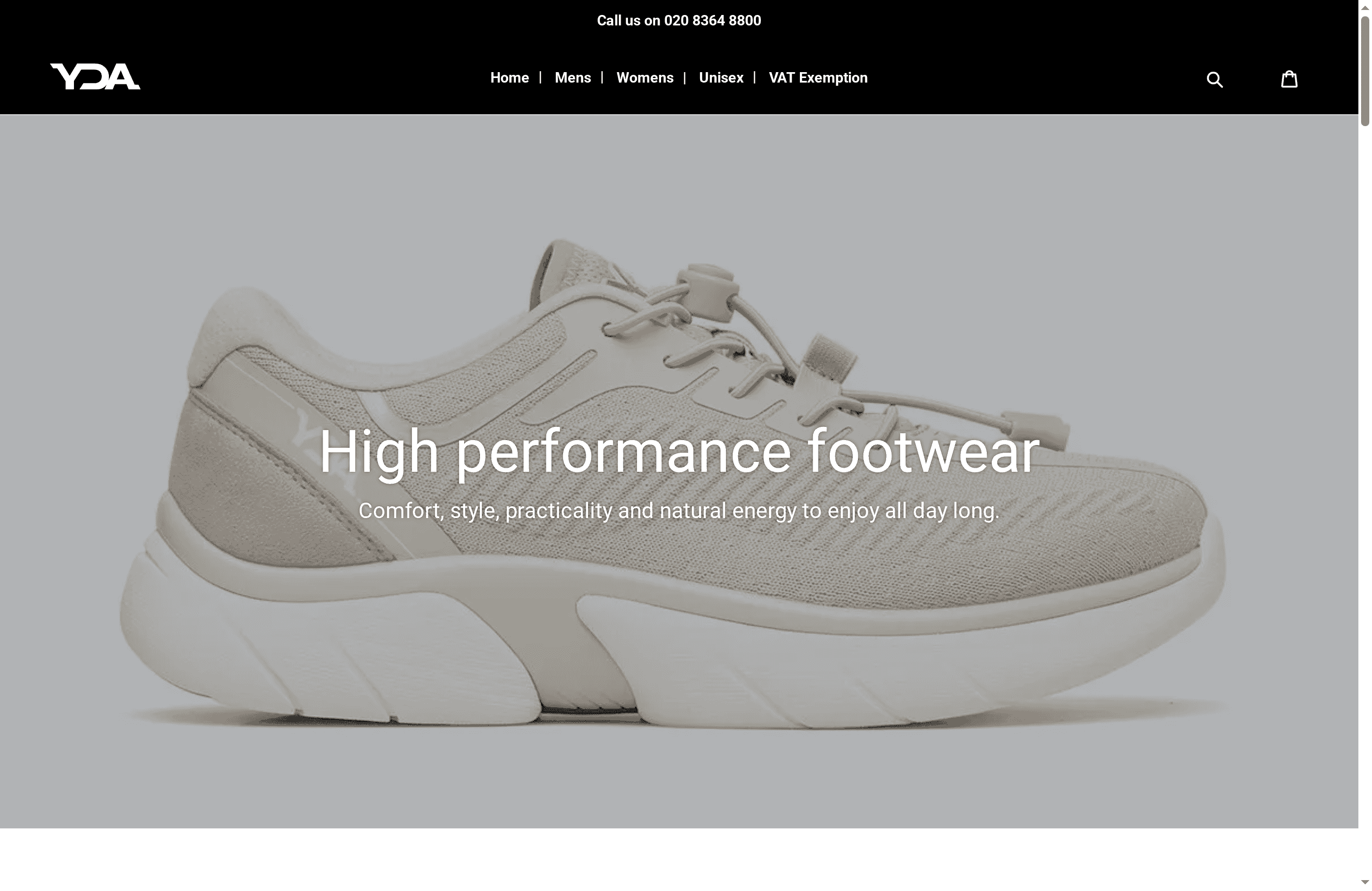
If you are ready to find a pair that matches your measured fit, browse our current footwear range and check the sizing notes on the product page before you order.
FAQ
Do HOKA shoes fit true to size?
Most HOKA models fit true to length when matched to your measured centimetre figure, though some performance trainers and trail variants have a snugger fit that leads some wearers to size up by half a size. Checking the specific product page for model notes before you order is the most reliable way to confirm fit for that particular shoe.
How do I know what size HOKA to get?
Measure your longer foot in centimetres using the heel-against-the-wall method, then match that figure to the HOKA size chart rather than relying on your usual size in another brand. If the shoe is listed as unisex, check whether the product page shows a men’s or women’s number, since the two scales differ by about one size.
What is the UK HOKA size chart?
A UK HOKA size is read off the same centimetre-anchored chart as US and EU sizes: for example, a 25 centimetre foot corresponds to roughly a UK 7.5. Always cross-check against the centimetre column first, since UK sizing is derived from the same foot-length measurement rather than a separate scale.
What do podiatrists think of HOKA?
Podiatrists commonly recommend certain cushioned HOKA models for conditions such as plantar fasciitis because of the cushioning and rocker geometry, but they note an adjustment period of one to two weeks as wearers get used to the rocking sensation. It is worth judging the fit after this break-in period rather than immediately on first wear.
Sources
- HOKA Shoe Sizes | US, UK & CM
- HOKA men’s and women’s size chart | RunRepeat
- Are Hoka shoes good for your feet | Podiatrist review