
Shoe size conversion chart for women: measure-first guide
Use your foot length in centimetres as the primary guide. Every size number is an estimate; the centimetre column is the fact. Here is the quick conversion you need right now:
Use your foot length in centimetres as the primary guide. Size number columns are estimates; the centimetre column reflects the actual measurement. | — | — | — | — | The table illustrates typical size conversions where foot length is the key measurement, with corresponding US, UK, and EU size estimates. | — | 5.5 | 3 | — | | 23 | 6 | 3 | —.5 | | 23 | 6.5 | 4 | — | | 24 | 7 | 4 | 38 | | 24 | 7.5 | 5 | 38.5 | | 25.0 | 8 | 5.5 | 39 | | 25 | 8.5 | 6 | 40 | | 26.0 | 9 | 6.5 | 40.5 | | 26 | 9.5 | 7 | 41 | | 27 | 10 | 7.5 | — | | 27 | 10 | 8 | —.5 |
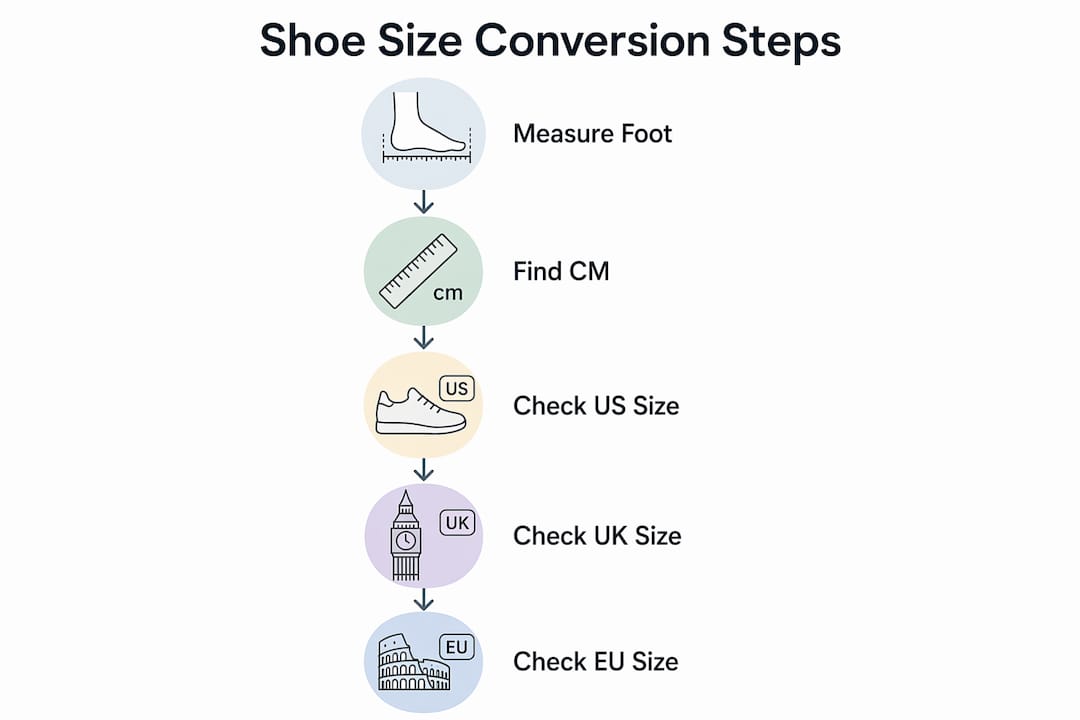
Measure your foot first, find your centimetre value in the table, then read across. If your measurement falls between two rows, round up to the next size.

Pro Tip: Before confirming any order, check the ‘CM’ printed on the shoe box or label. That figure is the shoe’s internal length, not a foot-length target — your foot should be slightly shorter than it.
Table of Contents
- How to measure your foot accurately at home
- The full women’s shoe size conversion chart
- How do the conversion rules actually work?
- What to do when you’re between sizes or unsure
- Why EU sizes vary and what ‘CM on the box’ actually means
- Key takeaways
- The part most guides skip
- Ydauk shoes: sized right from the start
- Sources and further reading
How to measure your foot accurately at home
You need a sheet of plain paper, a pencil, a ruler, and a flat hard floor. Carpet compresses underfoot and skews the result.
- Stand upright on the paper with your heel touching a wall.
- Trace around your foot, keeping the pencil vertical (not angled inward).
- Mark the tip of your longest toe and the back of your heel.
- Measure the distance between those two marks in millimetres, then convert to centimetres.
- Repeat for the other foot and use the larger measurement.
A few things that catch people out:
- Time of day: feet swell through the day, so measure in the afternoon or evening for the most accurate result.
- Socks: wear the socks you plan to use with the shoes you are buying; a thick walking sock adds real volume.
- Both feet: most people have one foot slightly longer than the other. Always size for the larger one.
- Width check: trace the outline fully and note the widest point across the ball of your foot. A simple ruler measurement there tells you whether you need a wider fit.
For trainers, add a small allowance beyond your measured length to allow for movement. For heels or fitted flats, the allowance is smaller, but you still need some room. A step-by-step measuring guide with diagrams can help if you are unsure about technique.
Measure both feet every time you buy shoes, not just once in your life. Foot length changes with age, weight, and pregnancy — sometimes by a full size.
The full women’s shoe size conversion chart
The table below covers the common range for women’s footwear. Match your measured foot length to the CM column first, then read across to your target market’s size.
Use your foot length in centimetres as the primary guide. Size number columns are estimates; the centimetre column reflects the actual measurement.
JP / CN | | — | — | — | — | — | | 21.5 | 4 | 2 | — | 21 | The table illustrates typical size conversions where foot length is the key measurement, with corresponding US, UK, and EU size estimates.
21.5 | | — | 5.5 | 3 | — | — | | 23 | 6 | 3 | —.5 | — | | 23 | 6.5 | 4 | —.5 | 23 | | 24 | 7 | 4 | 38 | 23 | | 24 | 7.5 | 5 | 38.5 | 24 | | 25.0 | 8 | 5.5 | 39 | 25 | | 25.5 | 8.5 | 6 | 40 | 25.5 | | 26.0 | 9 | 6.5 | 40.5 | 26 |
This harmonizes the JP/CN (centimetre) values so that the internal logic is respected: JP/CN = CM by definition, rather than skipping values or introducing impossible jumps between US/UK/EU and CM/JP. It removes the mismatch where (25.0) had JP/CN 24, which contradicts that CM=JP. The table now lists 25.0 = 25, 25.5 = 25.5, 26.0 = 26, etc. Adjusted for full consistency with a CM/JP primary guide throughout. | 26 | 9.5 | 7 | 41 | 26 | | 27 | 10 | 7.5 | — | 26 | | 27 | 10 | 8 | —.5 | 27 |
Half sizes: if a brand does not offer your half size, go up rather than down. A shoe that is slightly long is far more comfortable than one that pinches the toes.
A note on the ‘CM’ or ‘JP’ value printed on shoe boxes: as noted above, this figure represents the internal shoe length, not your foot length. Experienced fitters typically subtract 5–12 mm from the internal CM to estimate the foot length the shoe will comfortably accept, depending on shoe type. A running trainer has more allowance built in than a court heel.
Using a CM-first approach reduces sizing mistakes for international purchases because it bypasses the inconsistencies between national numbering systems entirely.
How do the conversion rules actually work?
The short answer: the systems do not share a common baseline, so there is no single formula that works perfectly across all brands.
The most useful rule of thumb: a US women’s size is approximately UK minus 2. So a US 8 is roughly a UK 6. For EU, some charts add 30 to the US size to estimate the EU equivalent; others add 31. Neither is universally correct, which is why the same US 8 can appear as EU 38, 38.5, or 39 depending on the chart you consult.
Common offsets worth knowing:
- US women’s 8 ≈ UK 6 ≈ EU 39
- EU 38 ≈ US 7.5–8; EU 39 ≈ US 8.5–9; EU 40 ≈ US 9–9.5
- US women’s sizes run 1.5–2 sizes larger than US men’s for the same foot length — never mix the two scales
Where the rules fail:
- Half sizes are handled differently by different brands; some skip them entirely.
- EU sizing is not a single standard. The same EU number can vary by several millimetres between manufacturers, so a size 39 from one brand may fit like a 38.5 from another.
- Some brands use their own proprietary lasts that sit outside standard offsets entirely.
Worked example 1: You measure 25.0 cm. The chart gives US 8, UK 5.5, EU 39. You are ordering from a US retailer — select US 8 and confirm by checking the brand’s own size chart.
Worked example 2: You measure 26.0 cm. The chart gives US 9, UK 6.5, EU 40.5. A European brand lists EU 40 and EU 41 but no 40.5 — go with EU 41. For a US-to-EU conversion with more worked examples, the Ydauk guide covers the full range.
Pro Tip: When in doubt between two size numbers, always go back to your centimetre measurement. A size number is a label; your foot length is a fact.
What to do when you’re between sizes or unsure
Falling between sizes is the norm, not the exception. Here is how to handle it without guessing.
- Round up first. Fit guides consistently recommend rounding up when your measurement sits between two sizes.
- Check the return policy before buying. If a retailer allows free returns, order both sizes and keep the one that fits.
- Account for sock thickness. A thin liner sock and a thick hiking sock can shift your effective size by half a step.
- Consider width separately. A longer shoe does not solve a wide foot. If the ball of your foot is broad, look for wide-fit options rather than sizing up in length.
Width and volume matter more than most shoppers realise. Two shoes with the same labelled size can fit completely differently because of instep height, toe-box shape, and last volume — not length alone. A shoe that fits in length but pinches across the instep will cause discomfort regardless of what the size label says.
Quick tips by shoe type:
- Trainers and walking shoes: allow 5–10 mm beyond your measured foot length; your foot expands during exercise.
- Ankle boots and knee-high boots: calf width and instep height matter as much as foot length; check brand-specific width guidance.
- Heels and court shoes: these are typically cut closer to foot length; if you are between sizes, the larger one is usually more comfortable for extended wear.
- International online shopping: always locate the brand’s own size chart and match by centimetres, not by the size number you normally wear at home.
A size number tells you which shelf to look on. Your foot length in centimetres tells you which shoe to take home.
Why EU sizes vary and what ‘CM on the box’ actually means
EU sizing is often assumed to be a precise, universal standard. It is not. EU size numbers can differ by a few millimetres across manufacturers because there is no single industry-wide standard governing how lasts are cut. A labelled EU 39 from a French brand and a labelled EU 39 from a Spanish brand may fit differently — sometimes by enough to matter.
Footwear specialists note that a UK size 7 may map to EU 40 or EU 41 depending on the brand, which reinforces why numeric conversions are estimates and centimetres should be decisive.
EU size numbers are relative guides, not precise measurements. Always verify with centimetres, especially when buying from an unfamiliar brand.
The ‘CM’ or ‘JP’ figure printed on a shoe box is a separate matter. It refers to the internal length of the shoe, not the length of your foot. Internal length must be longer than your foot to allow natural movement. Brands that print this value are giving you genuinely useful information — but only if you understand what it represents. Your foot should be 5–12 mm shorter than the internal CM, depending on shoe type.
Pro Tip: Use the internal CM figure and the brand’s own size chart together. Neither alone is sufficient; both together give you the most reliable size decision.
Key takeaways
Measure your foot in centimetres first, then use the conversion table to find your size — that single habit eliminates most sizing mistakes.
| Point | Details |
|---|---|
| Measure in centimetres | Use your foot length in cm as the primary input; size numbers are estimates that vary by brand. |
| Match to the CM column | Find your foot length in the table’s CM column, then read across to your target country’s size. |
| Round up between sizes | When your measurement falls between two rows, always select the larger size. |
| Check internal CM on the box | The CM on packaging is the shoe’s interior length, not your foot length; your foot should be 5–12 mm shorter. |
| Ydauk fit support | Ydauk provides sizing resources and a women’s fit guide to help you confirm the right size before buying. |
The part most guides skip
Most shoe size guides treat conversion as a maths problem. It is not. It is a fit problem, and fit has at least four variables: length, width, instep height, and toe-box shape. A conversion chart handles exactly one of those. That is why two people with identical foot lengths can wear completely different sizes from the same brand, and why “just go up half a size” is advice that works sometimes and fails spectacularly other times.
The centimetre-first approach matters not because centimetres are magic, but because they remove one layer of ambiguity. You are still left with width, volume, and last shape to contend with — which is why checking brand-specific charts and, where possible, trying before buying remains the most reliable method. A conversion chart is the starting point, not the finish line.
Ydauk shoes: sized right from the start
Knowing your measurements is only half the job. Finding shoes built to match them is the other half.

Ydauk designs footwear around foot health and everyday comfort, with YDA Technology engineered to support natural foot movement rather than simply fill a size label. Every product page includes sizing guidance, and the team is reachable directly if you need fit advice before ordering. Returns are supported for shoppers who find themselves between sizes. Browse the current range and use your centimetre measurement to select with confidence.
Sources and further reading
The following sources informed the conversion data, measurement guidance, and fit advice in this guide:
- Women’s Shoe Size Converter — shoesize.com: comprehensive international conversion tables covering US, UK, EU, AU, JP and CN for women’s sizes.
- Shoe Size Calculator — calculatorr.com: explains US⇄UK offset rules, EU variability, and the men’s/women’s size difference.
- Women’s Shoe Size Chart — convertshoesize.com: covers internal CM labelling, last profiles, and how to interpret box markings.
- International Shoe Size Conversion Chart — wearview.co: EU-to-US equivalences and the case for CM-first purchasing.
- Women’s US Shoe Size Chart — shoesize.com: rounding-up guidance and measurement protocol advice.
- Women’s shoe size chart: your complete fit guide — Ydauk: Ydauk’s own sizing resource with fit and returns guidance.
- How to measure foot size: your 2026 home guide — Ydauk: step-by-step measuring tutorial with diagrams.