
Key benefits of breathable sneakers for comfort and foot health
TL;DR:
- Breathable sneakers keep feet dry, reducing infections, blisters, and odour.
- They improve comfort and performance by regulating foot temperature and moisture levels.
- Not suitable for cold or wet conditions, they are best for active, warm, or dry environments.
Most people assume that choosing a stylish trainer means sacrificing comfort or foot health. That assumption is wrong. Breathable sneakers keep feet up to 30% drier than leather alternatives, and that single difference ripples through everything from your energy levels to your skin health. Whether you are running errands, hitting the gym, or commuting across the city, what your feet experience inside your shoes matters far more than most people realise. This article covers the evidence-backed health benefits, the real-world comfort gains, the materials that make it possible, and the situations where breathable trainers may not be the right call.
Table of Contents
- Why breathability matters for foot health
- Comfort and performance: Everyday and exercise advantages
- How breathable sneakers work: Materials and design choices
- Limitations and best use cases for breathable sneakers
- What most people miss about choosing breathable footwear
- Discover more with YDA’s health-driven sneaker range
- Frequently asked questions
Key Takeaways
| Point | Details |
|---|---|
| Reduces foot moisture | Breathable sneakers keep your feet drier by allowing sweat and heat to escape efficiently. |
| Improves comfort daily | Greater airflow in footwear reduces fatigue and keeps your feet feeling fresher all day. |
| Prevents foot problems | Ventilated trainers lower your risk of blisters, fungal infections, and unpleasant odour. |
| Modern materials matter | Mesh, knit, and perforated designs combine fashion with practical benefits for active lifestyles. |
| Best for warm conditions | Breathable sneakers excel in warm or humid weather but may provide less protection in cold or wet environments. |
Why breathability matters for foot health
Your feet contain around 250,000 sweat glands, more per square centimetre than almost anywhere else on your body. During a typical day, each foot can produce up to half a pint of moisture. Trap that inside a non-breathable shoe and you create a warm, damp environment that is practically ideal for bacteria and fungi.
The consequences are not trivial. Poor ventilation inside a trainer raises internal shoe temperature well above the optimal foot temperature range of 20 to 33°C, sometimes pushing it toward 37°C or higher. At those temperatures, microbial growth accelerates, and common problems follow quickly.
Here is what consistently poor breathability leads to:
- Blisters caused by friction between damp skin and the shoe lining
- Fungal infections such as athlete’s foot (tinea pedis), which thrive in warm, moist conditions
- Persistent foot odour driven by bacterial breakdown of sweat
- Skin maceration, where prolonged moisture softens and weakens the skin
- Increased risk of nail infections, particularly in those who are active daily
The good news is that the material choice alone makes a measurable difference. Knit uppers reduce sweat by up to 30% compared to leather, and breathable materials lower in-shoe humidity and heat enough to meaningfully reduce microbial growth. That is not a marginal gain. Over weeks and months, it translates into healthier skin, fewer infections, and noticeably fresher feet.
The breathable footwear benefits extend beyond comfort into genuine clinical territory. People with diabetes, for instance, are advised to pay close attention to footwear because poor circulation and reduced sensation make foot problems harder to detect and slower to heal. For them, breathability is not a luxury feature.
Pro Tip: If your feet feel hot and uncomfortable by midday, the issue is almost certainly your shoe’s upper material rather than your socks. Switching to a knit or mesh upper can make a noticeable difference within the first wear.
For anyone with an active lifestyle, the breathable shoes for foot health argument is straightforward: reduce moisture, reduce temperature, reduce risk. It really is that direct.
Comfort and performance: Everyday and exercise advantages
Breathability is not only a health story. It is a performance story too. When your feet are cooler and drier, your body does not have to work as hard to regulate temperature, which means more energy available for the actual activity you are doing.

Breathable sneakers maintain foot temperature between 28 and 34°C and reduce fatigue in hot or humid conditions. That range matters. Feet that are too hot swell slightly, increasing pressure inside the shoe, which in turn causes discomfort and reduces your ability to focus on whatever you are doing.
| Condition | Non-breathable shoe | Breathable shoe |
|---|---|---|
| Internal temperature | Up to 37°C or above | 28 to 34°C |
| Moisture build-up | High | Reduced by up to 30% |
| End-of-day comfort | Often poor | Consistently better |
| Fatigue in warm weather | Elevated | Noticeably reduced |
| Microbial activity | Increased | Significantly lower |
Think about a typical busy day: a morning walk, a supermarket run, an afternoon meeting, and perhaps an evening gym session. By the time you reach the gym, feet that have been in a non-breathable shoe for eight hours are already tired, damp, and slightly swollen. Breathable trainers interrupt that cycle early.
For workouts specifically, the advantages stack up:
- Better temperature regulation means less distraction from discomfort
- Reduced swelling keeps the fit consistent throughout the session
- Lower moisture levels reduce blister risk during longer runs or classes
- Lighter materials, common in breathable designs, reduce overall foot fatigue
The American Podiatric Medical Association (APMA) consistently endorses footwear that supports natural foot function, and breathability is a core part of that recommendation. As the APMA notes, shoes that allow adequate airflow support healthier skin and reduce the likelihood of common foot conditions that sideline active people.
Exploring shoes for active lifestyle use reveals just how much material technology has advanced in recent years. Equally, the benefits of lightweight shoes compound when combined with breathable uppers, because you get both thermal comfort and reduced physical load on the foot.
How breathable sneakers work: Materials and design choices
Understanding what makes a sneaker breathable helps you make a smarter purchase. Not all breathable shoes are equal, and the differences in material and construction affect both performance and durability.
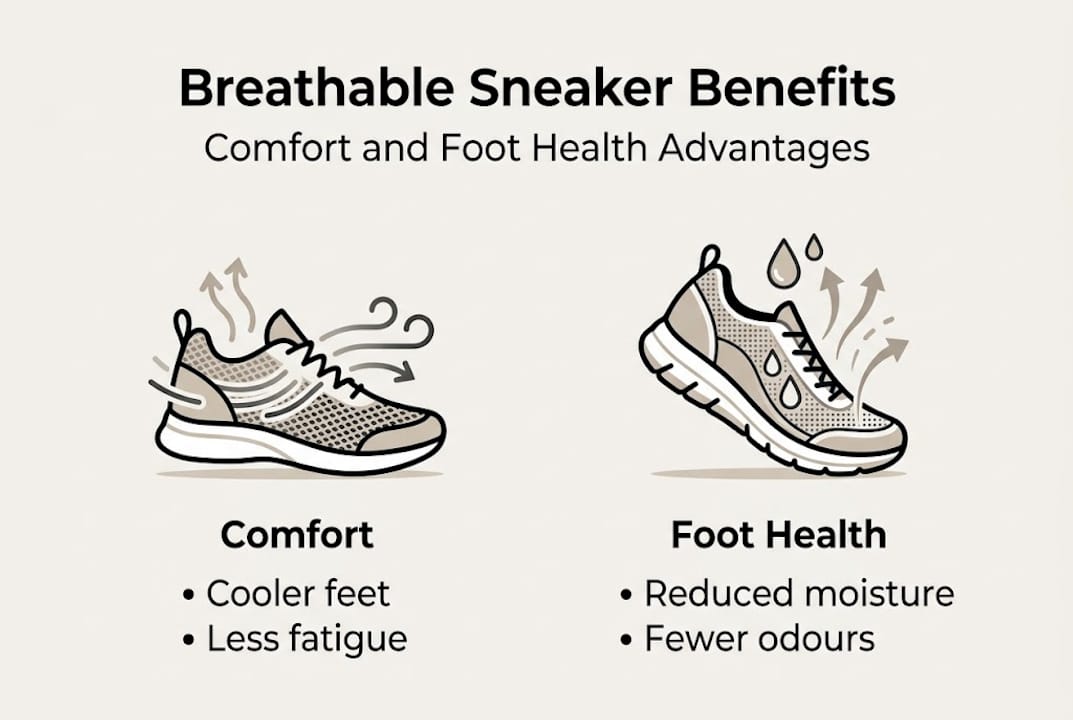
Here is a comparison of the most common upper materials:
| Material | Breathability | Durability | Weight | Best use |
|---|---|---|---|---|
| Engineered mesh | Excellent | Moderate | Light | Running, gym |
| Knit (e.g., Flyknit, Primeknit) | Excellent | Moderate | Very light | Everyday, training |
| Perforated leather | Moderate | High | Heavier | Casual, smart-casual |
| Solid leather/synthetic | Poor | Very high | Heavy | Cold, wet conditions |
| Hybrid (mesh panels) | Good | Good | Moderate | Versatile everyday |
Mesh, knit, perforated, and hybrid designs all enable meaningful airflow but involve trade-offs. A pure mesh upper breathes brilliantly but may wear faster in high-friction zones. Knit uppers offer a sock-like fit with excellent ventilation, though they can absorb moisture in wet conditions. Hybrid designs try to balance both by placing breathable panels where ventilation matters most.
Designers working on sneaker design trends are increasingly engineering shoes with strategic ventilation zones, placing mesh or perforations near the toe box and sides where heat accumulates most. This targeted approach means you get breathability where you need it without compromising the shoe’s structural integrity.
When evaluating a breathable trainer before buying, follow these three steps:
- Hold the upper up to a light source. If you can see light through the material, air will move through it.
- Check for mesh or knit panels. Look specifically at the toe box and sides, not just the tongue.
- Feel the lining. A moisture-wicking interior lining works alongside the upper to pull sweat away from the skin.
Pro Tip: Do not judge breathability by the number of visible holes alone. A tightly woven engineered knit can outperform a coarsely perforated synthetic because airflow depends on both the material’s porosity and its ability to wick moisture away from the skin.
Exploring health-oriented footwear types gives a broader picture of how construction choices affect long-term foot wellbeing beyond breathability alone.
Limitations and best use cases for breathable sneakers
Breathable trainers are not the right choice for every situation. Being clear-eyed about their limitations helps you build a footwear wardrobe that actually serves your life.
The main drawbacks are straightforward. Breathable trainers provide less insulation in cold or wet conditions and may cost more than standard options. The same openness that lets air in also lets water in, which makes them a poor choice for muddy trails or rainy winter commutes.
Here is a quick checklist to decide whether breathable sneakers suit your needs:
- Do you spend more than four hours a day on your feet? Yes: breathable is beneficial.
- Do you live or work in a warm or humid climate? Yes: breathable is strongly recommended.
- Do you experience excessive sweating (hyperhidrosis, meaning unusually high sweat production) or have diabetes? Yes: breathable is advisable for health reasons.
- Are you primarily outdoors in cold or wet British winters? No: consider waterproof or insulated options instead.
- Do you need heavy-duty ankle support for trail running or construction work? No: a structured boot is more appropriate.
Pro Tip: Own two pairs. A breathable trainer for warmer months and active days, and a waterproof or insulated shoe for cold, wet conditions. Rotating footwear also extends the life of both pairs by giving each time to dry and recover between uses.
The guide to buying healthy footwear walks through the broader decision-making process in detail, which is especially useful if you are buying for specific foot conditions. And if you are weighing up the comfort footwear benefits against other priorities, the evidence is clear that comfort and health are not competing goals. They reinforce each other.
For those concerned about fungal infections specifically, preventing athlete’s foot is meaningfully easier when your footwear supports airflow rather than working against it.
What most people miss about choosing breathable footwear
Most shoppers pick trainers based on brand recognition or aesthetics. That is understandable. But it means breathability is almost always an afterthought, if it is considered at all.
Here is what that oversight costs over time. Every day spent in a poorly ventilated shoe is a day of accumulated moisture, bacterial activity, and low-grade skin stress. None of it feels dramatic in the moment. But across months and years, it adds up to recurring foot odour, repeated bouts of athlete’s foot, and that familiar feeling of feet that are simply exhausted by mid-afternoon.
The cumulative benefit of breathable footwear is what most people only notice once they have made the switch. Fresher feet at the end of the day. Fewer skin irritations. Less reliance on foot sprays and odour insoles. These are not small things. They affect your confidence, your comfort, and your willingness to stay active.
We think the real question is not whether breathable trainers look good. Modern designs, including those informed by shoe buying for health and style principles, prove you do not have to choose between the two. The question is whether you are prioritising your foot health as seriously as you prioritise the rest of your wellbeing. Most people are not, yet.
Discover more with YDA’s health-driven sneaker range
If the evidence above has shifted how you think about your trainers, the next step is finding footwear that actually delivers on these principles. At YDA, every shoe in our range is built around the idea that style and foot health belong together.
Our YDA breathable trainers are engineered with advanced upper materials and ventilation design informed by the same foot health research covered in this article. The YDA shoe technology section explains exactly how we approach breathability, support, and energy efficiency in each design. Browse the range and find a pair built to keep your feet comfortable, healthy, and looking sharp all day long.
Frequently asked questions
Are breathable sneakers better for sweaty feet?
Yes, breathable sneakers significantly reduce sweat build-up and help keep your feet drier during activities. Knit uppers reduce sweat by up to 30% compared to leather, making them a practical choice for anyone prone to warm or sweaty feet.
Do breathable shoes prevent athlete’s foot and odour?
They help reduce the risk of athlete’s foot and odour by allowing for better airflow and moisture evaporation. Breathable sneakers lower the risk of fungal infections by keeping the internal shoe environment cooler and drier.
Are there situations where breathable trainers are not recommended?
Breathable trainers are less suitable in very cold or wet conditions due to limited insulation and reduced water protection. Limited cold weather insulation and lower resistance to wet or muddy terrain make waterproof alternatives the better option in those scenarios.
Who benefits most from wearing breathable sneakers?
Active people, those in warm climates, and individuals with excessive sweating or diabetes benefit the most. Best suited for warm climates and hyperhidrosis, breathable trainers also support foot health for diabetics who need to minimise skin irritation and moisture-related complications.