
What makes a shoe non slip: the complete guide
TL;DR:
- A slip-resistant shoe must meet specific standards, including a minimum coefficient of friction of 0.40 under ASTM F3445-24.
- Matching outsole material, tread design, and environment are crucial for effective slip prevention in various settings.
A non-slip shoe is defined by its outsole’s ability to generate sufficient friction against a surface to prevent uncontrolled sliding. The industry term is “slip-resistant,” and it carries a specific technical meaning. Under ASTM F3445-24, a shoe earns the slip-resistant (SR) label only when its outsole achieves a minimum coefficient of friction of 0.40 on both wet and dry surfaces, tested under ASTM F2913. That number is not arbitrary. It represents the threshold below which the human gait becomes unstable during normal walking. Understanding what makes a shoe non slip means understanding three things: the rubber compound in the outsole, the tread pattern cut into it, and the surface you are walking on.
What materials make a shoe slip resistant?
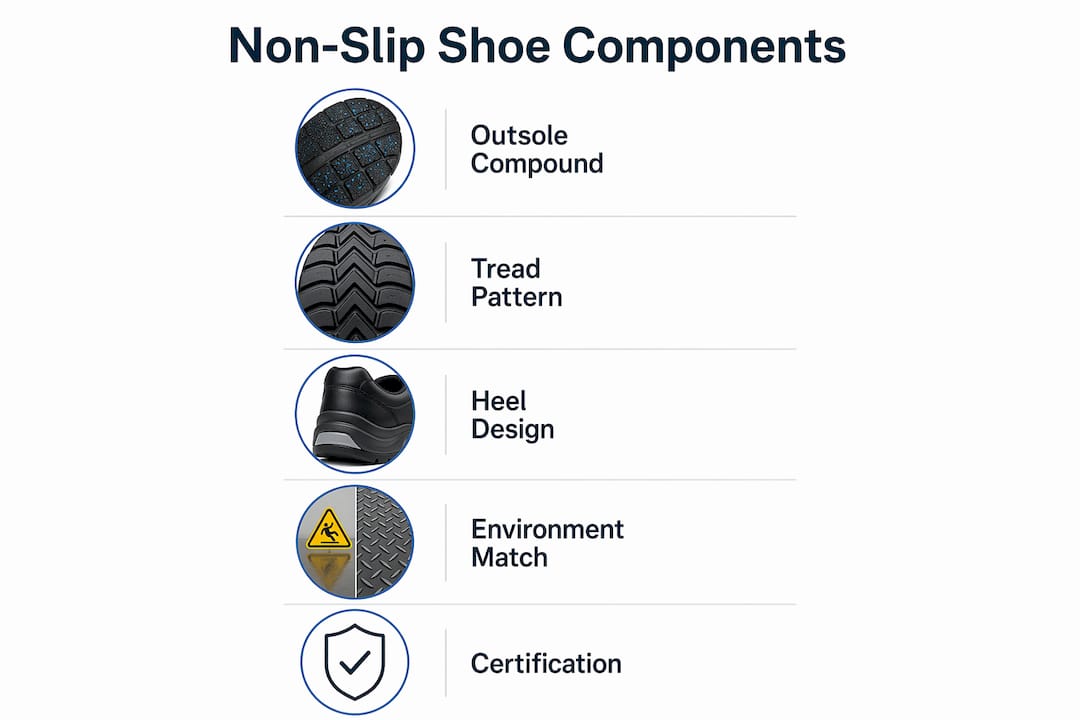
The outsole compound is the single biggest factor in slip resistance. Not all rubber is equal, and the differences matter enormously on wet or contaminated floors.
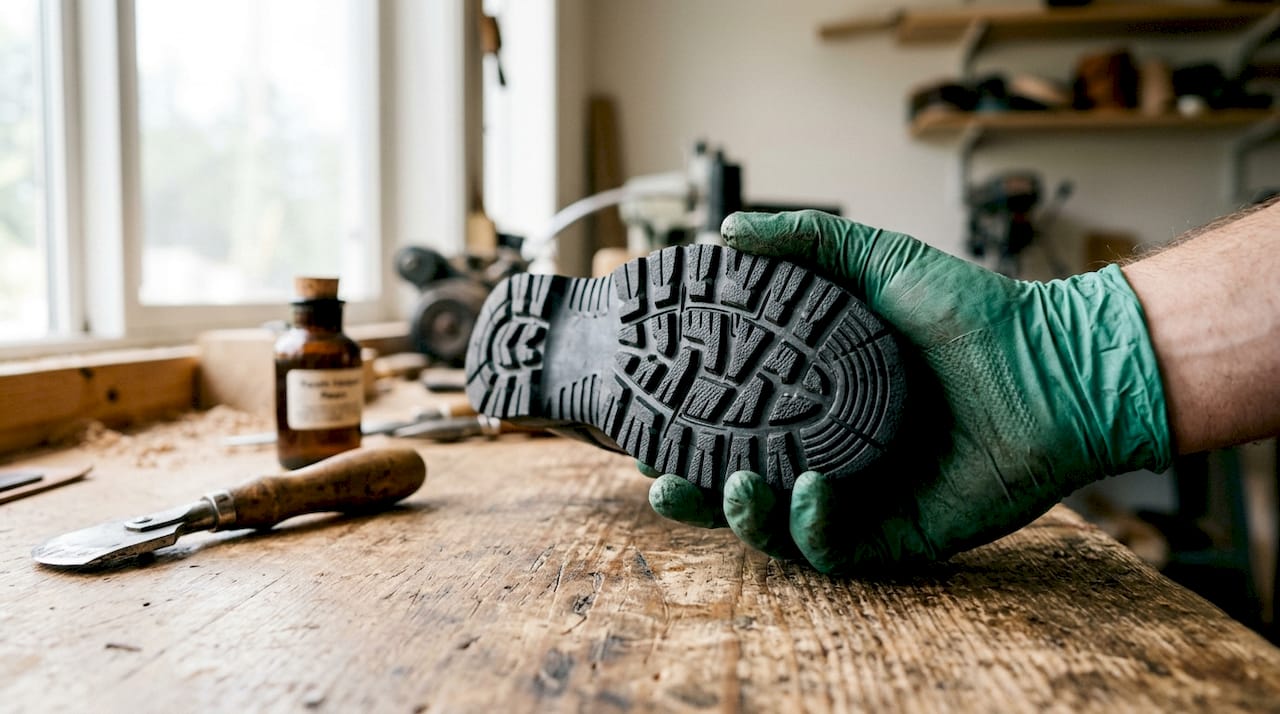
Soft rubber compounds deform slightly when they contact a surface. That deformation increases the area of contact, which raises friction. Harder compounds stay rigid, reducing contact area and grip. This is why a soft rubber sole grips a wet tile floor far better than a stiff polyurethane (PU) sole. Rubber outsoles outperform PU and foam alternatives on wet and oily surfaces because of this deformation property and their naturally higher friction coefficient.
The type of rubber also matters for specific environments:
- Soft natural or synthetic rubber: Best for wet floors, polished concrete, and general indoor use. Conforms well to surface irregularities.
- Nitrile rubber: Resists oils, fuels, and chemicals. The preferred compound for kitchen workers, mechanics, and anyone on oily floors.
- Oil-resistant compounds: A broader category that includes nitrile blends. Rated for environments where petroleum-based fluids are present.
- Polyurethane (PU): Lightweight and durable, but significantly lower grip on oily surfaces compared to certified rubber soles. Certified slip-resistant outsoles deliver 2–3 times higher friction coefficients than standard PU soles on oily surfaces.
Understanding the different types of shoe soles helps you match the right compound to your environment before you buy.
Pro Tip: If you work in a kitchen or any environment with oil or grease on the floor, look specifically for nitrile rubber outsoles rather than generic “rubber.” The difference in grip on an oily surface is substantial.
How does tread pattern affect grip and safety?
The tread pattern is the outsole’s drainage system. On a dry floor, a flat sole with maximum contact area would theoretically grip best. On a wet or contaminated floor, that flat sole traps liquid between the shoe and the surface, creating a film that eliminates friction entirely. Tread channels solve this problem by giving liquid somewhere to go.
Tread designs and what they do
Different tread geometries serve different purposes. Siped treads use fine cuts across the tread blocks. These cuts open under pressure, gripping the surface like a squeegee. Soft rubber combined with siping maintains friction on wet surfaces better than harder compounds or aggressive lug patterns on smooth indoor floors. Hexagonal and wave patterns disperse liquid in multiple directions simultaneously, making them effective on unpredictably wet surfaces. Lug treads, with their deep, widely spaced blocks, excel outdoors on mud and loose ground but can reduce contact area on polished indoor floors, which actually increases slip risk in those settings.
| Tread type | Best surface | Weakness |
|---|---|---|
| Siped | Wet tile, polished concrete | Wears faster than deep lugs |
| Hexagonal | Multi-directional wet surfaces | Less effective on heavy mud |
| Wave/chevron | Wet concrete, light outdoor | Moderate on very smooth floors |
| Lug | Outdoor, loose terrain | Reduces contact on smooth indoor floors |
| Wedge/flat | Dry indoor surfaces | Poor liquid dispersion |
Multi-directional tread patterns outperform single-direction designs because slips do not always happen in a straight line. A lateral stumble on a wet floor is just as dangerous as a forward slide.
One feature that most people overlook is the heel edge. A bevelled heel edge is critical for stability during heel strike, the moment when the foot first contacts the ground. A sharp 90-degree heel edge can catch on the surface and cause a sudden pitch forward. A bevelled edge rolls smoothly through the strike, maintaining contact and reducing the risk of a fall. The heel-strike phase is where the majority of slip events begin, making this design detail far more important than it looks.
Pro Tip: When assessing a shoe in a shop, run your thumb along the heel edge. A bevelled, rounded edge indicates a design that has considered slip mechanics. A sharp right-angle heel is a warning sign for anyone working on wet or uneven floors.
Why does the environment change everything?
Slip resistance depends on three pillars: outsole compound, tread pattern, and floor environment. No shoe is universally non-slip on all contaminants. This is the most important and most overlooked fact in footwear safety.
The same shoe that grips perfectly on a wet concrete floor can become dangerously slippery on a polished marble surface coated in a thin film of cooking oil. The contaminant changes the physics entirely. Water reduces friction but allows rubber to still make partial contact. Oil creates a much more persistent film that is harder for tread channels to displace. Dry dust on a smooth floor can be just as hazardous as liquid, because fine particles act like ball bearings under the outsole.
Matching your shoe to your specific environment requires thinking through four factors:
- Floor material: Concrete, tile, wood, and metal each have different base friction levels. Polished surfaces are the most demanding.
- Primary contaminant: Water, oil, grease, and dust each require different tread and compound responses. Nitrile rubber handles oil; siped soft rubber handles water.
- Activity level and shift length: A shoe worn for eight hours of standing on a wet kitchen floor needs a more aggressive slip-resistant specification than one worn for a two-hour leisure walk in light rain.
- Tread wear and rubber condition: Tread channels packed with debris and rubber that has hardened over time reduce slip resistance before the upper shows any visible wear. Outsoles degrade silently.
For guidance on selecting footwear matched to specific surfaces, the best running shoes for home gyms resource also covers grip and traction considerations worth reviewing for active environments.
Common myths about non-slip shoes and how to choose wisely
The biggest misconception in this category is that “non-slip” and “slip-resistant” mean the same thing. They do not. “Non-slip” is a marketing term with no regulated definition. Any manufacturer can print it on a box. “Slip-resistant” with an ASTM F3445-24 or EN ISO 13287 certification mark means the shoe has been independently tested and passed a defined friction threshold.
Marketing terms like “non-slip” carry no performance guarantee. Safety managers and insurers rely on ASTM or ISO certification marks to verify actual performance. If you are buying footwear for a workplace with genuine slip hazards, the certification mark is non-negotiable.
Beyond certification, several practical factors determine whether a shoe will actually keep you safe:
- Fit: Ill-fitting shoes can negate even the best outsole. If your foot slides inside the shoe, your gait becomes unstable regardless of the outsole’s friction rating. Proper fit means no heel lift and no lateral movement inside the shoe.
- Outsole inspection: Check the tread channels every few weeks. If they are packed with debris or the rubber feels hard and glassy rather than slightly tacky, grip has already declined.
- Surface matching: Buy for your specific floor, not for a generic “non-slip” claim. A shoe rated for wet concrete may underperform on oily tile.
- Heel design: Look for a bevelled heel edge, not a sharp right angle.
The slip resistance facts behind certified footwear go deeper than most product pages reveal. Reading them before you buy is time well spent.
Key takeaways
A shoe is genuinely slip resistant only when its outsole compound, tread design, and environment are matched correctly, and when it carries a verified certification such as ASTM F3445-24 or EN ISO 13287.
| Point | Details |
|---|---|
| Certification over marketing | Look for ASTM F3445-24 or EN ISO 13287 marks, not just “non-slip” labelling. |
| Rubber compound matters | Soft rubber and nitrile compounds outperform PU on wet and oily surfaces. |
| Tread design is drainage | Siped and multi-directional treads channel liquid away to maintain contact. |
| Bevelled heel is critical | A rounded heel edge reduces slip risk at heel strike, the most dangerous gait phase. |
| Fit and maintenance | Proper fit and regular outsole inspection are as important as the outsole specification itself. |
Why I think most people buy non-slip shoes wrong
After years of looking closely at footwear safety, the pattern I see most often is this: people buy on label, not on specification. They pick up a shoe, see “non-slip” on the box, and assume the job is done. The certification mark is rarely checked. The heel edge is never examined. The tread compound is never considered in relation to the actual floor they will be walking on.
The second mistake I see constantly is ignoring fit. A perfectly certified outsole does nothing if your heel is lifting with every step. The foot slipping inside the shoe is a slip event, even if the outsole stays planted. Shoe fit and foot stability are not separate from slip resistance. They are part of the same safety equation.
My practical advice is straightforward. Before you buy, identify your floor type and your primary contaminant. Then look for a certification mark, a soft or nitrile rubber compound, a siped or multi-directional tread, and a bevelled heel. Try the shoe on and walk in it. If your heel lifts, the shoe fails the safety test regardless of what the label says. Certified footwear combined with proper fit and environmental awareness is the only combination that reliably prevents falls.
— Panagiotis
Ydauk’s approach to slip-resistant footwear
Ydauk designs footwear around the same principles that define genuine slip resistance: certified outsole materials, considered tread geometry, and a fit that keeps the foot stable throughout the gait cycle.
The YDA Technology platform details exactly how each of these elements is built into Ydauk’s shoes, from the outsole compound selection to the tread pattern engineering. If you are looking for footwear that goes beyond a marketing label and delivers verified grip for work or everyday wear, the YDA shoe technology page is the right place to start. Ydauk’s focus on foot health and performance means slip resistance is treated as a functional requirement, not an afterthought.
FAQ
What is the minimum friction level for a slip-resistant shoe?
A shoe must achieve a coefficient of friction of at least 0.40 on wet and dry surfaces under ASTM F2913 testing to qualify for the slip-resistant (SR) label under ASTM F3445-24.
Why do shoes slip on oily floors even when labelled non-slip?
Oil creates a persistent film that standard rubber compounds and tread patterns struggle to displace. Nitrile rubber outsoles are specifically formulated to resist oil contamination and maintain grip where standard compounds fail.
How do I test whether my shoe’s grip has worn out?
Run your finger across the outsole. If the rubber feels hard and smooth rather than slightly tacky, and if the tread channels are packed or shallow, grip has declined. Replace the shoe before the upper shows visible wear.
Does tread depth always improve slip resistance?
No. Deep lug treads reduce contact area on smooth indoor floors, which can increase slip risk in those environments. Siped, shallower treads with soft rubber compounds perform better on polished tile and wet concrete.
Is “non-slip” the same as “slip-resistant”?
No. “Non-slip” is an unregulated marketing term. “Slip-resistant” with an ASTM F3445-24 or EN ISO 13287 certification mark indicates independently verified performance against a defined friction standard.