
What are non slip shoes? A guide for safer footwear
TL;DR:
- Non-slip shoes have marketing labels that do not guarantee safe slip resistance, unlike certified slip-resistant footwear. Slip-resistant shoes meet standards like ASTM F3445-24, which require a minimum coefficient of friction of 0.40 on wet and dry surfaces. Proper sole material, tread design, regular maintenance, and certification are essential for effective slip prevention.
Non-slip shoes are footwear engineered with specialised outsoles to reduce the risk of slipping on wet, oily, or smooth surfaces through measurable traction performance. The term “non-slip” appears widely on packaging and product listings, but it carries no guaranteed performance standard on its own. The industry term you need to know is “slip-resistant,” which refers to footwear that has passed certified friction testing. Whether you work in a hospital ward, a busy kitchen, or simply want safer shoes for daily life, understanding what separates a marketing label from a certified property is the most useful thing you can know before buying.
What are non slip shoes, and how do they differ from slip-resistant footwear?
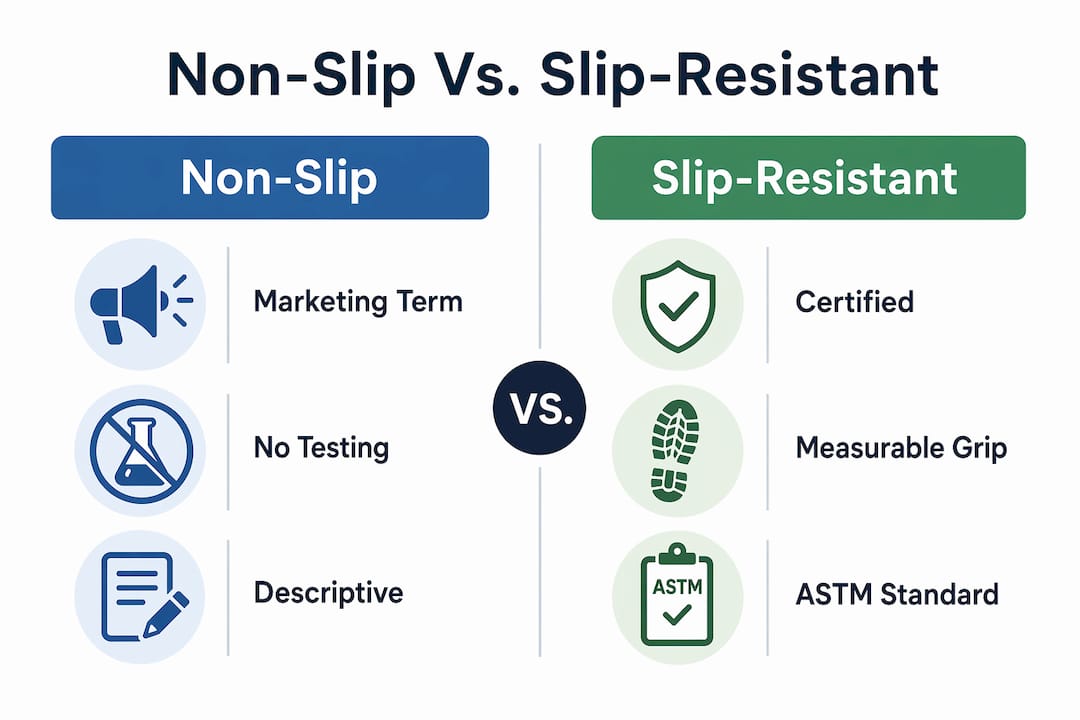
Non-slip and slip-resistant are not the same thing, even though they are used interchangeably in most shops. “Non-slip” is a marketing term without standardised performance guarantees, while “slip-resistant” is a tested engineering property. That distinction matters enormously when your safety depends on the shoe.
Slip-resistant footwear must meet measurable friction standards. The ASTM F3445-24 standard requires certified shoes to achieve a minimum coefficient of friction (COF) of 0.40 on both wet and dry surfaces. A COF of 0.40 is the threshold below which the risk of slipping increases significantly on contaminated floors. Shoes that carry this certification have passed whole-shoe traction tests, not just material assessments.
The confusion between the two terms leads to real consequences. Customers frequently assume that any shoe labelled “non-slip” provides high-level protection, but only certified slip-resistant footwear is tested and reliable. A shoe marketed as non-slip may use a rubber outsole that performs adequately on dry floors but fails on a wet kitchen tile or a polished hospital corridor.
| Term | Meaning | Tested? |
|---|---|---|
| Non-slip | Descriptive marketing phrase | No standardised test required |
| Slip-resistant | Certified traction property | Yes, via ASTM F3445-24 or ISO standards |
| Anti-slip | Often used interchangeably with slip-resistant | Depends on the certification claimed |
Pro Tip: When buying footwear for work, look for the ASTM F3445 or ISO certification mark on the product page or packaging. A label that says only “non-slip” without citing a standard is a marketing claim, not a safety guarantee.
How do materials and tread design affect grip?
The outsole is the single most important factor in slip resistance. Soft rubber compounds maintain friction on water films and oily surfaces by conforming to micro-irregularities in the floor. Hard rubber compounds, by contrast, sit on top of contamination rather than gripping through it, which is why many fashion shoes with stiff soles perform poorly on wet surfaces.
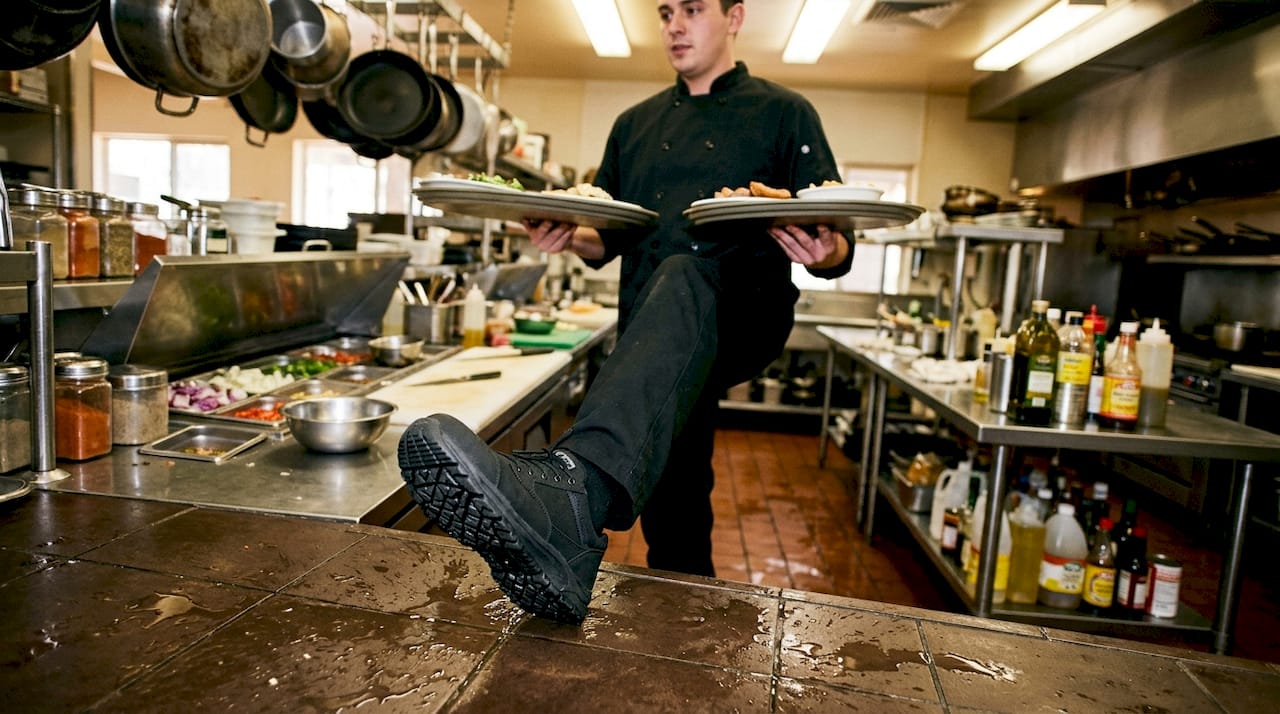
Tread geometry works alongside the rubber compound to channel fluids away from the contact area. Without fluid evacuation, water or oil forms a film between the sole and the floor, reducing friction to near zero. The tread pattern determines how effectively that film is displaced.
Different environments call for different tread designs:
- Siped soles feature thin cuts across the tread blocks, similar to winter tyre technology. They flex and grip on wet, smooth floors, making them well suited to healthcare settings and supermarkets.
- Hexagonal or honeycomb patterns increase the number of edges in contact with the floor. Hexagonal tread patterns and beveled heel edges reduce slip risk by improving traction during heel strike, which is the most slip-prone part of a step.
- Channeled or multi-directional designs are built for kitchens and food-service environments where grease and liquid are constant hazards. The channels direct fluid outward from the sole’s centre.
- Wedge soles offer a flat, broad contact surface that distributes weight evenly. They work well on construction sites and factory floors but can struggle on heavily contaminated surfaces without additional tread features.
Nitrile rubber compounds combined with appropriate tread geometry provide the best balance for oily and wet working conditions. Nitrile rubber resists oil degradation while maintaining the softness needed for grip, which is why it appears in many occupational safety shoes.
Pro Tip: If you work in a kitchen or food-processing environment, prioritise a hexagonal or channeled tread over a smooth or lug-style sole. Lug soles trap grease and become dangerously slippery on tiled floors.
How to choose the best non slip shoes for your work or lifestyle
Choosing the right slip-resistant footwear requires matching the shoe’s properties to your specific environment. A shoe that excels in a hospital may underperform in a restaurant kitchen, and vice versa.
-
Check for certification. Look for ASTM F3445-24 or relevant ISO standard markings. These confirm the shoe has passed whole-shoe traction testing, not just a material test. A certified shoe gives you a measurable baseline of protection.
-
Match the tread to your floor. Siped soles suit wet, smooth floors. Hexagonal patterns work best in kitchens. Channeled designs handle oily environments. Knowing your floor type before you buy is the most direct way to improve your safety.
-
Understand oil resistance versus slip resistance. Oil resistance and slip resistance are distinct properties requiring separate testing. Oil resistance means the outsole material will not degrade when exposed to oils and chemicals. Slip resistance means the shoe grips the floor. A shoe can have one without the other, so check both specifications if you work around oils or cleaning fluids.
-
Prioritise fit and sole thickness. Fit, comfort, and sole thickness greatly impact workplace safety and injury prevention. A shoe that fits poorly causes fatigue, which increases the likelihood of missteps regardless of how good the outsole is. Sole thickness also affects how much impact is absorbed during long shifts.
-
Inspect and maintain regularly. Slip-resistant outsole performance degrades over time due to wear, contamination, and floor material changes. Worn tread loses its fluid-evacuation channels and its grip. Check the tread depth every few months and replace shoes when the pattern becomes visibly shallow.
-
Clean the outsoles consistently. Grease and debris clog tread channels and reduce friction. A stiff brush and warm soapy water after each shift restores much of the tread’s original performance. For a full routine, a shoe maintenance guide covers the steps in detail.
Pro Tip: Carry out a simple wet-floor test when you first wear a new pair of slip-resistant shoes. Pour a small amount of water on a tiled surface and walk across it slowly. If you feel any sliding, the tread pattern may not suit that floor type.
What are the practical benefits and limitations of non slip footwear?
Certified slip-resistant shoes reduce the risk of slipping but do not eliminate it entirely. Real-world performance depends on the floor surface, the type and volume of contamination, and how well the tread is maintained. Understanding these limits helps you use the footwear correctly rather than relying on it as a complete solution.
The benefits for specific groups are well established. Healthcare workers spend long shifts on polished vinyl and wet bathroom tiles. Restaurant staff face grease, spilled liquids, and smooth ceramic floors. People with active lifestyles encounter wet pavements, muddy paths, and slick gym floors. For all three groups, certified non-slip footwear reduces the frequency and severity of slip-related injuries, which are among the most common causes of workplace accidents.
Key benefits include:
- Reduced injury risk on wet, oily, and smooth surfaces
- Greater confidence and stability during long working hours
- Lower fatigue from improved grip, which reduces the muscular effort needed to compensate for unstable footing
- Protection of foot health through better sole construction and shock absorption
The limitations are equally worth knowing:
- No shoe is 100% slip-proof on all surfaces. Black ice, heavily polished marble, and certain industrial floor coatings can defeat even certified outsoles.
- Performance drops sharply when tread channels are clogged with grease or debris.
- Slip-resistant shoes must be paired with proper maintenance and awareness of floor conditions to remain effective. The shoe alone is not sufficient.
- Shoes that fit poorly or have worn through their tread provide little meaningful protection, regardless of their original certification.
Understanding the role of non-slip soles in daily safety helps set realistic expectations. The goal is risk reduction, not risk elimination.
Key takeaways
Certified slip-resistant footwear, defined by standards such as ASTM F3445-24, provides measurable traction that “non-slip” marketing labels alone cannot guarantee.
| Point | Details |
|---|---|
| Non-slip vs. slip-resistant | “Non-slip” is a marketing term; “slip-resistant” requires certified friction testing to ASTM or ISO standards. |
| Minimum COF requirement | ASTM F3445-24 sets a minimum coefficient of friction of 0.40 on wet and dry surfaces for certified shoes. |
| Tread design matters | Match tread type to your environment: siped for wet floors, hexagonal for kitchens, channeled for oily surfaces. |
| Oil resistance is separate | Oil resistance protects the outsole material; slip resistance ensures grip. Check both specifications. |
| Maintenance is non-negotiable | Worn or clogged tread degrades performance. Clean outsoles regularly and replace shoes when tread is shallow. |
Why the label on your shoe matters more than you think
People often ask me whether the “non-slip” label on a shoe is enough. My honest answer is no, and I think the footwear industry has done a poor job of communicating that clearly.
I have seen healthcare workers buy shoes labelled “non-slip” from general retailers, wear them for a full shift on wet ward floors, and still slip. The shoes were not defective. They simply had not been tested to any friction standard. The label was accurate in a narrow sense: the rubber was softer than a dress shoe. But it was not slip-resistant in any meaningful, certified way.
The distinction between a marketing phrase and an engineering property is not pedantic. It is the difference between a shoe that has been measured against a floor under controlled conditions and one that has not. When you are carrying a patient, a tray of food, or simply walking quickly on a wet pavement, that difference is real.
What I find most overlooked is maintenance. Even the best certified shoe becomes unreliable once the tread wears down or the channels fill with grease. I have seen people replace their shoes far too late, long after the tread had become visibly smooth. The anti-slip outsole technology in a well-made shoe is only as good as the condition it is kept in.
My practical advice: buy certified, match the tread to your floor, and treat shoe maintenance as part of your safety routine, not an afterthought.
— Panagiotis
Ydauk’s approach to certified slip-resistant footwear
Ydauk builds its footwear around the principle that safety and comfort are not competing priorities. The YDA Technology platform integrates certified slip-resistant outsoles with foot health engineering, producing shoes designed for the demands of healthcare, hospitality, and active daily use.
Ydauk’s outsoles are developed with tread geometry and rubber compounds matched to real working environments, not just laboratory conditions. The range addresses the needs of people who stand, walk, and move for hours on surfaces where grip is not optional. If you are looking for footwear that combines verified traction with genuine comfort for long shifts, Ydauk’s technology page is the right starting point. The specifications, certifications, and design rationale are all publicly listed, so you can make an informed decision before you buy.
FAQ
What are non slip shoes made of?
Non-slip shoes use soft rubber outsoles, often nitrile rubber, combined with siped or multi-directional tread patterns to maintain grip on wet and oily surfaces. The rubber compound and tread geometry work together to channel fluids away from the contact area.
Is “non-slip” the same as “slip-resistant”?
No. “Non-slip” is a descriptive marketing term with no standardised performance requirement, while “slip-resistant” refers to footwear certified to meet a measured friction standard such as ASTM F3445-24.
What is the minimum COF for certified slip-resistant shoes?
The ASTM F3445-24 standard requires a minimum coefficient of friction of 0.40 on both wet and dry surfaces. Shoes that meet this threshold have passed whole-shoe traction testing.
How often should I replace slip-resistant shoes?
Replace slip-resistant shoes when the tread pattern becomes visibly shallow or when you notice reduced grip on familiar surfaces. Outsole performance degrades with wear and contamination, so regular inspection is necessary.
Can slip-resistant shoes prevent all slips?
No shoe eliminates slipping entirely. Certified slip-resistant footwear reduces risk significantly, but performance still depends on floor type, contamination level, and how well the tread is maintained.