
Sneaker production: how your trainers are made
TL;DR:
- Sneaker production involves nine stages, from design to packaging, that determine the shoe’s quality and environmental impact. Automation, such as On’s LightSpray system, reduces emissions and waste by replacing traditional bonding methods. Handmade sneakers take up to 14 days to produce, emphasizing craftsmanship and material choices over mass efficiency.
Sneaker production is the comprehensive series of stages that transforms a footwear design into a finished shoe ready for market. It spans nine distinct phases, from initial concept and material sourcing through cutting, stitching, lasting, and sole assembly, to finishing, quality control, and packaging. The process involves assembling 15–30 components per shoe, and the choices made at each stage directly affect durability, comfort, and environmental impact. Brands like On and artisan makers like FEIT sit at opposite ends of the manufacturing spectrum, yet both illustrate how material selection, design intent, and assembly method define the final product.
What are the core stages of sneaker production?
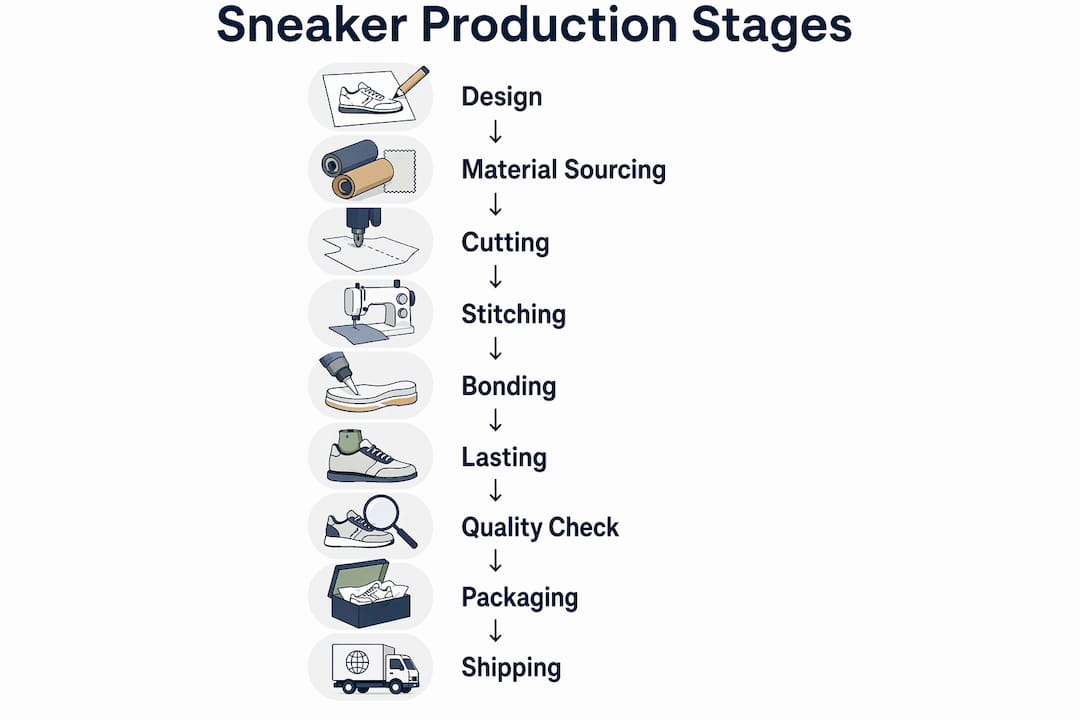
The sneaker manufacturing process follows nine stages, each with its own timeline and technical demands. Understanding the full sequence explains why a pair of trainers can take several weeks to reach a shelf, even when factories run around the clock.
| Stage | Typical duration | Key activity |
|---|---|---|
| Design and development | 2–8 weeks | Concept sketches, CAD modelling, prototype sampling |
| Material sourcing | 1–2 weeks | Ordering textiles, rubber, foam, and hardware |
| Cutting | 1–3 days | Hydraulic press or die cutting of uppers and linings |
| Upper assembly | 3–7 days | Stitching, bonding, and reinforcing panels |
| Lasting | 1–2 days | Stretching upper over a last to set the shoe shape |
| Sole assembly | 1–3 days | Attaching midsole and outsole with cement or injection |
| Finishing | 1–2 days | Lace insertion, logo application, trimming |
| Quality control | 1–2 days | Dimensional checks, bonding tests, visual inspection |
| Packaging and shipping | 2–5 days | Boxing, labelling, and despatch |
Material sourcing alone takes 1–2 weeks, which is why delays at this stage cascade through the entire schedule. Final packaging and shipping add a further 2–5 days, meaning the supply chain window is tight even before customs and freight are factored in.
The cutting stage is more technical than it appears. Skilled operators using hydraulic presses work to minimise material waste through precise nesting layouts, and factories maintain temperatures of 18–22°C and humidity of 45–55% to prevent leather and synthetic panels from warping before assembly. Sports shoes typically use injection moulding for their soles, while formal and heritage styles rely on stitching techniques such as Goodyear welt or Blake construction.
Pro Tip: If you are evaluating a factory’s capability, ask specifically about their cutting room conditions. Environmental control at the cutting stage is a reliable indicator of overall production discipline.
How is modern automation changing sneaker manufacturing?
Automation is the most significant shift in footwear production methods in decades. On’s factory in Busan, South Korea, demonstrates what fully automated upper production looks like at scale.
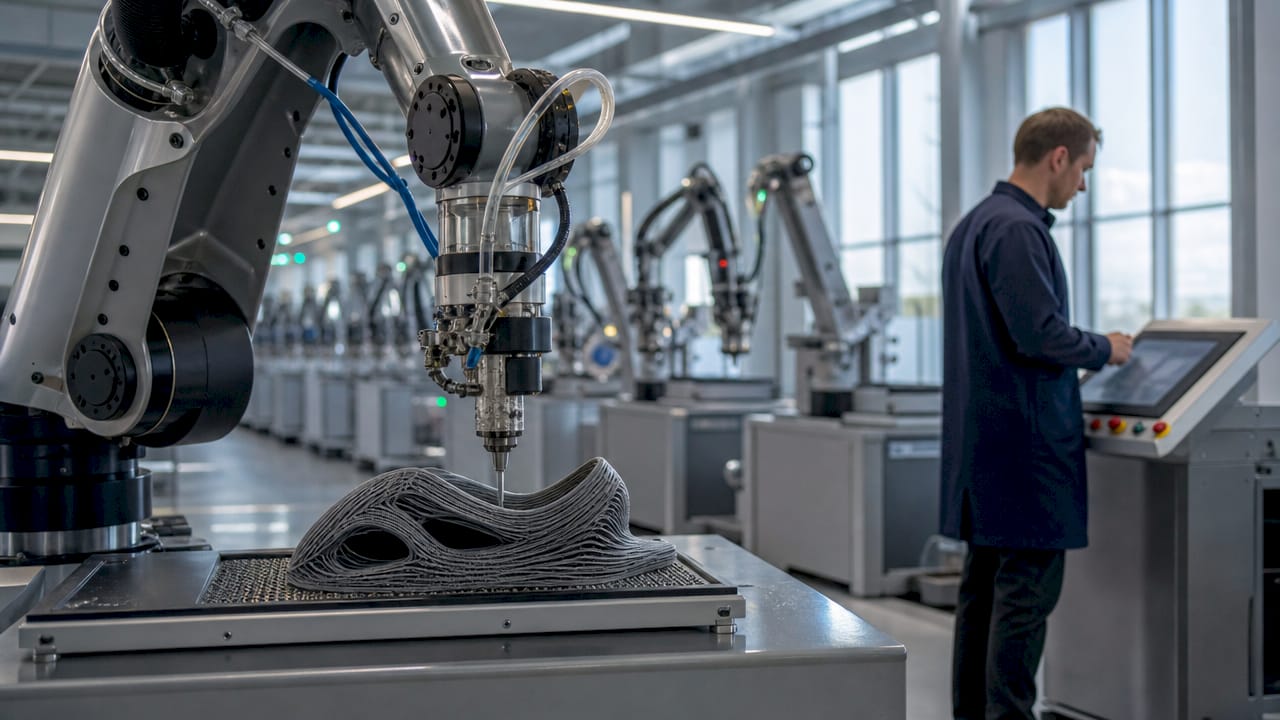
The Busan plant uses 32 robots to produce a complete upper in approximately three minutes. That speed is not just impressive on paper. It compresses what traditionally required hours of skilled hand labour into a cycle time measured in minutes, enabling far greater daily output without proportional increases in headcount.
The technology driving this is LightSpray, On’s proprietary filament spraying system. Rather than cutting panels and stitching them together, robots spray approximately 1.5 metres of filament directly onto a last to form a seamless upper. No glue is used. No stitching is required. The result is a shoe upper that bonds through the filament structure itself, which eliminates two of the most labour intensive and waste generating steps in conventional production.
The environmental gains are substantial. LightSpray production generates 70% fewer carbon emissions compared to traditional manufacturing methods. That figure matters because the upper assembly stage has historically been one of the most polluting parts of the process, relying on solvent based adhesives and energy intensive stitching machinery.
- Robots handle upper formation, removing human error from repetitive bonding tasks
- Filament spraying eliminates adhesive waste and solvent emissions
- Near-zero material offcuts reduce landfill contribution
- Compressed cycle times allow faster response to retail demand
Pro Tip: Automation does not replace design expertise. The most effective automated factories pair robotic precision with human oversight at the design and quality control stages, not throughout the entire line.
Handmade vs mass production: what is the real difference?
Handmade sneaker production and mass manufacturing are not simply different speeds of the same process. They represent fundamentally different philosophies about what a shoe is for.
FEIT, the Australian footwear brand, builds each pair over 14 days using hand cutting, hand stitching, and hand lasting. The leather is vegetable tanned, a process that uses plant derived tannins rather than chromium salts, producing a material that ages with the wearer rather than degrading uniformly. A single craftsman takes responsibility for the entire pair, which means quality control is personal rather than procedural.
| Factor | Handmade production | Mass production |
|---|---|---|
| Production time | Up to 14 days per pair | Hours to days per pair |
| Quality oversight | Individual craftsman | Multi-stage QC gates |
| Materials | Vegetable tanned leather, natural fibres | Synthetic textiles, engineered foam |
| Environmental impact | Lower chemical use, higher durability | Higher volume waste, adhesive emissions |
| Scalability | Very limited | High |
| Price point | Premium | Accessible to mid-range |
Mass production prioritises consistency and volume. A factory producing running shoes for a global brand needs every pair in a batch to meet identical dimensional tolerances. That requires standardised bonding processes, incoming material inspections, and multi-stage QC gates rather than the judgement of a single artisan.
The trade-off is not simply quality versus quantity. Handmade shoes built with vegetable tanned leather and hand lasting can outlast mass produced pairs by years. Mass produced shoes, particularly those using modern engineered foams and knit uppers, can deliver performance characteristics that handmade construction cannot replicate at any price.
Pro Tip: When assessing a handmade sneaker’s value, look at the tanning method and lasting technique. Vegetable tanning and hand lasting are the two most time consuming steps. Their presence signals genuine craft investment, not just marketing.
How do material sourcing and quality control affect production quality?
Mass production success depends as much on material and quality control processes as on machinery. A factory with excellent equipment but inconsistent incoming materials will produce inconsistent shoes.
Each sneaker contains 15–30 components, including upper textiles, lining fabrics, toe boxes, heel counters, insoles, midsoles, outsoles, eyelets, and laces. Each component arrives from a different supplier, often in a different country. Sourcing timelines and logistics coordination directly affect whether the production line runs on schedule or stalls waiting for a single missing part.
Bonding is the most failure-prone stage in the entire process. Cold cement processes require 8–24 hours of curing time, and improper heat activation or insufficient pressure during bonding creates delamination failures that may not appear until the shoe has been worn for weeks. Reliable factories apply QC gates specifically at the bonding and lasting stages, not just at the end of the line.
Common material categories and their implications:
- Leather: Durable and breathable, but sourcing quality varies significantly by tannery
- Knit textiles: Lightweight and flexible, used widely in performance running shoes
- Engineered mesh: High breathability, lower durability than leather
- Recycled polyester: Growing use in sustainable lines; performance comparable to virgin polyester
- Natural rubber outsoles: Better grip and biodegradability than synthetic alternatives
- EVA foam midsoles: Lightweight cushioning standard across most athletic footwear
Incoming material control is the unglamorous side of quality management. Factories that test tensile strength, colorfastness, and dimensional accuracy on arrival rather than assuming supplier consistency produce far fewer defective pairs. The manufacturing lead time for a full production run is directly tied to how quickly material inspections clear each batch.
What are the emerging trends shaping sneaker production in 2026?
The focus of manufacturing innovation has shifted from the midsole to the upper. For decades, brands competed on foam technology: Nike’s Air, Adidas’s Boost, New Balance’s Fresh Foam. The next competitive frontier is upper construction, and automation is the primary driver.
On’s Busan factory represents a broader industry aim: to compress years of R&D and months of logistics into a single automated system located close to the consumer market. That proximity reduces shipping emissions and allows faster iteration on design. It also changes the sneaker supply chain from a long linear sequence into something closer to a responsive loop.
Sustainability is no longer a secondary consideration. Brands are adopting biodegradable materials, eliminating solvent adhesives, and designing for disassembly so that components can be separated and recycled at end of life. The sustainable shoe materials conversation has moved from niche to mainstream, with major manufacturers committing to measurable emission reduction targets.
Additive manufacturing via robot-sprayed filament is the most disruptive development. It eliminates glues, reduces stitching labour, and produces near-zero offcut waste. As the technology matures, it will likely move from premium limited editions into broader production runs, making athletic footwear innovations accessible at lower price points. The sneaker trends for 2026 reflect this shift clearly, with performance and sustainability converging rather than competing.
Key takeaways
Sneaker production is a multi-stage process where material quality, bonding precision, and assembly method determine the durability, performance, and environmental footprint of every pair.
| Point | Details |
|---|---|
| Nine production stages | Each stage from design to packaging has distinct timing and quality requirements. |
| Automation cuts emissions | On’s LightSpray technology reduces carbon emissions by 70% versus traditional methods. |
| Handmade takes 14 days | Artisan makers like FEIT invest up to 14 days per pair for durability and craft. |
| Bonding is the critical stage | Cold cement processes require 8–24 hours curing; multi-stage QC prevents delamination. |
| Upper innovation leads trends | The industry focus has shifted from midsole foam to automated upper construction. |
Why I think the sneaker industry’s obsession with midsoles missed the point
The footwear world spent 20 years treating the midsole as the primary site of innovation. Every brand had a proprietary foam acronym. Every launch promised a new cushioning breakthrough. What that era obscured was the fact that the upper is where most of the labour, most of the waste, and most of the quality variation actually lives.
When I look at what On has built in Busan, the thing that strikes me is not the speed. Three minutes per upper is remarkable, but the more significant achievement is the elimination of adhesives. Solvent-based cements are one of the dirtiest inputs in conventional footwear manufacturing. Removing them entirely changes the environmental profile of a shoe more than switching to a recycled foam ever could.
The tension between artisan production and automation is real, but I think it is often framed incorrectly. FEIT’s 14-day build time is not inefficiency. It is a different product category. A vegetable-tanned leather shoe built by a single craftsman is not a slower version of a Nike running shoe. They serve different needs, different wardrobes, and different values. The mistake is assuming they are in competition.
What I find most encouraging is that the sustainability gains from automation are not marginal. A 70% reduction in carbon emissions is a structural change, not a rounding error. If LightSpray-style technology scales into mid-market production, the environmental impact across the industry could shift meaningfully within a decade. That is worth paying attention to.
— Panagiotis
Ydauk’s approach to technology-driven footwear
Ydauk sits at the intersection of foot health science and performance footwear design. The brand’s YDA Technology applies engineering principles to everyday shoe construction, prioritising energy return and anatomical support rather than trend-driven aesthetics.

For enthusiasts who want to understand how production technology translates into wearable benefit, Ydauk’s YDA shoe technology page explains the specific innovations behind each design decision. The focus on eco-friendly footwear and material performance reflects the same manufacturing priorities covered throughout this article. If you are interested in how production choices affect the shoe on your foot, Ydauk’s range is a practical starting point.
FAQ
How many stages does sneaker production involve?
Sneaker production involves nine core stages, from design and material sourcing through to packaging and shipping. The full cycle typically takes several weeks depending on factory capacity and supply chain conditions.
How long does it take to make a pair of handmade sneakers?
A master craftsman building handmade sneakers, such as those produced by FEIT, spends up to 14 days on a single pair. That time covers hand cutting, hand stitching, vegetable tanning, and hand lasting.
What is LightSpray technology in sneaker manufacturing?
LightSpray is On’s robot-operated filament spraying system that forms a complete shoe upper in approximately three minutes without glue or stitching. It reduces carbon emissions by 70% compared to conventional upper assembly methods.
Why is bonding the most critical stage in mass production?
Bonding is the most failure-prone stage because cold cement processes require 8–24 hours of curing, and incorrect heat or pressure causes delamination that appears only after the shoe has been worn. Factories apply dedicated QC checks at this stage to catch failures before finishing.
How many components does a typical sneaker contain?
A standard sneaker contains between 15 and 30 individual components, including upper panels, lining, toe box, heel counter, insole, midsole, outsole, eyelets, and laces. Sourcing all components reliably is one of the primary logistical challenges in footwear production.